
Make thankfulness your sacrifice to God, and keep the vows you made to the Most High. … But giving thanks is a sacrifice that truly honors me. If you keep to my path, I will reveal to you the salvation of God. [Psalm 50:14,23 (NLT)]
It’s one thing to be grateful. It’s another to give thanks. Gratitude is what you feel. Thanksgiving is what you do. [Tim Keller]
 Yesterday I happened upon a wood stork enjoying a fish breakfast. I was astonished as the stork swallowed the whole wriggling fish in one big gulp. “I’ll have to put that in my gratitude journal,” I thought as I walked on. Later, I spotted two woodpeckers hammering away at a tree and got up close and personal with a pond snail laying eggs. Two more for the journal, I thought. Did I put those little blessings in my journal last night? Shamefully, I forgot to write in it at all; worse, I totally forgot about them in my nightly prayers!
When I look back at the rest of yesterday, all sorts of wonderful little things happened for which I was grateful and yet failed to thank God. Without having one red light, I got to an appointment with time enough to take a short walk on the beach. I’m not self-centered enough to think God turned all those lights green just for me; nevertheless, my day went better because of it and it deserved thanks. I met a delightful young couple at cooking class. Did God put them there just for me? I don’t know, but I was thankful to have them as cooking partners for the afternoon. There was a beautiful cooling breeze and the sunset was magnificent. Did God arrange the weather to my wishes? I doubt it, but I should have told Him how much I appreciated it! I was remiss in acknowledging God’s presence or thanking him for the day’s numerous small blessings.
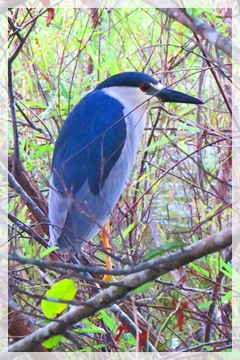
Today, I set out again and spotted a black-crowned night heron hiding in the bushes. While getting a photo, I thought, “I’ll have to put that in my gratitude journal.” This time, however, that small voice reminded me how lackadaisical I’ve gotten with my journal and asked me why I was waiting to thank the creator of all those beautiful moments. That gave me pause. If I’d been walking with someone else, I would have shared those sightings. Although I wasn’t walking with another person, I was walking with God. Why wasn’t I talking to Him? Why wasn’t I sharing my joy with the one who gave it to me? God was right beside me and He shouldn’t have to wait until I get around to thanking him or writing in my journal, especially since I’m not good about remembering to do so. Thanks should be speedy and sincere.
We thank God through our prayer. We don’t need church, a table blessing or a gratitude journal to do so. We certainly don’t need to wait until our regular prayer time to offer thanks and, most especially, we shouldn’t wait until November for Thanksgiving Day! Our whole day, every day, should consist of a prayer of thanksgiving. God is with us as we take our daily walk; let us remember to thank him for the joy we find along with way.
We need to discover all over again that worship is natural to the Christian, as it was to the godly Israelites who wrote the psalms, and that the habit of celebrating the greatness and graciousness of God yields an endless flow of thankfulness, joy, and zeal. [J.I. Packer]
 While some might groan, others may cheer on this the first day of winter. I remember being asked my favorite season and, since we were skiing in the mountains at the time, I said it was winter. I loved it for the powder days on the slopes, pines laden with snow cookies, and aspens glistening with hoarfrost. Winter meant snuggling by the fire with a hot drink while watching the snow fall and the wind blow the trees. Then, I remembered that winter brings shoveling, cleaning off the car, cold toes, drippy noses, falling on the ice, and heating bills so I quickly changed my answer.
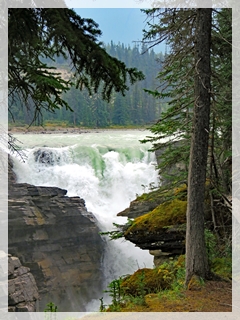 Fortunately, the words to Vivaldi’s “Laudamus te” from his Gloria were shown on the screen in the front of the auditorium: “We praise you. We bless you. We adore you. We glorify you.” The soprano’s exquisite voice did that beautifully. When she was finished, I thought back to last summer when hiking in the Canadian Rockies. While gazing at the breathtaking scenery, I turned to my husband and said, “I’m singing at the top of my lungs—you just can’t hear me!” While relishing the splendor of a glacial lake and waterfall, I was silently singing the Doxology for a private audience and the One for whom I sang heard me loud and clear. Had I sung that song of praise aloud, however, it wouldn’t have sounded anywhere as pleasant as that soprano’s clear voice. Nevertheless, I think God enjoyed my song just as much.
 Our fight is not against people on earth. We are fighting against the rulers and authorities and the powers of this world’s darkness. We are fighting against the spiritual powers of evil in the heavenly places. [Ephesians 6:12 (ERV)]
 The celebration of the Eucharist or Holy Communion has been central to our Christian worship since the early church. If asked the meaning of the word eucharist, most of us would probably respond that it is the Christian sacrament that commemorates the Last Supper with bread and wine. While it has come to mean that and often refers to the consecrated elements, especially the bread, the word eucharist originally meant something else entirely. Coming from the Greek words eukharistos, meaning grateful, and kharizesthai, meaning to offer graciously, it is a translation of the Hebrew word berekah which means a blessing or benediction. Acknowledging God as the source of all good things, a berekah would be similar to the grace or table blessing we offer before or after a meal.
 They [the Levites] are to stand every morning and evening to thank and praise the Lord. [1 Chronicles 23:30 (NLV)]
 Devotions of the Heart