
You are the light of the world—like a city on a hilltop that cannot be hidden. No one lights a lamp and then puts it under a basket. Instead, a lamp is placed on a stand, where it gives light to everyone in the house. In the same way, let your good deeds shine out for all to see, so that everyone will praise your heavenly Father. [Matthew 5:14-16 (NLT)]
 Did you happen to see the full moon last week? It was considered a super moon because it came within 90% of the moon’s closest approach to earth. Its nearness (221,772 miles) made it appear about 7% larger and much brighter than a typical full moon. When I saw its brilliance through the window, I stepped out on the lanai to view the glowing orb in the sky. Don’t be disappointed if you missed it, there will be another one, nearly as bright, on May 7!
Saying I saw the moon’s bright light is misleading—the moon itself has no light and doesn’t glow. It simply borrows its light from the sun and reflects it down to us as would a mirror. With the moon’s dark grey surface and bumpy landscape, it’s a poor mirror and only reflects between three and twelve percent of the sun’s light. Even that little bit, however, was enough to brightly light our lanai that night.
Even if the moon were perfectly white, it still wouldn’t appear as bright as the sun because the light would reflect off in all directions instead of straight back to us. Astronomer Roger Sinnott of Sky & Telescope theorizes that, in order to appear as bright as the sun, the moon would need a 2,160 mile-wide flat mirror to directly reflect the sun’s light back toward us on earth.
In Matthew 5, Jesus tells us to let our lights shine so that people see our good deeds. Even if we shine as brightly as the full moon, like the moon, that light isn’t ours; it is God’s Holy Spirit within us and we’re not the ones who should get the credit. Let us never forget that our good deeds are done not to enhance our reputations but rather to glorify our Father in Heaven. It’s His light that is seen and not ours. When people experience our love, compassion, forgiveness, gentleness, joy, peace, patience, thoughtfulness, integrity, faithfulness, and self-control, they see God’s beautiful light.
As Christ’s followers, we are to let God’s glory reflect through us. We may not be able to light up a lanai like the moon but we can bring His light to the world around us. Moreover, even without an enormous flat mirror, I think we could do better than the moon’s paltry three to twelve percent when it comes to reflecting God’s glory in our lives!
Poor world! What a faint light it receives from most Christians! The lighthouse, if its light is not burning is a peril instead of a safeguard. [Matthew Henry]
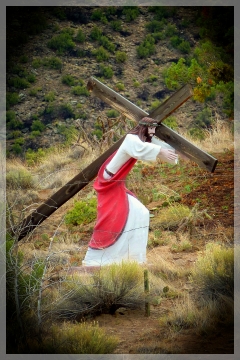 When asked about the temptation of Christ, we probably think of Satan’s three temptations in the wilderness. Since the gospels don’t mention other specific temptations, it’s easy to think that Jesus, unlike the rest of us, was only tempted three times. “He left him until the next opportunity came,” wrote Luke and, while reading the four gospel accounts of the crucifixion during Holy Week, I know He had to have been sorely tempted that awful last day. Right up to the end, Satan must have been at His side, whispering into his ear and reminding Him that He didn’t have to take the abuse—after all, He was God!
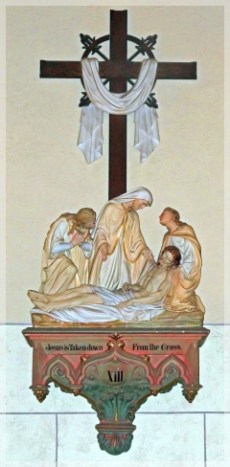 Easter will be a little different this year. Instead of getting up early for the sunrise service, we’ll have all day to go to online church and, rather than new Easter attire, we can attend church in sweats or jammies and our proverbial Easter bonnet can be a baseball cap. The kids won’t have brunch with the Easter Bunny, no family or friends will come for dinner, and, instead of hunting for Easter eggs, we’ll search for hand sanitizer or face masks on the Internet. Fortunately, we don’t need new clothes, eggs, brunch, jelly beans, Peeps, parades, Easter lilies, chocolate bunnies, beautiful hymns, or even a church service for Easter. All we really need is the Resurrection!
 The story has been told of a shoemaker who dreamt that Jesus would come to his shop the following day. His dream was so realistic that he washed his shop windows and dusted every shelf in preparation for his holy guest. The man patiently waited at his bench for the Lord to arrive but the only person to come through his door that morning was an old man seeking shelter from the icy winter rain. When the cobbler looked down at the man’s wet feet, he saw toes poking out of his beat-up shoes. Selecting a new pair of shoes, the shoemaker sat the old man down, dried off his feet, gave him a fresh pair of socks, and fitted him with the new shoes. When the rain stopped, the old man went on his way.
 In my granddaughter’s ethics class, the question was posed, “Should elected officials be held to a higher standard than the population that elected them?” She maintained that everyone should be held to the same high standard and I agreed. We have no right to hold anyone to a higher standard than the one we keep. I added, however, that having taken on the public’s trust, elected officials have an obligation to hold themselves to the highest standards possible.
 In Jesus’s time, rabbis weren’t the Jewish equivalent of a minister or employed by a synagogue. A rabbi simply was a teacher of the Torah—what we’d call a sage—and his students were called disciples. Jesus’s disciples often called him “rabbi” and there were more than just twelve of them. Although we know the identity of His inner circle, we don’t know the names of the seventy-two he sent out to prepare towns for his visit or the two with whom He spoke on the road to Emmaus that Sunday morning.
 Devotions of the Heart