
NEVER FORGET – MEMORIAL DAY 2018

Freedom Park - Naples FL
The Lord is near to the brokenhearted and saves the crushed in spirit. [Psalm 34:18 (ESV)]

When I was a girl, regardless of the day of the week, Memorial Day was always May 30. It was when we took off the storm windows, put on the screens, could start wearing white shoes, and got out the grill. Nowadays, we no longer have the twice a year storm window/screen exchange or the silly “no white before Memorial Day or after Labor Day” fashion rule, we grill all year long, and Memorial Day means a three-day weekend. As the “official” start of summer, it’s when city pools open, families and friends gather for picnics, the kids get out the bubbles and sidewalk chalk, bicycle tires get pumped up, flowers are planted, and we relax in the yard with a cool lemonade while the ribs cook on the grill.

Memorial Day, however, is a day of remembrance—of remembering the more than 1.3 million American military men and women who, over the last 242 years, paid the ultimate price for our freedom to enjoy this pleasant holiday. That number, however, only reflects those who lost their lives in combat. Many more, like the nine who died in Georgia earlier this month, lost their lives in training.

People have paid for this three-day holiday weekend with their lives. Yet, with less than one percent of our population on active duty or in the reserves, most of us are distanced from the true cost of war. When we don’t know any military personnel, it’s easy to become unappreciative or complacent about their sacrifice. Let’s never forget that we continue to have American men and women in harm’s way. Since 2001, nearly 7,000 American troops have lost their lives in Operation Enduring Freedom/Afghanistan and Operation Iraqi Freedom alone and there seems to be no end in sight. Each one of those fallen soldiers left behind loved ones who still mourn their loss. For some people, today means placing flowers on a grave rather than a cook-out with hot dogs and s’mores. For them, every day is Memorial Day.

As we celebrate the start of summer, let’s pause to remember those who died in the service of their country, thank God for their sacrifice, pray for their families, and, most of all, pray for peace. Father in Heaven, we thank you for this nation in which we are blessed to live. Thank you for those who went before us, making our freedom possible and those who continue to battle for our country’s safety and survival. Just as we must remember that our salvation was because of your sacrifice, let us never forget that the freedom we enjoy as a nation came at a great sacrifice, as well.

Heavenly Father, on this Memorial Day, we pray for those who courageously laid down their lives for the cause of freedom. May the example of their sacrifice inspire in us the selfless love of your Son, our Lord Jesus Christ. Bless the families of our fallen troops, and fill their homes and their lives with your strength and peace. In union with people of goodwill of every nation, embolden us to answer the call to work for peace and justice, and thus, seek an end to violence and conflict around the globe. We pray through Christ our Lord. Amen. [Archdiocese of Detroit]

Greater love has no one than this, that someone lay down his life for his friends. [John 15:13 (ESV)]

Copyright ©2018 jsjdevotions. All rights reserved.

KNOWING WHY (Discipline – Part 2)

As you endure this divine discipline, remember that God is treating you as his own children. Who ever heard of a child who is never disciplined by its father? If God doesn’t discipline you as he does all of his children, it means that you are illegitimate and are not really his children at all. Since we respected our earthly fathers who disciplined us, shouldn’t we submit even more to the discipline of the Father of our spirits, and live forever? [Hebrews 12:7-9 (NLT)]

water dropwortSeveral years ago, there was a popular television program in which “Supernanny” Jo Frost would visit a home to help parents deal with the behavior problems of their children. She emphasized the need for both discipline and forgiveness. If children misbehaved or broke a rule after receiving a warning, they served a time-out on the “naughty step.” The parent clearly explained the reason for the discipline and the length of time they’d be sitting there. Once the sentence on the step had been served, the parent offered a second explanation for the discipline. An apology was requested which, once offered, was followed up by a kiss and cuddle and the incident was over and done.
I thought of the nanny’s insistence that an explanation for the discipline was essential. After all, what good is discipline if we don’t understand the reason for it? In yesterday’s devotion about Aravis and Aslan, it was not the wounds that changed Aravis; it was understanding the connection between her wounds and her callous behavior that did. In real life, however, we don’t have a talking lion to explain our wounds. Moreover, God’s discipline involves far more than a few minutes in “time out” and can be more painful than the cuts received by Aravis.

We live in a fallen world and troubles will besiege both the righteous and sinner. As the Book of Job illustrates, not all trouble, hardship, sickness, and disaster come from God’s discipline. Nevertheless, we’re usually more than willing to blame the world rather than ourselves when life goes awry. When we dismiss our troubles simply as bad luck or complain about them without realizing we could be reaping the consequences of our own sin, we miss the point of enduring them. The one thing troubles aren’t is mere chance or fate. All that happens to us is part of God’s providence; there is a reason for the storms of life whether it is direction, inspection, protection, perfection or correction.

Unlike the Supernanny, God doesn’t sit us on the naughty step for as many minutes as our age. If He did, I might spend hours each day sitting on the stairs! We’re not toddlers but even toddlers know when they’ve misbehaved. As for me, with just a little Scripture reading and prayerful thought, I usually know when my troubles are of my own making. Rather than mistakenly asking Him, “Why?” the question should be, “What do you want me to learn from this?” God is far wiser and loving than even Jo Frost and He’ll be sure to tell us! God will sit us on that step, the Holy Spirit will convict us, and Jesus will forgive us. Like the toddler’s error, the incident will be over and done with as far as He is concerned.

For our earthly fathers disciplined us for a few years, doing the best they knew how. But God’s discipline is always good for us, so that we might share in his holiness. No discipline is enjoyable while it is happening—it’s painful! But afterward there will be a peaceful harvest of right living for those who are trained in this way. [Hebrews 12:10-11 (NLT)]

Copyright ©2018 jsjdevotions. All rights reserved.

FAITHFUL FRIENDS

Then they lowered the man on his mat, right down in front of Jesus. Seeing their faith, Jesus said to the paralyzed man, “My child, your sins are forgiven.” … “Stand up, pick up your mat, and go home!” [Mark 2:4b-5,11 (NLT)]

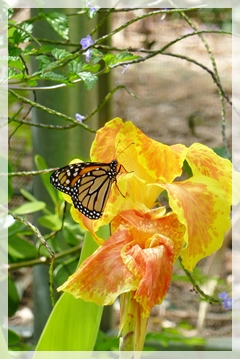
monarch butterfly - cannaJesus had returned to Capernaum and the word was out—the rabbi from Nazareth could heal. People were flocking to Him and the crowd followed Jesus right into the house where he was staying. Four friends of a paralyzed man carried him to see Jesus but the house was so full they couldn’t get through the door. Determined to get to Jesus, they carried the paralyzed man up the outside stairs to the rooftop and started to dig through the thatch. Picture the scene. The room is jam-packed when a disturbance is heard overhead. Dried mud and straw start to fall into the room, a head peaks through, more straw and dirt come spilling through the opening, a mat is dropped, and then four men lower their paralyzed friend down to the ground right at the feet of Jesus.

Rather than heal the man, however, Jesus forgave his sins. Then again, Jesus always put first things first; even more important than health is the forgiveness of sin! Scandalized, the scribes thought His words blasphemy since only God can forgive sins. To prove His authority to forgive, Jesus then healed the paralytic. While the forgiveness of the man’s sins couldn’t be demonstrated, the scribes couldn’t refute the validity of his healing when the once paralyzed man jumped up, grabbed his pallet, and walked. Imagine the gasps of the astonished people as he worked his way through the crowded room to the door.

This story tells us we must be stretcher bearers. When our friends are weak, we should bring them to God as did those four men when they placed the paralytic at Jesus’s feet. We often think that Jesus healed the man because of his faith. Look more carefully at the words; Jesus healed the man because of the faith of his friends! They were so sure that Jesus could heal him that nothing discouraged or stopped them. Like them, nothing should stop us from carrying our friends (or even people we don’t know) to God in prayer. Yet, how often do we offer to pray for someone and pray just once, haphazardly, or not at all? Our faithful prayers can make a difference!

For the last several months, I’ve been praying for a toddler with metastasized cancer. Hundreds of us, many of whom don’t even know her (including fifty from my Tuesday Bible study), have joined in bearing her stretcher and placing it at Jesus’s feet. What looked absolutely hopeless in October looks hopeful today; her scans are good and she’s begun physical therapy. Knowing she still has to face a transplant, radiation, and immunotherapy, her stretcher bearers will continue to carry her until the day she lifts up her pallet and goes home—which brings me to another lesson from this story. It is God, and God alone, who has the authority both to forgive our sins and to answer our prayers. No matter how deep our faith, not everyone whose stretcher we bear will be healed. Some may pick up their pallet and go home to their family but others will pick up their pallet and go home to God. Nevertheless, let us never forget that before Jesus healed, He forgave; while health is not guaranteed, forgiveness is. Thank you, God, for your saving grace!

Rejoice in our confident hope. Be patient in trouble, and keep on praying. When God’s people are in need, be ready to help them. [Romans 12:12-13a (NLT)]

Copyright ©2018 jsjdevotions. All rights reserved.

FILL US WITH YOUR LOVE

Dear friends, let us continue to love one another, for love comes from God. Anyone who loves is a child of God and knows God. But anyone who does not love does not know God, for God is love. [1 John 4:7-8 (NLT)]

scarlet- swamp hibiscus - Corkscrew SwampEvery Saturday, our newspaper runs a guest editorial written by one of the local pastors. In one of these commentaries, the author shared that a ministerial colleague begins every pastoral prayer with, “O kind and loving God, fill us with your love.” There’s a whole lot of prayer packed into those few beautiful words. God doesn’t just love; He actually is love. So, when we ask God to fill us with His love, we’re inviting Him to fill us with His Holy Spirit, as well.

So, what does God’s love look like? We only have to look to the Bible to see. When God lays love on people, He changes their lives. He corrects, feeds, leads, forgives, chastises, heals, comforts, and teaches. He frees them from slavery to both man and sin. He walks with, listens to and speaks with them. He blesses, spends time with them, and calls them into service. He loves unconditionally, impartially and generously. Most of all, He loves sacrificially! God’s love isn’t passive; it’s active. When we ask Him to fill us with His love, we best be prepared for some changes to be made both in our lives and in the lives of others!

I can’t help but think of a line from Hello Dolly! in which Dolly Levi says, “Money, pardon the expression, is like manure. It’s not worth a thing unless it’s spread around, encouraging young things to grow.” She’s actually quoting Thornton Wilder who probably borrowed the quote from Francis Bacon. In any case, when manure is not put to good use, it starts to stink and the same goes for both money and love! If we ask God to fill us with His love, let’s remember that God’s love is way more than a warm fuzzy feeling. His love isn’t meant to stay in our hearts; it’s meant to be used the same way Jesus used God’s love. When we ask God to fill us with His love, He expects us to spread His love around; His love compels us to love one another.

I’m beginning to think some of the best prayers are the shortest ones: O kind and loving God, fill us with your love!

So now I am giving you a new commandment: Love each other. Just as I have loved you, you should love each other. Your love for one another will prove to the world that you are my disciples.” [John 13:34-35 (NLT)]

Copyright ©2018 jsjdevotions. All rights reserved.

MEZUZAHS

rue anemone - swamp lilyWrite them [God’s words] on the doorposts of your house and on your gates, so that as long as the sky remains above the earth, you and your children may flourish in the land the Lord swore to give your ancestors. [Deuteronomy 11:20-21 (NLT)]
After unlocking the door, he reached up to the small metal case on the right side of the door post, touched it, and brought his fingers to his lips. My friend is Jewish and inside the box he touched was a mezuzah—a parchment (called a klaf) upon which the words of Deuteronomy 6:4-9 and 11:13-21 are hand-written.

Like the tefillin worn during prayers, the mezuzah serves as a reminder of God’s continual presence and the covenant He made with His people. For the Jew, it’s like God saying, “As you enter this house and as you leave it, remember me, your heritage, and all that I’ve taught you.” When touched upon entry, the mezuzah is a reminder that the home is a holy place and, when touched upon exit, it is a reminder of how one should act when out in the world. Observant Jews place a mezuzah on nearly every exterior and interior doorway (bathrooms excepted) as a constant reminder of God as they walk throughout the house. The mezuzah also tells anyone passing through the doorway that it is a Jewish household: a home that serves one God and operates by a special set of traditions, rituals, and principles.

As Christians, we don’t affix mezuzahs to our doorposts but there certainly are times I wish we had a sign by the door that said, “Jesus lives here!” It would remind all who pass through the door (including me) that ours is a home that serves Jesus and operates by His principles. While it should be obvious to anyone that Christ is our king, I wonder if it is as obvious as it should be. I’m not talking about crosses or pictures of Jesus on our walls, Bibles on the bookshelves, or Scripture verses on pillows. Is every room in our house filled with the Fruit of the Spirit? Are love, joy, peace, forbearance, kindness, goodness, faithfulness, gentleness and self-control evidenced in all of our interactions? Is there mercy and forgiveness in our dealings? Is the presence of Christ sensed and is God acknowledged in all we say and do? It’s those things, not décor, that identify a home where Jesus lives.

Thinking about touching the mezuzah upon entry and exit, I wonder what it would be like if, every time we came in the doorway, we paused for a brief moment of prayer, thanking God for our safe arrival, asking Him to help us leave the worries and troubles of the day at the threshold, and praying to be filled with His wisdom, love and patience. What if, every time we left our houses, we also paused for a brief moment of prayer, asking God for safe travel and the guidance of the Holy Spirit in all we say and do?

There are hundreds of rules regarding the mezuzah: everything from what size room requires one and the height of its placement to the form of the letters in the script and the way the scroll is to be rolled. Although Jesus freed us from the Old Testament laws, the purpose of the law has not diminished—both in our houses and out, we must always remember the Lord our God and all that He has done (and continues to do) for us.

Listen, O Israel! The Lord is our God, the Lord alone. And you must love the Lord your God with all your heart, all your soul, and all your strength. [Deuteronomy 6:4-5 (NLT)]

Copyright ©2018 jsjdevotions. All rights reserved.

THY WILL BE DONE

Thy will be done, On earth as it is in heaven. [Matthew 6:10b (RSV)]

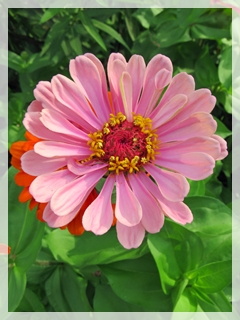
zinniaIn our house, we have an unwritten agreement to accept each other’s choices when it comes to giving. God had laid it on my heart to help a young family in our church through some difficult financial times. When I told my husband I’d written a generous check to them, he said I didn’t need to ask him. “I wasn’t asking,” I replied, adding that I hoped he was in agreement with me. Although that check was not dependent upon my husband’s authorization or approval, I still wanted him on board with my decision to write it.

I thought of our exchange while praying, “Thy will be done.” I’d mistakenly thought I was merely consenting to or accepting God’s will with those words. God, however, certainly doesn’t need my agreement for His will to be done any more than I needed my husband’s permission to write that check. God is all-powerful and whatever He wants to do, He easily can do without my prayers, input or approval. Why then then did Jesus tell us to pray those words?

“Thy will be done”—are they simply words of resignation and surrender? While that sentence is one of humble submission, I think there is much more to it. We’re asking God to reveal His will and praying for the obedience, wisdom, guidance, and means to accomplish it. We’re asking God to reassure us so that we can trust Him and go about achieving His purpose in eagerness and joy. We’re not offering a prayer to authorize or strengthen Him; we’re praying that He will strengthen and empower us. With those words, we’re thanking God for knowing what is best for each and every one of us.

In our daily walk, we have a choice. God can drag us along (much I had to drag the dog into the vet’s office) or we can eagerly follow Him. Either way, whether we’re kicking and screaming or moving enthusiastically, God’s will shall be done. Nevertheless, in praying, “Thy will be done,” we fully commit our hearts to that will. It’s saying, “Here I am, Lord. Put on my armor, send me into battle and keep me strong in the enemy’s attack!” Heavenly Father, thy will be done!

Prayer is not so much the means whereby God’s will is bent to man’s desires, as it is that whereby man’s will is bent to God’s desires. [Charles Bent]

And he said to all, “If any man would come after me, let him deny himself and take up his cross daily and follow me.” [Luke 9:23 (RSV)]

Copyright ©2018 jsjdevotions. All rights reserved.