WE ASK THE LORD’S BLESSINGS

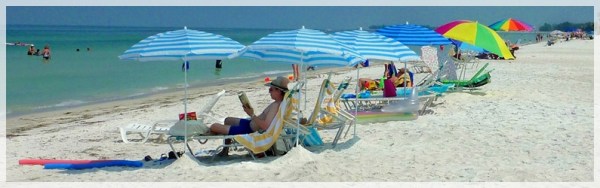
Anna Maria Island beachYou will experience all these blessings if you obey the Lord your God: Your towns and your fields will be blessed. Your children and your crops will be blessed. The offspring of your herds and flocks will be blessed. Your fruit baskets and breadboards will be blessed. Wherever you go and whatever you do, you will be blessed. [Deuteronomy 28:2-6 (NLT)]

When praying for the Church one recent Sunday, we asked our Creator God to bless wild animals and family pets, prairies and kitchen gardens, beaches and sandboxes, mountains and hearths. While I’m used to asking God for spiritual blessings, to bless people and even activities (such as a ministry), I’m not as used to asking Him to bless physical things (and certainly not sandboxes and beaches).

While people may present their pets for a special blessing of the animals, I’ve never thought to ask for God’s blessing on creatures such as the squirrel, panther, skunk, or alligator. I frequently thank God for the beauty of His wildflowers but have never asked Him to bless the prairie displaying those flowers and, when saying grace, I ask Him to bless our food and those eating it but I haven’t thought to ask Him to bless the farmer or the garden that grew that food. I often asked God’s blessing on my children while they dug in their sandbox or played at the shore but I didn’t ask Him to bless either the sandbox or beach. When gazing at the Grand Tetons, in awe of God’s power and majesty, I thanked Him for His magnificent mountains. It didn’t occur to me that I could ask Him to bless those peaks and I’ve never asked Him to bless the slate on my fireplace hearth or the granite on my counters.

Ministers and priests often ask blessings on sacramental objects like baptismal water, bread, wine, and even wedding rings, but I’ve not heard them ask God’s blessing on the reservoir, wheat field, grape arbor or gold mine that produced those things. Yet, asking blessings on things is not so odd. When I asked God to bless my brother-in-law, I didn’t know that the wings he proudly wore on his Navy uniform had been blessed in a special ceremony when he graduated from fight school. An annual Blessing of the Fleet has been a tradition for boaters, sailors, fishermen, and the Navy for generations. The Roman Catholic Church has specific rituals for the blessing of things designated for sacred purposes, such as vestments or a chalice, and also for those designated for ordinary use, such as a cornerstone, houses, schools, and hospitals. Whenever we sing “God Bless America,” we ask God to bless our nation and I suppose we can ask for God’s blessing on anything, as long as it isn’t evil or would lead to sin. Nevertheless, I seriously doubt that God blessed any of the assault rifles brought to a ceremony last February that was sponsored by the Sanctuary Church and Rod of Iron Ministries (offshoot of the Unification Church).

God is the source of all good things and, in that Sunday’s prayer, I think we were asking Him to shower His goodness on all of His creation so that it would sing with joy. We were asking for His divine care and the restoration and protection of the world in which we live. We asked God to reveal Himself in His creation and, as we asked for His blessings on it, we offered Him our praise and grateful hearts. Most of all, the words of that prayer reflected the love that both God and His Church have for all of creation. They also served as a vivid reminder of the obligation and responsibility we have to care for all that has been given to us.

Unfailing love and truth have met together. Righteousness and peace have kissed! Truth springs up from the earth, and righteousness smiles down from heaven. Yes, the Lord pours down his blessings. Our land will yield its bountiful harvest. Righteousness goes as a herald before him, preparing the way for his steps. [Psalm 85:10-13 (NLT)]

Copyright ©2018 jsjdevotions. All rights reserved.

COULD IT BE TODAY?

Teach us to realize the brevity of life, so that we may grow in wisdom. [Psalm 90:12 (NLT)]

black vultureA few years ago, unaware of what the day would bring, a family friend kissed her new husband good-bye as he left for work. While riding the train that morning, the young man collapsed; he died of sudden cardiac arrest less than an hour after that tender kiss. That same year, another friend, whose wife’s body was ravaged by cancer, knew how short the time was he had with her. “While watching TV,” he confided downheartedly, “I looked over at Maureen and realized that next year her chair will be empty and I’ll be alone!” Today is Patriot Day, an annual remembrance of those who died or were injured during the terrorist attacks on September 11, 2001. Thinking about that tragic morning seventeen years ago when so many lost their loved ones unexpectedly, I remembered these two widowed friends. Which is worse: watching the one you love deteriorate and knowing that you’re running out of time for kisses or kissing a loved one in the morning and not knowing that will be the last kiss you’ll ever share?

I can’t imagine the anguish of either scenario and am thankful that God doesn’t give us a choice in this matter. But, I do know what would be more heartbreaking than either scenario. Instead of kissing one another when parting, it would be worse if our last words were angry or harsh ones. How tragic if, instead of sharing a few loving words, we spent our last moments together in heated discussion or spiteful silence. What if we squandered our last opportunity to say “I love you,” to apologize or forgive, to pray together, to laugh with one another, or to share a kiss?

Whenever we say good-bye to my mother-in-law, we always give her a kiss and express our love. Since she’s nearing her 102nd birthday, we understand that each time we see her might be the last. This day of remembrance, however, is a powerful reminder that we can’t see what the next day will bring. There is no guarantee of tomorrow or even the next hour. We don’t know when our last moments with someone may be, whether they are 102 or only 12, dying of cancer or in the prime of life. We mustn’t waste the time with which we’re blessed. Let’s fill our lives, and the lives of others, with love, peace, and joy.

Father in Heaven, may we all learn to live each day as if it is our last. Remind us, O Lord, that this could be the final day, not just for us, but for those we love. May your Spirit guide us so that we truly appreciate the time and people you’ve given us. Let us leave no forgiveness denied, no love unexpressed, no apologies unoffered, no conflicts unresolved, and no thanks unspoken.

I expect to pass this way but once; any good therefore that I can do, or any kindness that I can show to any fellow creature, let me do it now. Let me not defer or neglect it, for I shall not pass this way again. [Stephen Grellet]

Look here, you who say, “Today or tomorrow we are going to a certain town and will stay there a year. We will do business there and make a profit.” How do you know what your life will be like tomorrow? Your life is like the morning fog—it’s here a little while, then it’s gone. [James 4:13-14 (NLT)]

Copyright ©2018 jsjdevotions. All rights reserved.

LETTING GO

gulf fritillary - Monarch butterfliesBut blessed is the man who trusts me, God, the woman who sticks with God. They’re like trees replanted in Eden, putting down roots near the rivers — Never a worry through the hottest of summers, never dropping a leaf, Serene and calm through droughts, bearing fresh fruit every season. [Jeremiah 17:7-8 (MSG)]

This morning, in a symbolic gesture of turning my worries over to God, I added a name to the “God box” that sits on my desk. Yesterday, I received a photo of my grand proudly holding a bowl of pasta with the text, “I have yet to set off the fire alarm with my cooking.” As I looked at her beautiful smile, I prayed, “Dear God, please let setting off that smoke alarm be the worst thing that happens to her this year!” She just started her freshman year of college, in a large city, in a foreign country, 5,500 miles from home. I know that drinking and drugs are pervasive on all college campuses and, having been a freshman once upon a time, I know how many foolish mistakes can be made when free from parental supervision. Yet, even if every decision my grand makes is a wise one, I know the statistics: with a more than a 20% chance of being sexually assaulted in her college years, she’s most vulnerable to attack her freshman year. Since the day my son left his daughter at her apartment, my concerns have weighed heavily on my heart. Nevertheless, I know that all the worry in the world can’t protect her from harm. Accepting that all I can do is give my concerns to God, I put her name in my box.

“Let go and let God!” is a favorite phrase in recovery but that doesn’t mean we let the troubles of this world run over us like a steamroller. When there’s a fire, we don’t stand idly by and say, “Let go and let God!” With God’s direction, we reach for a hose and do what is within our control. Letting go and letting God is refusing to worry about fires that haven’t started (and might never start) and recognizing when a fire isn’t ours to extinguish. It is, however, more than putting a name on a slip of paper and placing it in a wooden box. It’s surrendering the outcome we desire and letting God manifest His will for the outcome He wants. It’s releasing our concerns and fears to Him and trusting His plan for the lives of those we love.

I can’t protect my grand from poor decisions or the violence and sorrow that comes from living in a fallen world. But, by putting her name in that box, I’ve acknowledged that my job description as grandmother does not include running the world; I’ve relinquished that role to the One whose job it is! I will continue offering prayers on her behalf but those prayers will no longer be ones of fear, anxiety, or apprehension. They will be ones of faith and trust because I know that God loves her even more than I do.

You find no difficulty in trusting the Lord with the management of the universe and all the outward creation, and can your case be any more complex or difficult than these, that you need to be anxious or troubled about His management of it? [Hannah Whitall Smith]

Don’t fret or worry. Instead of worrying, pray. Let petitions and praises shape your worries into prayers, letting God know your concerns. Before you know it, a sense of God’s wholeness, everything coming together for good, will come and settle you down. It’s wonderful what happens when Christ displaces worry at the center of your life. [Philippians 4:6-7 (MSG)]

Copyright ©2018 jsjdevotions. All rights reserved.

STILLING THE WATERS

Their ships were tossed to the heavens and plunged again to the depths; the sailors cringed in terror. They reeled and staggered like drunkards and were at their wits’ end. “Lord, help!” they cried in their trouble, and he saved them from their distress. [Psalm 107:26-18 (NLT)]

sunset - Naples FLMark, Matthew, and Luke all tell the story of Jesus calming the sea. He and the disciples had started to sail the five miles across the Sea of Galilee when a fierce storm struck. Tired from a day of preaching, Jesus remained asleep in the stern while the storm raged. As the waves broke and the boat began to fill with water, the disciples were sure they would perish. After they woke Jesus by shouting, “Teacher, don’t you care that we’re going to drown?” He rebuked the wind and the storm ended.

Since we’ve probably heard more than one sermon on this story, we know that the presence of Jesus in our boat is no guarantee of a storm-free life and that, even when it seems like God is asleep on the job, He has the situation firmly in hand. But think about the storm and imagine the sounds that night: the howling of the wind, waves smacking the sides of the boat, rain pounding down, sails furiously flapping, the crack of thunder, and men shouting to one another as they tried to lower the sails, bail and row. With all that noise and the boat pitching and heaving as the waves tossed it about, even the soundest sleeper would have difficulty sleeping. Jesus, however, was undisturbed by the commotion and remained asleep. Although the storm couldn’t wake Him, the disciples’ call to Him did! Whether we are shouting over the sound of thunder or whispering to Him beside a loved one’s hospital bed, this story tells us God will hear our call.

My final take-away from this story is not to underestimate the power of Jesus, something I think the disciples did. When they spotted the first black clouds on the horizon, they didn’t wake Jesus and ask Him to send the storm elsewhere. They tried to sail through the storm on their own power. It wasn’t until they feared they were at death’s door that they finally called to Him. Did the men wake Him because they thought He could still the storm or because they needed His help bailing and rowing? In spite of the miracles they’d seen Jesus do, their shock and terror when He stopped the wind and calmed the sea instantly (something that normally took 24 to 48 hours after a storm’s end) makes me think they expected a helping hand rather than a supernatural solution.

I wonder how often we, like the disciples, underestimate God’s power to handle the crises in our lives and wait until we’re desperate before calling to Him. While we may not get a miracle, His power is enough to get us through any storm. Even if He doesn’t calm the waters, He will bring us safely into harbor.

He calmed the storm to a whisper and stilled the waves. What a blessing was that stillness as he brought them safely into harbor! Let them praise the Lord for his great love and for the wonderful things he has done for them. [Psalm 107:29-31 (NLT)]

Copyright ©2018 jsjdevotions. All rights reserved.

LET THE VINEYARDS BE FRUITFUL

We give thanks for the cup of blessing, which is a sharing in the blood of Christ. And the bread that we break is a sharing in the body of Christ. Because there is one loaf of bread, we who are many are one body, because we all share that one loaf. [1 Corinthians 10:16-17 (NCV)]

Let the vineyards be fruitful, Lord,
And fill to the brim our cup of blessing.
Gather a harvest from the seeds that were sown,
That we may be fed with the bread of life.
Gather the hopes and dreams of all;
Unite them with the prayers we offer now.
Grace our table with Your presence, and give us
A foretaste of the feast to come. [John W Arthur]

monarch butterfly - common milkweedWhen the ushers brought the offering plates forward, the congregation rose and sang “Let the Vineyards be Fruitful.” Often used in Lutheran churches as an offertory hymn when the gifts are presented at the altar, its references to vine, bread, and table make it especially appropriate on Communion Sundays.

As I sung those familiar words about fruitful vineyards, seeds and harvest, I was struck by the somewhat incongruous words in the middle of the song: “Gather the hopes and dreams of all; Unite them with the prayers we offer now.” I envisioned the congregation’s hopes, dreams, needs, and concerns piled high on top of the offering envelopes in those plates and realized we were presenting more than our checks and cash; we were offering our petitions for things like healing, reconciliation, peace, guidance, recovery, relief, purpose, increase, wisdom, strength, and restoration. While the particulars differed from person to person, our various hopes and dreams were being gathered, united into one prayer, and given to God. It wasn’t until I re-read the hymn’s words after church that I understood what that prayer asked or that our words referred both to the day’s simple meal of wafer and wine as well as to the eternal feast at Christ’s return. In our unified prayer, we were asking that Jesus grace us with His presence and give us a preview of the magnificent banquet that is yet to come in the Kingdom of God.

I’ve probably sung the words to this simple hymn hundreds (if not thousands) of times but last Sunday, as those words exited my mouth, they also settled into my heart and mind in a new way. I doubt that I will sing it again without picturing the congregation’s assorted prayers spilling over the sides of the collection plates and then melding into one unified prayer for both His presence and the coming of His Kingdom. Just as reading a book of the Bible once (or even several times) doesn’t mean we’ve fully grasped the meaning of the passages, the same goes for the hymns we sing or the liturgy we recite during worship. When Jesus warned us about meaningless repetition or babbling on in our prayers, repetition wasn’t necessarily the problem. After all, both the persistent neighbor and widow in His parables repeated their pleas and He repeated the same prayer three times in Gethsemane. The problem occurs when we repeat our words mindlessly or automatically. Let us always remember that knowing the words by heart doesn’t necessarily mean our hearts know the depth of their meaning.

The Lord All-Powerful will prepare a feast on this mountain for all people. It will be a feast with all the best food and wine, the finest meat and wine. On this mountain God will destroy the veil that covers all nations, the veil that stretches over all peoples; he will destroy death forever. The Lord God will wipe away every tear from every face. He will take away the shame of his people from the earth. The Lord has spoken. [Isaiah 25:6-8 (NCV)]

Copyright ©2018 jsjdevotions. All rights reserved.

THE HACKER

Stay alert! Watch out for your great enemy, the devil. He prowls around like a roaring lion, looking for someone to devour. Stand firm against him, and be strong in your faith. [1 Peter 5:8-9b (NLT)]

red shouldered hawkAfter asking us how we protect our personal safety, the cyber-security specialist asked how we protect ourselves from cyber attacks. One woman proudly told how Microsoft had recently saved her from a hacking attempt. After a message popped up telling her to call them, she gave them remote access to her computer. The necessary patch and technical advice only cost $700 and now her computer was secure. Until the speaker told her, she didn’t know the hack was the $700 she’d spent, access to her credit card, and possible malware now active on her computer. While she never would have allowed a complete stranger into her home, she unwittingly opened the door to a criminal and welcomed him into her life.

Following the seminar, I couldn’t help but think about Satan. Scripture describes him as a serpent, lion, liar, thief, and tempter with adjectives like prowling, cunning and crafty. Those same words describe a hacker rather well. Both Satan and the hacker want to take over our lives and they can do it without our even realizing it’s been done. The weakest link in both cases is the user—us. Outside consultants regularly try to hack into our bank and the good news is that their security software works. Unfortunately, in every test, someone (who clearly knows better) was conned into replying, hyperlinking, or opening an attachment. When Satan comes trolling, how often do we err by ignoring God’s guidelines, not examining the source of the message, going somewhere we shouldn’t, or letting curiosity get the best of us?

Our speaker spoke of maintaining the security of the devices and networks we use. Since new hacking techniques are developed continually, once secured doesn’t mean forever secure; software must be updated to stay current with new threats. Once saved doesn’t mean forever safe, either. We must keep updating our soul’s software with regular prayer, Bible study, and church. Where we use our devices and the sort of data we transmit and receive affects their safety and where we go and what we put into our minds affects our souls. We don’t hang around dangerous neighborhoods but, sometimes, that’s exactly what we do with our computers and phones or our friends and media choices! When the considering the importance of backing up data, I thought of the value of Christian friends who have our backs and both encourage and support us in times of trouble—times when we’re most vulnerable to Satan’s attack.

Two-factor authentication (2FA) was another security feature discussed. Although a website can use 2FA to make sure it is us, we should use 2FA to make sure those great ideas we get have come from God rather than the enemy. A little two-factor authentication in the way of seeing whether those thoughts match up with God’s word and Jesus’s actions could keep us out of a lot of trouble.

Good cyber-security habits include malware protection, virtual private networks, cloud storage, secure routers, password protection, 2FA, and common sense. None of those, however, will protect us if we fail to use them. The same goes for the armor of God. We’ve been given the best protection money can’t buy but God’s armor won’t defend us from the enemy if we don’t put it on!

A final word: Be strong in the Lord and in his mighty power. Put on all of God’s armor so that you will be able to stand firm against all strategies of the devil. For we are not fighting against flesh-and-blood enemies, but against evil rulers and authorities of the unseen world, against mighty powers in this dark world, and against evil spirits in the heavenly places. [Ephesians 6:10-12 (NLT)]

Copyright ©2018 jsjdevotions. All rights reserved.