The Lord detests the proud; they will surely be punished. … Pride goes before destruction, and haughtiness before a fall. First pride, then the crash—the bigger the ego, the harder the fall. [Proverbs 16:5,18 (NLT)]
 While reading C.S. Lewis’ The Horse and His Boy, I couldn’t help but think of the proud Babylonian King Nebuchadnezzar. He was so full of himself that he erected a 90-foot golden statue and then demanded that people fall down and worship it as a sign of loyalty to him. When interpreting one of the king’s dreams, Daniel told Nebuchadnezzar that he would be driven from human society and only regain his kingdom when the king learned that heaven, not man, rules. The king was warned to change his evil behavior. In spite of the caution and even though he’d seen the power of the Israelites’ one true God when Shadrach, Meshach, and Abednego survived the fiery furnace, Nebuchadnezzar didn’t change his ways. While looking down from his rooftop and surveying the wonders of Babylon, he expressed pride in his accomplishments and congratulated himself on his mighty power. Before the words were even out of his mouth, a voice from heaven pronounced judgment upon him. The king developed what is known as boanthropy, a psychological disorder in which one becomes delusional and thinks he or she is a cow. The high and mighty king was driven from society and lived and ate like an animal for the next seven years.
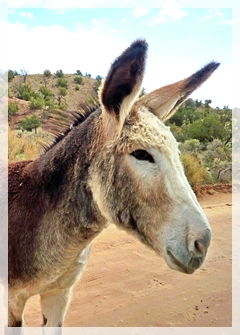
In The Horse and His Boy, instead of a king, the reader meets the pompous Prince Rabadash, the tale’s villain. Fancying himself a great warrior, he set off to seek revenge on a Narnian queen who spurned his advances. After being defeated in battle, the captured prince was told to forget his pride and anger and accept the mercy offered by Narnia’s kings. Even though he replied with an arrogant tirade, another chance to change his evil ways was offered to the proud prince. While responding with even more invective, Rabadash’s last words came out as braying. Unlike Nebuchadnezzar, who only thought he was an animal, the prince actually became one—a donkey.
Both true and fictional stories can help us understand God and life. After all, even Jesus made up stories with his parables. It is no mere coincidence that Rabadash’s fate resembles that of Nebuchadnezzar. C.S. Lewis considered pride to be the “great sin”—the sin that leads us to what he called “the complete anti-God state of mind” and the sin that leads us to all other sins. Pride causes us to look down on things and people (as it did with both Nebuchadnezzar and Rabadash) instead of looking up to God. It was only when the humbled king looked up at heaven that he returned to sanity and only when thousands had looked down at the four-legged prince that he regained his body.
Envy is private, lust and anger can be concealed, and selfishness and greed can be disguised as the virtues of prudence and fortitude. Things like pride, arrogance, contempt and conceit, however, are rather obvious and there is a sense of poetic justice to both men’s public humiliation. By the time they returned to their normal states, their subjects had witnessed them either acting like a cow or looking like a donkey. Behind the prince’s back while alive (and openly once dead), he was known as Prince Rabadash the Ridiculous. Although the Bible makes no mention of it, I can only imagine that the people of Babylon must have snickered when they saw the once powerful and proud king grazing in the fields, his hair long and matted and his untrimmed nails looking like claws.
God hates it when we’re proud and yet we all suffer from pride. Although Jesus took our punishment for that sin (and every other one), we often find ourselves recipients of some of God’s divine discipline when we err and stray. As for pride, God seems to have fitting and often public ways of knocking us down a peg or two when necessary. If we don’t keep ourselves humble, we can be pretty sure that God will do it for us. Like Nebuchadnezzar, we may find ourselves ostracized from society or, like Rabadash, looking like an awful lot like an ass.
Every Christian has a choice between being humble or being humbled. [Charles Spurgeon]
As the Scriptures say, “God opposes the proud but gives grace to the humble.” So humble yourselves before God. Resist the devil, and he will flee from you. Come close to God, and God will come close to you. Wash your hands, you sinners; purify your hearts, for your loyalty is divided between God and the world. … Humble yourselves before the Lord, and he will lift you up in honor. [James 4:6b-8,10 (NLT)]
Copyright ©2017 jsjdevotions. All rights reserved.

 The gardenias were blooming. The aroma of those beautiful flowers filled the air as I walked that morning and I paused in my walk just to inhale and relish the pleasant scent.
 His testimony enraged the Jewish high council and he was taken from the city and stoned to death. Stephen was the first of the Christian martyrs but clearly not the last. We’ve all been horror-stricken by the recent news from Egypt where ISIS thugs attacked Coptic Christians on their way to a remote monastery. According to witnesses, the men were told their lives would be spared if they recited the shahada, the Islamic declaration of faith. When they refused to do so, they were gunned down. Since December, more than 100 Coptic Christians have died in Egypt in four different attacks. On Palm Sunday, two of their churches were bombed leaving forty-four dead. It’s not easy being a Christian in Egypt.
 I recently happened upon a YouTube video about a goose and two police officers. A mother goose kept pecking at the window of a parked Cincinnati police car. When the officer opened the door, the goose led him over to one of her babies; it was tangled up in a string tied to a balloon. Concerned that mama goose would attack if he came close to the baby, the first officer stayed back. His partner was a woman and a mother; seeing the anguish of another mother, she went forward and carefully untangled the little gosling while its mama patiently watched and waited. Once free of the twine, the baby rejoined its siblings and the family swam off with their mother.
 The book of Daniel was written during the Babylonian captivity. Nebuchadnezzar had assaulted Judah, destroyed Jerusalem and the temple and exiled the people of Judah to Babylon. Jeremiah had prophesized that Jerusalem’s desolation would last seventy years and Daniel realized that their time of exile was nearly complete. After fasting, donning sackcloth, and covering himself with ashes, Daniel passionately prayed and pled with God to return His people to their land.
 Jealousy – that green-eyed monster – certainly caused a lot of problems throughout the Bible. The first case of sibling rivalry occurred when Cain, jealous that God approved his brother’s sacrifice but not his, killed Abel. Saul was jealous of David’s popularity and battles were fought, the Jews slandered Paul and Silas because they were jealous of the large crowds that gathered to hear them preach, Jacob was jealous of Esau’s relationship with Isaac, Joseph’s brothers sold him into slavery out of jealousy and the prodigal’s brother became jealous when his father threw a party for the black sheep of the family.
 Devotions of the Heart