
So you shall keep my commandments and do them: I am the Lord. And you shall not profane my holy name, but I will be hallowed among the people of Israel; I am the Lord who sanctify you, who brought you out of the land of Egypt to be your God: I am the Lord. [Leviticus 22:31-33 (RSV)]
 For several years, a well-known and highly regarded actor/comedian’s name was synonymous with fatherhood and family values. After becoming the subject of sexual abuse allegations, spanning more than fifty years, by more than fifty women, his name went from respected to scorned. Several universities rescinded the honorary degrees awarded him, removed him from their boards and fund-raising campaigns, and eradicated his name from buildings and scholarships. His statue was removed from a Disney theme park, reruns of his shows were cancelled, there was a petition to revoke his Presidential Medal of Freedom, and he was dumped by his agent. No one wanted their good names tarnished by any association with such disgraceful behavior.
Names and reputations are important and none of us want our names to be besmirched by someone else’s words or actions. Apparently, God felt the same way when He gave us that often ignored commandment about not taking His name in vain. Some Bibles translate “in vain” as misusing, using thoughtlessly or irreverently, or making empty promises in God’s name. Whatever Bible we use, the meaning is clear; we must honor God’s name and never use it in a disrespectful, false or blasphemous way.
When Jesus taught us to pray, after addressing our Father in heaven, He said the words, “Hallowed be thy name.” Although some Bibles translate that sentence as, “May your name be kept holy,” the King James’ words are the ones most of us use in the Lord’s Prayer. I used to think those words were a call to worship and pretty much dismissed them as part of the preface to the actual prayer. I hadn’t realized that they are the first petition (or request) the prayer makes. In those four prayerful words, “Hallowed be thy name,” we are appealing to God to help us keep His commandment about not dishonoring His name! That sentence, however, means far more than just not cursing or committing perjury after promising to tell the truth.
If we call ourselves Christians—followers of Jesus Christ—whenever we act or speak shamefully we are not keeping God’s name holy. If we distort God’s word with our witness or actions, His name is not hallowed. It’s not just blasphemy, irreverence or profanity; hypocrisy, deception, treachery, insincerity, falseness, and immorality of any kind profane His name! We don’t have to be celebrities and have our transgressions blasted across the tabloids; we disgrace His name whenever we speak or act in any way that dishonors Him.
If we never get beyond those four little words, “Hallowed be thy name,” we’ve said enough. In that one sentence, we ask God to make our words and actions reflect His holiness. We express our desire to live godly lives and ask Him to enable us to live in a way that makes His name holy. Heavenly Father, hallowed be thy name!
 In Leviticus, we find Aaron’s sons, Nadab and Abihu, offering incense to worship God. Although their goal was good, priests were required to fulfill their duties without variation and the brothers disregarded the method specified by God. Worshiping God was the right intent but using prohibited fire was the wrong way to do it and they were consumed by God’s fire. Bringing the Ark of the Covenant back to Jerusalem was a good goal but using a cart to transport it was the wrong method and Uzzah was struck dead when he reached out to steady it.
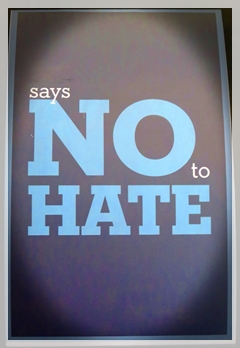 I walked into the university workout facility and was greeted by a large sign telling me the school says no to hate. I was surprised that a Christian University felt the need to say what should be obvious. Has hate become so much a part of our everyday lives that we have to be reminded not to do it? There wasn’t a sign telling us not to pee in the pool, have fist fights, or swear. Evidently, certain acceptable behavior was assumed but not hating wasn’t! Apparently, the sign is necessary because people feel freer to express their prejudice, intolerance, and bias than do any of those other things.
 As he took us to the car rental agency, the van’s driver welcomed us to Cleveland, explained where to get gas before returning our cars, and reminded us not to text and drive. After asking if there were any other questions, a voice from the back asked, “What is the purpose of life?” The driver quickly replied, “Finding comfortable shoes!” While we might rank finding comfy shoes high on our life list, that’s not the purpose of life.
 I’m not a good sitter and I’m even worse at soaking in a tub. Just wanting to get clean and get on with my day, I’m a shower person. Friends insist that sitting in the tub and reading is the best way to relax but that doesn’t work for me. I don’t have the patience to wait for the water to get high enough for a good soak or for the spa jets to work, I’ve never figured out how to turn pages without getting them wet and, rather than relaxing, I think about all the things I could and should be doing instead of sitting in hot water. I considered my inability to enjoy a bath when our pastor suggested that we bathe our decisions in prayer. Unfortunately, the same impatience that keeps me from enjoying my over-sized bath tub keeps me from bathing my decisions in prayer.
 The celebration of the Eucharist or Holy Communion has been central to our Christian worship since the early church. If asked the meaning of the word eucharist, most of us would probably respond that it is the Christian sacrament that commemorates the Last Supper with bread and wine. While it has come to mean that and often refers to the consecrated elements, especially the bread, the word eucharist originally meant something else entirely. Coming from the Greek words eukharistos, meaning grateful, and kharizesthai, meaning to offer graciously, it is a translation of the Hebrew word berekah which means a blessing or benediction. Acknowledging God as the source of all good things, a berekah would be similar to the grace or table blessing we offer before or after a meal.
 Devotions of the Heart