
GOD’S BANKERS

wild geraniumThere are always going to be poor and needy people among you. So I command you: Always be generous, open purse and hands, give to your neighbors in trouble, your poor and hurting neighbors. [Deuteronomy 15:11 (MSG)]

The Hebrew word for what we call “charity” is tzedakah; its nature, however, is far different than acts of benevolence or generosity. Rather than being a magnanimous act by someone more fortunate, tzedakah is considered an act of justice and righteousness. It is remedying a wrong, doing what is right and just, and fulfilling a duty; in short, it is giving the poor what they deserve.

In writing about charity, Rabbi Yanki Tauber tells of a wealthy man who often supported his rabbi’s charitable activities. One day a letter requesting a large sum for a good cause arrived. At the time, money was a little tight and making a donation was inconvenient so the rich man ignored the request. Shortly after that, his businesses began to fail and the wealthy entrepreneur lost his entire fortune.

The distraught fellow went to the synagogue and berated the holy man for not warning him that he’d suffer if he ignored the rabbi’s plea. “I would have given you the money had I known what punishment I would suffer!” he said. The rabbi calmly responded that the loss of money wasn’t a punishment. “Nothing that was yours has been taken from you,” he explained, adding that God had allotted a certain amount of resources to the rabbi in his work. Since the time he spent in prayer, studying, teaching, counseling and helping others left him no time to manage finances or property, the rabbi’s resources had been placed in the trust of several people who acted as “bankers” for that wealth. In turn, those bankers recognized the value of the rabbi’s work and supported it. When the once rich man failed to carry out his banking duty, the money was simply transferred to another, more responsible, “banker.”

God loves all of His children but that does not mean that He allots equal portions of blessings or sorrows to each of them. Some are healthier, wealthier, smarter, more talented or more attractive than others. Some people seem to escape misfortune while others seem to encounter storms at every turn. Because of an accident of birth, we may live comfortable lives in a wealthy nation or suffer in poverty in a corrupt or war-torn land. Some people have power and are easily heard while others are powerless and often ignored. That we are not given equal portions, however, does not mean that we are not equally deserving. If we have been blessed with wealth, education, influence or opportunities, we should think of ourselves as God’s bankers. We’re just holding on to other people’s resources and it is our job to distribute those resources to their rightful owners. Like our Jewish brothers and sisters, Christians should be dispensers of tzedakah. Unlike them, however, we don’t do it to buy our way into heaven (which it won’t). We do it because God tells us it is the right thing to do!

God does not need your good works, but our neighbor does. [Martin Luther]
This is how we’ve come to understand and experience love: Christ sacrificed his life for us. This is why we ought to live sacrificially for our fellow believers, and not just be out for ourselves. If you see some brother or sister in need and have the means to do something about it but turn a cold shoulder and do nothing, what happens to God’s love? It disappears. And you made it disappear. [1 John 3:16-17 (MSG)]

Then the King will say, “I’m telling the solemn truth: Whenever you did one of these things to someone overlooked or ignored, that was me—you did it to me.” [Matthew 25:40 (MSG)]

Copyright ©2017 jsjdevotions. All rights reserved.

WHAT LEGACY?

But God said to him, “You fool! You will die this very night. Then who will get everything you worked for?” Yes, a person is a fool to store up earthly wealth but not have a rich relationship with God. [Luke 12: 20-21 (NLT)]

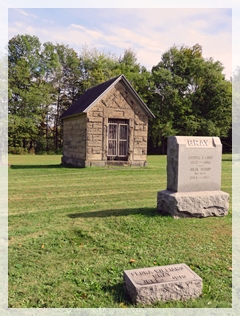
Trumbull Cemetery - OhioWhen touring a nearby resort town, a beautiful old mansion was pointed out. It was once owned by a man who made so much money on his invention of the sanitary milk bottle cap that he retired at the age of 26. For 93 years, the Chicago White Sox played at a ball field named for the team’s founder. In 2003, the field was renamed US Cellular Park and then, in 2016, it became the Guaranteed Rate Field. When I went to Northwestern University, the football venue was named for a former Evanston mayor. In 1997, the stadium was renamed to honor the family of a generous donor to the school’s athletic facilities. A friend’s daughter is attending a school named for a German immigrant who opened a Chicago butcher shop in 1883. Who were these men?

If you’ve not been on a Lake Geneva boat tour, you’ve never heard O.N. Tevander. Although one can still find pictures of his bottle capping machine, he doesn’t even rate a mention in Wikipedia. Do today’s baseball fans know that Charles Comiskey was a key person in the formation of the American League and founder of the Chicago White Sox? Do the Northwestern Wildcats know anything of William Dyche, class of 1882, and that his name was to remain on any NU stadium for perpetuity? In another twenty years, will they have any idea that Patrick Ryan founded Aon Corporation and once served on the university’s Board of Trustees? By then, it’s possible that another large check will have been written and the stadium will have yet another name. When you hear the name Oscar Mayer, do you think of an immigrant butcher from Bavaria or of a large corporation (now owned by Kraft), hot dogs and the wiener song?

Even if we amass great wealth, make generous donations, or achieve some modicum of fame, chances are that most of us will be forgotten in a few generations. Our last name might remain on a corporate letterhead or, if wealthy enough, we could have a building or stadium named after us (at least for a while). Our headstone may rest in a cemetery, we might be listed in a genealogy chart, or an old letter or picture of us may reside in a box of memorabilia stored in someone’s attic. Nevertheless, we will be long gone and, for the most part, forgotten. For William Dyche, perpetuity lasted only 71 years! How long will it last for us? Even if a great grandchild has our china, a piece of our jewelry or carries our name, our essence will have vanished. We will be little more than a short family story or a faceless name.

Jesus told a parable about the rich man whose land was so productive that he ran out of room to store his crops. Rather than share his excess, he just built bigger barns so he could relax and enjoy his wealth for years to come. Unfortunately for him, he died that very night. A simple parable, it points out the temporal nature of life.

Financial planners often ask their clients, “What will be your legacy?” The rich man in the parable left a legacy of filled barns for someone else to enjoy. Sadly, he forgot the most important thing—his soul. Sometimes we’re so busy thinking about our legacy here on earth that, like the man in the parable, we also forget about our souls. Whether or not we are remembered in this world isn’t really important. The real question is whether or not God will welcome us into His kingdom in the next.

Don’t store up treasures here on earth, where moths eat them and rust destroys them, and where thieves break in and steal. Store your treasures in heaven, where moths and rust cannot destroy, and thieves do not break in and steal. Wherever your treasure is, there the desires of your heart will also be. [Matthew 6:19-21 (NLT)]

Copyright ©2017 jsjdevotions. All rights reserved.

AFTER THE STORM

compass plantThe terrible storm raged for many days, blotting out the sun and the stars, until at last all hope was gone. [Acts 27:20 (NLT)]

“Lord, help!” they cried in their trouble, and he saved them from their distress. He calmed the storm to a whisper and stilled the waves. What a blessing was that stillness as he brought them safely into harbor! [Psalm 107:28-30 (NLT)]

While walking this morning, I could see the toll last night’s hail storm took on the wildflowers. Many that yesterday stood tall and proud over the prairie were now bent and broken. These defeated looking plants made me think of a friend and the storm that overwhelmed and nearly defeated him.

Raised in a Christian home and once a believer, he lost his faith in a loving God years ago when a series of medical errors left his child with severe brain damage. Angry at God and then disillusioned by the hypocrisy he saw in his church, he decided to worship the god of achievement and wealth. All went well for him until one day it didn’t. The storm hit when the multi-national corporation for which he worked closed its doors. In spite of his stellar resume, nearly two years passed without employment. When the economy tanked, so did his investments and his savings dwindled to nothing. Upside down with his mortgage, his god of success and prosperity was nowhere to be found. It was at that point that this once proud man literally fell to his knees and humbly admitted his defeat and nothingness to God. He wanted to believe but needed to know that God really was there. He didn’t ask for relief; he asked for reassurance of God’s presence. “Show me that you exist, that you care, that you are good!” was his simple prayer.

Most of those drooping wildflowers along the trail will again stand tall when the sun shines. Like those flowers, my friend was raised up when he turned to God and allowed the Son back into his life. Within a day of his prayer, he received a call from a struggling Christian-based non-profit and, within a week, he’d started working there as the CEO. Several years have passed and he is happier and more content than he was in his previous life. Because of his business acumen, the organization he serves is now thriving and people’s lives are being changed in incredible ways. His child is still disabled and his standard of living is not what it was before the storm, but he lives joyfully in the knowledge of a loving and good God—a God who can still storms and lift a drowning man out of the sea.

A hail storm can knock down flowers and, sometimes, God knocks us to our knees with a storm of troubles. It’s when we’re on our knees, however, that the only place to look is up! When we ask God to reveal Himself to us, we shouldn’t expect Him to do it with a job or financial support. After all, God only promises relief from all of our troubles in the next world. In this life, we will be relieved only from some of them; other troubles He will enable us to endure. Nevertheless, when we humbly and sincerely ask God to reveal himself to us, He will.

If God seems far away, who moved? [AA slogan]

But whenever they were in trouble and turned to the LORD, the God of Israel, and sought him out, they found him. [2 Chronicles 15:4 (NLT)]

Copyright ©2017 jsjdevotions. All rights reserved.

A FIRM FOUNDATION

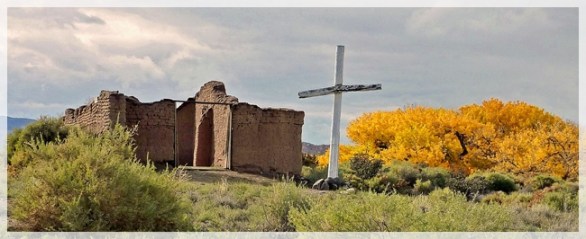
Santa Rose de Lima - Abiqui NM
You are members of God’s family. Together, we are his house, built on the foundation of the apostles and the prophets. And the cornerstone is Christ Jesus himself. [Ephesians 2:19b-20 (NLT)]

Four years ago, a Seffner, Florida, man went to bed and disappeared. As he screamed for help, he, his bed and then his entire bedroom vanished into the earth, never to be seen again. A sinkhole some twenty-feet across had formed beneath the house and the house simply collapsed into it. The house was demolished and the hole filled with four truckloads of gravel. Two year later, the hole reappeared, measuring 17-feet across and 20-feet deep and the area now is deemed uninhabitable.

Apparently, sinkholes are a natural component of Florida landscape and pose a geological hazard throughout the state. My “Sunshine State” lies on bedrock made of limestone or other carbonate rock which is dissolved by naturally acidic rainwater. As the rock dissolves, underground cavities or caves form. Eventually, the ceiling of the cavity can no longer support the overlying weight of what’s above it. Since our Florida home is made of poured concrete, I thought our foundation was firm until I learned about sinkholes. Florida is not alone; about 20% of our nation’s land is susceptible to sinkholes.

How firm is your foundation? If you live in the San Francisco area, not very! One of the most dangerous seismological zones in our country is the Hayward Fault in California, running between Richmond, south through Berkeley, Oakland, and Hayward to San Jose. Every year it spreads or creeps about 4.6 millimeters a year. That’s only about an ant’s length, which doesn’t sound like much, but it adds up. In a hundred years, that’s about a foot and a half. That little bit of creep every year moves curbs, creates gaps in roads, and cracks foundations and walls.

When Hayward’s paving crews repave and fill in cracks, they are only treating the symptoms, not the cause, and the pavement continues to crack. Steel bracing rods are inserted into buildings but they, too, are only short term solutions. Hayward’s first City Hall was built in 1931 directly on top of the fault line. Gradually splitting in two, no amount of plaster, cement or steel rods can hold it together; it is now unusable and abandoned. All along the fault line, the ground continually moves and pulls apart sidewalks, pipelines and any structures sitting on it. It’s not just the Hayward fault that endangers structures and people—we have the San Andreas (California), Cascadian (Pacific Northwest), New Madrid (Midwest), Ramapo (East Coast), Wasatch (Utah), Denali (Alaska) faults and numerous others. As the man who sank to his death in Florida learned too late, sometimes we think our foundation is much firmer than it actually is.

While sinkholes and earthquakes are a fact of life and reason for concern, we should be more concerned about the base upon which we build our lives. We may think we’ve got a disaster-proof life built on a firm foundation of money, job, health, family, education, skills, talent, friends, status, or even looks. If Jesus isn’t the cornerstone, watch those bricks start to collapse when even one of those things is removed. When we choose to build our lives on God’s bedrock, even if we live over a sinkhole or the Hayward fault, when disaster hits (and it will), we will neither cave in nor fall down!

Anyone who listens to my teaching and follows it is wise, like a person who builds a house on solid rock. Though the rain comes in torrents and the floodwaters rise and the winds beat against that house, it won’t collapse because it is built on bedrock. But anyone who hears my teaching and doesn’t obey it is foolish, like a person who builds a house on sand. When the rains and floods come and the winds beat against that house, it will collapse with a mighty crash. [Matthew 7:24-27 (NLT)]

Fear not, I am with thee, O be not dismayed, For I am thy God and will still give thee aid; I’ll strengthen and help thee, and cause thee to stand Upheld by My righteous, omnipotent hand. [“How Firm a Foundation” (attributed to Kirkham or John Keene)]

Copyright ©2017 jsjdevotions. All rights reserved.


NURSERY LOGS

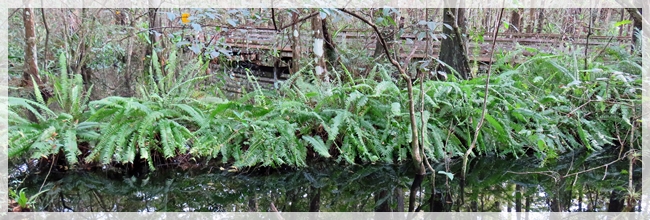
nursery log - corkscrew swamp
Blessed is the man who fears the Lord, who greatly delights in his commandments! His offspring will be mighty in the land; the generation of the upright will be blessed. Wealth and riches are in his house, and his righteousness endures forever. [Psalm 112:1-3 (ESV)]

When walking in the swamp, I often see what are known as “nursery logs.” After a tree dies, its roots eventually decay and it falls to the ground, leaving an opening in the forest’s canopy for sunlight to reach down to the forest floor. The dead tree’s raised trunk becomes a nursery for new plant life as seeds fall on it and take root. Its bark holds moisture, providing young plants with water, and the decaying wood provides them with decades of rich organic nutrients. Starting with moss and ferns, vegetation grows and flourishes in the patch of light left by the tree’s demise. These nursery logs become gardens of new life and can contain five times more living matter than they did when alive! Eventually, a new tree will take root in the remains of the old one and the cycle of life continues for another generation. Supposedly, it will take about the same number of years for a tree to decompose as it took to live. Considering that trees can live several hundred years, one dead tree can leave quite a legacy.

I thought of those nursery logs today while reading an obituary in our local paper. Like the trees, this man may be dead but, most definitely, he is neither gone or forgotten. Here are just a few of the loving words written about him:

He touched the lives of everyone he came in contact with…after talking to him for two minutes he would immediately become your friend…would do anything to help someone in need…always had a positive attitude and was ready to listen if you needed to talk…a great man who was loved by all his family and friends and will be missed dearly…he would say love unconditionally, don’t hold grudges, and never walk away mad… tomorrow isn’t promised so make the best of today so you have no regrets…know you are right with God…remember [him] as the man who always made the most of life and always had a smile on his face.

I never met this man and consider it my loss that I didn’t. I have no idea the size of his financial holdings but, based on his career as a fishing guide, I suspect he was not a wealthy man. He was, however, an incredibly rich one! Whether or not he left his family with any money, his bequest of love, faith and joy, as seen in a life well lived, makes them more than rich.

While it is our belief in Jesus that gives us eternal life in our heavenly home, like the nursery logs in the forest, even dead, we can still persist. Once we’ve fallen to the forest floor, we continue to nourish life if the lives we touched while living were touched with faith, love, generosity, compassion and joy. Unlike the cypress trees, we may only be blessed with seventy to eighty years but, if wisely lived, think how that legacy can grow as each life we touched touches another. As did this man, we can leave a patch of sunlight when we fall, our example can provide a base for young seedlings, and the memory of us can bring nourishment to hungry souls.

Our death is not an end if we can live on in our children and the younger generation. For they are us, our bodies are only wilted leaves on the tree of life. [Albert Einstein]

Therefore I intend always to remind you of these qualities, though you know them and are established in the truth that you have. I think it right, as long as I am in this body, to stir you up by way of reminder, since I know that the putting off of my body will be soon, as our Lord Jesus Christ made clear to me. And I will make every effort so that after my departure you may be able at any time to recall these things. [1 Peter:12-15 (ESV)]

Copyright ©2017 jsjdevotions. All rights reserved.

SEND IT ON AHEAD

Do not lay up for yourselves treasures on earth, where moth and rust destroy and where thieves break in and steal, but lay up for yourselves treasures in heaven, where neither moth nor rust destroys and where thieves do not break in and steal. For where your treasure is, there your heart will be also. [Matthew 6:19-21 (ESV)]

For the Son of Man is going to come with his angels in the glory of his Father, and then he will repay each person according to what he has done. [Matthew 16:27 [(ESV)]

orchid“A Christian doesn’t die,” declared the pastor, which may have been news to some of those attending the Celebration of Life. “He just moves!” the minister added as an explanation. Indeed, we are just temporary residents here on earth. Death for a Christian is simply a relocation and, unlike most moves we’ve made, it doesn’t require a purging of the items in the attic, garage sales, packing up boxes, or wrangling friends into helping us carry the heavy stuff! This is one transfer that neither requires moving vans nor mail forwarding.

Although we can’t take anything with us, our pastor often reminds us that we can send things on ahead! That doesn’t mean we gather our favorite possessions and take them to FedEx but it does mean we can store treasures in heaven. Unlike treasure here on earth, however, heavenly treasure has no monetary value. It’s made of up things like earnest prayers for others (including our enemies), sharing the gospel message, loving unconditionally, using our wealth for God’s good works, being generous with our time and talents, obedience, patience, taking a stand against evil and wrongs, and fulfilling God’s purpose for us. These are the treasures laid up in heaven and no good deed will be overlooked.

At first, that sounds a lot like salvation through works but it isn’t. All the good works in the world won’t get us into heaven without belief in Jesus. We are saved through God’s grace—it is His gift to us. Jesus’ death and resurrection paid the price for our ticket to eternal life. There is, however, some fine print on that ticket—once we get there, God will hold us accountable for His gifts to us in this life. Were we good stewards who used them wisely or did we squander His blessings? Did we invest God’s gifts in His kingdom or bury them in the ground? Did our activities transform the world in some way? Did we change anyone’s life for the better?

I can’t pretend to know what our heavenly rewards will be but I seriously doubt they’ll be anything like gold faucets and marble floors for the truly generous and just stainless and linoleum for those who didn’t tithe. I think the rewards will have something to do both with joy and responsibility. Here on earth, responsibility sounds suspiciously like work and work is hardly what we consider a reward, especially in heaven! Yet, in the parable of the talents, Jesus told the servants who had invested wisely that they would be given even more opportunities to serve their master. The difference between earthly work and heavenly work is that it won’t be a burden; work in God’s kingdom will be a joy! Perhaps the greatest reward, however, will be hearing His voice say, “Well done, good and faithful servant!”

And he who had received the five talents came forward, bringing five talents more, saying, “Master, you delivered to me five talents; here, I have made five talents more.” His master said to him, “Well done, good and faithful servant. You have been faithful over a little; I will set you over much. Enter into the joy of your master.” [Matthew 25:20-21 (ESV)]

Copyright©2017 jsjdevotions. All rights reserved.