
A word out of your mouth may seem of no account, but it can accomplish nearly anything—or destroy it! It only takes a spark, remember, to set off a forest fire. A careless or wrongly placed word out of your mouth can do that. By our speech we can ruin the world, turn harmony to chaos, throw mud on a reputation, send the whole world up in smoke and go up in smoke with it, smoke right from the pit of hell. [James 3:4-6 (MSG)]
 James warns of the dangers of an untamed tongue and the damage that can be done with ill-considered words. Although he was speaking of speech, the same goes for the written word. Whether we’re holding a pen, our fingers are speeding across a keyboard, or our thumbs are tapping out a text, our words are powerful. Whether we use them to build or destroy is our choice.
C.S. Lewis, one of the great Christian minds of the 20th century, authored more than thirty books. A man who never used a typewriter, he also was a prolific letter writer. Writing not just to friends and colleagues, he answered every letter sent to him. Most of us probably have trouble responding to someone with a quick email, yet this busy man never hesitated to handwrite a response, even to strangers or children who wrote after reading one of his books or hearing him on radio. More than 3,200 of Lewis’ handwritten letters remain and have been published in various collections. They range from the somewhat mundane (thanking someone for a ham) to the exceptional (reassuring a woman who is afraid of dying).
Often writing more than 100 letters a month, his letters show not just a deep thinker with a brilliant mind but also a compassionate man generous enough to take the time to instruct, explain, empathize, encourage, and reveal himself and his vulnerabilities. Nevertheless, Lewis once complained, “If I didn’t have so many letters to answer, I’d have time to write another book.” His words from another letter, however, explain why he did it: “Ever since I became a Christian, I have thought that perhaps the best, perhaps the only service I could do for my unbelieving neighbours was to explain and defend the belief.” He wrote those letters out of obedience to God and concern for the people who’d written to him.
While many proverbs give dire warnings about imprudent words, the other half of those proverbs often are about judicious ones. That C.S. Lewis’ letters continue to be read today illustrates the power of the written word. Rather than start a wildfire with cruel words, Lewis sowed seeds of Christ with his kind ones; may we do the same. Let us never forget the beautiful things our words, both spoken and written, can do when used wisely and with love!
 Around this time of year, I frequently return to Bedford Falls and get reacquainted with the conflicted George Bailey, the money-grubbing Mr. Potter, and Angel 2nd Class, Clarence Odbody. This year’s version of It’s a Wonderful Life was somewhat different. Rather than seeing the movie, I attended a theatrical production set in a New York City radio station in the 1940s. The well-known story unfolded as if it were a live radio broadcast. Just five actors took on all of the roles (along with producing the various sound effects required for a radio show). In spite of the unusual adaptation, the production remained true to the original movie’s message.
 Then God said to Noah, “Leave the boat, all of you—you and your wife, and your sons and their wives. Release all the animals—the birds, the livestock, and the small animals that scurry along the ground—so they can be fruitful and multiply throughout the earth.” Genesis 8:15-17 (NLT)]
 Years ago, we were acquainted with “Henry, dear” and “Mary, darling.” We called them that because we never heard them refer to one another any other way. They always were so sweet and charming in public that halos seemed to hover over their heads. My husband and I often wondered what they called one another behind closed doors and, as we got to know them better, we realized our wariness was well-founded. As noble as they appeared in public, there always seemed to be an ulterior motive behind their kindness and, while “Henry, dear” was patting your back, his other hand probably was reaching into your back pocket. While we never knew what they called one another in private, we knew that what the public saw was not what they actually got.
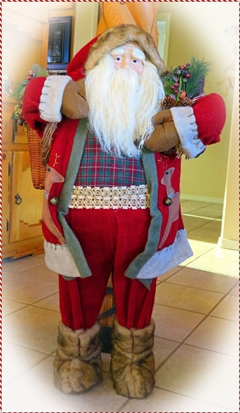 The National Retail Federation estimates that Americans will spend between 727.9 and 730.7 billion dollars on Christmas gifts and merchandise between November 1 and the end of the year. If they’re correct, we’ll have spent nearly $95 for every one of the 7.7 billion people on earth (most of whom won’t get any of those purchases). It’s ironic that a day set aside to honor the birth of Jesus, the Savior who sacrificed His life for us, has become a frenzied season of obtaining and consuming.
 I used the Lenox bone china that belonged to my mother and some of the stoneware that belonged to my husband’s grandparents at our Thanksgiving dinner. While the Lenox was special ordered from the city’s finest department store as a wedding gift in 1938, the stoneware was purchased in 1929 at the local five-and-ten-cent store. The ornate gold-rimmed Lenox is translucent and elegant; used only on special occasions, it still looks new after eighty years. The stoneware is opaque, less formal and meant for daily use; having been used every day for more than forty years, a few pieces are chipped or stained. When compared, people might think the Lenox more valuable than the stoneware, but they’d be wrong. Both are equally precious because they tell the story of generations gathering together for good food and fellowship and both sets of china served their specific purposes well.
 Devotions of the Heart