
And now, just as you accepted Christ Jesus as your Lord, you must continue to follow him. Let your roots grow down into him, and let your lives be built on him. Then your faith will grow strong in the truth you were taught, and you will overflow with thankfulness. [Colossians 2:6-7 (NLT)]
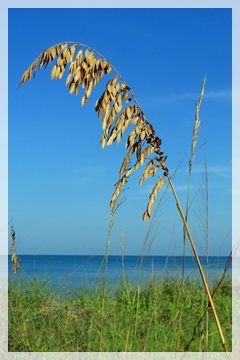 It’s not just light poles that were destroyed by Hurricane Irma’s winds; many trees also met their end at her hands. As I looked at the upended roots of a once mighty oak, I thought of one of Aesop’s fables about an oak in a storm. A proud oak stood by a stream, and like this one, had survived several storms in its many years. One day, a hurricane the likes of Irma arrived and the great oak fell with a thunderous crash. As the water rose, it was carried down to the sea. When the oak eventually came to rest along the shore, it looked up at the sea oats that were waving in the now gentle sea breeze, “How did you manage to weather such a terrible storm?” it asked. “I’m a great oak and even I didn’t have strength enough to battle the wind.”
The sea oats replied, “That was your problem. You were too proud to bend and yield a little and so the wind knocked you over. I’m just an insubstantial sea oats plant but, knowing my weakness, I didn’t resist as the wind gusted. The harder it blew, the more I humbled myself and the lower I bent. So, here I am, still enjoying the beach. Aesop’s moral is that it is better to bend than to break. “Perhaps there a message here,” I thought and, yet, I wasn’t sure it was just about pride and humility.
The Apostle Paul was very clear about standing firm in the face of trials and temptation. He told the early church to stand firm and not to waver; he wanted them to be oaks and not sea oats. When facing one of life’s hurricanes, however, it’s pretty hard not to wobble, quiver and quake wildly. If we stand firm, will we be knocked down and end up a piece of drift wood or ground up into mulch? If that mighty oak couldn’t weather the storm, how can we?
The Apostle also said that growing roots in Jesus is what will keep us strong. That fallen oak’s upended roots were taller than me and yet they didn’t do the oak much good when Irma arrived. The roots of which Paul speaks are deep roots that grown down into our Lord. It is strong deep roots that will serve to anchor a tree in the ground. I’m not an arborist, but I could easily see that there was nothing deep about that oak’s roots (or the roots of the many other uprooted oaks throughout our community).
In Jesus’ parable about soil, he told of seed scattered on good soil that grew, seed strewn on a path that was eaten by the birds, seed that was crowded out by the thorns, and seed that fell on rocky soil. Those plants in rockyy soil grew quickly but, since their roots weren’t deep, they withered in the hot sun. If He’d been in a tropical climate like Florida’s, Jesus could have used sand and hurricanes instead of rocks and sun in His analogy. Good nutritious soil is necessary for a plant’s success and Florida’s soil is shallow and mostly sand. The many fallen oaks’ roots, while wide, were shallow and certainly not the kind of roots of which Jesus and Paul spoke.
Aesop’s fable was about pride and humility but the many uprooted oaks in town tell me something more. Granted, there may be times we need to bend a little, as do the sea oats, but we must never bend if that means compromising our faith. I think of Daniel, Shadrach, Meshach, and Abednego. Their roots were so deep that they were willing to die before they bent down to worship a false god or failed to worship the true one. While a miracle saved them, there was no miracle for Stephen, a man whose deep roots in Christ gave him strength enough to stand and testify before the Jewish high council knowing he’d die because of it. These men were willing to be sacrificed and broken before bending to the prevailing wind.
Given a choice, I would rather stand strong, like an oak with deep roots, than fall because of the wind. Nevertheless, if the wind is blowing in the wrong direction, like Stephen and other Christian martyrs, I would rather be broken and fall than bend and survive as do the sea oats.
 The celebration of the Eucharist or Holy Communion has been central to our Christian worship since the early church. If asked the meaning of the word eucharist, most of us would probably respond that it is the Christian sacrament that commemorates the Last Supper with bread and wine. While it has come to mean that and often refers to the consecrated elements, especially the bread, the word eucharist originally meant something else entirely. Coming from the Greek words eukharistos, meaning grateful, and kharizesthai, meaning to offer graciously, it is a translation of the Hebrew word berekah which means a blessing or benediction. Acknowledging God as the source of all good things, a berekah would be similar to the grace or table blessing we offer before or after a meal.
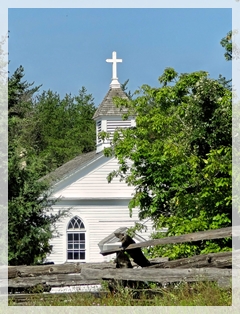 Yesterday I mentioned getting an email with the subject, “How firm is your foundation?” Although it was an advertisement for a new study Bible connecting Biblical teachings to Christian beliefs, that very question has been the topic of discussion in our northern church for the last few weeks. The parish is doing a church-wide study of Martin Luther’s Small Catechism. Back in the 1500s, Martin Luther was appalled at the lack of knowledge of both pastors and their congregations. Not especially tactful, he accused some pastors of being “lazy bellies and presumptuous saints!” His words for their congregations, “simple cattle and mindless pigs!” were no more diplomatic. People who called themselves Christians had no idea what that meant. They didn’t know the Ten Commandments, the Apostle’s Creed or even the Lord’s Prayer, let alone anything else in the Bible. Last week, our Pastor asked us what Luther might say if he visited today’s churches. We agreed that his words for our pastors would be more complimentary but that his words for their congregations might be the same or worse!
 Our recent trip to the Canadian Rockies reminded me of a hiking trip I took there with my daughter more than twenty years ago. With two guides for our group, one acted as lead and tied orange ribbons along the trail to mark the way. Knowing that we are to leave nothing in the forest but footprints, a second guide (the sweep) followed the last hiker and removed the trail markers. That morning’s hike was a trek up to a mountainside teahouse and my daughter and I (both fast walkers) wanted to have time at the top to explore. Confident we couldn’t get lost, we shot ahead of the guide, promising to meet at the teahouse. Apparently, there was a fork in the trail we missed in our haste; we veered left when we should have stayed right. After a while, it occurred to us that we seemed to be going down when the trail should be going up. Nevertheless, expecting an uphill just around the next turn and unwilling to admit we may have erred, we continued down. When we arrived at the same lake from which we’d started, we saw the error of our ways, turned around, and made the hike back uphill. By the time we reached the main trail, the trail markers placed by the lead guide had already been removed by the sweep. Knowing we needed to go further uphill, we continued our trek and eventually rejoined our group at the teahouse. In our case, the first really were the last and we barely had enough time to eat lunch before starting back down the mountain.
 As we watched the helicopters fly through the sky, we could see the water buckets hanging under them. Once the copters were in position, hoping to extinguish the forest fire, the crews would open the dump valve and empty water on the flames below them. The helicopters flew back and forth all afternoon as they refilled their buckets from the glacial lakes. If the helicopters are too low or slow in dropping the water, the water will be too concentrated to work effectively and, rather that put out the flames, the rotors’ downwash will intensify it. Even though those buckets can carry as much as 2,600 gallons of water, to those of us on the ground, it seemed a little like a mop bucket was being used to extinguish a house fire. Nevertheless, the firefighters continued their valiant fight against the blaze.
 Devotions of the Heart