
I tell you the truth, those who listen to my message and believe in God who sent me have eternal life. They will never be condemned for their sins, but they have already passed from death into life. [John 5:24 (NLT)]
 Death is the consequence of sin—of living in a fallen world—but Jesus promised that all believers have eternal life. In the Apostles’ Creed, we affirm our belief in this “life everlasting.” Eternal life, life in perpetuity, life forever and ever: how can that be? For centuries thousands of inventors have attempted to make a perpetual motion machine that will run indefinitely with no input of energy and have failed every time. Apparently perpetual motion violates the first and second laws of thermodynamics. If perpetual motion is an impossibility, perpetual life seems improbable, as well. It seems to violate all sorts of natural laws let alone human logic. God, however, isn’t limited by thermodynamics, any other law of nature, or human understanding; after all, He’s the author of them all!
The Greek word translated as “eternal” is aiónios which means eternal, forever, everlasting or perpetual. When combined with the Greek zoe (meaning life), it focuses not just on quantity of time but also on the quality of that time! The eternal life promised in the gospel isn’t just about the number of years; it is about the fullness of that unending life. Independent of time as we know it, eternal life is not something for which we need to hope. Jesus didn’t promise eternal life at some point in the future. Using the present tense, He said that “anyone who believes has eternal life” [John 6:47] For Christians, eternal life starts when we first believe in Christ. It has begun!
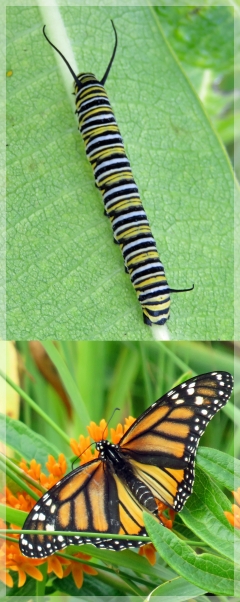
When our heart stops beating, our brain ceases functioning, and life has ebbed out of our body, we won’t stop existing. We will, however, change form. The caterpillar that wriggles along leaves and branches with its sixteen legs looks nothing like the butterfly whose beautiful wings enable it to flit from flower to flower. Nevertheless, they are the same creature with the same DNA. It will be much like that for us when we leave this dimension and enter into the next. While our bodies as we knew them will cease to exist in this world, our spirit or soul will continue into the next and (unlike a butterfly) last forever!
As a believer who is closer to the end of her years than the beginning, I find comfort in knowing that Jesus has already made good on His promise of eternal life. It’s mine already! When the time comes for my last breath, it simply will be like going to sleep as a caterpillar and awakening as a perpetual butterfly.
 While some of us may have become couch-potatoes during his time of sheltering in place, that’s not truly the sin of sloth. Thought of as one of the seven “deadly sins,” sloth originally was two sins: acedia (meaning absence of care) and trisitia (meaning sorrow). A 4th century monk, Evagrius of Ponticus, listed them (along with gluttony, lust, greed, anger, vainglory, and pride) as the “terrible temptations” of life. Acedia and sadness were seen as particularly dangerous threats to the ascetic life of a monk living in the Egyptian desert, as was Evagrius. The monks easily could grow despondent, lonely, weary or discontented as they prayed, fasted, and labored in their harsh and isolated setting.
 With each new day feeling like yesterday, we decided to watch the 1993 movie Groundhog Day. In it, the discontented TV weatherman Phil Connors, played by Bill Murray, is trapped in a time loop and keeps reliving February 2. At first, he takes advantage of never having to reap the consequences of his selfish actions but grows tired of his hedonistic life. When the predictability of the day causes boredom, depression, and cynicism to set in, he commits suicide several times—only to wake again and again on the same February 2. Eventually, Phil comes to grips with his situation and decides to make the most of it. Among other things, he learns to to play jazz piano, speak French, memorize the life story of everyone in town, sculpt ice, and master the art of flipping cards into an upturned hat. As he betters himself, he begins to better the lives of the people around him. The time loop eventually ends when the changed man finally gets the day right by caring more about others than himself.
 When we retired, we joked that our pill boxes were the only way we knew the day of the week. Now that we’re sheltering in place, that is more true than funny. For young and old alike, the days are blending one into the other with the only difference between yesterday and today being the news (which just seems to gets worse).
 Did you happen to see the full moon last week? It was considered a super moon because it came within 90% of the moon’s closest approach to earth. Its nearness (221,772 miles) made it appear about 7% larger and much brighter than a typical full moon. When I saw its brilliance through the window, I stepped out on the lanai to view the glowing orb in the sky. Don’t be disappointed if you missed it, there will be another one, nearly as bright, on May 7!
 Devotions of the Heart