
Then everyone will see the Son of Man coming on the clouds with great power and glory. And he will send out his angels to gather his chosen ones from all over the world—from the farthest ends of the earth and heaven. [Mark 13:26-27 (NLT)]
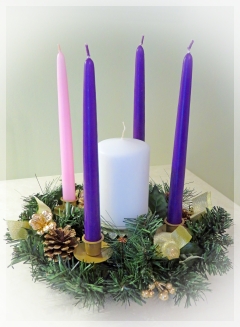 It’s less than a month until Christmas. This Christmas will be vastly different from past ones for us as I imagine it will be for you. Traditionally, our holiday season has been a busy and festive one of concerts, friends, church, fellowship activities, volunteering, entertaining, and family but being in the midst of a pandemic has changed all that. In an attempt to keep the spirit of Christmas alive in what has been a dreary and disappointing year, I’ve started decorating for the holiday and playing Christmas music. Christmas, however, is more than decorations, carols, presents, parties, and peppermint bark. Perhaps not having all of the fun-filled extras of this season will help us focus on its true meaning.
When I was young, I always had a special Advent calendar with a nativity scene and 24 little numbered “windows.” Starting December 1, I opened a window every day to find a special picture or Bible verse that helped tell the Christmas story. Advent, however, isn’t just a way to count down the days until Christmas. In the 4th and 5th centuries, the season of Advent wasn’t about Christmas at all. Lasting 40 days, it was a season of penance, prayer, and fasting in preparation for the baptism of new believers on the Feast of Epiphany (January 6). By the 6th century, Advent was tied to the coming of Jesus—but not His first arrival in Bethlehem. Coming from the Latin adventus, meaning “coming,” Advent was about Christ’s second coming—when the one who arrived as a lamb would return as a triumphant lion. It was not until the Middle Ages that four Sundays became Advent’s length and the season was linked to both Christ’s first and second comings along with His presence among us through the Holy Spirit.
Although the custom of an Advent wreath began with Lutheran and Roman Catholic families in 16th century Germany, it didn’t spread to churches until three centuries later. The wreath is a circle of evergreen branches; its circular shape, with no beginning or end, symbolizes the immortality of the soul and God’s promise of eternal life through Jesus Christ. Four candles, representing the four weeks of Advent, are arranged around the wreath; sometimes, a fifth candle is in its center. A new candle is lit on each of the four Sundays leading up to Christmas with the fifth candle lit on Christmas.
The season of Advent begins this Sunday and, while COVID-19 keeps us from our liturgical church and its Advent wreath ritual, it can’t prevent us from observing Advent at home. We will read the pleas for a savior found in Isaiah 60 and Psalm 80, Jesus’ words about His return in Mark 13, and Paul’s assurance that Jesus will return in 1 Corinthians 1. While it doesn’t seem Christmassy to read about Jesus’ return before He’s appeared in Bethlehem, these readings are reminders that ours is an in-between time—a time between Jesus’s first arrival and His final return. After the readings, we’ll light the first candle on our Advent wreath: the candle of hope, often called the “prophecy candle.” We’ll say a prayer of thanksgiving for the gift of hope that came with the Messiah. This first candle will remind us that we wait with hope for His return: for the time when Satan is defeated, God’s final judgment occurs, all things are made new, and all of God’s promises come true! May the candle of hope stay lit in our lives!
Let us be alert to the season in which we are living. It is the season of the Blessed Hope, calling for us to cut our ties with the world and build ourselves on this One who will soon appear. He is our hope—a Blessed Hope enabling us to rise above our times and fix our gaze upon Him. [A.W. Tozer]
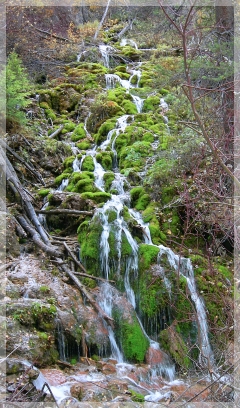 Living in a country where clean water readily flows out of a faucet, we don’t fully understand the concept of “living water” or mayim chaim. Ancient Israel was an arid land where fresh water was precious. Because it only rained a few months of the year, rain was stored in cisterns and grew stagnant. In contrast, living water came directly from God either by rain or a natural spring. Unlike sea water and the hypersaline Dead Sea, which looked refreshing but were poisonous and made the surrounding land barren, mayim chaim brought life. Throughout Scripture, “living water” was associated with God.
 So, since God wants us to be prosperous, we’ll get 100 acres of land for every acre we give up or a return of $10,000 for every $100? Sounds too good to be true and it is. Logic tells us Matthew 19:29 can’t be taken literally—we can’t have one hundred fathers and none of us want one hundred children or wives! To make sure the disciples understood, Jesus made it clear that God is not our heavenly banker who dispenses gifts (especially monetary ones) to the most deserving with His parable of the Gracious Landowner. “Do I not have the right to do what I want to do with my own money? Does your eye make you want more because I am good?” asked the landowner. Jesus explained: “So those who are last will be first and the first will be last.” [Matthew 20:15-16] His message was clear: God’s grace can’t be earned or controlled. Moreover, the word often translated as “prosper” in Jeremiah 29:11 is shalom, meaning completeness, soundness, welfare, and peace rather than wealth. Biblical prosperity and prosperity theology are not the same!
 The Apostle John used the word menó 53 times in his gospel and epistles. Frequently translated as abide, menó originally referred to the staying power of an army that is not driven from the battlefield. Meaning “to stay, remain, reside or stand fast,” menó came to imply an unbroken friendship or a continuous fellowship.
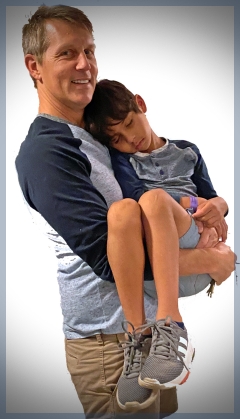 My daughter-in-law sent photos of the family’s day at the apple orchard. The grands picked apples, pet the farm animals, climbed the tractors, raced the pedal karts, did the zip-line, raced through the corn maze, traversed the goat bridge, and enjoyed their fill of donuts and apple cider. It was a fun-filled but exhausting day. The last picture was of my son carrying the youngest grand (who’d fallen asleep on the ride home) into the house.
 Devotions of the Heart