
GOD’S BANKERS

wild geraniumThere are always going to be poor and needy people among you. So I command you: Always be generous, open purse and hands, give to your neighbors in trouble, your poor and hurting neighbors. [Deuteronomy 15:11 (MSG)]

The Hebrew word for what we call “charity” is tzedakah; its nature, however, is far different than acts of benevolence or generosity. Rather than being a magnanimous act by someone more fortunate, tzedakah is considered an act of justice and righteousness. It is remedying a wrong, doing what is right and just, and fulfilling a duty; in short, it is giving the poor what they deserve.

In writing about charity, Rabbi Yanki Tauber tells of a wealthy man who often supported his rabbi’s charitable activities. One day a letter requesting a large sum for a good cause arrived. At the time, money was a little tight and making a donation was inconvenient so the rich man ignored the request. Shortly after that, his businesses began to fail and the wealthy entrepreneur lost his entire fortune.

The distraught fellow went to the synagogue and berated the holy man for not warning him that he’d suffer if he ignored the rabbi’s plea. “I would have given you the money had I known what punishment I would suffer!” he said. The rabbi calmly responded that the loss of money wasn’t a punishment. “Nothing that was yours has been taken from you,” he explained, adding that God had allotted a certain amount of resources to the rabbi in his work. Since the time he spent in prayer, studying, teaching, counseling and helping others left him no time to manage finances or property, the rabbi’s resources had been placed in the trust of several people who acted as “bankers” for that wealth. In turn, those bankers recognized the value of the rabbi’s work and supported it. When the once rich man failed to carry out his banking duty, the money was simply transferred to another, more responsible, “banker.”

God loves all of His children but that does not mean that He allots equal portions of blessings or sorrows to each of them. Some are healthier, wealthier, smarter, more talented or more attractive than others. Some people seem to escape misfortune while others seem to encounter storms at every turn. Because of an accident of birth, we may live comfortable lives in a wealthy nation or suffer in poverty in a corrupt or war-torn land. Some people have power and are easily heard while others are powerless and often ignored. That we are not given equal portions, however, does not mean that we are not equally deserving. If we have been blessed with wealth, education, influence or opportunities, we should think of ourselves as God’s bankers. We’re just holding on to other people’s resources and it is our job to distribute those resources to their rightful owners. Like our Jewish brothers and sisters, Christians should be dispensers of tzedakah. Unlike them, however, we don’t do it to buy our way into heaven (which it won’t). We do it because God tells us it is the right thing to do!

God does not need your good works, but our neighbor does. [Martin Luther]
This is how we’ve come to understand and experience love: Christ sacrificed his life for us. This is why we ought to live sacrificially for our fellow believers, and not just be out for ourselves. If you see some brother or sister in need and have the means to do something about it but turn a cold shoulder and do nothing, what happens to God’s love? It disappears. And you made it disappear. [1 John 3:16-17 (MSG)]

Then the King will say, “I’m telling the solemn truth: Whenever you did one of these things to someone overlooked or ignored, that was me—you did it to me.” [Matthew 25:40 (MSG)]

Copyright ©2017 jsjdevotions. All rights reserved.

DOWN BUT NOT OUT

No one lights a lamp and then hides it or puts it under a basket. Instead, a lamp is placed on a stand, where its light can be seen by all who enter the house. Your eye is like a lamp that provides light for your body. When your eye is healthy, your whole body is filled with light. But when it is unhealthy, your body is filled with darkness. Make sure that the light you think you have is not actually darkness. If you are filled with light, with no dark corners, then your whole life will be radiant, as though a floodlight were filling you with light. [Luke 11:34-36 (NLT)]

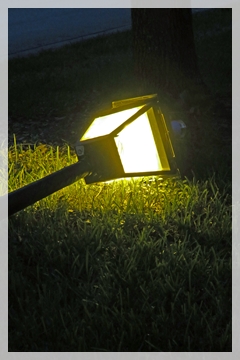
broken lightTo avoid the southwest Florida heat, I waited until dusk to take my walk. Thanks to Hurricane Irma, most of the street lamps in my neighborhood don’t work. For a light to function, electrical energy has to be converted into light energy and both a source of electricity and a working connection are needed. For many of the lights, the connection was broken when blowing debris shattered their bulbs. For others, Irma’s 150 mph winds broke the connection when it blew off their tops, wrapped their poles around trees, or knocked them to the ground. Without a connection to their source of power, those street lights are useless—they’re just a tangle of wires and a pile of glass, plastic and metal. Even though they don’t work, people have been cautioned to remember that their exposed wires are live. It’s not the electricity that is missing; it’s the connection that is inoperative. Two poles, however, were down but not out. Even though they’d been flattened by the storm, neither wires nor bulb had broken. In spite of the storm’s violence, they remained connected and were beacons in the night’s darkness.

When the storms of life batter us and knock us down, like those street lamps, we can lose our connection, not to electricity, but to God. Our minds may get so caught up in anger, worry, fear, depression, or self-pity that we become separated from our true source of power—Jesus. He told us to let our lights shine but we can’t shine if we’re not connected to Him. When our lives go dark, we should remember that God hasn’t gone anywhere—like the electricity, He’s still there. We’re the ones who are broken. Unfortunately, no Florida Power & Light truck is going to arrive and reconnect us to God.

Reconnecting is a choice we have to make. Reconnecting is trusting God and ceding to His will. It is prayer and reading the Bible; it is praise, thanksgiving and worship. Reconnecting is turning to God and choosing joy over misery, light over darkness, love over hate, forgiveness over rancor, peace over anger and service over selfishness. Fortunately, we’re not alone in this. We may not have FP&L but we have something more powerful (and far more dependable)—the Holy Spirit! If we allow Him, He will reconnect us to the light of the world. We may be down, but we don’t ever have to go out! By His power, our lights can continue to shine.

Remember this. When people choose to withdraw far from a fire, the fire continues to give warmth, but they grow cold. When people choose to withdraw far from light, the light continues to be bright in itself but they are in darkness. This is also the case when people withdraw from God. [Augustine]

And now I will send the Holy Spirit, just as my Father promised. But stay here in the city until the Holy Spirit comes and fills you with power from heaven. [Luke 24:49 (NLT)]

Jesus spoke to the people once more and said, “I am the light of the world. If you follow me, you won’t have to walk in darkness, because you will have the light that leads to life.” [John 8:12 (NLT)]

Copyright ©2017 jsjdevotions. All rights reserved.

THE BLESSING

As they were eating, Jesus took some bread and blessed it. Then he broke it in pieces and gave it to the disciples, saying, “Take this and eat it, for this is my body.” And he took a cup of wine and gave thanks to God for it. He gave it to them and said, “Each of you drink from it, for this is my blood, which confirms the covenant between God and his people. It is poured out as a sacrifice to forgive the sins of many. [Matthew 26:26-28 (NLT)]

columbineThe celebration of the Eucharist or Holy Communion has been central to our Christian worship since the early church. If asked the meaning of the word eucharist, most of us would probably respond that it is the Christian sacrament that commemorates the Last Supper with bread and wine. While it has come to mean that and often refers to the consecrated elements, especially the bread, the word eucharist originally meant something else entirely. Coming from the Greek words eukharistos, meaning grateful, and kharizesthai, meaning to offer graciously, it is a translation of the Hebrew word berekah which means a blessing or benediction. Acknowledging God as the source of all good things, a berekah would be similar to the grace or table blessing we offer before or after a meal.

When Jesus spoke the traditional Passover meal berakahot that night in the upper room, he gave them new meaning when he added the words, “this is my body” and “this is my blood.” In thanks, He raised the bread just as his body soon would be raised on the cross. He took the matzah that symbolized the suffering of Israel, thanked God for it, and broke it, knowing that his body would be broken in less than a day. As He passed it to the disciples, the bread that once symbolized Israel’s suffering became the bread that would symbolize His. The disciples may have thought he was simply offering a blessing for the Passover bread but Jesus was offering thanks for the body which soon would be defeated by thorns, whip, nails and cross. He then thanked God as he poured out the wine that symbolized Israel’s redemption from Egypt and passed it around. The disciples may have thought he was giving thanks for Israel’s redemption from Egypt but Jesus knew it was for their redemption from sin. For something to be redeemed, however, a price must be paid and Jesus knew that price would be his blood. While pouring out the wine, He knew his blood would soon pour from his body and yet he still gave thanks. Knowing full well the torment he would suffer, He graciously offered himself for us and gave thanks.

Last week, when the Words of Institution were spoken before Communion and the bread and wine were consecrated, I realized I hadn’t fully appreciated the circumstances in which those words originally were spoken. Jesus knew He’d be betrayed, disappointed and denied within hours. He knew the agony that would soon occur. Jesus knew he would be broken and bleed. He knew the real sacrifice was not the lamb on which they’d supped; He was the sacrificial Lamb of God and yet He acknowledged God as the source of all blessings and thanked Him! Blessed be the Lord; let us give thanks!

Blessed are You, Lord our God, King of the Universe, who brings bread from the earth. … Blessed are You, Lord our God, King of the Universe, who creates the fruit of the vine. [Jewish prayers over bread and wine] 

The next day John saw Jesus coming toward him and said, “Look! The Lamb of God who takes away the sin of the world! [John 1:29 (NLT)]

Copyright ©2017 jsjdevotions. All rights reserved.

MASTER WEAVERS

And we know that God causes everything to work together for the good of those who love God and are called according to his purpose for them. [Romans 8:28 (NLT)]

spider websIt rained last night. During our early morning walk, we looked out over the prairie and saw hundreds of sparkling spider webs. As the morning sun caught the water droplets on the silk, the master weavers’ work glistened in the mist. Although we take that trail several times a week, it was the first time this season we saw those arachnidan works of art. The spiders didn’t start spinning just the previous night; their webs have been there all summer but weather and light conditions kept us from seeing them. In fact, had we chosen to walk the loop in the other direction, we never would have seen them at all!

God, like his eight legged creations, is always busy weaving the strands of our lives. Much of the time, however, as with the spider webs, we don’t see or understand what He’s doing. “Where is God in all of this?” we ask. It is usually in hindsight that we recognize His presence—the way He moved, guided, protected, instructed, disciplined or provided for us. Nevertheless, whether or not we see His hand in our circumstances, we know that He, like the spiders, is ever-present and busy weaving.

I find those beautiful webs reassuring. They show me that God will give us beautiful gifts when we least expect them but that we must be willing to look for them in the most unlikely places. The webs remind me that we don’t need to see God to know that He is always there and always working. Moreover, God reveals himself in a variety of ways. While an angel or burning bush is dramatic and impressive, let’s remember that Elijah did not find God in the mighty wind, earthquake or fire. He found God in a gentle whisper. As for me, spiders’ webs on a misty morning are one of the ways God reassures me of His presence and His amazing plan; they are God’s gentle whisper of reassurance from the Master Weaver!

Our lives are but fine weavings
That God and we prepare
Each life becomes a fabric planned
And fashioned in His care.
We may not always see just how
The weavings intertwine,
But we must trust the Master’s hand
And follow His design,
For He can view the pattern
Upon the upper side,
While we must look from underneath
And trust in Him to guide.
Sometimes a strand of sorrow
Is added to His plan,
And though it is difficult for us,
We still must understand
That it is He who fills the shuttle,
It is He who knows what is best,
So we must weave in patience
And leave to Him the rest.
Not till the loom is silent
And the shuttles cease to fly
Shall God unroll the canvas
And explain the reason why
The dark threads are as needed
In the Weaver’s skillful hand
As the threads of gold and silver
In the pattern He has planned. [Author unknown]

Just as you cannot understand the path of the wind or the mystery of a tiny baby growing in its mother’s womb, so you cannot understand the activity of God, who does all things. [Ecclesiastes 11:5 (NLT)]

Copyright ©2017 jsjdevotions. All rights reserved.

THE BUS DRIVER

And the Lord will guide you continually and satisfy your desire in scorched places and make your bones strong; and you shall be like a watered garden, like a spring of water, whose waters do not fail. [Isaiah 58:11 (ESV)]

Kanakaskis CanadaOn our recent visit to the Canadian Rockies, we had a delightful bus driver named Phil. At seventy, he’s logged thousands of miles. We were his eleventh tour of the summer and he knows the area like the back of his hand. Although kind and good-natured, Phil was just formidable enough that we wanted to obey his directions for fear of encountering his wrath. Clearly, he was the boss of the bus!

Phil told us of one tour director who didn’t understand that the man with the keys is the one in charge. After delivering her group to a scenic glacial lake, a forest fire caused the highway to be closed. When he told the tour director that the closure prevented their return to Jasper, she refused to believe him. When the bus was denied passage by the police, she insisted that her group was special and should be allowed to proceed in spite of the danger. Perhaps she didn’t understand the “fire” part of forest fire and that people and busses burn right along with trees. Realizing that the fire had stranded hundreds of tourists who would now need beds for the night, the experienced driver used his connections to reserve rooms for the group near Banff. When he told the director of his find, she was irate. “That’s my job!” she exclaimed, “You can’t do that!” Sure that she knew more than Phil, he was told to cancel their reservations. Of course, she had no connections, no rooms were available, and the accommodations they’d briefly had courtesy of Phil had been immediately snapped up by another tour. As a result of her pigheadedness, rather than spending the evening at a charming mountainside lodge, the group piled back on the bus. There is only one road between Jasper and Banff and, since it was impassable, the group had a ten hour drive across Alberta before arriving back in Jasper in the wee hours of the morning. Unappreciative of Phil’s efforts, the tour director had the gall to complain about him; the wild fire, road closure and the resulting fiasco were all his fault!

Phil’s story could be a parable of sorts. The experienced bus driver represents God. It is He who makes the rules, determines where we’ll go, and the length of our trip. He knows when we should slow down to enjoy the scenery, speed up to get somewhere, take a detour, or stop to take a rest. Knowledgeable and experienced, His first priority is the welfare of His people. Although He wants us to have a memorable journey, like Phil, God doesn’t want us to perish in an inferno. Unfortunately, we’re much like the headstrong tour director. When God says, “No!” we insist that the answer should be yes. When God offers a better alternative, we refuse to accept it because it’s not our idea. We miss out on blessings because we’re sure we know more than He. Moreover, we then have the nerve to complain about God’s plan when we’re the ones who refused to follow it!

That intractable tour director was a “Plan A” sort of person; no deviations allowed in her itinerary! Fortunately, ours was a “Plan B” guide; new to the tour, she listened to Phil. When he suggested a few itinerary changes that would make our trip more enjoyable, she happily conceded to his wisdom. A “Plan B” person knows that life rarely runs according to plan and that adjustments continually have to be made. Sometimes we need to stop to take a breath, run for shelter from a storm, or detour around danger. A “Plan B” person thinks of life as an adventure and trusts that God has a beautiful journey planned. Life’s delays and detours, while not what we expect or even want, must be embraced and enjoyed. If we’ll just accept His direction, God usually has something wonderful waiting right around the corner. He’s been running the world for a very long time. Trust Him; He’s taken people down this road before and knows exactly what He’s doing.

You find no difficulty in trusting the Lord with the management of the universe and all the outward creation, and can your case be any more complex or difficult than these, that you need to be anxious or troubled about His management of it? [Hannah Whitall Smith]

Blessed is the man who trusts in the Lord, whose trust is the Lord. [Jeremiah 17:7 (ESV)]

Copyright ©2017 jsjdevotions. All rights reserved.

EQUIPPED

But Moses protested to God, “Who am I to appear before Pharaoh? Who am I to lead the people of Israel out of Egypt?” God answered, “I will be with you. [Exodus 3:11-12a (NLT)]

pale purple cone flowerNot all of us have the benefit of eighty years’ experience as did Moses when God called on him. Take David, for example, he was just a young shepherd boy when called on to become both warrior and king. Peter and John were fishermen; nothing in their backgrounds prepared them for their roles as Apostles and founders of a church. Mary was just a girl, in the town of Nazareth, engaged to be married to a local carpenter. What preparation did she have to become the mother of God? Gideon was a farmer, hiding from the Midianites in a wine press while threshing wheat, when God called to him. In fact, Gideon protested that, as the most insignificant member of the weakest clan, he couldn’t be the one to rescue Israel.

When God called to Moses from that burning bush, Moses didn’t see his eighty years’ experience as an asset. Instead, like Gideon, he focused only on his inadequacies. Understandably, the man raised in Pharaoh’s court wondered how the elders of Israel would believe he had been chosen to free their people let alone how an exile could convince Pharaoh to let the people of Israel leave his country. God, however, provided Moses with the additional tools and skills necessary to do the job. He was given three signs to demonstrate God’s power to the Israelites and was enabled to perform miracles before Pharaoh. When Moses pointed out that he wasn’t eloquent, God promised to give him the necessary words and then provided him with Aaron to serve as his mouthpiece. God empowered His servant and provided all that was necessary to achieve His task.

While God probably won’t get our attention with a burning bush, I think He regularly calls to us with tasks. There’s a good chance we’ll be like Gideon and Moses and see only our inadequacies and, like those men, we will be inadequate on our own. God, however, doesn’t ask us to do His work by ourselves. He told Gideon, “I will be with you!” and He will be with us. As God did with Moses, He will shore up our weak spots and provide us with the resources and skills we need to accomplish His will. God doesn’t call the equipped; He equips the ones He calls!

May he equip you with all you need for doing his will. May he produce in you, through the power of Jesus Christ, every good thing that is pleasing to him. All glory to him forever and ever! Amen. [Hebrews 13:21 (NLT)]

This is my command—be strong and courageous! Do not be afraid or discouraged. For the Lord your God is with you wherever you go. [Joshua 1:9 (NLT)]

Copyright ©2017 jsjdevotions. All rights reserved.