THY WILL BE DONE

Thy will be done, On earth as it is in heaven. [Matthew 6:10b (RSV)]

zinniaIn our house, we have an unwritten agreement to accept each other’s choices when it comes to giving. God had laid it on my heart to help a young family in our church through some difficult financial times. When I told my husband I’d written a generous check to them, he said I didn’t need to ask him. “I wasn’t asking,” I replied, adding that I hoped he was in agreement with me. Although that check was not dependent upon my husband’s authorization or approval, I still wanted him on board with my decision to write it.

I thought of our exchange while praying, “Thy will be done.” I’d mistakenly thought I was merely consenting to or accepting God’s will with those words. God, however, certainly doesn’t need my agreement for His will to be done any more than I needed my husband’s permission to write that check. God is all-powerful and whatever He wants to do, He easily can do without my prayers, input or approval. Why then then did Jesus tell us to pray those words?

“Thy will be done”—are they simply words of resignation and surrender? While that sentence is one of humble submission, I think there is much more to it. We’re asking God to reveal His will and praying for the obedience, wisdom, guidance, and means to accomplish it. We’re asking God to reassure us so that we can trust Him and go about achieving His purpose in eagerness and joy. We’re not offering a prayer to authorize or strengthen Him; we’re praying that He will strengthen and empower us. With those words, we’re thanking God for knowing what is best for each and every one of us.

In our daily walk, we have a choice. God can drag us along (much I had to drag the dog into the vet’s office) or we can eagerly follow Him. Either way, whether we’re kicking and screaming or moving enthusiastically, God’s will shall be done. Nevertheless, in praying, “Thy will be done,” we fully commit our hearts to that will. It’s saying, “Here I am, Lord. Put on my armor, send me into battle and keep me strong in the enemy’s attack!” Heavenly Father, thy will be done!

Prayer is not so much the means whereby God’s will is bent to man’s desires, as it is that whereby man’s will is bent to God’s desires. [Charles Bent]

And he said to all, “If any man would come after me, let him deny himself and take up his cross daily and follow me.” [Luke 9:23 (RSV)]

Copyright ©2018 jsjdevotions. All rights reserved.

EASY COME

For this is how God loved the world: He gave his one and only Son, so that everyone who believes in him will not perish but have eternal life. [John 3:16 (NLT)]

God saved you by his grace when you believed. And you can’t take credit for this; it is a gift from God. [Ephesians 2:8 (NLT)]

little bue heron“How do you get to Carnegie Hall?” asks the comedian. “Practice, practice, practice,” is his answer. “Nothing ever comes to one, that is worth having, except as a result of hard work,” said Booker T. Washington, a man who truly knew the value of hard work. Most of us, having been raised with a strong work ethic, would agree with Washington’s words. If we want something we must work for it. If we want to be musicians, we practice; if we want to get on the team, we train; if we want a scholarship, we study. Success comes through determination and lots of hard work. We’ve heard all the maxims; there’s no elevator to success so we have to take the stairs. We know there’s no such thing as a free lunch, we must work our way up the ladder, and we’ve got to pull ourselves up by our bootstraps. Success is never handed to you and it’s only in the dictionary that success comes before work.

If we get to Carnegie Hall by practicing, the Olympics by training and Harvard by studying, how do we get to Heaven? What do we have to do? Here’s the rub—unlike just about everything else in the world, we can’t earn our way, practice our way, study our way, work our way or even buy our way into Heaven. All we really have to do is believe our way through those pearly gates but that just seems so un-American! Surely everything has a price—there’s got to be something noble we can accomplish, someone we can impress or bribe, some special words we can say, or a way we can pay to guarantee a spot. In fact, we’re just a bit suspicious of a deal that seems too good to be true. Surely, there’s a catch but, truly, there isn’t. Jesus paid the price long ago; all we have to do is accept His gift of salvation!

Religion is spelled ‘D-O’, because it consists of the things people do try to somehow gain God’s forgiveness and favor. But the problem is that you never know when you’ve done enough. But thankfully, Christianity is spelled differently. It’s spelled ‘D-O-N-E’, which means that what we could never do for ourselves, Christ has already done for us. To become a real Christian is to humbly receive God’s gift of forgiveness and to commit to following His leadership. [From “Becoming a Contagious Christian” by Bill Hybels]

“Sirs, what must I do to be saved?” They replied, “Believe in the Lord Jesus and you will be saved. [Acts 16:30-31a (NLT)]

Copyright ©2018 jsjdevotions. All rights reserved.

QUESTIONS AND ANSWERS

I heard a loud shout from the throne, saying, “Look, God’s home is now among his people! He will live with them, and they will be his people. God himself will be with them. He will wipe every tear from their eyes, and there will be no more death or sorrow or crying or pain. All these things are gone forever.” [Revelation 21:3-4 (NLT)

star jasmineIn a recent Close to Home comic (drawn by John McPherson), we see the back of a white-haired gentleman at a podium. Several people are facing him with hands raised. “Does the universe really go on forever or is there a brick wall at the end?” asks one. “Who would win in a total fight to the death? Attila the Hun or Mike Tyson?” asks another. The caption at the bottom says, “Once a week, God holds a question and answer session for new arrivals in Heaven.” It reminded me of a quote by Bethany Hamilton, a professional surfer who, at the age of 13, survived the loss of her left arm in a 2003 shark attack.
I don’t pretend to have all the answers to why bad things happen to good people. But I do know that God knows all those answers and sometimes He lets you know in this life, and sometimes He asks you to wait so that you can have a face-to-face talk about it. [From “Soul Surfer” by Bethany Hamilton]

Later that day, I was talking with a widow friend. It had been just three months since her husband died in her arms and she has many questions she’d like God to answer. Thinking of the young surfer’s quote, I reminded her that any questions we don’t get answered in this lifetime will be answered in the next. We then looked at each other and almost simultaneously said, “But, will we care?”

It occurred to us that, once in heaven, all of our earthly questions will be insignificant. We think we want to know why someone suffered or a child’s innocence was violently stolen. We think we want God’s reasoning for a partner’s betrayal, the barren womb, a loved one’s addiction, or a spouse’s death. Once in God’s presence, I wonder if those questions will seem as ridiculous as the questions posed by the people in McPherson’s comic strip.

As Job learned, our “whys” are not likely to be answered on this side of the pearly gates and I doubt we’ll need those answers on other side. The repentant thief on the cross beside Jesus was told, “Today you will be with me in paradise.” Do you think when he got there, he spent time asking God about his abusive step-father or the unfairness of his death sentence? Our last breath here will be followed by our first breath in heaven (a place without pain or tears—one of joy and perfect peace) and all of our earthly concerns will be gone. When we arrive in God’s dwelling place and come face to face with Jesus, I seriously doubt we’ll have any questions that need answering. Knowing God’s love for us, it will all make sense.

You have not come to a physical mountain, to a place of flaming fire, darkness, gloom, and whirlwind, as the Israelites did at Mount Sinai. … No, you have come to Mount Zion, to the city of the living God, the heavenly Jerusalem, and to countless thousands of angels in a joyful gathering. [Hebrews 12:18,22 (NLT)]

Copyright ©2018 jsjdevotions. All rights reserved.

CLAIMING PROMISES

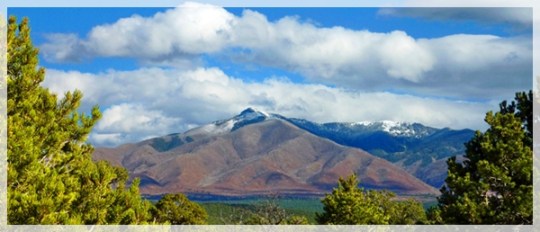
Tao New MexicoThe Lord said to Abram after Lot had parted from him, “Look around from where you are, to the north and south, to the east and west. All the land that you see I will give to you and your offspring forever. [Genesis 13:14-15 (NIV)]

We were visiting an area church when the pastor referred to the above verse from Genesis in which God tells Abram (Abraham) he can have all that he sees. As the sermon continued, the pastor recited a litany of God’s promises and he seemed to be preaching a “name it and claim it” theology only, in this case, it was more like a “see it and have it” one. Granted, it was the first sermon of the year and the pastor clearly wanted to start 2018 on a high note. Nevertheless, claiming God’s promises and thinking they mean He’ll give me everything I visualize isn’t Bible-based.

Our faith and thoughts do not create our reality. If they did, among other things, I would be two inches taller, a whole lot shapelier, and without a wrinkle or any arthritis. Our faith doesn’t promise to give us what we want; our faith allows us to trust in a loving God who will give us what we need.

It is God, not us, who chooses when and how to bless us or, as in the case of Job, afflict us with trials. Job didn’t suffer for lack of faith; the man was filled with faith and yet he endured the loss of everything but his life. As baffled as Job was by his troubles, he knew that blessings and misfortune are not a measure of faith; the faithful can suffer and the wicked can prosper.

Not every promise made by God in the Bible is a wholesale across-the-board promise to us. That promise to Abram was a specific promise about a particular piece of land. God said nothing about seeing and having boyfriends, better jobs, new businesses, babies, healing, bigger paychecks, larger houses, or freedom from debt. Jesus came to save us from our sins and not from bankruptcy, infertility, illness, bad marriages, poor choices, difficult in-laws, unemployment, demanding bosses, or a host of other life challenges. Moreover, He calls us to sacrifice and deny rather than want and get.

Although God wants our love, worship, faith and obedience, He doesn’t need any of those to operate the universe. As Christians, we believe in the power of faith and prayer but we must remember the real power lies in God and His plan. We’re not God’s customers who can order what they see; we’re His children who thankfully accept what He gives us. Much of what we envision never will be ours simply because it’s not in God’s plan. When we become so intent on seeing what we want, we may miss seeing the blessings we’ve been given or different ones waiting in another direction.

I will continue to have faith and claim God’s promises—the promises of His presence, unfailing love, strength, wisdom, comfort, forgiveness, salvation, eternal life, the power of Holy Spirit, and the peace of God. What He hasn’t promised me is that if I see it, believe it or name it, it will be mine.

 Faith is not the belief that God will do what you want. It is the belief that God will do what is right. [Max Lucado]

Do not be anxious about anything, but in every situation, by prayer and petition, with thanksgiving, present your requests to God. And the peace of God, which transcends all understanding, will guard your hearts and your minds in Christ Jesus. [Philippians 4:6-7 (NIV)]

Copyright ©2018 jsjdevotions. All rights reserved.

PSALM 151

I was small among my brothers, and the youngest in my father’s house… [Psalm 151:1a (NRSV)]

ground orchidOn the last day of 2017, the liturgist at church read Malachi 4, Revelation 22, Proverbs 31, and Psalm 150 – the last chapters of the Old and New Testaments, Proverbs and Psalms. It seemed fitting on the final day of the year to hear the final words in Scripture. It was only later that I learned there is one more psalm, but don’t look for it in your Bible. Unless you are Greek Orthodox, it probably won’t be there. Although both the traditional Hebrew and Christian Bibles have only 150 psalms, the Greek translation known as the Septuagint includes Psalm 151. We have to go back a bit in history to understand why the discrepancy.

By the 4th century, Latin was replacing Greek as the common language and Pope Damascus commissioned a young priest named Jerome to translate the Gospels into Latin. Once done, Jerome turned to translating the Old Testament. Not wanting to depend on the earlier Greek translations of what originally had been written in Hebrew, the gifted linguist translated from the original language. Finding Psalm 151 only in Greek translations and not in the Hebrew Scriptures, he omitted it from the Psalter.

Much of what we call the Old Testament is based on the work of a scholarly group of rabbis called Masoretes who worked between the 6th and the 10th centuries. They corrected any errors that crept into the text of the Hebrew Bible following the Babylonian captivity and wanted to prevent any future alterations of the text. Like Jerome, they only found Psalm 151 in Greek translations so they, too, did not consider it to be part of the Psalter. They did, however, place it in the Apocrypha with other works of unknown origin or doubtful authorship.

When a copy of this disputed psalm was found in a Hebrew psalter among the Dead Sea Scrolls some sixty years ago, scholars had to rethink their exclusion of the psalm. The Hebrew Psalter in which it was found dates back to between 300 BC and 50 AD.  Originally two psalms in Hebrew, the Greek translators had condensed them into the one found in the Septuagint. Psalm 151 is now found in some expanded versions of the NRSV (and some other translations) with the notation that it is ascribed to David “though it is outside the number.”

A first-person account of both his anointing by Samuel and his defeat of Goliath, the psalm certainly could have been written by David. It’s a bit like a Reader’s Digest version of 1 Samuel 16 and 17. Perhaps, however, it should be renumbered; rather than being the last of the psalms, this should the first in the Psalter. These seem to be the words of a young David, with a hint of boyish braggadocio, fresh from his victory over Goliath. Little did the confident young man know of the weight of kingship—the joy and sorrow, love and loss, friendships and betrayals, or the great and terrible things that lay in his future. Yet, even then, he knew the most important thing—he had been called by God to be His servant.

I was small among my brothers, and the youngest in my father’s house; I tended my father’s sheep. My hands made a harp; my fingers fashioned a lyre. And who will tell my Lord? The Lord himself; it is he who hears.  It was he who sent his messenger and took me from my father’s sheep, and anointed me with his anointing oil. My brothers were handsome and tall, but the Lord was not pleased with them. I went out to meet the Philistine, and he cursed me by his idols. But I drew his own sword; I beheaded him, and took away disgrace from the people of Israel. [Psalm 151 (NRSV)]

Copyright ©2018 jsjdevotions. All rights reserved.

WHERE IS GOD?

DARK GREEN FRITILLARY“You intended to harm me, but God intended it all for good. He brought me to this position so I could save the lives of many people. No, don’t be afraid. I will continue to take care of you and your children.” So he reassured them by speaking kindly to them. [Genesis 50:20-21 (NLT)]

The above words were spoken by Joseph to his brothers—the men who planned on killing him until greed entered into it and they sold him into slavery for twenty pieces of silver. In retrospect, God’s plan made sense to Joseph but what about the thirteen years he spent between being thrown into a cistern like a piece of trash and becoming second in command to Pharaoh? Was Jacob’s beloved son so confident of God’s plan while standing on the slave auction block in Egypt? What about when he was unjustly accused of rape by Potiphar’s wife? He may have been the warden’s favorite prisoner, but he languished in jail for a crime he refused to commit! What did he think of God’s plan then? When Pharaoh’s cup-bearer was restored to his former position, Joseph’s hopes rose only to have them dashed when the man forgot about his cell mate for another two years. Did Joseph ever doubt? Did he ever ask, “Where’s God in all of this?”

I thought of Joseph’s words after praying for a toddler who is fighting a losing battle with metastasized cancer. In terrible pain, her physicians are running out of treatment options. “Where is God in all of this?” I wondered. “What good can possibly come from it?” If I’m asking these questions, I know her family must be asking them as well. As they watch their daughter suffer, do they ever wonder if God has abandoned them? In retrospect, maybe it will make sense someday. Perhaps the knowledge the toddler’s oncologists glean from her treatment will save some other child. Who knows? Right now, however, her parents can’t look back—they can only look forward and the future is bleak.

It’s times like these that call for faith and hope. God didn’t walk away from us when He finished with creation and He hasn’t walked away from us now. He is still here—at large and in charge! No matter how desolate the circumstances appear, God has not forgotten, abandoned or ignored us.

If I truly believe God is good and in control, I must trust in His inexplicable plan. I believe He is gently holding this little girl and wiping her tears. I believe He is standing with His arms around her worried parents as they stand beside her and that He’s guiding the hospital staff as they insert IVs and search for ways to save her precious life. I know His Holy Spirit is giving voice to my silent prayers for her.

In retrospect, Joseph saw God’s purpose in all he endured. Whether or not we will ever understand God’s actions regarding this beautiful child, I don’t know. From Joseph’s story, we know that God can reroute evil to accomplish good. God was there for Joseph and He’s there for this little girl and her family. He is present; we’re just having trouble seeing Him. Open our eyes, O Lord, open our eyes.

We want Christ to hurry and calm the storm. He wants us to find Him in the midst of it first. [Beth Moore]

And we know that God causes everything to work together for the good of those who love God and are called according to his purpose for them. [Romans 8:28 (NLT)]

Yet I still dare to hope when I remember this: The faithful love of the Lord never ends! His mercies never cease. Great is his faithfulness; his mercies begin afresh each morning. I say to myself, “The Lord is my inheritance; therefore, I will hope in him!” [Lamentations 3:21-24 (NLT)]

Copyright ©2018 jsjdevotions. All rights reserved.