THE REASON FOR MORE THAN A SEASON

Because God’s children are human beings—made of flesh and blood—the Son also became flesh and blood. For only as a human being could he die, and only by dying could he break the power of the devil, who had the power of death. Only in this way could he set free all who have lived their lives as slaves to the fear of dying. [Hebrews 2:14-15 (NLT)]
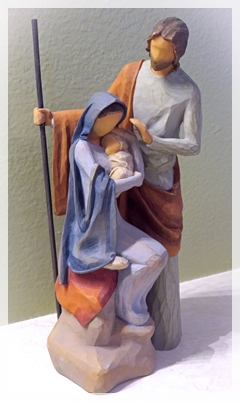
The Holy Family - Willow TreeAlthough Epiphany celebrates the magi’s visit to the Christ child, for many people it simply marks the official end to the holiday season. It’s the day the tree goes down, lights are removed, and nativity scenes get stowed for another year. British tradition holds that if you haven’t removed the holiday décor by January 6, you must leave it in place all year long to avoid misfortune. I don’t know about misfortune but, in our community, you’ll face a fine if holiday lights or decorations remain after this week!

This year, my five-year old grand helped me take down the tree and put away the Christmas decorations. Along with the ornaments, candle holders, stockings, and two Santas, we put away four nativity sets. As the little guy placed the Christ child in one of the boxes, he asked me why I had so many figures of baby Jesus. I reminded him that Jesus (not Santa) is the reason for the season and that we always want to keep Christ in Christmas.

After everything Christmas was packed up and put away, I realized a small resin figurine of the Holy Family remained on a shelf in the living room. The crates in the garage were filled to the brim and, just as on that first Christmas, there was no room anywhere for Mary, Joseph and the newborn King. Rather than having them spend the next eleven months in a high cabinet with assorted vases, I decided to keep them on my desk.

That figurine will serve as a reminder of how God deliberately chose to humble Himself: to be born of woman and live as a mortal man. That was God Himself who entered our world through a birth canal amidst blood and amniotic fluid. The baby who nursed at Mary’s breast and peed, pooped, spit up and drooled was God! He who created man was so helpless He couldn’t even roll over for the first few months of His life and had to learn to crawl and walk. The God who gave mankind the gift of speech had to learn to speak, the One who invented numbers had to learn to count, and He who spoke the law to Moses had to learn how to read His own words! The God who spoke light into existence had to light a candle at night and our omnipresent God had to walk to get from one place to another. The God who never gets tired, thirsty or hungry became a man who did. Jesus humbled Himself by living as a man and endured everything mankind does: blisters, bruises, colds, waiting, toothaches, bug bites, stubbed toes, hangnails, exhaustion, sunburn, skinned knees, and probably diarrhea. He even endured temptation but, unlike us, He remained sinless!

Sometimes, it’s easy to forget the human part of Jesus: that our infinite God chose to live in a finite world with all of its limitations. That figurine will remain on my desk this year as a reminder that our invincible and invulnerable God freely chose to live as a man so that He could die as a man in my place. Fully man and fully God at the same time, Jesus is more than just the reason for the Christmas season; He is the reason for our salvation. Christ belongs in far more than Christmas; He belongs in everything we think, say and do.

Therefore, it was necessary for him to be made in every respect like us, his brothers and sisters, so that he could be our merciful and faithful High Priest before God. Then he could offer a sacrifice that would take away the sins of the people.  Since he himself has gone through suffering and testing, he is able to help us when we are being tested. [Hebrews 2:17-18 (NLT)]

Copyright ©2019 jsjdevotions. All rights reserved.

PERFECTION

He is the Rock; his deeds are perfect. Everything he does is just and fair. He is a faithful God who does no wrong; how just and upright he is! [Deuteronomy 32:4 (NLT)]

But you are to be perfect, even as your Father in heaven is perfect. [Matthew 5:48 (NLT)]

water lilyAlthough humanity started out as a perfect creation, we quickly lost that perfection in the Garden of Eden; Jesus was the only sinless perfect man. If He’s telling us to be perfectly sinless when He calls us to be perfect, we’re in trouble. I suppose we should be able to resist all sin (as did Jesus) but, in reality, no one else (not even the Apostle Paul) has managed to do that. Perfection is God’s alone and we flawed mortals will never be His equals. If Jesus means things like spotless kitchens, beds made with hospital corners, and clean mirrors when He says to be perfect, even without having guests, I’m still in serious trouble. Yet, Jesus’s answer to the rich young man that, to be perfect, he should sell his possessions and give to the poor tells us that possessions and how neatly they’re arranged have no importance to Him. So, what does it mean to be perfect?


Of course, Jesus wants us to be as flawless as humanly possible. Nevertheless, He isn’t expecting us to be completely faultless. By telling us to be perfect, He’s telling us to reflect the moral excellence of God, something God told people to do centuries earlier when He said, “Be holy because I am holy.” [Leviticus 19:2] Jesus is asking us to imitate God, just as children imitate their parents. The original Hebrew word used in this verse was tamim. Rather than perfect (meaning without fault, flaw or defect), it might better be translated as complete in all its parts, full grown or mature. Jesus is the standard by which we set our goal and He wants us become mature in our faith by growing more like Him.

The Pharisees tried to achieve perfection through exacting obedience to the law but, while they looked good on the outside, they were soiled inside (and Jesus took them to task for that). Our perfection will never be found their way. By telling us to be perfect, our words and actions are to match up with our faith. Jesus wants us to be resolute, wholehearted and completely committed to walking with Him and living His way. We’ll become perfect by living through the power of the Holy Spirit: by letting God’s glory shine through our imperfect and flawed lives into the world. Our call is not to have spotless mirrors but to mirror the spotless character of God.

Imitate God, therefore, in everything you do, because you are his dear children. Live a life filled with love, following the example of Christ. [Ephesians 5:1-2 (NLT)]

Don’t copy the behavior and customs of this world, but let God transform you into a new person by changing the way you think. Then you will learn to know God’s will for you, which is good and pleasing and perfect. [Romans 12:2 (NLT)]

And as we live in God, our love grows more perfect. So we will not be afraid on the day of judgment, but we can face him with confidence because we live like Jesus here in this world. [1 John 4:17 (NLT)]

Copyright ©2019 jsjdevotions. All rights reserved.

WHAT’S YOUR STATE?

For I know the plans I have for you,” says the Lord. “They are plans for good and not for disaster, to give you a future and a hope. [Jeremiah 29:11 (NLT)]

For I can do everything through Christ, who gives me strength. [Philippians 4:13 (NLT)]

african iris

If there were a Hall of Fame for favorite Bible verses, John 3:16, Jeremiah 29:11, and Philippians 4:13 would be in it; every year, they are the most popular verses on my favorite Bible web site. This year, in a stunning upset, Jeremiah 29:11 edged out perennial favorite John 3:16 for first place with Philippians 4:13 running a close third.

In 2017, John 3:16 easily held first place with Jeremiah 29:11 and Philippians 4:13 in a hotly contested race for the next two spots. In honor of the Electoral College meeting that year, the website determined which of those two verses carried each of the fifty states and gave them electoral votes. Had it been a presidential election, Jeremiah 29:11 would have won with 302 electoral votes. With the nation split into two camps, rather than dividing us into red or blue states, the site asked: “Do You Live in a ‘God Has a Plan’ State or an ‘I Can Do All Things’ State?” While my residence in is a “God Has a Plan” state, I wondered if that truly is my state of mind.

I’m a voter who splits her ticket. Sometimes, I’m accepting of circumstances, serenely confident in God’s plan, and (usually without complaint) easily can step forward in trust and faith. Other times, I’m sure that God has intentionally given me challenges to overcome—challenges to strengthen and mature my faith. Rather than accept the situation, confident in God’s power, I try to surmount the challenging circumstances. The problem arises when I’m unsure about whether I should trust and accept or trust and overcome.

Most of our decisions are made without consciously thinking about God—red or blue shirt, sneakers or sandals, oatmeal or yogurt, walk in the park or at the beach, and so on. We don’t ask God if we should go through the yellow light, where to park, or whether to buy peas or beans. We don’t consult Him about mowing the lawn, making the bed, balancing the checkbook, going to the grocery, or doing the laundry. Although we’re operating on auto-pilot, many of those little decisions can make a difference in our lives. They may determine if we’re in the right place at the right time or in the wrong place at the wrong time. Nevertheless, even if we did stop and pray about even the smallest decision, it’s unlikely that God would provide a definitive answer about all of them. I don’t think it’s because He doesn’t care but rather that He expects us to use our God-given common sense and free will to make our everyday choices godly ones.

Sometimes, even when we’ve asked for His guidance, God seems to be silent. We ask who to marry, which job to take, how much money to give, how much to keep, where to live, what cancer treatment to choose, how to deal with the addicted child, where to attend church, or whether to start a new business and His definitive answer just doesn’t seem to come. There’s no angel, star in the East, burning bush, writing on the wall, or wet fleece. The heavens don’t open, a lamb doesn’t miraculously appear, a donkey doesn’t speak, and a neon sign is unlikely. That God knows the detailed plan doesn’t mean He’s going to tell us what it is!

Perhaps knowing the plan isn’t as important for us as knowing the God who made the plan. He has revealed Himself and everything we need to know about living a godly life in Scripture. The more we know Him, the more we know His answers. We pray and proceed, trusting in the God who loved us enough to sacrifice His son for our salvation, the God whose plans are for good and not disaster, the God who wants to give us a future and hope. We do so, confident that we can do all we need to do through Christ who gives us strength.

Now may the God of peace—who brought up from the dead our Lord Jesus, the great Shepherd of the sheep, and ratified an eternal covenant with his blood—may he equip you with all you need for doing his will. May he produce in you, through the power of Jesus Christ, every good thing that is pleasing to him. All glory to him forever and ever! Amen. [Hebrews 13:20-21 (NLT)]

Copyright ©2018 jsjdevotions. All rights reserved.


THE NEXT STEP

Since we believe that Christ died for all, we also believe that we have all died to our old life. He died for everyone so that those who receive his new life will no longer live for themselves. Instead, they will live for Christ, who died and was raised for them. … This means that anyone who belongs to Christ has become a new person. The old life is gone; a new life has begun! [2 Corinthians 5: 14b-15,17 (NLT)]

Sanctification is the work of God’s free grace, whereby we are renewed in the whole man after the image of God, and are enabled more and more to die unto sin, and live unto righteousness. [Westminster Shorter Catechism]

waterfallIn writing about the Sinner’s Prayer yesterday, I wondered if, by saying it, a new believer gets the false impression that his responsibility ends with a prayer when, in fact, it has just begun! Justification takes only a moment but sanctification takes a lifetime. Addressing the guilt of our sins, justification is when, by the grace of God, we are made righteous through God’s grace and our faith. It’s as if we’re guilty criminals, standing in God’s courtroom, and God pardons us. Telling us our debt to society has been paid, He sets us free. While it’s easy to walk out of the courthouse, it’s not so easy to alter the behavior that led to our life of crime. Like any felon, we need to change our ways, which is where sanctification comes in. Rather than the reformation of a criminal, it is the transformation of a sinner.

Powered by our faith and the Holy Spirit, sanctification transforms our sinful character so we grow more and more like Christ. Focusing on the destructive power of sin in our lives, it gradually shapes our hearts, minds, and desires to those of God. Sanctification is the work part of our salvation and requires diligence in study, prayer, fellowship, witness and service. It’s coming to know Jesus, loving and obeying God, and letting both His word and the Holy Spirit convict us when we sin. It’s allowing God to work in and through us, not as a way to earn His blessings and favor, but because we delight in His will.

While holiness is the goal of sanctification, I don’t think any mortal can live a life completely free from sin in this world. Nevertheless, even though we can’t attain sinless perfection, like the Apostle Paul, we will continue to struggle against sin and temptation as long as we’re on this side of the grass. We persevere and, through the power of the Holy Spirit, continue to grow more and more like Christ every day.

The Christian life requires hard work. Our sanctification is a process wherein we are coworkers with God. We have the promise of God’s assistance in our labor, but His divine help does not annul our responsibility to work. [R.C. Sproul]

Work hard to show the results of your salvation, obeying God with deep reverence and fear. For God is working in you, giving you the desire and the power to do what pleases him. [Philippians 2:12b-13 (NLT)]

Since you have heard about Jesus and have learned the truth that comes from him, throw off your old sinful nature and your former way of life, which is corrupted by lust and deception. Instead, let the Spirit renew your thoughts and attitudes. Put on your new nature, created to be like God—truly righteous and holy. [Ephesians 4:21-24 (NLT)]

Copyright ©2018 jsjdevotions. All rights reserved.

NINE MONTHS

Mary responded, “Oh, how my soul praises the Lord. How my spirit rejoices in God my Savior! For he took notice of his lowly servant girl, and from now on all generations will call me blessed. [Luke 1:46-48 (NLT)]

campionWe know that within a few days of the angel’s visit that Mary went to her cousin Elizabeth’s home, but what of those first few days after the annunciation? Did Mary tell anyone or did she wait until she’d seen proof of Elizabeth’s pregnancy before she truly believed that she, too, was with child? Did she tell Joseph immediately or wait until she returned to Nazareth three months later?

Have you ever wondered how that conversation went and about Joseph’s initial reaction to her unbelievable news? The couple’s betrothal was far more involved and serious than today’s engagements. In those days, betrothal wasn’t just an agreement between two people; it was an arrangement and commitment connecting two families. Joseph would have presented a ketubah, or marriage contract, to Mary and her father and paid a bride price, called a mohar, to compensate her father for the cost of raising the young woman. He then would have returned home to prepare a place for her and their engagement may have lasted as long as a year. Although the couple didn’t live together and certainly didn’t have sex, they were bound to one another as if married.

Though unconsummated, their betrothal was binding and could only be undone by a divorce with just cause (such as Mary not being a virgin). Knowing he wasn’t the father of her child, Joseph could have had her stoned for adultery. Matthew tells us he considered quietly divorcing her until he was visited by an angel who explained how the baby was conceived. But what of Mary’s parents? Worse, what about the reaction of Joseph’s family? How did Mary and Joseph explain this miraculous conception? Who would believe them? For that matter, what about the gossips of Nazareth? Mary had gone to visit her cousin and returned pregnant so it couldn’t be Joseph’s! There probably were whispers of scandal surrounding Mary all of her days.

After the angel Gabriel told Mary that she would conceive without virtue of a husband, he left. We can only hope that when the Holy Spirit came upon her and the Most High overshadowed her that Mary was given more than a baby—that she was given wisdom and strength beyond her years. I suppose any doubts Joseph had about the baby boy eventually were allayed by the unprecedented visits of shepherds and angels at the nativity, their encounters with Simeon and Anna at the temple, and the visit of the Magi with their extravagant gifts. Nevertheless, I’d like to think that the angel who visited him also gave him wisdom and strength for the challenges ahead.

The Christmas story actually begins nine months before that extraordinary night in Bethlehem. In celebration of the angel Gabriel’s visit to Mary, many churches celebrate the feast or festival of the annunciation on March 25 but it’s easily overlooked by many of us. Today, as I set out the figures for the nativity scene, I thought about Mary and Joseph and couldn’t help but wonder what happened in the nine months between Nazareth and Bethlehem.

All of this occurred to fulfill the Lord’s message through his prophet: Look! The virgin will conceive a child! She will give birth to a son, and they will call him Immanuel,  which means “God is with us.” [Matthew 1:22-23 (NLT)]

Copyright ©2018 jsjdevotions. All rights reserved

GOD NUDGES

blanket fower - tulip - golden cannaAnd after the earthquake there was a fire, but the Lord was not in the fire. And after the fire there was the sound of a gentle whisper. [1 Kings 19: 12 (NLT)]

God’s nudges—we all get them and, all too often, we ignore them.

Last week, one of my pastors felt an uncanny impulse to call an old friend who lives across the country. As far as she knew, all was well with her friend and, as often happens with that sort of thing, she got busy and forgot about making the call. Today, she was reminded of her failure when she received a call telling her that her friend had died suddenly over the weekend. As she shared her regret, she reminded us all to respond to God’s gentle nudges. As Elijah learned, sometimes God’s voice is in a whisper!

When asked how to know whether we’re getting a nudge from God or simply have an idea, the pastor suggested we look to the source; if it comes from our heart, it’s probably from God and if it comes from our head, it’s probably us. Nevertheless, our own feelings and desires certainly can influence our perception of the idea and, for some people, “God laid it on my heart,” is just a euphemism for, “This is something I want to do.” A friend’s ex-daughter-in-law claimed that God “laid it on her heart” to leave her husband and children for another man—proof that our hearts can be as deceitful as our thoughts. We must be cautious of attributing our feelings to God. Not every good idea is a mystical message from the Lord; sometimes it’s just an idea!

Discerning the voice of God is not always an easy task. When something is weighing heavy on our heart, perhaps we ought to weigh the message against God’s word. Every one of God’s nudges will match up with His word and none will be something Scripture forbids! Of course, the better we know His word, the easier it is to recognize His voice. Checking Scripture, however, doesn’t mean randomly opening the Bible, picking the first verse we see, and saying that is God’s specific word for us; that’s little different than using a Magic 8-Ball for decisions.

Not everyone will get the same nudge and what God lays on my heart may not be what He lays on yours. His nudge is for us alone and rarely does anyone need to know the reason for our actions. Moreover, we should never say God told us to do something merely to add credibility to what we’re doing. Finally, just because someone says God laid it on his or her heart doesn’t mean He actually did! Just as we, on occasion, can mistake our own desire for one of God’s nudges, so can others. If someone tells us that God laid it on their heart that we should join choir or donate to their cause, we must be wary of getting pressured into something that isn’t God’s plan for us. If God really wants us to do something, most likely, He’ll be the one to tell us!

If God is nudging me about something of major consequence, I pray, study His word, and do research. For the most part, however, those little God-nudges are pretty easy to identify and don’t ask much of us: cross the room to speak with someone, make a call, offer to pray with them, give a hug, ask what you can do, or invite him to church. When in doubt, as long as it’s not contrary to Scripture, I’d rather risk looking foolish than miss a God-given opportunity. Most important, when we get a God-nudge, we should respond (and the sooner the better). We certainly wouldn’t want to miss our last chance to chat with a dear friend.

Your own ears will hear him. Right behind you a voice will say, “This is the way you should go,” whether to the right or to the left. [Isaiah 30:21 (NLT)]

My sheep listen to my voice; I know them, and they follow me. [John 10:27 (NLT)]

Copyright ©2018 jsjdevotions. All rights reserved.