
May the Lord bless you and protect you. May the Lord smile on you and be gracious to you. May the Lord show you his favor and give you his peace. [Numbers 6:24-26 (NLT)]
 The Lord instructed Moses that this prayer was to be used by Aaron and his descendants (Israel’s priests) as a blessing for the people of Israel. Since then, this familiar benediction, often said at the end of a worship service, has been used by synagogues and Christian churches throughout the world.
There’s another blessing that’s been around for centuries: saying “God bless you!” after a sneeze. The source of this tradition is murkier than the source of that beautiful benediction. It may have been because of an ancient superstition that the soul left the body during a sneeze; the blessing was a way to keep evil spirits from invading the sneezer while his soul was out wandering. Another notion was that a sneeze expelled evil spirits and the blessing kept those spirits from invading a new person. Some people thought that one’s heart stopped beating during a sneeze so the blessing welcomed the sneezer back from the dead.
Some scholars credit Pope Gregory I with starting this pleasant tradition. During an outbreak of the bubonic plague in the late 6th century, the Pope commanded unceasing prayer to stop the epidemic. Since sneezing and coughing were plague symptoms, he asked that a sneezer be immediately blessed so he wouldn’t develop the disease. How ever it came to be, “God bless” following a sneeze is considered common courtesy. What does is actually mean when we ask God to bless someone?
A blessing is a divine gift (whether spiritual, physical, or material) that either directly or indirectly affects the life, health, or well-being of an individual or community. As with any true gift, a blessing is offered unconditionally. When we ask God’s blessings on someone, we are asking for God’s divine favor to rest upon him or her. It’s a prayer that God will care for someone and keep that person from harm. It’s a request for God’s kindness and mercy to someone. A blessing asks God to shower someone with His approval and to bring him or her harmony and peace.
We’re not Levitical priests, bubonic plague is not a concern, and we know our spirits don’t run off nor do our hearts stop beating when we sneeze, so we don’t need to ask God’s blessing on someone for any of those reasons. What does God’s command to Moses mean to us? As Christians, we are members of a royal priesthood. As Christ’s priests, we are called to bring His love into this dark and troubled world. Asking God’s blessing upon someone is more than good manners; it’s our job. We shouldn’t save the words “God bless you!” to be said unthinkingly only when people sneeze. As His priests, we should sincerely, thoughtfully, and regularly be asking for God’s blessings upon all of His people. May God richly bless you!

 In 539 BC, thousands of Medes and Persians were digging outside Babylon’s walls. Thinking they were futilely trying to undermine the city’s impregnable walls, Babylon’s King Belshazzar was unconcerned. While carousing with 1,000 of his nobles, he gave orders to bring out the gold and silver cups that Nebuchadnezzar had looted from Jerusalem’s temple 47 years earlier. The revelers were drinking to their false Babylonian gods with vessels dedicated to the one true God when a human hand appeared and started writing on the plaster wall. No longer so arrogant, the frightened Belshazzar called for his astrologers and diviners but, when the pagans were incapable of deciphering God’s message, Daniel was called to interpret the words.
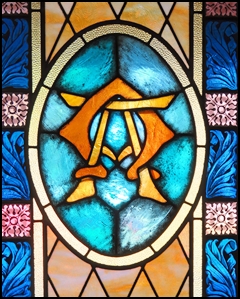 In the book of Revelation, when Jesus says He is the Alpha (the beginning), He also says He is the Omega (the end). He’s not talking of alphabets but rather the absolute beginning, revealed in Genesis, and the absolute end, revealed in Revelation. God had the first word when He spoke the universe into existence and He will have the last word when the world as we know it ends.
 Having forgotten the Greek alphabet he learned as a fraternity pledge, my husband asked the meaning of the symbols on the lecterns in the church sanctuary. On the left was A for alpha and, on the right, was Ω for omega: the first and last letters of the Greek alphabet. In Hebrew, those letters would have been aleph and tau. Among Jewish rabbis, using the first and last letters of the alphabet was a common way to express the whole of something, from its beginning to its end. Today’s equivalent expression would be “from A to Z” or “from soup to nuts.” Those Greek letters refer to three verses in Revelation in which Jesus claims to be the Alpha and Omega. They tell us that that, as part of our Triune God, Jesus was there at the beginning and He will be there at the end.
 We were at the symphony watching Alfred Hitchcock’s Psycho while the orchestra played Bernard Herrman’s chilling soundtrack. When Janet Leigh’s character, Marion Crane, stepped into the shower, a man in the audience yelled, ”Don’t do it!” Since most of us saw the movie decades ago, we didn’t want her to take that fatal shower either. In spite of the warning, however, she did. Since Marion was at the Bates Motel because she’d embezzled $40,000 from her boss, perhaps that man should have yelled, “Don’t do it!” much sooner.
 Devotions of the Heart