TECHNICALITIES (Passover – Part 2)

Sin is no longer your master, for you no longer live under the requirements of the law. Instead, you live under the freedom of God’s grace. [Romans 6:14 (NLT)]

great egret - breeding loresSince Jews are prohibited from possessing any food products containing leavening (chametz) during Passover, a Muslim Arab-Israeli man in Abu Ghosh now owns most of the bread, pastries and beer in Israel. As they have for many years, Israel’s two chief rabbis sold all of the leaven food from state-owned companies, the prison system, and the national emergency stores to him. He symbolically purchased the chametz for the duration of Passover by making a small down payment. Having promised to pay an enormous sum at the end of Passover, at week’s end he will tell the rabbis that he can’t pay up, the deal will be canceled, his down payment returned, and Israel again will own its yeast-laden products. Here in the U.S., some Jewish families “sell” their chametz to non-Jewish friends and then put the food in an out-of-the way cupboard. Technically, while still on their property, it’s not really theirs because they’ve “leased” the cupboard to the Gentile buyer. After Passover, the lease expires and the food is sold back to its original owner. While this may circumvent the law, I’m not sure it’s what God had in mind when He commanded, “There must be no yeast bread or any yeast at all found within the borders of your land during this time.” [Exodus 13:7]

Finding ingenious ways to sidestep rules and regulations is not limited to Judaism; we all do it. Technically, we’re not texting while driving—we’re texting while stopping at a red light! In principle, the dog is on a leash even when he’s dragging it on the ground or carrying it in his mouth. In 2007, a Minnesota bar got around the smoking ban by using a technicality in the law that allowed actors to smoke in their roles. The bar announced their staging of a continuous improvisational play. Every customer of the bar would be an actor taking a role in the “play” and, therefore, smoking was permitted! Teenagers have a special knack for getting around parental and school rules. It’s part of their make-up to think outside the box to outwit authority. Mankind will find every technicality, loophole, ambiguity, and grey area to circumvent laws and regulations.

Imagine God’s frustration while watching his children sidestep and disobey His law. A covenant of law requires complete obedience and, frankly, try as we might, we just can’t make the cut. We see rules and regulations as an infringement and prohibitions seem to increase our desire to do just that thing. Fortunately, rather than a covenant of law, Christians are under a covenant of grace and freed from the Old Testament rules and regulations. In grace, our salvation doesn’t come from following rules or doing the right thing and God accepts the less than perfect. It is our sincere belief rather than our faultless behavior that saves us. We have no need for sidestepping, semantics, and technicalities because obedience to rules is not what gives us eternal life and sin won’t cause us to lose it. Grace, however, is not license to sin; it is a license to live as God intended and follow the spirit of His law through the power of the Holy Spirit.


So now there is no condemnation for those who belong to Christ Jesus. And because you belong to him, the power of the life-giving Spirit has freed you from the power of sin that leads to death. The law of Moses was unable to save us because of the weakness of our sinful nature. So God did what the law could not do. He sent his own Son in a body like the bodies we sinners have. And in that body God declared an end to sin’s control over us by giving his Son as a sacrifice for our sins. [Romans 8:1-3 (NLT)]

Copyright ©2017 jsjdevotions. All rights reserved.

WHEN BELIEF BECOMES FAITH

trapeze
You say you have faith, for you believe that there is one God. Good for you! Even the demons believe this, and they tremble in terror. How foolish! Can’t you see that faith without good deeds is useless? [James 2:19-20 (NLT)]

When we visited our grandchildren in February, I had another opportunity to watch my granddaughter fly on the trapeze. As she practiced transferring from her fly bar into the catcher’s hands, I thought of promises. The catcher assured the flyers he’d catch them and they clearly believed him when they jumped off the platform, turned upside down and hung from their knees. Knowing his promise and believing it, however, isn’t enough to get someone from the fly bar into his hands. Once swinging through the air, my grand had to act on his promise by straightening her legs, flying off the bar and reaching into emptiness. In that moment, when she floated in the air between fly bar and catcher, her belief in the catcher became faith in him. The catcher can only make good on his promise when the flyer acts on it. Those flyers who professed to believe his words but never reached for him were left hanging upside down.

The word “promise” appears 364 times in my NLT Bible. Scholars usually say that God made more than 3,500 promises to man. In 1956, however, during his 27th reading of the Bible, Canadian schoolteacher Everett Storms catalogued 7,487 promises from God to mankind. Although I couldn’t even begin to list them all, I know that God promises provision, protection, direction, wisdom and a love that will never fail. He promises peace, forgiveness, an abundant life, salvation, Jesus’ 2nd coming, healing and eternal life. Nevertheless, even if I could recite every promise found in the Bible’s 31,173 verses and wholeheartedly professed my belief in each one of them, I still have not shown faith.

Faith requires action; it requires us to live our lives in reliance on each one of God’s glorious promises. It’s when we act on our belief, when we live our lives in dependence on God’s word, that faith is born. God can never make good on His promises if we never act on them! Of course, since my grand is still learning, she wears a safety harness in case her timing is off. When we take that leap of faith with God, however, we don’t need a harness—we can get it right the first time we do it. It’s always the right time to take our belief and act in faith on God. Without that leap of faith that propels us into God’s arms, however, we’re just hanging upside down from the fly bar!

But don’t just listen to God’s word. You must do what it says. Otherwise, you are only fooling yourselves. For if you listen to the word and don’t obey, it is like glancing at your face in a mirror. You see yourself, walk away, and forget what you look like. But if you look carefully into the perfect law that sets you free, and if you do what it says and don’t forget what you heard, then God will bless you for doing it. [James 1:22-25 (NLT)]

Copyright ©2017 jsjdevotions. All rights reserved.

SPIDER WEBS

spider webs - corckscrew swampOh, the depth of the riches and wisdom and knowledge of God! How unsearchable are his judgments and how inscrutable his ways! [Romans 11:33 (ESV)]
Last Friday, I wrote that I preferred visiting the enigmatic swamp to the impeccable Botanic Garden because it more closely resembles the confusion and disorder of this holy mess we call life. Nevertheless, hidden in its mystifying disarray of vines, trees, lichens, ferns and other assorted plants and animals, order can be found.

On certain days, when conditions are just right, beautiful orb spider webs can be seen in the early morning light. These amazing feats of engineering begin when a spider floats just one strand of silk on the wind to another surface. After securing the line, the spider crosses the “bridge,” reinforcing it as he goes and continues to drop and secure lines. Eventually, a nearly perfect circular web is constructed of numerous concentric circles with spokes going out from the center. A spider’s web can be anything from a few inches to six feet across. Ounce for ounce, spider silk is five to six times stronger than the same weight of steel. More elastic than rubber, it can stretch two to four times its length without breaking. Only a tenth the diameter of a human hair, a strand of spider silk long enough to circle the earth would weigh less than a bar of soap! I find it humbling that one diminutive eight-legged creature can construct a complex web from a thread we humans can’t even reproduce. There is nothing haphazard or chaotic about spiders and webs. Their amazing creations tell me that, unplanned as the swamp or our lives may seem, there is nothing random or haphazard about them—they are as much a part of God’s amazing and complex plan as are spider webs.

On most days, the spiders’ delicate webs are difficult to see; yet, even when they are indiscernible, I know they are there. God’s plan is much like that—sometimes it appears crystal clear and other times it seems undetectable. Nevertheless, there is a divine plan for each one of us! Whether or not I see their webs, I know the spiders are there and haven’t abandoned the swamp. Regardless of our perception of His plan, we can be sure that God is in control and won’t abandon us either. If we believe in the goodness of God, we must trust His plan (whether or not we understand or appreciate it). Like the spiders’ webs, it is intricate and sometimes difficult to discern. It is, however, a plan of strength, resilience and exquisite beauty.

God from all eternity did by the most wise and holy counsel of his own will freely and unchangeably ordain whatsoever comes to pass. [Westminister Confession of Faith]

In the infinite wisdom of the Lord of all the earth, each event falls with exact precision into its proper place in the unfolding of His divine plan. Nothing, however small, however strange, occurs without His ordering, or without its particular fitness for its place in the working out of His purpose; and the end of all shall be the manifestation of His glory, and the accumulation of His praise. [B.B. Warfield]

For we are his workmanship, created in Christ Jesus for good works, which God prepared beforehand, that we should walk in them. [Ephesians 2:10 (ESV)]

Copyright ©2017 jsjdevotions. All rights reserved.

DOING FOR OTHERS

Here is a simple rule of thumb for behavior: Ask yourself what you want people to do for you; then grab the initiative and do it for them! [Luke 6:31 (MSG)]

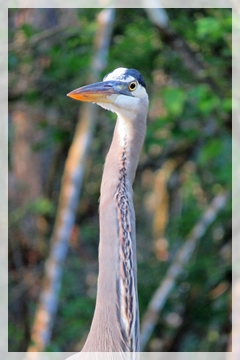
Great Blue HeronYears ago I took a short class in genealogy research. One of the first things told to us was that we were obligated to share any information we discovered with the rest of the genealogy community. Genealogy research depends on the results of other people’s searches of sources like birth and death records, cemeteries, census results and newspapers. We simply owe it to those who led us to our findings to share our knowledge with those who follow in our footsteps. I thought of that class as I wrote yesterday’s devotion about offering thanks.
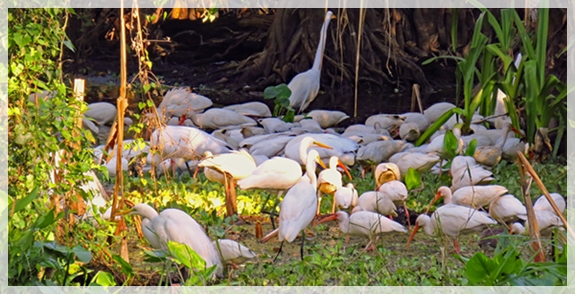
A few years ago I wouldn’t have been any use at all to those people we helped at the swamp. I knew next to nothing about any of the birds in southwest Florida or where to find them. I’m still a rookie birder and most of my avian knowledge is limited to the shore and wading birds. Nevertheless, thanks to the people who generously shared their knowledge with me—who so willingly pointed out birds, identified species, answered my questions, and explained their behavior—I can now help others who are even less knowledgeable than am I. As for that off-the beaten-track conservation area, the only reason we knew about it is that someone kindly shared his knowledge of it with us.

Both the genealogy information and bird lore I’ve received were given to me gratis. There was no quid pro quo—I gave nothing (but my thanks) in exchange for what was given me. It was shared out of kindness with no expectation of repayment—a little like God’s grace. We can never pay the deeper debt we owe to God for all of His goodness. Any attempt to repay Him is a contradiction of grace because grace wouldn’t be grace if it could be repaid. Just because it can’t be repaid, however, doesn’t mean it can’t be spread around. The Golden Rule tells us to do to others as we would have done to us and then I think of Jesus washing the disciple’s feet. He humbled himself to serve them and told the disciples that they must do for others what He had done for them. We must do for others that which has been freely done for us. Whether it is the giving of knowledge, service, skill, assistance, forgiveness or love, the good things that have been done for us are not ours to keep—they are ours to share. When doors are opened for us (both literally and figuratively), we are obligated to open doors for others.

Here’s another way to put it: You’re here to be light, bringing out the God-colors in the world. God is not a secret to be kept. … In a word, what I’m saying is, Grow up. You’re kingdom subjects. Now live like it. Live out your God-created identity. Live generously and graciously toward others, the way God lives toward you. [Matthew 5:14,48 (MSG)]

Then he said, “Do you understand what I have done to you? You address me as ‘Teacher’ and ‘Master,’ and rightly so. That is what I am. So if I, the Master and Teacher, washed your feet, you must now wash each other’s feet. I’ve laid down a pattern for you. What I’ve done, you do.”  [John 13:12-14 (MSG)]

Copyright ©2017 jsjdevotions. All rights reserved.

THE WINNER

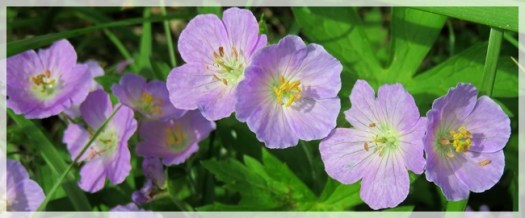
wild geranium
I find joy in the way shown by your written instructions more than I find joy in all kinds of riches. [Psalm 119:14 (GW)]

It’s March Madness time for basketball fans and my team is already out of the competition. Last year, however, my choice won—but not in basketball. After placing sixteen popular Bible stories in brackets, my preferred Bible resource site had its followers tweet votes for their favorite story to see which one moved forward. The choices were: Esther and the king, Jesus walking on water, the Good Samaritan, the Prodigal Son, Joseph and his coat, Jonah and the fish, Noah and the ark, the exodus from Egypt, David and Goliath, Ezekiel and the dry bones, Jericho’s walls, Balaam’s donkey, Daniel and the lion’s den, Jesus healing the blind, Rahab and the spies, and the burning bush. Which would you expect to be the final winner?

Ezekiel and the dry bones didn’t make it past the first round (which I understand since that one sort of creeps me out). Unfortunately, the lovely story of Esther, up against the more familiar parable of the Prodigal Son, was defeated in the first round. In the final round, on one side was the historical account of the young David defeating the giant Goliath. The story is exciting, has danger and violence, and illustrates the supernatural power of God. It’s a tale of a brave young man who demonstrates the power of God with just a sling and a few stones. It tells us that, when we step out in faith, the God we serve can defeat any of the giants in our lives. Everyone loves a story where faith in God beats brute strength and the little guy defeats the big one.

David’s underdog opponent was the parable of the Prodigal Son. It’s a moving story with a not totally happy ending. After the younger son insults his father and foolishly demands his inheritance, he squanders it all. In desperate circumstances, he returns home with his head hanging low and is welcomed by his father. The dark side to the story is that the older son, the one who faithfully remained at his father’s side, is indignant and can’t understand his father’s compassion and forgiveness.

At first glance, David’s defeat of the formidable Philistine would appear to be the favorite. Nevertheless, the undefeatable youth was trounced by the Prodigal Son. When we first meet David, even though he’s young, he seems larger than life. He’s handsome, a skilled musician, and described as having good judgment and being a brave warrior. Among all of Jesse’s sons, he is the one chosen by God to become king. Most of us don’t resemble David nor have we been anointed as a king. We’re not heroic future monarchs, but we are God’s troubled children. As much as we appreciate a story of good triumphing over evil, we can personally relate to Jesus’ parable because we all are God’s prodigal sons.

The parable is a story of hope (the father is waiting at the gate for his son), mercy (the boy is not punished), love (he is hugged and greeted with a kiss), forgiveness (he is welcomed as a son, not a slave) and joy (there’s to be a huge celebration). Like the son, we all disappointed our parents and, if we were blessed with children, they disappointed us at times. Moreover, just as the son misused his father’s money, we have misused the gift of free will and squandered the blessings given us by our heavenly Father. This story reassures us that no matter how immoral, unscrupulous, self-indulgent or corrupt we’ve been, God welcomes his children home when they come with humble and repentant hearts. Once dead because of sin, we can come alive again. Knowing what sinners we are, this demonstration of the Father’s love and forgiveness is reassuring. The parable reminds us that blessings aren’t earned and obedience is not what gives us eternal life. God’s grace is not something we deserve but something He freely gives. Thank you, Heavenly Father, for loving and forgiving your undeserving prodigal children.

He has not treated us as we deserve for our sins or paid us back for our wrongs. As high as the heavens are above the earth—that is how vast his mercy is toward those who fear him. As far as the east is from the west—that is how far he has removed our rebellious acts from himself. As a father has compassion for his children, so the Lord has compassion for those who fear him. [Psalm 103: 10-13 (GW)]

Copyright ©2017 jsjdevotions. All rights reserved.

LIVING WATER

ibis - corkscrew swamp sanctuary
Jesus replied, “Anyone who drinks this water will soon become thirsty again. But those who drink the water I give will never be thirsty again. It becomes a fresh, bubbling spring within them, giving them eternal life.” [John 4:13-14 (NLT)]

For a state that receives over 55-inches of rain a year, the words “Florida drought” seem an oxymoron. Nevertheless, southwest Florida is in moderate drought and the water in the swamp is receding at record pace. The dry down of the swamp concentrates fish into the shallow water that remains and they become easy prey for the wading birds. There is a feeding frenzy as hundreds of birds (and several alligators) gather to enjoy a virtual buffet table lined with fish, frogs, and crayfish. The water in the swamp sustains these beautiful birds and, when it evaporates, they will fly elsewhere. I watched in awe as the birds vied for spots in the diminishing lakes and thought about the importance of water.

About 60% of the human body is made up of water and every living cell needs it to function. It lubricates joints, regulates temperature, flushes waste, and carries nutrients through the body. We can last three weeks without food but we can last only three to five days without water (and as little as three to four hours in extreme heat). Once deprived of water, the cells and organs of the body start to deteriorate. Water in our bodies is the difference between life and death.

Jesus offers us living water and His water truly is the difference between life and death. The water in the swamp is not living water – with no springs, it’s really just a large cistern that collects rain and will eventually evaporate. When the water is gone, only some vultures eating the scraps will remain. The living water offered by Jesus is never-ending; it is poured out in all seasons and will never disappear. Unlike the birds, we don’t have to fight for our spot in the pond or, like the Samaritan woman, come to the well. All we have to do is ask for the living water of eternal life. One drink of His Holy Spirit and we’ll never thirst again.

I find it ironic that some of the last words spoken by the man who offered living water were, “I am thirsty.” [John 19:28] Dehydrated by the torture He’d endured, was it just His dry mouth that led to those words? Did He thirst for the end of His pain and suffering? Or did He make a final demonstration of His humanity by speaking words that showed how much he thirsted for fellowship with God? Let us gather at His table, drink deep of His love, wash in His forgiveness, and never thirst again.

O God, you are my God; I earnestly search for you. My soul thirsts for you; my whole body longs for you in this parched and weary land where there is no water. [Psalm 63:1 (NLT)]

As the deer longs for streams of water, so I long for you, O God. I thirst for God, the living God. When can I go and stand before him? [Psalm 42:1-2 (NLT)]

Copyright ©2017 jsjdevotions. All rights reserved.