FEARING

For everyone has sinned; we all fall short of God’s glorious standard. Yet God, in his grace, freely makes us right in his sight. He did this through Christ Jesus when he freed us from the penalty for our sins. For God presented Jesus as the sacrifice for sin. People are made right with God when they believe that Jesus sacrificed his life, shedding his blood. [Romans 3:23-25 (NLT)]

I thought of Mr. Fearing in John Bunyan’s allegory The Pilgrim’s Progress when a friend told me about her mother who was nearing the end of her life. Although a Christian, she believed there was something in her distant past for which she couldn’t be forgiven. Even though her family reassured her that Jesus died for her sins and God is faithful to His promises, she still seemed fearful of taking that final journey home.

In Bunyan’s tale, Mr. Fearing’s story is told by his guide to the Celestial City, Mr. Great Heart. Even though Fearing escaped the Swamp of Despondence, he seemed to carry that despondence in his mind everywhere he went. When Fearing came to the gate where it said, “Knock and the door will be opened to you,” he was afraid to knock. Sure that he was unworthy of entrance, he stood back and allowed others to take his place whenever the door opened. When he eventually had the gumption to timidly knock, Fearing fainted in unbelief when the door was opened for him.

Accompanied by Mr. Great Heart, Mr. Fearing continued on his journey. He effortlessly hiked straight up the Hill of Difficulty, showed no fear when he encountered lions, and easily walked down into the Valley of Humiliation. When the travelers had to pass through Vanity Fair (a place ruled by Beelzebub and filled with evil temptations), Mr. Fearing had no difficulty staying on the Way and, while others fell asleep in the Enchanted Ground (the land of spiritual lethargy), Fearing stayed alert. But, believing himself unworthy of God’s grace, his shame kept him from enjoying the blessings God provided on the journey and caused him to be afraid of death and the journey’s end.

Mr. Fearing wasn’t afraid of difficulties, danger, or challenges to his faith but, because he had doubts about his welcome in the Celestial City, he was terrified of death and Hell. His fear was that of his final acceptance—that God would reject him! Sure that he’d drown and never see the face of the King he’d traveled so far to meet, he was afraid to cross the River of Death: the only way to the Celestial City. Both Fearing and my friend’s mother eventually crossed that river and were welcomed because all of their sins had been forgiven.

As Good Heart related the story of Mr. Fearing to Christiana and her fellow pilgrims, they shared their fears about their own salvation—fears that many of us may share. Bunyan experienced this same fear; in his autobiography, he said that early in his conversion Satan tempted him to unbelief by declaring his sins unpardonable. Bunyan’s reply to the enemy simply was, “Well, I will pray.”

Indeed, it’s difficult to believe in God’s extravagant grace: that, as soiled and unworthy as we are, we’ve been washed clean in the blood of the Lamb. Let us remember—the burden of our sins fell off at the foot of the cross! God didn’t sacrifice His son for us because we deserved it; He did out of love for us! Jesus Christ died for us while we were still sinners, not saints! When we fear our welcome in God’s heavenly realm, let us do as did John Bunyan: let us pray!
For this is how God loved the world: He gave his one and only Son, so that everyone who believes in him will not perish but have eternal life. [John 3:16 (NLT)]

Copyright ©2019 jsjdevotions. All rights reserved.

THE BURDEN

My guilt overwhelms me—it is a burden too heavy to bear. [Psalm 38:4 (NLT)]

First published in 1678, John Bunyan’s The Pilgrim’s Progress is the second best-selling book of all time (the first being the Bible). In this religious allegory, the reader follows the adventures and trials of Christian (Part I) and his wife Christiana and their children (Part II) as they journey from the City of Destruction toward the Celestial City.
The iconic picture of the pilgrim Christian is that of a man bent over with a heavy pack strapped to his back. From that illustration, many assume that means Christians must carry a heavy burden, which is anything but the truth. Although Bunyan’s allegory opens with the man saddled with that pack on his back, he is free of its enormous weight for most of the story.

At the book’s start, the burdened man is crying while reading the Bible. Realizing that death is followed by judgment, he fears that his heavy load of sin will condemn him to Hell. The troubled man asks, “What must I do to be saved?” When the Evangelist tells him to follow the light to the Narrow Gate, Christian leaves on his pilgrim’s journey. He still carries that pack laden with the weight and shame of his sins; it is a burden that he can’t remove by himself.

Even after Christian enters the Gate, that heavy load remains. Goodwill tells him to be content carrying it until he comes to the Place of Deliverance.  Upon getting there, Christian sees a cross at the top of the hill and a tomb at the bottom. As he approaches the Cross, the straps on his pack loosen from his shoulders. The burden drops to the ground, tumbles down the hill, and disappears into the mouth of the sepulcher. Christian’s burden has been transferred to Jesus who, while on that cross, atoned for all of his sins. When the empty tomb receives his sins, they are gone forever.

It’s no surprise that Charles Spurgeon’s favorite book (after the Bible) was The Pilgrim’s Progress, that this man known as the “Prince of Preachers” read it at least one hundred times, or that Bunyan’s allegory has been used by Christian missionaries for centuries. As with the parables of Jesus, the book’s powerful visual images skillfully illuminate gospel truths. Christian’s burden falling at the cross is what Good Friday was all about. We are rid of the weight of sin and the burden of trying to earn our way into God’s good graces. Released from guilt and condemnation, we are free of sin’s penalty because Jesus paid that price for us. That Christian will eventually reach the Celestial City is what Easter was about!

We know that our old sinful selves were crucified with Christ so that sin might lose its power in our lives. We are no longer slaves to sin. For when we died with Christ we were set free from the power of sin. And since we died with Christ, we know we will also live with him. [Romans 6:6-8 (NLT)]

Then Jesus said, “Come to me, all of you who are weary and carry heavy burdens, and I will give you rest. [Matthew 11:28 (NLT)]

Copyright ©2019 jsjdevotions. All rights reserved.


MAUNDY THURSDAY: THE ROOSTER CROWS

“Don’t be so sure,” Jesus said. “This very night, before the rooster crows up the dawn, you will deny me three times.” Peter protested, “Even if I had to die with you, I would never deny you.” All the others said the same thing. [Matthew 26:34-35 (MSG)]

Ballenburg roosterThere’s a therapeutic riding center across the highway from one of the churches we attend. Along with horses, barn cat, and dog, they have a rooster. No matter what the time of day we’re there, that rooster crows. Every time I hear that bird’s loud “cock-a-doodle-do!” I remember Jesus’s words to Peter and ask myself, “Have I denied my Lord today?”
I can’t say I blame Peter for his betrayal. He was there when Judas, along with Temple guards and a contingent of Roman soldiers armed with swords and clubs, arrived in Gethsemane. Peter saw them man-handle and arrest Jesus. Peter was the one who impulsively drew his sword and cut off the ear of the high priest’s slave. Although Jesus healed the man, Peter had to be afraid as he stood around the fire with the servants and guards in the high priest’s courtyard. Would he be the next one arrested? His name may have meant “rock,” but his behavior was anything but rock-like that night.

Would I have been braver and more faithful than Peter or would I, too, have denied Christ? I’m ashamed to say that I probably wouldn’t have behaved any better than did Peter. I often deny knowing Jesus, and I’m not even afraid of being arrested. I deny Him when I ignore His call to service, remain silent when I should speak, or speak when I should remain silent. I deny Him when I hold a grudge, withhold forgiveness, judge others, and act prideful, spiteful or self-righteous. I deny Christ when I do what I know is wrong, when I don’t do what should be done, when I accept what I know He wouldn’t, and when I take credit for His gifts to me. Unfortunately, there are many ways we can deny knowing Jesus.

Lord, forgive us for the times we’ve denied being your servant. Fill us with your Holy Spirit so that our denials become affirmations and our lives give testimony to your saving grace.

All this time, Peter was sitting out in the courtyard. One servant girl came up to him and said, “You were with Jesus the Galilean.” In front of everybody there, he denied it. “I don’t know what you’re talking about.” As he moved over toward the gate, someone else said to the people there, “This man was with Jesus the Nazarene.” Again he denied it, salting his denial with an oath: “I swear, I never laid eyes on the man.” Shortly after that, some bystanders approached Peter. “You’ve got to be one of them. Your accent gives you away.” Then he got really nervous and swore. “I don’t know the man!” Just then a rooster crowed. Peter remembered what Jesus had said: “Before the rooster crows, you will deny me three times.” He went out and cried and cried and cried. [Matthew 26:69-75 (MSG)]

Copyright ©2019 jsjdevotions. All rights reserved.

SEEING THE ERROR

For false messiahs and false prophets will rise up and perform signs and wonders so as to deceive, if possible, even God’s chosen ones. Watch out! I have warned you about this ahead of time! [Mark 13:22-23 (NLT)]

white ibisYesterday, I wrote about Cyrus Teed, the Koreshan Unity, their strange theology, and Cellular Cosmogony: the belief that the earth is a hollow shell and the entire universe exists inside that shell. Whether he was a charlatan or insane fanatic, Cyrus Teed claimed to be immortal. When he died in 1908, his followers kept his body in a bathtub for five days and waited for his resurrection. Rather than rising, Teed began to stink and authorities forced his corpse to be buried. Nevertheless, many of his followers faithfully waited another thirteen years for his return.

When it became obvious his second coming would never come, membership in the Koreshan Unity began to decline (the belief in celibacy not helping their numbers). By 1961, when it was clear the community would not survive, its last four members deeded the remaining 305 acres of Unity land to the state.

Hedwig Michel was the last of the Koreshans. In 1982, reporters asked if she still believed in Cellular Cosmogony and she replied, “Well, I did believe it until I saw the boys walking on the moon.” That moon walk took place in 1969, 61 years after Teed’s failed resurrection and several years after Sputnik and Explorer 1 launched, Alan Shepherd flew into space, and both Yuri Gagarin and John Glenn orbited the earth in spacecraft. Yet, Hedwig Michel held fast to her Koreshan beliefs until she saw Neil Armstrong and Buzz Aldrin walk on the moon.

For the most part, the Koreshans were an educated lot and, when walking through their settlement, I wondered why they clung to their strange theology and pseudo-science for so long. Then again, while it’s easy to recognize the folly of someone else’s ideas, it’s not so easy with our own. Jesus warned us about false prophets but not all of them are as obvious as Cyrus Teed. At some time or another, we all may have believed in the wrong person or ideology or held on to erroneous viewpoints or prejudices. Perhaps, we still do.

Why do people continue with false beliefs or follow false prophets? Perhaps, it is easier to believe a lie than admit our thinking could be wrong. The Koreshans gave up their homes and personal possessions to devote their lives to Koreshanity. Like them, could we stubbornly cling to certain beliefs or biases because admitting our error might mean we’ve wasted opportunities, time, energy or even money? For many years, the Koreshan Unity prospered, having 7,500 acres of land and more than a dozen businesses. Skepticism and doubt probably don’t thrive in well-being and, like Teed’s followers, we’re unlikely to question what appears to be successful, even when we suspect it could be wrong. With such a strong sense of community, some Koreshans may have been afraid to abandon their sect and step out on their own while others may have feared ridicule from outsiders if they admitted their error.

Like those die-hard Koreshans, do we have blind spots? Are we unwilling to examine some of our beliefs in the light of God’s truth? While it’s never easy to admit we’re in error, it’s easy to know God’s truth. If we’re not loving God, loving all of His people, and walking in the way of Jesus, we’re in error. When our attitude, values, principles or opinions don’t line up with God’s word, they’re wrong. For Hedwig Michel, it took seeing men walk on the moon’s surface before she accepted the falseness of Koreshanity. What will it take for us to see any falseness in our lives?

For a time is coming when people will no longer listen to sound and wholesome teaching. They will follow their own desires and will look for teachers who will tell them whatever their itching ears want to hear. They will reject the truth and chase after myths. [2 Timothy 4:3-4 (NLT)]

Copyright ©2019 jsjdevotions. All rights reserved.

FAITH AND OBEDIENCE

Trust in the Lord always, for the Lord God is the eternal Rock. [Isaiah 12:4 (NLT)]

wild geraniumAbraham and Sarah waited twenty-five years for their promised son, Isaac, but then God demands that Abraham sacrifice his long-awaited child as a burnt offering. Abraham takes Isaac off to the mountain and to what he believes is his son’s death. Abraham’s knife is drawn and he’s ready to kill Isaac when God intervenes. After an angel tells him not to lay a hand on his son, Abraham looks up to see a ram caught in the brush. With God’s blessing, he sacrifices it in place of Isaac.
This story is troubling and we wonder at God’s purpose in making such a horrifying demand and then retracting it. Does God play cruel pranks on people? While it certainly shows that God will not tolerate the sacrifice of children, that seems a thoughtless and brutal way to make such a point. The torment that Abraham must have suffered thinking he had to kill his own son is unimaginable. This story, however, is not about sacrifice and cruelty; it is about obedience and faith. It is about the fact that God demands our absolute obedience and our complete and unwavering faith.

Abraham truly didn’t know what was going to happen on the mountain, but he did as he was told. He had an unquestioning faith in God, a God who knows and does what is best. If Abraham had known that God wouldn’t allow Isaac’s death, he would simply have been obedient to God as he prepared the altar and placed the wood on it. But, when Abraham tied his son’s hands, laid him on the altar and brought the knife blade to his throat, he didn’t know that God would intervene; that was both obedience and faith!

If the widow had dropped her last two coins into the collection box knowing she’d get two more the following week, if Mary had known for sure that Joseph wouldn’t abandon her, if Daniel had been sure the lion’s mouths would remain closed, or if Shadrach, Meshach, and Abednego had known they wouldn’t be incinerated in the furnace, they would simply have been obedient to God when they submitted to His will. Instead, like Abraham, they showed faith even though they didn’t know how their stories would finish. They didn’t ignore the difficult circumstances; they simply knew that God is bigger than any circumstance.

Martin Luther King, Jr. said, “Faith is taking the first step even when you don’t see the whole staircase.” It‘s merely obedience when we can see all the way to the end of the stairs. Faith doesn’t know the outcome; faith is obedience even when we don’t know where the staircase leads or how long and steep it is.

Faith is to believe what you do not see; the reward of this faith is to see what you believe. [Saint Augustine]

Don’t you remember that our ancestor Abraham was shown to be right with God by his actions when he offered his son Isaac on the altar? You see, his faith and his actions worked together. His actions made his faith complete. And so it happened just as the Scriptures say: “Abraham believed God, and God counted him as righteous because of his faith.” He was even called the friend of God. [James 2:21-23 (NLT)]

Copyright ©2019 jsjdevotions. All rights reserved.

HE LIFTS US

Save me, O God! The water is up to my neck; I am sinking in deep mud, and there is no solid ground; I am out in deep water, and the waves are about to drown me. [Psalm 69:1-2 (GNT)]

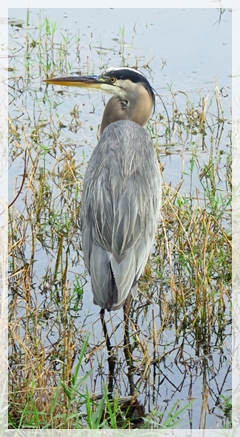
Great Blue HeronQuicksand forms in saturated loose sand and, when undisturbed, appears to be solid ground. If a person steps into it, however, there is a decrease in its viscosity which causes the water and sand to separate so the soil becomes liquefied. When I was growing up, a scene of someone sinking into the death trap of quicksand was a staple of adventure movies. Because of those Saturday matinees in the 1950s and 60s, countless children probably had a fear of plunging into quicksand while walking in the woods; I know I did!

Even though an Arizona man was recently stuck in quicksand at Zion National Park, the old Hollywood cliché doesn’t stand up to scrutiny and a person is unlikely to submerge completely. As that trapped man discovered, the real danger comes from hypothermia, bad weather, predators, dehydration, or even drowning from rising tides while stuck.

Without ever going near a swamp, beach or river bank, we can easily encounter quicksand-like conditions in our lives. Trusting ourselves rather than God, we think we’re on firm ground only to misstep and fall into a pit of problems. As we’re sucked into the muck of doubt, fear, worry, deceit, or depression, we start to panic. As happens in real quicksand, the more we struggle, the faster we sink.

Stuck in a quagmire of despondency or pit of despair, Satan finds us easy prey. Frightened, feeling alone, and thirsting for relief, we’re tempted to accept whatever comfort he offers. Feeling defenseless in the swamp of hopelessness, we reach for whatever seems easiest and, instead of rescue, a rising tide of more troubles sweeps over us.

Although I feared quicksand as a child, I’m not likely to be sucked into a bottomless pit of muck any time soon. Nevertheless, since quicksand does remain a minor threat wherever super-saturated sand exists, it’s reassuring to know that, if we step into quicksand, we don’t have to stay there. We don’t have to remain in situational quicksand, either. In both cases, we should get rid of anything that weighs us down, whether backpacks or negative thoughts and emotions. Frantic movement can agitate quicksand which further liquefies the soil but, by remaining calm, breathing deeply, and relaxing, it’s possible to float on top of the muck. In situational quicksand, the same rule holds. Knowing that God has not abandoned us, there’s no need for anxiety or panic. By pausing, praying, and following God’s direction, we can rise above our problems. Life’s challenges can’t sink us because our God will teach us how to float through them. Finally, in both situations, we must be patient. It usually takes a long time to move through both muck and troubles. In God’s time, He will lift us out of the pit and put our feet on solid ground!

I waited patiently for the Lord’s help; then he listened to me and heard my cry. He pulled me out of a dangerous pit, out of the deadly quicksand. He set me safely on a rock and made me secure. [Psalm 40:1-2 (GNT)]

Copyright ©2019 jsjdevotions. All rights reserved.