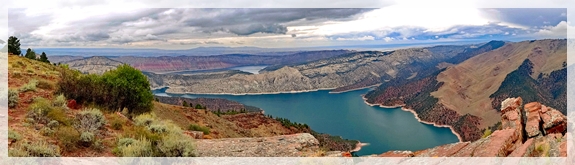
BE STRONG AND COURAGEOUS

UtahThis is my command—be strong and courageous! Do not be afraid or discouraged. For the Lord your God is with you wherever you go.” [Joshua 1:6a,9 (NLT)]

Joshua 1:9 was my Bible verse for the day but I decided to make it my verse for the week. To make sure I kept it in mind, I wrote it on a post-a-note and stuck it where I’d be sure to see it: on my phone!

Wanting to put this inspirational verse in context, I reread the first chapter of Joshua. The book of Joshua is about the fulfillment of God’s promises to Abraham made four hundred years earlier. Its first chapter is one of my favorite chapters of the Old Testament narratives. To set the stage: Israel is camped on the east side of the Jordan River with the Promised Land in sight. Forty years have passed since the parting of the Red Sea. Moses is dead and only Caleb and Joshua remain of the adults who’d once been slaves in Egypt. The Israelites are standing on the edge of the unknown and the Jordan River is at flood stage. With no bridges or ferry boats, they must have wondered how they’d manage to get safely to the other side. Joshua is the new leader of the Israelites and God tells him to be strong and courageous.

Granted, God’s words were spoken to Joshua around 1400 BC in an entirely different setting but, because I’m standing on the edge of the unknown as well, God’s words to Joshua are both comforting and encouraging. Then again, we’re all standing on the edge of the unknown. None of us know what tomorrow (or even the rest of today) will bring: be it good news or bad, tornadoes or sunny skies, an accident or a near miss, the making of a new friend or the loss of an old one.

When Joshua is told to be strong, God wasn’t talking about working out at the gym. This strength had nothing to do with muscles unless, of course, we’re talking about spiritual muscles. It had to do with having the strength to prevail, withstand, and sustain. Being of good courage, is more than not being a fearful coward; it’s being alert both physically and mentally, steadfast, and determined. It wasn’t powerful foes or a lack of weapons, battle strategy, or seasoned warriors that threatened Israel; it was fear, discouragement, and weakness of faith.

Being strong and courageous is easier said than done. Nevertheless, God tells Joshua exactly how to do that: meditate on and obey the instructions in the Torah (the first five books of the Bible and the only scripture at the time). Authored by God through Moses, those books contained the people’s history and God’s law, promises and plan. If the Israelites had only done that, the Old Testament would be an entirely different (and far less violent) story! 3,400 years later, we’re no longer limited to a mere five books; we have both Old and New Testaments to make us strong and courageous. Just the same, knowing and obeying those words can be as much of a problem for us as it was for the Israelites.

At least for me, the best part of Joshua 1:9 is God’s promise that He is with us wherever we go. Whether we’re crossing a deep river or just going across the street, confronting an enemy army or a CT scan, or facing a walled city or the loss of a spouse, we know that, no matter what befalls us, God is with us. When we’re standing at an abyss, facing the great unknown, there is no need to be afraid or discouraged. We can be strong and courageous because we have his promise in writing; He is always with us, “even to the end of the age.”

If the Lord be with us, we have no cause of fear. His eye is upon us, His arm over us, His ear open to our prayer – His grace sufficient, His promise unchangeable. [John Newton]

Teach these new disciples to obey all the commands I have given you. And be sure of this: I am with you always, even to the end of the age. [Matthew 28:20 (NLT)]

Copyright ©2019 jsjdevotions. All rights reserved.

QUESTIONS AND ANSWERS

Make the most of your chances to tell others the Good News. Be wise in all your contacts with them. Let your conversation be gracious as well as sensible, for then you will have the right answer for everyone. [Colossians 4:5-6 (TLB)]

doris longwing butterflyWhen Meg and John walked into the church narthex, Meg was visibly disturbed. “I just can’t believe they said that. How can they call themselves Christians?” she asked her husband. Seeing Meg’s obvious distress, the pastor who’d been greeting at the door went over to talk. The two had been at a small group study before service when, after class, another couple nonchalantly dismissed the virgin birth as fiction and, as they walked out the door, added that the resurrection was as much a fabrication as the virgin birth.

The virgin birth is a doctrine plainly stated in the Apostle’s Creed—a creed that is regularly recited at that church. Christianity holds that Jesus had no earthly father and was not the product of intercourse. How it happened, we don’t know and certainly can’t understand. The resurrection of Christ is also affirmed in the Apostle’s Creed. For the most part even non-believers won’t argue the crucifixion, death and burial of Jesus nor will they dispute that his tomb was empty on the third day. They simply can’t accept how the tomb came to be that way. Just because we can’t understand how something happened, however, doesn’t mean that it didn’t occur!

This devotion, however, isn’t about defending the virgin birth and the resurrection. It’s about Meg and John. “I don’t think that group is right for us,” she said. “Let’s find another group; we’re not going back there again.” Her husband, however, emphatically disagreed: “Oh, yes we are! We’re not going to let this go unanswered.” Meg and John have a valuable opportunity to share the gospel and one that I hope they use wisely.

This devotion is also about that other questioning couple and I think back to nearly fifty years ago when a young woman, from a Buddhist background, was about to join our church. Having grown up in a Buddhist home with a family altar, she was struggling with a way to reconcile praying to her ancestors (something she had always done) with her new Christian beliefs. While there is no place for ancestor worship in Christianity, our pastor’s answer was gentle and loving. Rather than condemning her for her past beliefs and practices, he encouraged her to grow in her new ones. His words were encouraging and accepting—not of ancestor worship—but of her.

Meg and John’s experience is a reminder that not everyone we meet at church, Bible study, or small group is a firm believer. The fact they are there, however, is a step in the right direction! We must do our best to keep them there by being sympathetic, compassionate, humble, loving, gracious, patient, and willing to listen. If people can’t freely question doctrine, express their disbelief, or ask for further explanation in church, where should they go? Remember, even Thomas had doubts! Rather than telling them what we think and why we think it, perhaps we should start by asking them what they think and why they think it. Let’s meet them wherever they happen to be, walk with them into a deeper understanding of the gospel, and pray with and for them.

Try to help those who argue against you. Be merciful to those who doubt. Save some by snatching them as from the very flames of hell itself. And as for others, help them to find the Lord by being kind to them, but be careful that you yourselves aren’t pulled along into their sins. Hate every trace of their sin while being merciful to them as sinners. [Jude 1:22-23 (TLB)]

Copyright ©2019 jsjdevotions. All rights reserved.

DIGGING FOR THE TRUTH

Open your ears to my teachings, my people. Turn your ears to the words from my mouth. I will open my mouth to illustrate points. I will explain what has been hidden long ago, things that we have heard and known about, things that our parents have told us. We will not hide them from our children. We will tell the next generation about the Lord’s power and great deeds and the miraculous things he has done. [Psalm 78:1-4 (GW)]

limpkinYesterday, I wrote about archeological support for the story of Balaam; his is but one of many Old Testament stories with evidence provided by archeology. When reading about King Belshazzar giving a feast for 1,000 in his Babylonian palace, it’s easy to think there must have been exaggeration as to the size of his party. Archaeologists, however, have excavated a large hall in Babylon that was 55 feet wide and 165 feet long, a room sufficient to host a gathering of that size. The Bible mentions writing that appeared on the room’s plaster walls and archeologists found that this ancient room had plaster walls!

In 2 Chronicles 12, we read of Judah’s invasion by Egypt’s Pharaoh Shishak during Rehoboam’s fifth year as king. Archeologists have found evidence of their devastating invasion at settlements in both Israel and Judah. Hieroglyphics on the wall of the temple at Karnak describe Egypt’s 926 BC campaign and list 183 conquered cities, 43 of which are known Bible cities. Notably missing from the list of destroyed towns is Jerusalem, the city that Shemaiah prophesized God would not allow to be destroyed. Instead, Rehoboam surrendered and the Egyptians robbed Solomon’s temple of its treasures. When we wonder where all of that plunder went, a pillar in a temple at Bubastis tells of Osorkon I (Shishak’s son) giving away 383 tons of gold and silver to all the gods of Egypt just five year later.

When King Uzziah (who was struck with leprosy) died in 740 BC, 2 Chronicles 26 tells us he was buried in a field that belonged to the kings. His stone burial plaque was discovered on the Mt. of Olives with these words: “Here, the bones of Uzziah, King of Judah, were brought. Do not open.”

The Old Testament tells us of the Babylonians’ defeat of Judah but so do a collection of clay tablets known as the Babylonian Chronicles. These annals record Babylon’s history from 750 to 280 BC and tell of such things as the battle of Carchemish (recorded in Jeremiah 46), Nebuchadnezzar’s siege of Jerusalem (found in 2 Kings 24), and removing King Jehoiachin and replacing him with Zedekiah (recorded in 2 Kings 24). They even include receipts for goods that were issued to the deposed Jehoiachin when he was in Babylonian captivity (mentioned in 2 Chronicles 36).

The cornerstone of our faith is the Bible and archeology should never be the litmus test for its truth. Archeology can’t prove Scripture’s divine inspiration or the exactness of its every word. Because it’s based on what’s been left behind, discovered and deciphered, many pieces are missing in the puzzle. Moreover, since the Bible tells just a portion of the story, some ancient pieces will be found that don’t fit. Although we will never have undisputed historic proof of its truth, archeology can confirm the historicity of many Biblical events, people, civilizations, and places. For me, it is comforting to find that external evidence points to the trustworthiness of the Bible. Of course, since it is God-breathed, we shouldn’t be surprised that secular history dovetails so well with Biblical truth.

Every Scripture passage is inspired by God. All of them are useful for teaching, pointing out errors, correcting people, and training them for a life that has God’s approval.  They equip God’s servants so that they are completely prepared to do good things. [2 Timothy 3:16-17 (GW)]

Copyright ©2019 jsjdevotions. All rights reserved.

GOING HOME

Let not your hearts be troubled. Believe in God; believe also in me. In my Father’s house are many rooms. If it were not so, would I have told you that I go to prepare a place for you? And if I go and prepare a place for you, I will come again and will take you to myself, that where I am you may be also. [John 14:1-4 (ESV)]

Jesus said to her, “I am the resurrection and the life. Whoever believes in me, though he die, yet shall he live, and everyone who lives and believes in me shall never die.” [John 11:25-26 (ESV)]

After a brief stay at hospital, we’d brought Gert, my 102-year old mother-in-law, home to die. Although she was a woman of faith, she seemed frightened of the journey that lay ahead of her and kept calling for her mother and father (who’ve been gone for more than half a century). When I shared this with the Hospice nurse, she asked if I’d told her that it was all right to leave. Since Gert was in a state of semi-consciousness, I questioned whether she would understand but the nurse assured me that hearing is the last sense to go.

That day, as I sat at her side, I read to Gert from the Bible, prayed with her, thanked her, and reminded her of her favorite memories. I knew them well since, not wanting to lose her amazing history when we lost her, I’d asked her about them (and written them down) several years ago. While talking to her that afternoon, I remembered a story Gert told me. Beginning with, “I believe in prayer!” she told of a cold winter day when she’d met some friends at a resort across the lake from her house. On her way home that evening, she took a short cut across the frozen lake (probably something the twelve-year-old had been told not to do). “I heard the ice cracking all around me,” she related, “and, believe me, I honestly thought I was a goner that time!” Sure that she’d fall through the ice and no one would ever find her, the terrified girl recited everything she had ever learned in her Sunday school classes. Having seen the “Star Memory Certificate” she’d received as a girl, I knew that included the Lord’s Prayer, the Ten Commandments, the Beatitudes, the 23rd Psalm, and all of the books of the Bible.

I reminded her of that cold winter night when she was a child and how her faith had gotten her across the ice and safely home to her mother and father. Telling her I understood the walk was frightening, I reassured her that she wasn’t a goner and we’d all know where to find her. Reading from the book of John, I reminded her that God had prepared a room especially for her and that, across the daunting lake was that room and her home: a home where the lights were on, the fire was lit, and her loved ones were waiting for her with spritz cookies and a warm cup of cocoa. Calmed and almost serene, Gert went to her forever home early that evening.

Gert once told me she loved the 23rd psalm but added that she always skipped “that one line.” Sunday afternoon, when I read that beautiful psalm to her, I included all of its comforting words. I spoke to Gert of that dark valley and God’s reassurance that He is beside her, just as He was that cold night ninety years ago. While I’ve always thought of our Christian faith as comforting to those who mourn, that afternoon reminded me of how comforting it is for those taking their final journey through the dark valley of death. Although neither family nor friends can accompany us on our last walk, we will not be alone and, waiting on the other side, is a beautiful room  prepared especially for us in our eternal home.

Even though I walk through the valley of the shadow of death, I will fear no evil, for you are with me; your rod and your staff, they comfort me. … Surely goodness and mercy shall follow me all the days of my life, and I shall dwell in the house of the Lord forever. [Psalm 23:4,6 (ESV)]

Copyright ©2019 jsjdevotions. All rights reserved.


HE KNOWS WHAT WILL FIT

Then the Lord asked Moses, “Who makes a person’s mouth? Who decides whether people speak or do not speak, hear or do not hear, see or do not see? Is it not I, the Lord? Now go! I will be with you as you speak, and I will instruct you in what to say.” [Exodus 4:11-12 (NLT)]

white admiral butterflyWe were window shopping and celebrating our anniversary. Wanting to get me a gift, my husband spotted a dress he liked in the window of a little boutique and insisted we go inside. The owner greeted us, said the dress in the window wouldn’t fit and showed me a different dress. It was so unlike anything I’d ever worn that I immediately said it wouldn’t look right on me—wrong color, wrong style, wrong material, and wrong fit. ”Don’t you tell me what it will look like,” she said indignantly. “I created this dress and know exactly who it will fit. It will be beautiful on you.” Chastened, but still sure it would look terrible, I reluctantly tried it on. The designer, however, was right. As the creator of the dress, she knew what she had in mind when making it and that it would be right for me.

Through the years, we got to know this woman rather well; as a Messianic Jew, I imagine she was familiar with the book of Exodus. Our first exchange was much like that between God and Moses when God spoke out of the burning bush and gave Moses the task of leading the Israelites out of Egypt. Like me, Moses protested that the job wasn’t a good fit. Who was he to approach Pharaoh? Why would the Israelites listen to or believe him? God responded by giving Moses three miraculous signs to convince them but Moses still objected that the task was not right because he wasn’t eloquent. Like the dress designer, God took that complaint personally and was angry that Moses didn’t seem to trust the One who made Him. As Creator of the man’s mouth in the first place, God knew what it could and couldn’t do. When He promised to empower Moses by putting the words in his mouth, Moses still balked so God provided him with Aaron.

It’s not just trying on dresses and freeing Israelites at which we balk. Whenever we feel one of those God nudges to step out of our comfort zones, our first response is usually something like, ”But God, that’s not the right task for me. I’m not designed for that sort of thing!” Be it sharing our faith or offering to pray with someone, volunteering at the food pantry, greeting at church, teaching Sunday school, writing a blog, visiting a shut-in, planning a fund raiser, organizing a blood drive, starting a Bible study or leading a grief group, we’re sure there is someone better qualified.

Perhaps there is; nevertheless, if God calls us to a task, it’s one He wants us to do and, as our creator, He knows exactly what it is we are capable of doing. Besides, He’ll give us the skills we need. He gave Moses the words and, when God appointed Bezalel and Oholiab to be in charge of building the Ark, the Tabernacle and its furnishings, God filled them with His spirit, wisdom, ability and expertise and gave special skill to all of their craftsmen. He’ll do the same for us! Moreover, just as He provided Moses with the assistance of Aaron, He’ll give us all of the help we need to do His work.

What sorrow awaits those who argue with their Creator. Does a clay pot argue with its maker? Does the clay dispute with the one who shapes it, saying, “Stop, you’re doing it wrong!” Does the pot exclaim, “How clumsy can you be”? [Isaiah 45:9 (NLT)]

For we are God’s masterpiece. He has created us anew in Christ Jesus, so we can do the good things he planned for us long ago. [Ephesians 2:10 (NLT)]

Copyright ©2019 jsjdevotions. All rights reserved.

WORRY AND PRIDE

Give all your worries and cares to God, for he cares about you. [1 Peter 5:7 (NLT)]

tropical water lilyWhen the Israelites sent scouts out to Canaan, they were doing due diligence and getting the lay of the land. Let’s remember, Moses had only asked them to scout out the land, not to determine how or whether they should proceed. But, when they returned, ten of the twelve reported the Promised Land was the land of giants who were undefeatable. In spite of Moses’s leadership, the reassurances of Joshua and Caleb, and God’s promises and power, the Israelites pridefully decided they knew more than God and chose fear instead of stepping out in faith.

Right now, while I’m not looking over the Jordan to Canaan, I’m in the land of waiting—between tests and results, between diagnosis and treatment. On the plus side, at least I won’t be here for forty years as were the Israelites! Nevertheless, the land of waiting can turn into a land of fear and worry. Our “what is?” evolves into “what if?” Instead of scouting Canaan, we scour the Internet, sift through contradictory information, imagine assorted scenarios, try to make sense of medical terms, research, and recommendations without benefit of a medical degree, and turn unknown challenges into undefeatable giants.

It occurred to me that, to a great extent, my worry is the result of pride. The Israelites trusted themselves more than God and, apparently, I trust myself and my research more than either my doctors or God. Could I really think that I, whose only medical degree is that of Dr. Mom, am smarter than my doctors? There’s a fine line between understanding a condition and self-diagnosing or treating it, between concern about something and worry over it, and I’ve crossed that line. Having already researched the qualifications of my physicians, I was satisfied with their credentials, so why did I think I should second guess them? I must remember that God didn’t ask the Israelites for their opinion about Canaan; He asked them to trust Him. Not trusting our doctors can be a mistake but not trusting God is a sin!

I’ve been pridefully leaning on my own understanding when I should be leaning on God. He’s the one in control of my tomorrows and whatever they may bring. My prayer is no longer that I become more enlightened and better qualified than my doctors but that God leads me to the right doctors and gives wisdom to them.  We can worry or we can trust God, but we can’t do both! Let us cast our anxiety and cares on Him, our Great Physician.

Do what you can, and then trust God with what you cannot do. [Craig Groeschel]

Trust in the Lord with all your heart; do not depend on your own understanding. Seek his will in all you do, and he will show you which path to take. [Proverbs 3:5-6 (NLT)]

Copyright ©2019 jsjdevotions. All rights reserved.