THE WAGER (Part 2)

They know the truth about God because he has made it obvious to them. For ever since the world was created, people have seen the earth and sky. Through everything God made, they can clearly see his invisible qualities—his eternal power and divine nature. So they have no excuse for not knowing God. [Romans 1:20 (NLT)]
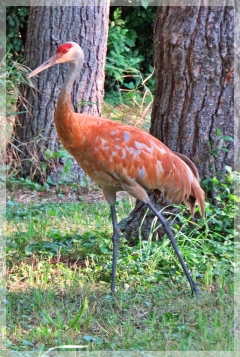
sandhill craneIn researching yesterday’s devotion, I learned some interesting things about Blaise Pascal. Along with building the first digital calculator (c. 1642), he invented the syringe, created the hydraulic press, and, along with Pierre de Fermat, formulated the fundamental principles of probability theory.

It was when reading about Pascal’s Pensées, a compilation of notes and essays about Christian apologetics, that I saw mention of “Pascal’s Wager.” Curious as to what gambling and Christianity had in common, I read on. Perhaps it was Pascal’s interest in probabilities that led him to present the choice between belief and disbelief in God as a coin toss but, instead of betting on heads or tails, the bet is about God’s existence. After pointing out that making a wager is not optional, he asked how we’d bet. In mathematical terms, Pascal explains that, if God exists, and you bet that He does, you have infinite gain (eternal life) but, if you bet He doesn’t, you have infinite loss (loss of paradise and an eternity in hell). If, however, God doesn’t exist and you bet that He does, you lose nothing and, if you win, you gain nothing. Simply put, a winning bet on God pays off far better than a winning bet against Him and, if the bettor happens to be wrong, the one who’s bet against God has far more to lose than the one who’s bet on God.

If it should turn out that God doesn’t exist, Pascal says to the one who made a losing bet on Him: “Now, what harm will befall you in taking this side? You will be faithful, humble, grateful, generous, a sincere friend, truthful. Certainly you will not have those poisonous pleasures, glory and luxury; but will you not have others? I will tell you that you will thereby gain in this life, and that, at each step you take on this road, you will see so great certainty of gain, so much nothingness in what you risk, that you will at last recognise that you have wagered for something certain and infinite, for which you have given nothing.”

Summarizing, Pascal says: “According to the doctrine of chance, you ought to put yourself to the trouble of searching for the truth; for if you die without worshipping the True Cause, you are lost. ‘But,’ say you, ‘if He had wished me to worship Him, He would have left me signs of His will.’ He has done so; but you neglect them. Seek them, therefore; it is well worth it.”

Pascal’s wager does not prove the existence of God and wasn’t intended to do so; it simply tells us that belief in God is the best choice! There are, however, valid Christian criticisms of Pascal’s Wager. True faith doesn’t come from probability theory or a cost/benefit analysis; it comes from being born again. Pascal’s Wager seems to base belief in God on a risk and reward system that speaks of a heavenly reward without mentioning loving Jesus, obedience, or bearing fruit. His wager also fails to mention that there actually is a cost to following Jesus—one that is not always easy to pay. Whether we’re betting or choosing, the one thing about which we can’t argue is Pascal’s very first premise—the choice is not optional. We cannot sit this one out, the consequences are eternal, and the stakes are high.

Belief is a wise wager. Granted that faith cannot be proved, what harm will come to you if you gamble on its truth and it proves false? If you gain, you gain all; if you lose, you lose nothing. Wager, then, without hesitation, that He exists. [Blaise Pascal]

Then, calling the crowd to join his disciples, he said, “If any of you wants to be my follower, you must give up your own way, take up your cross, and follow me. If you try to hang on to your life, you will lose it. But if you give up your life for my sake and for the sake of the Good News, you will save it. And what do you benefit if you gain the whole world but lose your own soul? Is anything worth more than your soul? [Mark 8:34-37 (NLT)]

Copyright ©2021 jsjdevotions. All rights reserved.

TOO DEFINITE FOR LANGUAGE

We know that a person is not justified by works of the law but through faith in Jesus Christ, so we also have believed in Christ Jesus, in order to be justified by faith in Christ and not by works of the law, because by works of the law no one will be justified. [Galatians 2:16 (ESV)]

You see that a person is justified by works and not by faith alone. [James 2:24 (ESV)]

Siberian reindeerChristianity seems to be full of paradoxes. We’re saved by faith and not by works but we can’t have faith without works. As for grace and obedience—it’s God’s grace not our obedience that saves us. But, what initially sounds like a free pass isn’t because the saved are expected to have grace-fueled obedience! It’s easy to get confused when we read only isolated verses in Scripture. Rather than inconsistent or even contradictory concepts, however, faith, works, grace and obedience are complementary and interrelated. Perhaps some of the confusion comes from our language rather than our doctrine.
I think back to an exchange between two characters in Perelandra by C.S. Lewis. When the character Ransom is at a loss for words while trying to explain a concept, his companion says, “I realize it’s all too vague for you to put into words.” Looking at his friend sharply, Ransom replies, “On the contrary, it is words that are vague. The reason why it can’t be expressed is that it’s too definite for language.” Faith, works, grace, and obedience are so distinct and yet so interconnected in Christian doctrine that it’s a pity we don’t have a wider Christian vocabulary.

According to The Washington Post, there really are at least fifty Inuit words for snow that describe everything from a soft falling snow to a wet snow that will ice a sled’s runners. Along with having a multitude of words related to snow and ice, the Sami people of northern Scandinavia and Russia have over 1,000 words for reindeer. They have a different word for each year of a male reindeer’s life and I suspect they have one that would perfectly describe the reindeer in today’s picture. It’s done through something linguists call “polysynthesis,” which allows speakers to encode a huge amount of information into one word by plugging various suffixes onto a base word so that one word can encompass a whole sentence

Language evolves to meet the ideas and needs of the people speaking it. If the Sami people can use a single word like sietnjanjunni to describe a reindeer with the hair nearest to its nostrils having a different color than the one you’d expect from the color of the rest of its hair, we should be able to come up with something for the combined concepts of faith, works, grace, and obedience. Using a little polysynthesis, we could try for the whole shebang and come up with “faithorkobegracience,” but it still wouldn’t capture these concepts because we’re talking of something far greater than reindeer, snow, or ice.

We are finite beings trying to capture an infinite, omnipotent, omniscient, and omnipresent being with words. No word in any language can come close to the immensity of all that is encompassed in our salvation. We are saved by grace through faith but true faith is obedient and obedient faith leads to works. Simply put, it is our obedience and works that reveal the authenticity of our faith!  We will just have to continue as we have for centuries: by having faith, doing His works, being saved by grace, remaining obedient to His commands and walking the way Jesus walked.

And by this we know that we have come to know him, if we keep his commandments. … By this we may know that we are in him: whoever says he abides in him ought to walk in the same way in which he walked. [1 John 2:3,5b-6 (ESV)]

But someone will say, “You have faith and I have works.” Show me your faith apart from your works, and I will show you my faith by my works. [James 2:18 (ESV)]

Copyright ©2021 jsjdevotions. All rights reserved.

CASTING CARES

Cast your cares on the Lord and he will sustain you; he will never let the righteous be shaken. [Psalm 55:22 (NIV)]

Cast all your anxiety on him because he cares for you. [1 Peter 5:7 (NIV)]

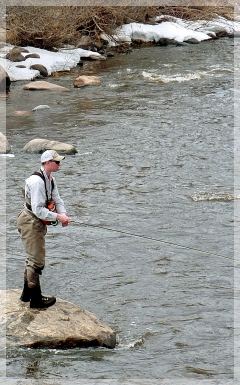
yampa river fishingEven though I’m not an angler, whenever I read about casting my cares, I picture using a fly rod and casting my concerns out into the river so the fast moving water can carry them away to God. When we lived in the mountains, one of our favorite walking trails ran alongside the Yampa River and we often paused to watch as the fishermen (and women) cast their lines into the water. Fly fishing is all about the art of casting and a bit like poetry in motion. It was fascinating to watch an angler flick the rod back and forth, gradually increasing the speed of the motion, before finally casting the line forward so the fly would land in the perfect spot. Masquerading as a water insect, the fly is made of things like fur, feathers, fabric and tinsel and secured to a hook. Rather than purchasing flies, many fishermen spend hours tying their own flies. Not wanting to lose either fly or fish in the river, anglers use at least five different knots to securely connect the reel to the backing, fly line, leader, and tippet before finally tying on the fly.
There is an art to fly casting and fly fishermen spend years perfecting their technique, especially since no one cast is ideal for every situation. Christians, however, aren’t casting flies—they’re casting things like fear, problems, anxiety, and worry—the cares every believer faces in this fallen world. While there’s no special technique to casting those cares, like fly fishing, it’s often easier said than done. Just as a fly fisherman may labor over tying his flies and fret about choosing the perfect ones for the day’s conditions, we often spend a great deal of time focusing on our worries rather than casting them into God’s river. Just as the fisherman ties those five knots to keep from losing his fly, we tie ourselves up in knots when we’re reluctant to give up our cares to God!

The anglers casting their lines in the river want to catch and land a fish but, when we cast our cares, we want to bring in an empty line. They catch, we release! Our cares are not for God to take away from us but for us to release to Him. Because the flies on the end of a fishing line are nearly weightless and our cares often seem as heavy as boulders, casting cares seems harder than casting a fly in the river. Nevertheless, it can be done and is far more rewarding than a trophy-sized trout.

Fishermen go to the river with an empty creel and hope to return home with a full one but we go to God with a creel full of cares so we’ll end up with an empty one. Our creels may be empty but we’ll be filled with the peace of God!

He that takes his cares on himself loads himself in vain with an uneasy burden. I will cast my cares on God; he has bidden me; they cannot burden him. [Joseph Hall]

Peace I leave with you; my peace I give you. I do not give to you as the world gives. Do not let your hearts be troubled and do not be afraid. [John 14:27 (NIV)]

Do not be anxious about anything, but in every situation, by prayer and petition, with thanksgiving, present your requests to God. And the peace of God, which transcends all understanding, will guard your hearts and your minds in Christ Jesus. [Philippians 4:6-7 (NIV)] 

Copyright ©2021 jsjdevotions. All rights reserved.

THE LORD’S VICTORY

And he said to him, “Please, Lord, how can I save Israel? Behold, my clan is the weakest in Manasseh, and I am the least in my father’s house.” And the Lord said to him, “But I will be with you, and you shall strike the Midianites as one man.” [Judges 6:15-16 (NLT)]

Because the Midianites were raiding and plundering Israel, we meet Gideon hiding in a large vat. Rather than threshing wheat in the open air so the wind could blow away the chaff, he was cautiously working in the bottom of a secluded wine press when an angel of the Lord delivered a message to the timid man. Addressing Gideon as a mighty warrior, the unlikely hero demurred and claimed to be the least worthy of the weakest clan in the tribe of Manasseh.

After a fair amount of hesitation and questions, the reluctant warrior eventually gathered an army of 32,000 to battle the Midianites, a force of 153,000 men. With the odds against Gideon being four to one, I imagine he was wondering where to find more men when God told him that he had too many! He was instructed to send home all those who were afraid. After 22,000 men departed, God told Gideon there still were too many men. He was to separate them by the way they drank water from a stream—whether they cupped the water with their hands and lapped it up or knelt down to drink from the stream. Only the 300 warriors who drank from their hands were allowed to remain. With an overwhelming ratio of 450 Midianites to one Israelite, Gideon’s defeat seemed inevitable. Nevertheless, while Gideon may have been fearful, he never lost faith. Gideon’s few good men crushed the Midianites. The nomadic tribe never recovered and there was peace in the land for the next forty years.

We might wonder why God chose Gideon—the least of the least—and why He didn’t provide him with as large an army as possible to ensure an Israelite victory. The odds were bad enough when Gideon started with 32,000 men but, with only 300, victory seemed impossible. But that was God’s point! When the angel of the Lord entered Gideon’s life, the Israelites had been oppressed by the Midianites for seven years because they “did evil in the Lord’s sight.” [Judges 6:1] They’d worshipped pagan gods, built an altar to Baal, and erected an Asherah pole. Gideon’s first task, prior to leading the men into battle, had been to destroy those pagan symbols. When Baal did not retaliate, it became clear how worthless the false god was. But, did the people understand how powerful the Lord was?

God chose Gideon, the youngest son of the weakest clan, and only a handful of men because their victory against absolutely impossible odds made it abundantly clear to all that the victory didn’t belong to Gideon or his soldiers; it belonged only to God! Rather than looking at this story as an example of what just a few men (or women) can do, we should look at it as an example of what God can do just with a few! He is, after all, the hero in every story!

Selfish and proud creatures that we are, we tend to blame God when things go wrong but remove Him of any responsibility for our successes. In Gideon’s story, God eliminated any possibility that the Israelites’ strength, skill, or valor had anything to do with their triumph. Victory was the Lord’s! God was the hero of Gideon’s story; let Him continue to be acknowledged as the hero of ours, as well!

The horse is made ready for the day of battle, but the victory belongs to the Lord. [Proverbs 21:31 (ESV)]

Copyright ©2021 jsjdevotions. All rights reserved.

IT’S TERMINAL

Better to spend your time at funerals than at parties. After all, everyone dies—so the living should take this to heart. … A wise person thinks a lot about death, while a fool thinks only about having a good time. [Ecclesiastes 7:2,4 (NLT)]

ghost bikeIt’s often said that there are no atheists in foxholes. This maxim traces its beginnings back to 1914 and World War 1 when an English newspaper quoted a chaplain at a memorial service for a fallen soldier: “Tell the Territorials and soldiers at home that they must know God before they come to the front if they would face what lies before them. We have no atheists in the trenches. Men are not ashamed to say that, though they never prayed before, they pray now with all their hearts.” When we joined our northern church, it was during the Viet Nam War. I remember a young man in our new member class who’d drawn a low number in the draft lottery. Expecting to be in combat within the year, he confessed wanting to “get right” with God before that time came. Apparently, even the threat of a foxhole is enough to cause some people to rethink their relationship with the Almighty.
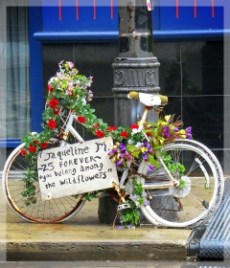
Whenever we pass a roadside memorial or ghost bike like the one in today’s picture, I’m reminded of the precariousness of life. There’s a memorial at a corner near us for a young man who died there several years ago. Decorated seasonally by family and friends, it’s a poignant reminder of how unexpectedly a life can be extinguished and how much he is missed. Unlike the fellow in our church class, that young man, the victim of a drunk driver who ran a red light, didn’t have a low lottery number to warn him how near to death he was.

“A funeral provides an indispensable perspective on the universally terminal condition,” said the Reformation Study Bible notes for today’s verses from Ecclesiastes 7. Indeed, everyone is born with the incurable disease of death. I’m of an age where the many notes of condolence I’ve written these last few months make me think I should buy sympathy cards in bulk. These are dark thoughts for an early spring day, yet far too many of us choose to ignore our inevitable fate. Death is the one appointment that none of us will miss. While we have little control over the when of that day, we do have control over how we choose to prepare for the inevitable.

In both this world and the next, what happens after we die depends entirely on what we do now. Once laid out in the mortuary, it’s too late to write a will or accept Jesus. When we’re placed in a casket, we won’t be able to mend fences or make amends and we’ll have missed the opportunity to get right with God. By the time we’re on the other side of the sod or turned to ash in a crematorium, we can’t express our love and forgiveness or decide to accept God’s saving grace.

The problem with foxhole conversions, of course, is that once out of the trenches, they rarely last. Moreover, if we don’t make it out alive, by waiting until the very end to accept Jesus, we’ve missed out on the abundant Kingdom life He offers that begins while we’re here. Getting right with God long before we enter either foxhole or hospice care seems to be the wiser choice. The good news for the saved is that dying doesn’t mean departing from the land of the living. For those who know Jesus, death means departing from the land of the dying for the land of the living.

Depend upon it, your dying hour will be the best hour you have ever known! Your last moment will be your richest moment, better than the day of your birth will be the day of your death. It shall be the beginning of heaven, the rising of a sun that shall go no more down forever! [Charles Spurgeon]

And just as each person is destined to die once and after that comes judgment, so also Christ was offered once for all time as a sacrifice to take away the sins of many people. He will come again, not to deal with our sins, but to bring salvation to all who are eagerly waiting for him. [Hebrews 9:27-28 (NLT)]

Copyright ©2021 jsjdevotions. All rights reserved.

TUMBLEWEED AND COTTONWOODS

This is what the Lord says: “Cursed are those who put their trust in mere humans, who rely on human strength and turn their hearts away from the Lord. They are like stunted shrubs in the desert, with no hope for the future.” [Jeremiah 17:5-6 (NLT)]

Russian thistle - tumbleweed

Russian thistle – tumbleweed

Because Judah had trusted in false gods and foreign alliances rather than God, Jeremiah pronounced God’s judgment on the southern kingdom. After saying their sins were as if they’d been etched on their stony hearts with a diamond-pointed iron chisel, he compared them to a stunted shrub. That shrub may have been the tumble thistle, a common plant found in Israel’s grasslands. I’ve never been to Israel but I’ve seen a similar plant in the western states: the Russian thistle, commonly known as tumbleweed or wind witch. Both kinds of weeds begin with flowers on a spiny plant. As their seeds mature, the entire plant dries and breaks from its roots at the soil surface. Shaped like a ball and rootless, the wind blows and rolls these plant “skeletons” across the prairie.

In stark contrast to a stunted shrub, Jeremiah likened those who trust in the Lord to deep-rooted trees planted by the riverbank—trees untroubled by heat or drought. I’m reminded of our hardy American cottonwoods found near rivers, lakes, and irrigation ditches throughout the nation. The fastest growing trees in North America, cottonwoods can grow to over 100-feet tall, with a trunk diameter of 6-feet, and a leaf canopy over 75-feet wide. Instead of being blown by the wind like tumbleweed, the cottonwood’s size makes it an excellent windbreak. When we trust in ourselves and false gods, we’ll be blown every which way like a tumbleweed but, when we trust in God, we can withstand life’s headwinds like a cottonwood.

Growing on the water’s edge, cottonwoods typically survive adverse conditions and prairie fires. Few plants can survive the scorching heat, scant rainfall, relentless winds, blowing sand and poor soil of New Mexico’s White Sands National Monument but the deeply rooted Rio Grande cottonwood thrives there! When we trust in God and sink our roots deep in His word, like the cottonwood, we will flourish and have a full life, even in harsh conditions.

Dubbed “the pioneer tree,” the cottonwood was a welcome sight for settlers crossing the plains because it meant shade from the heat, fuel for a fire, and a source of water. Those same settlers considered tumbleweeds a menace. They leeched nutrients from the soil, crowded out forage grass and, being highly flammable when dry, could become flying fireballs and spread a grass fire. Just as pioneers found refuge in the cottonwood, those who trust in the Lord find refuge in Him. Those who trust only in man are as worthless as a noxious weed and as dangerous as burning tumbleweed.

When we put our trust in man, false gods, or empty ideologies, we’re no different than a tumbleweed: dry and rootless, rolling in whatever direction the wind is blowing, and with no hope for the future. When we trust in the Lord, we’re like the cottonwood: deeply rooted in His word, fed by His living water, and able to survive, even thrive, in the bleakest of situations.

But blessed are those who trust in the Lord and have made the Lord their hope and confidence. They are like trees planted along a riverbank, with roots that reach deep into the water. Such trees are not bothered by the heat or worried by long months of drought. Their leaves stay green, and they never stop producing fruit. [Jeremiah 17:7-8 (NLT)]

Copyright ©2021 jsjdevotions. All rights reserved.