HE HAS HIS PURPOSE

“Why doesn’t the Almighty bring the wicked to judgment? Why must the godly wait for him in vain? … Then the Lord answered Job from the whirlwind: “Who is this that questions my wisdom with such ignorant words? … You are God’s critic, but do you have the answers?” [Job 24:1,38:1-2,40:2b (NLT)]

Like Job, Richard Wurmbrand suffered unspeakably horrific circumstances and certainly had reason to ponder God’s purpose in his troubles. An evangelical minister in Romania, he endured more than eight years of Communist imprisonment and torture before being released. He immediately returned to his underground church ministry, was re-arrested, and sentenced to another 25 years in prison. After six more years of imprisonment, Wurmbrand was freed under an amnesty program and again returned to his ministry. When the Communist regime accepted a $10,000 ransom for him, Wurmbrand left his homeland and became a voice for persecuted Christians. When testifying before a U.S. Senate Subcommittee in 1966, he stripped to the waist to show the 18 deep scars that covered his torso—undeniable evidence of the brutal torture he and others endured at the hands of their Communist captors.

In his 100 Prison Meditations, Wurmbrand, who knew suffering first-hand, tells a story about Moses, who was meditating near a well. When a traveler stopped to drink from the well, the man failed to notice his purse fall onto the ground. After his departure, a second man came along. Spotting the purse, he picked it up, and went on his way. Later, a third wayfarer arrived who, after drinking from the well, took a nap in the shade.

When the first man discovered his purse was missing, he returned to get it at the well. Upon seeing the sleeping man, he woke him and demanded his money. When the third man pled his innocence, the first man became furious and killed him.

Speaking to God, Moses explained that it was times like that, when evil and injustice seemed to reign, that caused men not to believe in the Almighty. “Why,” he asked, “should the first man, who merely lost his purse, become a murderer?  Why should the second man get a purse full of gold without having worked for it? And why should the third completely innocent man be slain?”

God responded that once, and only once, He would give an explanation for all that happened. God explained that the first man was the son of a thief and the purse he lost was filled with gold stolen from the father of the second man. By taking the purse, the second man only took what was rightfully his. The third man, while innocent of stealing the purse, was a murderer who’d gotten away with his crime and had finally received the punishment he deserved. God finished His explanation by saying, “In the future, believe that there is sense and righteousness in what transpires even when you do not understand.”

For those of us who’ve never endured the misfortunes of Job or Wurmbrand, it’s easy to say that all things work for good until, of course, the things that happen are terrible! Nevertheless, Wurmbrand’s story came from a man who suffered in a horrific way because of his faith and knew first-hand how unfair and painful life can be. He also knew that all things are not good—there is nothing good about torture, oppression, slave labor camps or persecution. Nevertheless, Wurmbrand also knew that God, in His own time and own way, can take bad things and mix them together in such a way that they bring about something better—a better that is not dependent upon man’s understanding.

Rather than ask why, as did Job, let us believe in a God who loves us, who is at large and in charge, who has His reasons for all that happens, and who will achieve His purpose. “And what is that purpose?” we ask. Pastor Adrian Rogers answers, “To make us like Jesus. To be conformed to the image of His Son. There is no higher good than to be like the Lord Jesus Christ.”


And we know that God causes everything to work together for the good of those who love God and are called according to his purpose for them. [Romans 8:28 (NLT)]

Copyright ©2021 jsjdevotions. All rights reserved.

NATIONAL DAY OF PRAYER – 2021

I urge, then, first of all, that requests, prayers, intercession and thanksgiving be made for everyone – for kings and all those in authority, that we may live peaceful and quiet lives in all godliness and holiness. [I Timothy 2:1-2 (NLT)]

Without God, there is no virtue because there’s no prompting of the conscience. And without God, democracy will not and cannot long endure. If we ever forget that we are One Nation Under God, then we will be a nation gone under. [Ronald Reagan]

In 1775, the Continental Congress proclaimed that “a day of public humiliation, fasting, and prayer” be created and, since then, a president has called for over 140 national days of prayer. In 1795, for example, George Washington declared a day of public thanksgiving and prayer and, in 1863, Abraham Lincoln signed a resolution making April 30 a day of fasting and prayer. It was in 1952, during the Korean War, that Reverend Billy Graham challenged our nation’s leaders with these words: “What a thrilling, glorious thing it would be to see the leaders of our country today kneeling before Almighty God in prayer. What a thrill would sweep this country. What renewed hope and courage would grip the Americans at this hour of peril.”

In response to Graham’s challenge, a bill proclaiming an annual National Day of Prayer “on which the people of the United States may turn to God in prayer and meditation at churches, in groups, and as individuals” was unanimously passed by both houses of Congress. President Truman signed the bill requiring each subsequent president to proclaim a National Day of Prayer on the date of his choice. The original law was amended in 1988 when the first Thursday in May was designated as our nation’s National Day of Prayer.

The National Day of Prayer isn’t just a “Christian only” holiday and people of all faiths are encouraged to put aside their differences to pray for our nation. The day’s purpose is to unite people of all religions in prayer and to renew respect for God. Over 40,000 prayer gatherings at churches, parks, mosques, synagogues, temples, courthouses, and schools are held on this day every year. Of course, even though the law doesn’t establish or mandate a religion, its constitutionality has been challenged several times. The day has been found legal because it simply acknowledges the role of religion in the United States and can be ignored if one so wishes.

”Lord, pour out your love, life, and liberty,” is this year’s prayer theme and, other than being sure to pray, there are no guidelines for the day’s observance. This past year has been an extremely challenging one for our nation—the lives and health taken by COVID-19, chaos in our capitol, political polarization, isolation from friends and family, on-line learning, business closures, working from home, immigration issues, a troubled economy, church services suspended, unemployment, and escalating racial tensions to name just a few. We could spend the entire day in prayer and not cover them all. Regardless of your politics, I think we all can agree that divine intervention is desperately needed if our nation is to heal. The president’s call to prayer on this day, however, is merely a symbolic gesture unless we collectively fall to our knees in heartfelt prayer! Let us pray, not just today but every day, for our nation.

It is our prayer today and throughout 2021 that the Spirit of the Lord, pour out, pour through us across America, to fill our lives, families, churches, workplace, education, military, government, arts, entertainment and media, with Biblical, not cultural, not worldly, but Spirit-empowered, Spirit-filled LOVE, LIFE and LIBERTY as designed and defined by our Creator and Savior. [Kathy Branzell, President, National Day of Prayer Task Force]

What joy for the nation whose God is the Lord, whose people he has chosen as his inheritance. … We put our hope in the Lord. He is our help and our shield. In him our hearts rejoice, for we trust in his holy name. Let your unfailing love surround us, Lord, for our hope is in you alone. [Psalm 33:12,20-22 (NLT)]

Copyright ©2021 jsjdevotions. All rights reserved.

WITH JUST A WORD

I tell you the truth, I haven’t seen faith like this in all Israel! [Matthew 8:10]

Coming from a career in the military where, as the commanding officer, his word was law, my brother-in-law had a rude awakening when he retired from the Navy and returned to civilian life. If, at his word, a squadron of planes could be on the runway and ready for flight at 0700 sharp, he didn’t understand why the cable man or plumber couldn’t be counted on to arrive on time (let alone, at all)! Unfortunately, the power and authority he had as a commanding officer didn’t transfer to his new role as a private citizen.

Like my brother-in-law, the Roman centurion who asked Jesus to heal his servant was used to the power of his words. When the centurion spoke, he spoke with the emperor’s authority and he knew he didn’t need to be present to have his orders carried out by the 100 men he commanded. Recognizing Jesus as more than an itinerant rabbi, the centurion knew that, when Jesus spoke, He spoke with God’s authority. Like the centurion, Jesus didn’t need to be present to exercise His power—all that was needed was His command!

Typically, people were amazed by Jesus but, that time, Jesus was amazed by the centurion. Turning to the crowd around him, He commended the Gentile’s faith—saying he’d not seen so great a faith in the land. Reminding his listeners that the Kingdom of Heaven was open to everyone, both Gentile and Jew, He warned them that faith, rather than heritage, would determine attendance at the Messianic banquet and cautioned that some Israelites would not be there!

The only other time Scripture records Jesus’ amazement is when, after being scoffed and scorned in Nazareth, Jesus expressed amazement at his fellow Jews’ lack of faith. Mark tells us that was why Jesus could perform only a few healings (but no miracles) in his home town. The lack of miracles, however, doesn’t mean that Jesus didn’t have the power to perform them; it means that He chose not to do so in an atmosphere of unbelief. Rather than being subject to our faith, God acts in response to it! God’s power is unlimited but He will not force His blessings on those who don’t believe. Let us remember that the One who spoke the universe into existence is capable of far more than we can ask! The centurion had great faith in Jesus; we should follow his example!

And it is impossible to please God without faith. Anyone who wants to come to him must believe that God exists and that he rewards those who sincerely seek him. [Hebrews 11:6 (NLT)]

Jesus looked at them intently and said, “Humanly speaking, it is impossible. But not with God. Everything is possible with God.” [Mark 10:27 (NLT)]

Copyright ©2021 jsjdevotions. All rights reserved.

ALEXAMENOS

“I’ve said these things to you,” Jesus went on, “to stop you from being tripped up. They will put you out of the synagogues. In fact, the time is coming when anyone who kills you will suppose that they are in that way offering worship to God. They will do these things because they haven’t known the father, or me. But I have been talking to you about these things so that, when their time comes, you will remember that I told you about them.” [John 16:1-4 (NLT)]

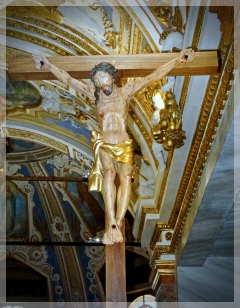
Locarno-Madonna del SassowIn any cathedral or art museum, we’ll find many pictures of Jesus and even rather graphic depictions of Him on the cross. None of them, however, tell us anything about His appearance because they were created long after His time. Still, in a world where we seem to memorialize everything with pictures, you’d think one of Jesus’ followers would have sketched Him while blessing the children, giving the Sermon on the Mount, or feeding the multitude! 1st century rabbis in Judah, however, vehemently objected to the depiction of human figures because the second commandment prohibited making a “graven image.” With its Jewish roots, this prohibition carried into the early church and inhibited early Christian art.


At first, Jesus was represented indirectly by symbols such as the peacock, lamb, dove, and anchor. One of the most common was the ichthus (fish) because the Greek word served as an acronym “Jesus Christ, Son of God, Savior.” While making the sign of the cross dated from sometime in the second century, because of its connection with the horrific death of criminals, the cross did not became a symbol of Christianity until the 4th century; crucifixes and other depictions of the crucifixion did not occur until the 6th.

One earlier depiction of Jesus’ crucifixion, however, does exist. Crudely scratched into a stone wall, it was discovered in 1857 during an excavation of the Paedagogiumon (a school for the training of slaves) on Rome’s Palatine Hill. Dating from around 200 AD, it shows a man (or boy) worshiping a figure on a cross; the figure, however, has the head of an ass. The inscription reads, “Alexamenos worships his God.” This derisive graffiti gives us an idea of the way early Christians were ridiculed for worshiping a man who had been executed as a criminal.

Along with claims of onolatry (donkey worship), the early Christians had to deal with several other disparaging, malicious, and false accusations such as incest, cannibalism, and drinking the blood of infants. Roman orator Marcus Cornelius Fronto (c. 100-160) wrote that Christians were “initiated by the slaughter and the blood of an infant” and that Christianity was “foolish” because, “they worship a crucified man, and even the instrument itself of his punishment” and “are said to worship the head of an ass.”

This was the world—a world that misunderstood, slandered, ridiculed, hated and persecuted them—of the early Christians. And yet, they proceeded in faith and spread the gospel. I wonder how the 21st century church would do in similar circumstances! As for Alexamenos, the fellow mocked by that ancient graffiti—more graffiti was found on a wall in an adjacent room. In Latin it said, “Alexamenos is faithful.”  In the face of opposition, we must be the same!

Think back on those early days when you first learned about Christ. Remember how you remained faithful even though it meant terrible suffering. Sometimes you were exposed to public ridicule and were beaten, and sometimes you helped others who were suffering the same things. You suffered along with those who were thrown into jail, and when all you owned was taken from you, you accepted it with joy. You knew there were better things waiting for you that will last forever. So do not throw away this confident trust in the Lord. Remember the great reward it brings you! [Hebrews 10:32-35 (NLT)]

Copyright ©2021 jsjdevotions. All rights reserved.

IN ALL CIRCUMSTANCES

Be thankful in all circumstances, for this is God’s will for you who belong to Christ Jesus. [1 Thessalonians 5: 18 (NLT)]

With his words, the Apostle Paul doesn’t give us any exceptions—we are to give thanks in all circumstance (rather than some or most and certainly not just in the ones we like)! Right now, however, I’m not feeling particularly thankful. In the span of a week’s time, two dear friends died—men that were like brothers to us. Distance and COVID meant that we couldn’t even grieve in person with their families. As I sit here tearfully, I realize that in the past eighteen months a dozen people who were important parts of our lives are no longer with us. Grief weighs heavy on my heart. When I consider my prayer list and the people on it who are struggling with the devastating aftereffects of a stroke or suffering from cancer, Parkinson’s, chronic pain, dementia, and heart failure, I realize that number will soon grow. I want to stomp my feet and shout at God that it’s not fair and ask Him how He expects me to give thanks!

As a Christian, I know I should be in a permanent state of thanksgiving for God’s grace in my salvation and I am thankful for that. It’s things like the suffering and loss in life that pose the problem for me. I should be reassured by the words of Romans 8:28 that, “We know that God causes everything to work together for the good of those who love God and are called according to his purpose for them.” In theory, I know that even in the worst of circumstances, God can take a bad thing and make it work for a good purpose. I know He is in full control of all of life’s happenings and that He can put all of those horrible events together to achieve a beautiful God-designed purpose. Nevertheless, that knowledge is of little comfort to those who mourn. Finding comfort in Paul’s words is a great deal harder than repeating them.

That David could say he was “worn out from sobbing” and his vision was “blurred from grief,” [Psalm 6:7-6] tells me that neither grief nor calling out to God in sorrow means a loss of faith; sorrow is an unavoidable part of life. One thing that frequently keeps us from giving thanks in our grief is that pesky question of “why?” I’ve written enough about Job to know that I have no business asking why and that I’ll never know the answer. Yet, even knowing God’s reasons wouldn’t take away the sense of loss or make the grief disappear.

Where do we find the ability to give thanks? Perhaps by looking more closely at the Apostle’s words. Paul tells us to be thankful in everything not for everything. While there’s a fine line between the two, we don’t have to be thankful for things like heart attacks, strokes, car accidents, COVID, or cancer but we do need to have a grateful heart in the midst of those afflictions.

Giving thanks in all circumstances requires a change of heart. Without that change, we might stop crying, start smiling, and even laugh at times but something sour will begin growing in our hearts—bitterness, anger, resentment, or self-pity. Giving thanks is the only way out of the pit of grief; yet it seems impossible until I remember the simple truth that God is good. Regardless of the circumstances, He remains the same loving, wise, and good God that He always has been.

Pauls’ admonition to give thanks in all circumstances follows two other directives—to rejoice always and to pray continually. In prayer, I asked the Spirit for guidance, strength and peace and then listed the names of those for whom I mourn. Thinking of each one by name, I rejoiced in the privilege of having those beautiful people in my life—to have talked, worked, agreed, and disagreed with them—to have touched and been touched by them—to have both taught and learned from them—to have shared good times and bad, gain and loss, secrets, sorrow, and laughter with them—to have loved and been loved by them. As I thanked God for the blessing of bringing each and every one them into my life, I found that I am, indeed, thankful in even this circumstance!

Give thanks to the Lord, for he is good! His faithful love endures forever.… You are my God, and I will praise you! You are my God, and I will exalt you! Give thanks to the Lord, for he is good! His faithful love endures forever.  [Psalm 118:1, 28-29 (NLT)]

And let the peace that comes from Christ rule in your hearts. For as members of one body you are called to live in peace. And always be thankful. [Colossians 3:15 (NLT)]

Copyright ©2021 jsjdevotions. All rights reserved.

WHAT REASON? (Part 1)

If you obey my decrees and my regulations, you will find life through them. I am the Lord. [Leviticus 18:5 (NLT)]

Ten COmmandments windowThe Ten Commandments are the foundation of both Jewish and Christian principles, conduct, and accountability, but they are just ten of the 613 mitzvot or commandments given to the Jewish people. In light of the big ten, many of those commands, such as using accurate scales and weights and fulfilling our promises make perfect sense as do prohibitions about speaking derogatorily of others or standing idly by if another person’s life is in danger. Moreover, laws regarding boundary markers, evidence, assessing property damages, and not perverting justice or accepting bribes certainly were necessary in a new nation. Some laws, like the ones regarding latrine placement, covering excrement, and making a guard rail around a flat roof seem reasonable from a health and safety viewpoint. Other laws may have served as a way to separate the Jews from their pagan neighbors. Perhaps it was because the Hittites, Elamites, and Sumerians were clean-shaven and the Egyptians often were clean shaven or had shaped goatees that Jewish men were not to trim the hair on their temples or shape their beards. Many laws, such as the intricate laws of sacrifice, the blue tassels on hems, reciting the Shema twice a day, and saying a blessing after meals, were related to worship and God.

Many of those laws, however, seem inexplicable. What, for example, makes land animals that don’t chew the cud and have completely split hooves (like the pig) unacceptable food? Why eat only fish with fins and scales but no shellfish or mollusks? If locusts can be eaten, why not ants? Why can’t linen be woven with wool? Why can’t a Nazarite eat grapes or raisins or cut his hair and why did every sacrifice require salt?

As I looked through these ancient laws and tried to understand God’s reasoning behind them, I missed the point. The first rule God made was the simple one he gave to Adam and Eve: don’t eat from that tree. Although He warned that death would be the result of disobedience, God didn’t explain His reasons for the prohibition because obedience to God isn’t supposed depend upon human reasoning. If we have to understand before we obey, rather than obedience, it becomes agreement and dependent on us! God, however, doesn’t require our understanding or agreement; He requires our obedience.

Abraham didn’t know where he was going when he packed up his family nor did he question God’s reasoning when he placed his son on a sacrificial altar. Building an enormous ark on dry land probably made no sense to Noah, wearing out his troops by marching around Jericho for a week seemed a questionable battle plan to Joshua, and Mary didn’t understand God’s reasoning behind her pregnancy; nevertheless, they all obeyed without understanding.

Obedience shows reliance and trust—an acceptance that God knows more than we can ever know or understand—that God is God and we are not! I don’t know God’s reasoning behind those mitzvot nor do I need to. It’s enough that God made them and expected the Israelites to abide by them. The only thing we must understand about God’s commands is that they are divinely decreed and, as such, are to be unquestionably obeyed. Rather than leading us away from God’s blessings, obedience will lead us to them.

Loving God means keeping his commandments, and his commandments are not burdensome. [1 John 5:3 (NLT)]

Trust in the Lord with all your heart; do not depend on your own understanding.  Seek his will in all you do, and he will show you which path to take. [Proverbs 3:5-6 (NLT)]

Copyright ©2021 jsjdevotions. All rights reserved.