WHAT’S YOUR GIFT

There are different kinds of spiritual gifts, but the same Spirit is the source of them all. There are different kinds of service, but we serve the same Lord. God works in different ways, but it is the same God who does the work in all of us. [1 Corinthians 12:4-6 (NLT)]
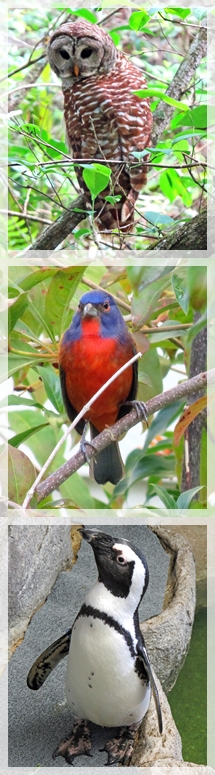
barred owl - painted bunting - penguin

When I was writing about the peacock’s unpleasant scream yesterday, I pictured him complaining to the owl that the wren has a nicer voice. The wren chirped back her complaint that, unlike the peacock, she was small and nondescript. Hearing them, the penguin complained about his plain black and white feathers but the colorful painted bunting countered that she was unable to swim. The pelican joined the grumbling and whined that he couldn’t flit from flower to flower like the hummingbird who then expressed jealously over the pelican’s large bill. When the bald eagle protested not having long legs like the ostrich and the ostrich expressed envy at the eagle’s ability to soar high in the sky, the wise owl hooted at them all to be quiet.

Unlike the other birds, the owl did not grumble about what many would consider his shortcomings: his dull color, asymmetrical ears, and farsightedness. Explaining that his dull color gives him camouflage, the lopsided ears allow him to locate prey at night, and his farsightedness makes him an excellent hunter, he told the other birds to be thankful for their gifts. He reminded each bird of what made it special: the peacock’s beautiful tail, the wren’s ability to sing and trill, the penguin’s powerful flippers and streamlined body, the bunting’s unique coloring, the pelican’s skill at diving from heights of 30-feet, the hummingbird’s capability of flying backwards, the eagle’s eyes that can spot a rabbit two miles away, and the ostrich’s gift of running faster than any other bird. Rather than complaining about what they didn’t have, they should appreciate their own unique God-given gifts and use what they were given with wisdom, joy and thanksgiving.

Like the birds, we too have gifts: both the talents we were given at birth and the spiritual gifts we received from the Holy Spirit. Those talents and gifts are as unique as a peacock’s tail or the wren’s song. Some gifts, like the strong legs of an ostrich or a pastor’s inspired preaching are rather obvious. Others, like the owl’s lopsided ears or the healing embrace of someone gifted with empathy are less apparent. Rather than complain, as did the birds, we should take inventory of our many gifts and talents, appreciate and develop them, and use them enthusiastically and wisely to glorify God. Let’s appreciate what we have and accept that there will always be some things, like singing or soaring, that are best left to others.

Our purpose should be to discover the gifts He has given us and to use those gifts faithfully and joyfully in His service, without either envying or disparaging the gifts we do not have. [John MacArthur]
A spiritual gift is given to each of us so we can help each other. … It is the one and only Spirit who distributes all these gifts. He alone decides which gift each person should have. [1 Corinthians 12:7,11 (NLT)]

Copyright ©2018 jsjdevotions. All rights reserved.

KING OF KINGS

In my vision at night I looked, and there before me was one like a son of man, coming with the clouds of heaven. He approached the Ancient of Days and was led into his presence. He was given authority, glory and sovereign power; all nations and peoples of every language worshiped him. His dominion is an everlasting dominion that will not pass away, and his kingdom is one that will never be destroyed. [Daniel 7:13-14 (NIV)]

Church of our Lady - Netherlands

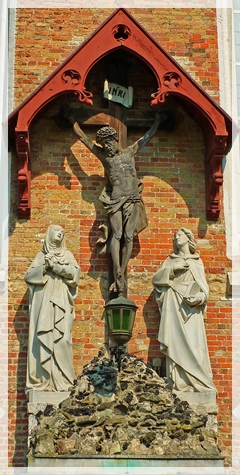
As we left the church, my friend asked “What do the letters INRI above the cross mean?” Unable to say it in Latin, I replied that it was an abbreviation of the words, “Jesus of Nazareth, the King of the Jews.” In Latin, these words would be Iesus Nazarenus Rex Iudaeorum. When someone was crucified, it was usual to affix a sign to the cross declaring the cause of execution. Since the official charge against Jesus seemed to be that he’d challenged Roman rule by proclaiming himself the king of the Jews, Pilate had those words written in Latin, Greek and Hebrew. As Pilate phrased it, however, the words seem more of a title rather than an accusation. When the high priests asked that the sign be changed to read “He said, I am the King of the Jews,” Pilate refused.

Other than that dark day when He was crucified and the title “king of the Jews” was used with scorn and mockery by the soldiers and crowd, Jesus was referred to as “king of the Jews” only one other time: at the visit of the Magi when they asked, “Where is the one who has been born king of the Jews?” [Matthew 2:2] While most of Jesus’s countrymen didn’t acknowledge His identity, it was foreigners who recognized his sovereignty at His birth and a Roman governor who acknowledged His kingship at death.

Was Jesus the king of the Jews? A king’s supremacy is limited to his domain. The ruler of a nation, a king’s power is limited by his lifetime and the borders of his kingdom. He must defend his government from enemy nations and his regime from revolution. A king of the Jews would reign only over Judah’s territory and the children of Israel. When asked if He was king of the Jews, Jesus told Pilate that His kingdom was not of this world. Indeed, Jesus’s kingdom wasn’t limited to Judah and the Jews. Unlike earthly kingships, His reign is absolute, unbreakable, sacred, and everlasting. When God raised Jesus from the dead, He was given power over all of creation and all people on earth, not just the Jews of Judah. Pilate’s sign was wrong. Jesus wasn’t the “king of the Jews;” He was and still is the King of kings and the Lord of lords.

They will wage war against the Lamb, but the Lamb will triumph over them because he is Lord of lords and King of kings—and with him will be his called, chosen and faithful followers. [Revelation 17:14 (NIV)]

Copyright ©2018 jsjdevotions. All rights reserved.

AS WE GATHER TOGETHER

Moraine Hills State ParkWell, my brothers and sisters, let’s summarize. When you meet together, one will sing, another will teach, another will tell some special revelation God has given, one will speak in tongues, and another will interpret what is said. But everything that is done must strengthen all of you. [1 Corinthians 14:26 (NLT)]
If you’re like us, when you visit a new church, you tend to sit toward the back so you can view the rest of the congregation and see when people stand, sit or kneel. If communion is served, you probably anxiously look around to see how it is done in that church. After all, we  want to worship “correctly.”

While there often appears to be a certain way to worship in a particular parish or a specific denomination, there is no one right way for us in our personal worship of God. At a church we recently visited, a young woman spontaneously stepped into the aisle and did a beautiful dance during a rousing praise song. The dance was her worship gift to God (and a blessing for the rest of us). While I pray silently when the pastor offers a prayer, I often hear people around me quietly adding their own petitions during his prayers. Recently, while the rest of the congregation sat, a woman stood and clapped her hands in praise during one of the songs. Some people shout a loud “Amen!” or applaud during the sermon when they heartily agree with the pastor while others quietly nod their heads. At our northern church, one woman’s “Amen!” at the end of every prayer can be distinctly heard above the rest of the congregation. At our Florida church, some people kneel and pray at the altar rail following communion while others quietly return to their seats for prayer. Kneeling in prayer, making the sign of the cross, genuflecting before entering a pew, or raising our arms during a praise song are all ways various people worship but not the way all people do. Nevertheless, if those actions come from the heart, they all are the correct way!

One size does not fit all in clothing and certainly not when it comes to either private or communal worship. Worship is an intensely personal act; we each bring our own unique worship style with us wherever we go. Some of us are staid and reserved while others are ebullient and demonstrative. The joy of the more expressive worshippers often enriches the worship experience for all and I imagine God prefers an enthusiastic “Amen” to a half-hearted one any day! Whether alone or with others, the important thing is to come before our Lord with love, passion, praise and thanksgiving.

In spite of my words, I’ll continue to play it safe and sit in the back when visiting a new church. After all, no one wants to be the person in the front row left standing when everyone else is seated! Then again, God doesn’t mind so why should we?

Worship is an inward feeling and outward action that reflects the worth of God. [John Piper]

Happy are those who hear the joyful call to worship, for they will walk in the light of your presence, Lord. They rejoice all day long in your wonderful reputation. They exult in your righteousness. [Psalm 89:15-16 (NLT)]

Copyright ©2018 jsjdevotions. All rights reserved.


BLOOD AND GUTS

For the life of the body is in its blood. I have given you the blood on the altar to purify you, making you right with the Lord. It is the blood, given in exchange for a life, that makes purification possible. [Leviticus 17:11-12 (NLT)]

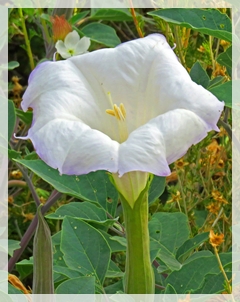
sacred daturaFor most of us, the meat we purchase arrives at the grocery store prepackaged. We’re not used to seeing animals slaughtered, skinned or butchered and, unless we’re phlebotomists, rarely see large amounts of blood. As a result, much of Leviticus makes for rather gory reading since the temple, a place of worship, also served as a ritual slaughterhouse. Perhaps it’s my vegetarian sensibilities but, when the Bible refers to the pleasing aroma of sacrifice, I wince when thinking of the stench of dried blood and burnt meat.

Biblical sacrifices go as far back as Cain and Abel but it is in Leviticus that we read of the sacrifices God required of the Israelites. The book gives complicated instructions for each of the sacrificial rituals: everything from the kind of animal offered and the draining of its blood to splashing that blood around the altar and what to do with the meat. Nowadays, these bizarre rites seem sickening and gruesome. Then again, perhaps that is exactly what they were supposed to be even back then. Watching one’s best lamb have its throat slit and seeing its blood pour out was probably as awful 3,400 years ago as it seems today. Seeing the animal’s life offered as a substitute for the sinner’s symbolized the high cost of sin and could not have been taken lightly. Moreover, as offensive as all that blood and butchering seems, think of how offended God is by our sins! Sin is far uglier and more repugnant than any abattoir.

My 21st century self has difficulty understanding why blood had to be shed in the first place and how blood—something that stains—could ever be considered cleansing. Caught up in picturing all of that blood, gore and smell, it’s easy to forget that the reason for those sacrifices was atonement. The Israelites sacrificed what was precious to them to satisfy God as atonement for their sins. A price had to be paid for mankind’s sins and, without blood, there could be no forgiveness. For God, the aroma was not that of blood and seared meat but of repentance. Those bloody offerings, however, were temporary substitutes. Even though the animal died rather than the sinner, the sacrifice had to be repeated again and again. It is those sacrifices, however, that foreshadowed the one true and everlasting sacrifice that took place on Calvary. Our sins against a holy and infinite God required a holy and infinite sacrifice: the flawless lamb, Jesus Christ. Our atonement is now found in our faith in Christ—the one perfect and final sacrifice.

With his own blood—not the blood of goats and calves—he entered the Most Holy Place once for all time and secured our redemption forever. Under the old system, the blood of goats and bulls and the ashes of a heifer could cleanse people’s bodies from ceremonial impurity. Just think how much more the blood of Christ will purify our consciences from sinful deeds so that we can worship the living God. For by the power of the eternal Spirit, Christ offered himself to God as a perfect sacrifice for our sins. [Hebrews 9:12-14 (NLT)]

Copyright ©2018 jsjdevotions. All rights reserved.

WE ASK THE LORD’S BLESSINGS

Anna Maria Island beachYou will experience all these blessings if you obey the Lord your God: Your towns and your fields will be blessed. Your children and your crops will be blessed. The offspring of your herds and flocks will be blessed. Your fruit baskets and breadboards will be blessed. Wherever you go and whatever you do, you will be blessed. [Deuteronomy 28:2-6 (NLT)]
When praying for the Church one recent Sunday, we asked our Creator God to bless wild animals and family pets, prairies and kitchen gardens, beaches and sandboxes, mountains and hearths. While I’m used to asking God for spiritual blessings, to bless people and even activities (such as a ministry), I’m not as used to asking Him to bless physical things (and certainly not sandboxes and beaches).

While people may present their pets for a special blessing of the animals, I’ve never thought to ask for God’s blessing on creatures such as the squirrel, panther, skunk, or alligator. I frequently thank God for the beauty of His wildflowers but have never asked Him to bless the prairie displaying those flowers and, when saying grace, I ask Him to bless our food and those eating it but I haven’t thought to ask Him to bless the farmer or the garden that grew that food. I often asked God’s blessing on my children while they dug in their sandbox or played at the shore but I didn’t ask Him to bless either the sandbox or beach. When gazing at the Grand Tetons, in awe of God’s power and majesty, I thanked Him for His magnificent mountains. It didn’t occur to me that I could ask Him to bless those peaks and I’ve never asked Him to bless the slate on my fireplace hearth or the granite on my counters.

Ministers and priests often ask blessings on sacramental objects like baptismal water, bread, wine, and even wedding rings, but I’ve not heard them ask God’s blessing on the reservoir, wheat field, grape arbor or gold mine that produced those things. Yet, asking blessings on things is not so odd. When I asked God to bless my brother-in-law, I didn’t know that the wings he proudly wore on his Navy uniform had been blessed in a special ceremony when he graduated from fight school. An annual Blessing of the Fleet has been a tradition for boaters, sailors, fishermen, and the Navy for generations. The Roman Catholic Church has specific rituals for the blessing of things designated for sacred purposes, such as vestments or a chalice, and also for those designated for ordinary use, such as a cornerstone, houses, schools, and hospitals. Whenever we sing “God Bless America,” we ask God to bless our nation and I suppose we can ask for God’s blessing on anything, as long as it isn’t evil or would lead to sin. Nevertheless, I seriously doubt that God blessed any of the assault rifles brought to a ceremony last February that was sponsored by the Sanctuary Church and Rod of Iron Ministries (offshoot of the Unification Church).

God is the source of all good things and, in that Sunday’s prayer, I think we were asking Him to shower His goodness on all of His creation so that it would sing with joy. We were asking for His divine care and the restoration and protection of the world in which we live. We asked God to reveal Himself in His creation and, as we asked for His blessings on it, we offered Him our praise and grateful hearts. Most of all, the words of that prayer reflected the love that both God and His Church have for all of creation. They also served as a vivid reminder of the obligation and responsibility we have to care for all that has been given to us.

Unfailing love and truth have met together. Righteousness and peace have kissed! Truth springs up from the earth, and righteousness smiles down from heaven. Yes, the Lord pours down his blessings. Our land will yield its bountiful harvest. Righteousness goes as a herald before him, preparing the way for his steps. [Psalm 85:10-13 (NLT)]

Copyright ©2018 jsjdevotions. All rights reserved.

YOUR MISSION

Therefore, go and make disciples of all the nations, baptizing them in the name of the Father and the Son and the Holy Spirit. Teach these new disciples to obey all the commands I have given you. And be sure of this: I am with you always, even to the end of the age. [Matthew 28:19-20 (NLT)]

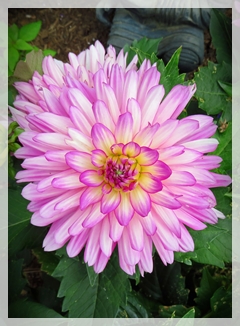
dahliaIn 1978, Merck Research Laboratories was approached by a scientist who thought a drug he was developing to treat parasitic infections in animals might be useful in treating a parasitic infection in humans. Called onchocerciasis or river blindness, it is transmitted through the bite of black flies and had no known cure. The pharmaceutical company faced a dilemma. Since onchocerciasis is found only in third world areas, the people needing the medication could never afford to buy it. How could the company expend money to develop a drug they’d never be able to sell? Nevertheless, they did and, in 1987, Merck announced that, for as long as was necessary, they would give away the drug (Mectizan®) for the treatment of onchocerciasis to any country that needed it. Eleven years later, they expanded their commitment and started donating Mectizan® for the treatment of Lymphatic filariasis, a mosquito-transmitted disease which can develop into elephantiasis. Since 1987, more than a billion treatments have been donated to thirty-three countries and the World Health Organization forecasts that both diseases could be eradicated by 2020.

Typically, in business, if there’s no chance for profit, there’s no chance for the project. In the case of Mectizan®, however, Merck saw the company’s primary goal as getting the drug to the people who needed it rather than getting a return on their investment. This mindset goes back to a statement by George Merck in 1933 that the company’s mission was to develop scientific breakthroughs to benefit humanity. In 1950, he elaborated by saying, “Medicine is for the people. It is not for the profits.” Merck’s CEO in 1978, Dr. Roy Vagelos, further clarified the company’s mission by directing its scientists to put medical needs before profits and to think of their work as a quest to alleviate worldwide human disease and suffering.

Jesus gave us what’s known as the Great Commission; recently, our northern church wanted to clarify how it intended to fulfill that command. At a congregational meeting to formulate a mission statement, the story of Merck putting people before profit was shared to illustrate the importance of knowing our purpose and what we will or won’t do to achieve it. It’s not just churches, businesses or charitable foundations, however, that need to articulate their mission. “What is my objective? What have I been called to do and how will I do it?” are questions each of us should ask of ourselves and our families.

In that same 1950 speech, George Merck said, “The all-important question in research, which must be asked constantly, is: what is the right thing to do? … We cannot rest till the way has been found…to bring our finest achievement to everyone.” I’m not in medical research but Merck’s words apply to us all. What is the right thing to do? How can we bring our finest achievements to others? A good place to start is to ask two more questions: “What would Jesus do and how would He do it?”

Do all the good you can, by all the means you can, in all the ways you can, in all the places you can, at all the times you can, to all the people you can, as long as ever you can. [John Wesley]

Don’t copy the behavior and customs of this world, but let God transform you into a new person by changing the way you think. Then you will learn to know God’s will for you, which is good and pleasing and perfect. … Don’t let evil conquer you, but conquer evil by doing good. [Romans 12:2,21 (NLT)]

Copyright ©2018 jsjdevotions. All rights reserved.