THE BENEFIT OF DOUBT


When you talk, do not say harmful things, but say what people need—words that will help others become stronger. Then what you say will do good to those who listen to you. [Ephesians 4:29 (NCV)]

crinium lily

“What did she mean by that?” we might wonder. We know better than to make insensitive, unkind, or inappropriate remarks but what about when we think we’ve heard those same kinds of comments? Unfortunately, what we perceive is not necessarily what was meant or said. Sometimes, we over analyze the things we hear: the words chosen, the way they’re said, and even the speaker’s tone of voice. We may assign unkind intentions or hidden meanings that aren’t there. When we do that, we can easily find offense where none is intended.

Let’s face it, we all have had “foot in mouth” disease and said the wrong thing or the right thing the wrong way more than once. We’ve used poor choices of words, been politically incorrect, forgotten something we were supposed to remember or mentioned something we should have forgotten. We’ve called people by the wrong names and probably even asked a heavy-set woman when the baby’s due! We didn’t mean to hurt anyone; we were just being the imperfect people we are! I suspect most people are like me, not anywhere near clever enough for veiled messages and double meanings. Nevertheless, I can analyze someone else’s remarks as if they’ve spent hours choosing their words and practicing their delivery. When I think about it, if I’ve felt hurt or offended by another person’s words, it’s usually because of my own insecurities.

I never intend to say rude or thoughtless things but, unfortunately, it sometimes happens. Lord, let your Holy Spirit keep my foot out of my mouth. When in doubt, remind me that silence is always a good option. Just as I want others to give me the benefit of the doubt when I speak carelessly, show me how to be willing to do the same thing. May your Holy Spirit help me assume innocent intentions on the part of those whose words upset or offend me. Guide me so that I not only speak with love but listen with love, as well.

This does not mean that love is gullible, but that it does not think the worst (as is the way of the world). It retains its faith. Love is not deceived … but it is always ready to give the benefit of the doubt. [Leon Morris, in his commentary on 1 Corinthians 13]
Love patiently accepts all things. It always trusts, always hopes, and always endures. [1 Corinthians 13:7 (NCV)]

Copyright ©2017 jsjdevotions. All rights reserved.

IT SEEMED LIKE A GOOD IDEA

Fools think they are doing right, but the wise listen to advice. [Proverbs 12:15 (NCV)]

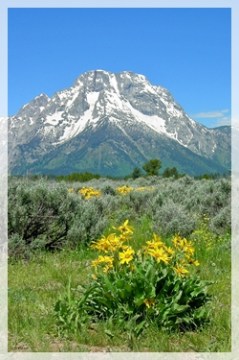
Grand Tetons - rubber rabbit brushAfter it was returned by the Philistines, the Ark of God had been neglected in Kiriath-jearim for twenty years. Fresh from victories over the Philistines, David decided to bring the Ark back to its rightful home in Jerusalem. It certainly seemed like a good idea at the time. Unfortunately, ignoring the law’s clear instructions that the Ark could only rest on poles and carried on the shoulders of Levites, David had it placed on a cart pulled by oxen. The oxen stumbled, the cart tipped, and Uzzah reached out to steady it. Under Hebrew law, touching the sacred Ark was a capital offense and Uzzah was immediately struck dead. The Ark should never have been on a cart and it was David’s disobedience and carelessness that caused the man’s death. Nevertheless, David’s reaction was to get mad at God.

How many times do we have what seems like a good idea that turns out bad? We try to do the right thing the wrong way and then get mad at God when things don’t turn out well. How many times have other people been hurt because of our haste, overconfidence, or ignorance? David had wisely consulted the Lord on military strategy against the Philistines. Yet, when it came to moving the sacred Ark, he consulted only his officials, the officers in his army, and the people. Was it pride at his military victories that keep David from consulting God about this endeavor? Remembering that our Father knows best, let’s learn from David’s mistake and seek God’s advice in all of our actions.

Lord, no matter how noble the goal, stop us when we barge on ahead without consulting you. Keep us from both reckless action and thoughtless inaction; show us how to act carefully and prudently. Remind us that easy answers are rarely as easy as we think them to be. Please don’t let our idea of a solution ever create a greater problem.

Commit your actions to the Lord, and your plans will succeed. [Proverbs 16:3 (NCV)]

Copyright ©2017 jsjdevotions. All rights reserved.


NO REGRETS

Look, God’s home is now among his people! He will live with them, and they will be his people. God himself will be with them. He will wipe every tear from their eyes, and there will be no more death or sorrow or crying or pain. All these things are gone forever. [Revelation 21:3-4 (NLT)]

It is the same way with the resurrection of the dead. Our earthly bodies are planted in the ground when we die, but they will be raised to live forever. Our bodies are buried in brokenness, but they will be raised in glory. They are buried in weakness, but they will be raised in strength. They are buried as natural human bodies, but they will be raised as spiritual bodies. For just as there are natural bodies, there are also spiritual bodies. [1 Corinthians 15:42-44 (NLT)]

tiger swallowtail butterfly on bergamotWhen writing yesterday’s devotion (“It’s Curtains”), I couldn’t help but feel a brief pang of regret because I never had those conversations with my parents before they died. The thoughts, “Please forgive me. I forgive you. Thank you. I love you,” may have been assumed but never were spoken. I was fifteen when my mother succumbed to cancer. I saw her that day in hospital but, when I walked out that afternoon, I was sure I’d see her again when I visited the following day. I never thought the next time I saw her she’d be lying in a casket. When people would say, “She looks so good,” I wanted to shout at them and say, “She doesn’t look good; she looks dead!” Five years later, I was in the same funeral home and surrounded by many of the same mourners. That time, it was my father’s body lying so still in the front of the room. Two day earlier he’d been hunting pheasants when his heart failed; he died in the middle of a corn field. I’d seen him just a few weeks before that and never thought our farewell was the final one. Did my parents know how much I loved them? Did they know how sorry I was for my failings? Did they know I forgave them for theirs? Did they know how thankful I was for the life they gave me?

If we’d had those conversations at that time, however, I’m not sure how satisfying they would have been. I was far too young to have any concept of what it meant to be a parent and make the difficult choices parents do. I was too immature to have a real appreciation of the sacrifices they made for me or to understand the depth of parental love and the pain that so often accompanies it. And, I was far too young to acknowledge how wrong I’d been in so many ways. I think of the Apostle Paul’s words, “I spoke and thought and reasoned as a child.” Indeed, I did. Now, more than fifty years later, I have the blessings of faith, maturity, perspective, and experience but those conversations cannot take place. Surely, like me, there are others whose final farewells were nonexistent or less than satisfactory. Nevertheless, they were final.

Although I expect to meet my parents in heaven, I think we’ll be too busy joyfully worshipping God to bring our regrets with us to the afterlife. What’s done is done and those last farewells, as unsatisfactory as they were, will have to do. The past is just that—passed! There really is no room in our lives for regret or looking backward. After all, we still have a race to run.

To dwell on the past simply causes failure in the present. While you are sitting down and bemoaning the past and regretting all the things you have not done, you are crippling yourself and preventing yourself from working in the present. Is that Christianity? Of course it is not. [Martyn Lloyd-Jones]

I focus on this one thing: Forgetting the past and looking forward to what lies ahead, I press on to reach the end of the race and receive the heavenly prize for which God, through Christ Jesus, is calling us. [Philippians 3:13b-14 (NLT)]

Copyright ©2017 jsjdevotions. All rights reserved.

INCONVENIENCED

Jesus traveled through all the towns and villages of that area, teaching in the synagogues and announcing the Good News about the Kingdom. And he healed every kind of disease and illness. When he saw the crowds, he had compassion on them because they were confused and helpless, like sheep without a shepherd. [Matthew 9:35-36 (NLT)]

gray-headed or prairie coneflowerMy summer beach novel began with a man having a heart attack on a commuter train. For the next several pages, I was privy to the thoughts of his fellow passengers. They were annoyed and frustrated by the train’s unscheduled stop and saw the man’s collapse as a tremendous inconvenience. As they disembarked to find another way into the city, their thoughts were not of the dying man and his wife but of themselves and how their lives had been disrupted.

My husband has twice been on trains delayed because of a jumper’s suicide on the tracks. His fellow passengers were no different than the fictional ones. Their thoughts were about themselves and how the delay ruined their day. They seemed to forget that the cause of that delay ruined a whole lot more than a day for someone’s family and friends.

A friend who taught typing in the local college several years ago mentioned having had a student with only one arm. When she first saw him, her initial thought was of the difficulty his handicap posed for her as a teacher rather than empathy for the challenges he would face conquering a keyboard. Like the train passengers and my teacher friend, we usually see life through the eyes of self-concern. Forgetting that it really isn’t about us and we’re not the center of the world, our self-interest undermines our compassion.

The disciples were no different. Disturbed and annoyed, they wanted to send away the woman who kept begging Jesus to heal her daughter, the crowd of hungry people they had no money to feed, and the parents who brought their small children to Jesus. Seeing a woman desperate to free her daughter from torment, hungry people requiring food, and children needing His touch and blessing, Jesus wasn’t bothered and never sent people away without meeting their needs. Surely all those people who followed Him and pled for healing inconvenienced and delayed our Lord. Rather than complain, Jesus showed mercy, sympathy, patience and kindness. Christ and compassion go hand in hand but compassion doesn’t always come easily. It’s only human to have our first response be, “What does this mean to me?” or “How will I be affected?” It may be human but it’s not Christ-like.

“It must be hard for you,” said a man to my friend. “Yes,” she admitted, “but it’s much harder for my mother who has Parkinson’s!”  My friend was inconvenienced by caregiving but she understood that it was no picnic for her mother either. On the days she resented the weight placed on her shoulders, she remembered it was even worse for the woman whose weight she was carrying. When she considered life from her mother’s position, any feeling of being inconvenienced was replaced with love and compassion. Isn’t that what doing unto others really means? To truly do unto others we need to put ourselves in the other person’s shoes instead of complaining about a little scuff on ours!

Father, when confronted with other people’s misfortune and difficulties, forgive us when we look to ourselves first. Instead of seeing how we’ve been inconvenienced, help us see ways we can help.  Replace our annoyance with patience, our callousness with kindness and our self-concern with compassion.

The first question which the priest and the Levite asked was: “If I stop to help this man, what will happen to me?” But the good Samaritan reversed the question: “If I do not stop to help this man, what will happen to him?” [Martin Luther King, Jr.]

Since God chose you to be the holy people he loves, you must clothe yourselves with tenderhearted mercy, kindness, humility, gentleness, and patience. [Colossians 3:12 (NLT)]

Copyright ©2017 jsjdevotions. All rights reserved.

AFTER THE STORM

compass plantThe terrible storm raged for many days, blotting out the sun and the stars, until at last all hope was gone. [Acts 27:20 (NLT)]

“Lord, help!” they cried in their trouble, and he saved them from their distress. He calmed the storm to a whisper and stilled the waves. What a blessing was that stillness as he brought them safely into harbor! [Psalm 107:28-30 (NLT)]

While walking this morning, I could see the toll last night’s hail storm took on the wildflowers. Many that yesterday stood tall and proud over the prairie were now bent and broken. These defeated looking plants made me think of a friend and the storm that overwhelmed and nearly defeated him.

Raised in a Christian home and once a believer, he lost his faith in a loving God years ago when a series of medical errors left his child with severe brain damage. Angry at God and then disillusioned by the hypocrisy he saw in his church, he decided to worship the god of achievement and wealth. All went well for him until one day it didn’t. The storm hit when the multi-national corporation for which he worked closed its doors. In spite of his stellar resume, nearly two years passed without employment. When the economy tanked, so did his investments and his savings dwindled to nothing. Upside down with his mortgage, his god of success and prosperity was nowhere to be found. It was at that point that this once proud man literally fell to his knees and humbly admitted his defeat and nothingness to God. He wanted to believe but needed to know that God really was there. He didn’t ask for relief; he asked for reassurance of God’s presence. “Show me that you exist, that you care, that you are good!” was his simple prayer.

Most of those drooping wildflowers along the trail will again stand tall when the sun shines. Like those flowers, my friend was raised up when he turned to God and allowed the Son back into his life. Within a day of his prayer, he received a call from a struggling Christian-based non-profit and, within a week, he’d started working there as the CEO. Several years have passed and he is happier and more content than he was in his previous life. Because of his business acumen, the organization he serves is now thriving and people’s lives are being changed in incredible ways. His child is still disabled and his standard of living is not what it was before the storm, but he lives joyfully in the knowledge of a loving and good God—a God who can still storms and lift a drowning man out of the sea.

A hail storm can knock down flowers and, sometimes, God knocks us to our knees with a storm of troubles. It’s when we’re on our knees, however, that the only place to look is up! When we ask God to reveal Himself to us, we shouldn’t expect Him to do it with a job or financial support. After all, God only promises relief from all of our troubles in the next world. In this life, we will be relieved only from some of them; other troubles He will enable us to endure. Nevertheless, when we humbly and sincerely ask God to reveal himself to us, He will.

If God seems far away, who moved? [AA slogan]

But whenever they were in trouble and turned to the LORD, the God of Israel, and sought him out, they found him. [2 Chronicles 15:4 (NLT)]

Copyright ©2017 jsjdevotions. All rights reserved.

EMBRACE YOUR INNER TORTOISE

Don’t be impatient for the Lord to act! Keep traveling steadily along his pathway and in due season he will honor you with every blessing. [Psalm 37:34a (TLB)]

And let us not get tired of doing what is right, for after a while we will reap a harvest of blessing if we don’t get discouraged and give up. [Galatians 6:9 (TLB)]gopher tortoise - rabbit


In the familiar Aesop’s fable of “The Tortoise and the Hare,” the over-confident hare takes a nap midway through the course while the tortoise, plodding steadily along, passes him and wins the race. I’ve always seen the moral of the story to be “slow but sure wins the race” with an added warning to beware of over-confidence. I never thought about how the tortoise must have felt as he trudged along so slowly. Did he ever measure his pace and progress against the hare’s? Did he think he could even finish the course let alone win it? Did he ever entertain thoughts of quitting? If I’d been the tortoise in Aesop’s story, I’m afraid I might have given up in despair long before discovering the sleeping hare along the road!

We recently visited a nature preserve that is home to several gopher tortoises. After comparing them with the rabbits in our neighborhood, given a choice, I’d prefer to move like the rabbit. Sometimes, however, life moves at the tortoise’s pace. Progress seems to come in fractions of an inch instead of feet and it’s easy to get discouraged.

Lord, thank you for the course you’ve laid out for us. Help us accept that sometimes progress is painstakingly slow. Give us endurance and patience so we can travel steadily (and joyfully) along the path you’ve given us.

The key to everything is patience. You get the chicken by hatching the egg, not by smashing it. [Ellen Glasgow]

Be glad for all God is planning for you. Be patient in trouble, and prayerful always. [Romans 12:12 (TLB)]

But if we must keep trusting God for something that hasn’t happened yet, it teaches us to wait patiently and confidently. [Romans 8:25 (TLB)]

Copyright ©2017 jsjdevotions. All rights reserved.