RATINGS

Obviously, I’m not trying to win the approval of people, but of God. If pleasing people were my goal, I would not be Christ’s servant. [Galatians 1:10 (NLT)]

passion glower - pasqueflower“Over 1 million served,” was the sign Ray Kroc posted at his first McDonald’s franchise in 1955. That number became 100 million in 1958 and was 1 billion in 1963. When the number of burgers served surpassed the 99 billion mark in 1994, operators were told to change their signs to “Billions and Billions Served!” Executives at McDonald’s claim they no longer keep track of how many are served but I don’t believe it! Someone there knows exactly how many of those hamburgers have been sold, along with the number of Egg McMuffins and chocolate shakes.

People gauge their success with numbers and I’m no different. Before quitting my work for the day, I often check the stats for my web site. How many people visited and how many views did they take? Did I get any new subscribers? Worse, did I lose any? I doubt that I’m alone in checking stats; we all seek approval and use some sort of yardstick to measure our success. The restaurant measures sales, the YouTuber his subscribers, the author his place on the best seller list, the student his class rank, and the blogger her followers. We live our lives measuring and comparing: how many likes on the posting, hits on the website, orders taken, compliments on the outfit, friends on Facebook, or Christmas cards received.

Granted, publishing a blog is a little like speaking into a radio station microphone and not knowing if anyone is listening. Nevertheless, I had to ask myself, “Whose approval do I seek?” Like most people, I tend to seek tangible approval from people when the only approval that matters is that from God. It’s not who or how many people follow me; the only thing of importance is that I follow Him!

Our pastor shared the story of a successful evangelist who literally lost his voice. No longer able to preach, he asked God, “Don’t you care about my ministry?” The answer clearly given to him was, “No! I care about you!” I think of his story whenever I struggle with my writing ministry—when the words don’t come or I feel like I’m speaking to an empty auditorium. God cares about us—not about our triumphs and certainly not about how many people hear our voices or read our words. That pastor’s voice returned when he understood that God loved him rather than his accomplishments. Consider the Old Testament prophets: with Haggai (at whose urging the temple finally was rebuilt) being the exception, most of the prophets’ messages fell on deaf ears. Misunderstood, persecuted, ridiculed and ignored, by human standards they were failures. God, however, uses an entirely different kind of measuring stick. The prophets’ lives tell us that the success of our endeavors is not what matters; what matters is our obedience to God’s word and the doing of His will. It’s not about our glory; it’s about our bringing glory to God!

So, my dear brothers and sisters, be strong and immovable. Always work enthusiastically for the Lord, for you know that nothing you do for the Lord is ever useless. [1 Corinthians 15:58 (NLT)]

Copyright ©2018 jsjdevotions. All rights reserved.

KING OF KINGS

In my vision at night I looked, and there before me was one like a son of man, coming with the clouds of heaven. He approached the Ancient of Days and was led into his presence. He was given authority, glory and sovereign power; all nations and peoples of every language worshiped him. His dominion is an everlasting dominion that will not pass away, and his kingdom is one that will never be destroyed. [Daniel 7:13-14 (NIV)]

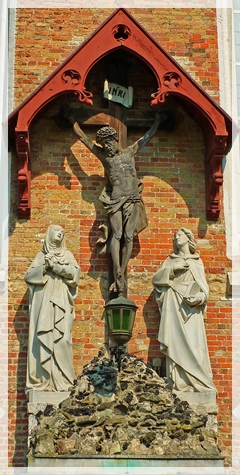
Church of our Lady - Netherlands

As we left the church, my friend asked “What do the letters INRI above the cross mean?” Unable to say it in Latin, I replied that it was an abbreviation of the words, “Jesus of Nazareth, the King of the Jews.” In Latin, these words would be Iesus Nazarenus Rex Iudaeorum. When someone was crucified, it was usual to affix a sign to the cross declaring the cause of execution. Since the official charge against Jesus seemed to be that he’d challenged Roman rule by proclaiming himself the king of the Jews, Pilate had those words written in Latin, Greek and Hebrew. As Pilate phrased it, however, the words seem more of a title rather than an accusation. When the high priests asked that the sign be changed to read “He said, I am the King of the Jews,” Pilate refused.

Other than that dark day when He was crucified and the title “king of the Jews” was used with scorn and mockery by the soldiers and crowd, Jesus was referred to as “king of the Jews” only one other time: at the visit of the Magi when they asked, “Where is the one who has been born king of the Jews?” [Matthew 2:2] While most of Jesus’s countrymen didn’t acknowledge His identity, it was foreigners who recognized his sovereignty at His birth and a Roman governor who acknowledged His kingship at death.

Was Jesus the king of the Jews? A king’s supremacy is limited to his domain. The ruler of a nation, a king’s power is limited by his lifetime and the borders of his kingdom. He must defend his government from enemy nations and his regime from revolution. A king of the Jews would reign only over Judah’s territory and the children of Israel. When asked if He was king of the Jews, Jesus told Pilate that His kingdom was not of this world. Indeed, Jesus’s kingdom wasn’t limited to Judah and the Jews. Unlike earthly kingships, His reign is absolute, unbreakable, sacred, and everlasting. When God raised Jesus from the dead, He was given power over all of creation and all people on earth, not just the Jews of Judah. Pilate’s sign was wrong. Jesus wasn’t the “king of the Jews;” He was and still is the King of kings and the Lord of lords.

They will wage war against the Lamb, but the Lamb will triumph over them because he is Lord of lords and King of kings—and with him will be his called, chosen and faithful followers. [Revelation 17:14 (NIV)]

Copyright ©2018 jsjdevotions. All rights reserved.

COBWEBS

Today I have given you the choice between life and death, between blessings and curses. Now I call on heaven and earth to witness the choice you make. Oh, that you would choose life, so that you and your descendants might live! You can make this choice by loving the Lord your God, obeying him, and committing yourself firmly to him. This is the key to your life. [Deuteronomy 30:19-20a (NLT)]

black and yellow garden spiderI glanced up at the ceiling; there, yet again, was a spider web hanging across the hallway. I brushed it away along with all the others that had appeared in our absence. Nevertheless, I know they will return; they always do. I can get rid of the spiders’ webs but, without getting rid of all the spiders, they will return.

That, in a nutshell, is what happened to the Israelites. When the Israelites arrived in Canaan, God told them to rid the land of all pagan practices by driving out the inhabitants of Canaan and destroying all of their shrines, idols, and high places. Unfortunately, the Israelites disobeyed and never fully carried out God’s command. Thus began a cycle of idol worship, warnings, punishment, pleas for relief, God’s rescue, repentance, obedience, and back-sliding into idolatry that lasted until their Babylonian captivity some 800 years later. Whenever pagan shrines were destroyed, like cobwebs, they always reappeared. When King Asa removed the idols from Judah, they came back and his son had to remove them again. Having returned by Jehosaphat’s reign, the offensive shrines were removed but, by the end of his reign, they were back. After Hezekiah destroyed all the pagan temples, idols and shrines, they were rebuilt during the reigns of his son and grandson. Although his great-grandson, Josiah, tore them down again, paganism returned during the reigns of the last four kings of Judah.

Merely destroying the idols and pagan shrines was no more effective than my knocking down the spider webs. The cobwebs, of course, are only a symptom of my real problem: spiders. Like those webs, the idols and shrines were merely symptoms of a far greater problem: the people’s unfaithfulness and disobedience to God. Whenever they were eradicated, like my spider webs, they reappeared because the source of the problem was never addressed. God’s prophets were ignored, unholy alliances were made, the temple was ransacked and allowed to fall into disrepair, and the Book of Law forgotten. The problem wasn’t in the high places and stone idols—it was in the people’s faithless and disobedient hearts! The pagan images and shrines of Israel and Judah were evidence of a disobedient and faithless people who forgot the God of their fathers.

Let us remember that idolatry doesn’t require the making of an idol or the erecting of an altar in a high place; it simply involves placing ourselves before God and putting our faith in anything other than Him. Believing in their false promises of blessings and security, people now worship at the altars of things like materialism, pride and ego, power, fame, science and technology, youth and beauty, and self-indulgence. As offensive to God as were Ashtoreth poles and images of Baal, today’s false gods continue to be a symptom of a faithless and disobedient people who’ve forgotten their true God. Without Him as the center of our lives, without our faith in God and our obedience to His word, like the people of Judah and Israel, we will simply continue to discard one idol only to replace it with another.

You don’t have to go to heathen lands today to find false gods. America is full of them. Whatever you love more than God is your idol. [Dwight L. Moody]

Do not love this world nor the things it offers you, for when you love the world, you do not have the love of the Father in you. For the world offers only a craving for physical pleasure, a craving for everything we see, and pride in our achievements and possessions. These are not from the Father, but are from this world. [1 John 2:15-16 (NLT)]

Copyright ©2018 jsjdevotions. All rights reserved.

OVER COMMITTED

I can do all things through him who strengthens me. [Philippians 4:13 (ESV)]

waterfallYears ago, facing overwhelming responsibilities, I stood in the middle of the Home Depot garden center, broke into tears, and prayed, “God, I just can’t do it all.” A very gentle voice said, “You don’t have to!” and then put into my mind the names of people who could help me in the many tasks that lay ahead. Not long ago, when planning another major event, I approached that same feeling of desperation and felt much like a gerbil on an exercise wheel—running hard and getting nowhere. I was running out of ideas, time, energy and patience. Circumstances over which I had no control were part of the problem but so was I! Pride made me both hesitant to ask for help and reluctant to share the glory. Fortunately, I’ve learned a few things since that day at Home Depot so I did some serious praying and humbly asked for help. Friends and family came together in the most amazing way and incredible solutions appeared for what had seemed to be unsolvable problems. It was as if God was saying, “See, you can do it—just not all by yourself!”

Solomon’s kingdom flourished because the wise king delegated responsibility; he appointed governors over twelve districts, another governor over them, and eleven other high officials. Even Jesus knew He couldn’t do it all when He lived as a man. He chose seventy-two disciples to act as advance men in the towns He would later visit. Later, when the Apostles learned that the widows weren’t getting their share of the food, they asked the church to appoint seven men to take on that responsibility. Paul appointed elders in every church, delegated leadership responsibilities to men like Timothy and Titus, and encouraged them to find other trustworthy men to pass on God’s word.

God gave Eve to Adam for more than procreation; “I will make a helper who is just right for him.” [Genesis 2:18] We’re not meant to go it alone. When Solomon delegated, his kingdom prospered and grew. When Jesus delegated, He trained the disciples to pass on the faith. When the Apostles delegated, they were better able to use their gift of teaching. When Paul delegated to other evangelists and elders, he demonstrated his trust in their ability. When I delegated, the result was far better than I could have imagined and I was able to share the joy of accomplishment with all who helped.

God is God and we are not. As mere mortals, we can only do our best. Sometimes, however, doing our best means allowing other people to do it! We have been instructed to serve one another but, for that to happen, we must be willing to let others serve!

Be strong enough to stand alone, smart enough to know when you need help, and brave enough to ask for it. [Ziad K. Abdelnour]

A friend loves at all times, and a brother is born for adversity. Proverbs 17:17 (ESV)]

I lift up my eyes to the hills. From where does my help come? My help comes from the Lord, who made heaven and earth. [Psalm 121:1-2 (ESV)]

Copyright ©2018 jsjdevotions. All rights reserved.

IT’S NOT OURS TO KEEP

When the poor and needy search for water and there is none, and their tongues are parched from thirst, then I, the Lord, will answer them. I, the God of Israel, will never abandon them. I will open up rivers for them on the high plateaus. I will give them fountains of water in the valleys. I will fill the desert with pools of water. Rivers fed by springs will flow across the parched ground. [Isaiah 41:17-18 (NLT)]

giant swallowtail butterflyYesterday, I wrote of God’s provision, yet I can’t help but wonder. If God promises His divine provision, why are there still people in need?

There was to be no permanent poverty in Israel. In the Old Testament, we find complex laws and social practices that were meant to ensure that no one lived in need. To eliminate food scarcity, every third year there was to be a special tithe of crops for the Levites and those at risk like foreigners, widows and orphans. The Israelites were to leave the edges of their fields unharvested and anything dropped during the harvest ungathered; this portion could be gleaned by the poor. There were laws against exploiting the vulnerable through usury or by demanding unreasonable collateral. Every seventh year was to be a Sabbath year when loans were forgiven and Hebrew slaves were released from servitude. The land would lay fallow and any produce that grew by itself was free to all. Additionally, in the Year of Jubilee, celebrated every fifty years, economic disparity was further minimized by returning all real estate (whether sold, mortgaged or leased) to its original owner.

The poor in the Bible were not much different than today’s poverty-stricken: the people without land or the economic, legal, or political resources to be self-sustaining. A diverse group of the marginalized, they were day laborers, subsistence farmers, indentured slaves, beggars, prostitutes, widows, resident aliens, the disabled and infirm. God’s vision wasn’t a welfare state but rather one that allowed families to have the opportunity to provide for themselves. The Sabbath and Jubilee years were a fresh start for those who found themselves in poverty. Unfortunately, the reproachful words of the prophets to Judah and Israel tell us that God’s laws were not obeyed.

The story is told of two businessmen. Like me, the first was troubled by the abject poverty that exists in the world today and wondered about God’s promise of provision. He said, “Someday, I hope to ask God why He allows poverty, famine, and injustice when He could do something about it.” The other man replied, “I’m afraid that God might ask me that very same question.”

Perhaps God has fulfilled His promise to provide by filling our wells with blessings. The problem is that we haven’t done our part by passing along His provision. Instead of letting His gifts flow through us to others, we’ve plugged the pipeline and are keeping His gifts for ourselves. We’ve been freed from the Old Testament laws but we haven’t been freed from the obligation to love our neighbors. Could we be holding the provision that God has promised? Could we be the answer to someone’s prayer? For those of us with water in our wells, perhaps it’s time turn on the faucet and let His blessings flow.

We are not cisterns made for hoarding, we are channels made for sharing. [Billy Graham]

We know what real love is because Jesus gave up his life for us. So we also ought to give up our lives for our brothers and sisters. If someone has enough money to live well and sees a brother or sister in need but shows no compassion—how can God’s love be in that person? Dear children, let’s not merely say that we love each other; let us show the truth by our actions. [1 John 3:16-18 (NLT)]

Copyright ©2018 jsjdevotions. All rights reserved.

FLOWERS AND BIRDS

Look at the birds. They don’t plant or harvest or store food in barns, for your heavenly Father feeds them. And aren’t you far more valuable to him than they are? Can all your worries add a single moment to your life? And why worry about your clothing? Look at the lilies of the field and how they grow. They don’t work or make their clothing, yet Solomon in all his glory was not dressed as beautifully as they are. And if God cares so wonderfully for wildflowers that are here today and thrown into the fire tomorrow, he will certainly care for you. Why do you have so little faith? [Matthew 6:26-30 (NLT)]

cardinal - narrow-leaved sunflower - Corkscrew SwampI’ve never seen a field of lilies in blossom but they couldn’t be any more beautiful than the field of narrow-leaved sunflowers that surrounded me at the bird sanctuary recently. Standing in wonder as their yellow faces smiled down on me, I was reminded of Jesus’s words about the lilies of the field. When I came upon a cardinal pecking away at a large ripe berry, I remembered His words regarding the birds. While watching the bird enjoy his breakfast, the story of Elijah and the ravens that fed him came to mind and I thought about God’s promise to provide.

Having more than enough clothes in my closet and a pantry full of food, I’m not worried about food or clothing. I do, however, tend to worry about God’s provision of words for these devotions. Trust in Him doesn’t come automatically—it is a learned response. Nevertheless, even though God has provided me with fodder for over 1,600 devotions, I’m a slow learner and I still have trouble trusting Him to continue with His provision.

Throughout Scripture, God promises over and over again to provide and, over and over again, people don’t trust Him. Consider the Israelites; after being told there would be manna enough every day, they tried to save it. Even though stored manna turned rotten and maggoty, I would venture a guess that some people continued trying to save it. If I’d been there, I probably would have tried different types of containers, hoping that I’d eventually find the right way to preserve manna (just in case God missed a day)! Later, when God promised to provide the power and strength to take Canaan, the Israelites didn’t believe that God’s provision would be enough and refused to enter. I’m afraid I wouldn’t have trusted God’s promise any more than did the rest of them.

You’re probably not worried about words and maybe not even food or clothing. Even so, we’re all worried about whether God will provide enough of something we need, be it money, health, time, comfort, friends, faith, strength, wisdom, peace or patience. Remember, God promises to provide for the birds and flowers and they’re not even made in His image! Jesus didn’t die on the cross for them and the Holy Spirit doesn’t dwell within them, yet God provides for them! God loves us—we’re created in His image, redeemed by His son, and given eternal life by Him. As His beloved children, we ought to trust Him enough to provide our necessities! When God brings us someplace, as He did with the Israelites and Elijah, He’ll provide us with a way to meet our needs, be it manna on the ground, ravens bringing us food, or wildflowers swaying in the breeze.

God looks at the anxious and says, I tore my Son to shreds for you, and you’re afraid I will not give you what you need? [Timothy Keller]

So don’t worry about these things, saying, “What will we eat? What will we drink? What will we wear?” These things dominate the thoughts of unbelievers, but your heavenly Father already knows all your needs. Seek the Kingdom of God above all else, and live righteously, and he will give you everything you need. So don’t worry about tomorrow, for tomorrow will bring its own worries. Today’s trouble is enough for today. [Matthew 6:31-34 (NLT)]

Copyright ©2018 jsjdevotions. All rights reserved.