TRAPPED

Then he said, “Beware! Guard against every kind of greed. Life is not measured by how much you own.” [Luke 12:15 (NLT)]

You say, “I am rich. I have everything I want. I don’t need a thing!” And you don’t realize that you are wretched and miserable and poor and blind and naked. [Revelation 3:17 (NLT)]

grey squirrel in bird feederI looked at the greedy squirrel caught in the bird feeder. He’d managed to get himself in but couldn’t get out and wasn’t even able to enjoy the seeds that enticed him there in the first place. Other squirrels, however, were gathered beneath the feeder feasting on the seeds he knocked out of the feeder with his frantic movements. That silly squirrel lives in a bird sanctuary where there is more than enough food in the way of fungi, nuts, seeds, fruit, caterpillars and insects (along with the bird seed that frequently spills from the bird feeders) to keep him plump and happy all year long. Nevertheless, unsatisfied with enough, he hungered for more. We’re not much different.

I thought about King Solomon; while best known for his wisdom, like the squirrel, he was greedy. Although God had warned against a king amassing great amounts of gold, Solomon collected 25 tons of it every year and, unlike those bird seeds, his wealth didn’t even scatter down to his people. After Solomon’s death, they begged King Rehoboam for relief from their labors and heavy taxes. Perhaps hungry for an even more extravagant lifestyle than his father’s, Rehoboam refused and lost it all to the king of Egypt within five years.

Some say wealth brings happiness but, if anyone should know about wealth and happiness, it would be wise King Solomon. His words in Ecclesiastes, however, are not those of a happy man: “Those who love money will never have enough. How meaningless to think that wealth brings true happiness!” [5:10] Amassing money and possessions is like running on a treadmill: a never ending journey. We think that bigger, better or more will bring contentment but what once seemed a luxury soon becomes commonplace and a mere necessity. So, wanting something even more extravagant, we get back on the treadmill of acquisition. So rich that he considered silver worthless, Solomon got rid of his silver goblets and utensils and replaced them with gold. Had platinum been discovered in his time, I imagine he would have replaced the gold with it.

Wealth is not evil; in fact, it can do wonderful things. Wealth, however, is dangerous because loving it and all that comes with it can lead us into temptation and trap us in spots far worse than a bird feeder.

Don’t feel sorry for the squirrel; a naturalist freed him that afternoon. But, chances are, many of us are still on a treadmill of acquisition, foolishly striving for that elusive place over the rainbow where dreams come true, “troubles melt like lemon drops,” and that pot of gold is hidden. The squirrel’s desire for more held him hostage; we mustn’t let our craving for more do the same to us!

You say, “If I had a little more, I should be very satisfied.” You make a mistake. If you are not content with what you have, you would not be satisfied if it were doubled. [Charles Spurgeon]
After all, we brought nothing with us when we came into the world, and we can’t take anything with us when we leave it. So if we have enough food and clothing, let us be content.  But people who long to be rich fall into temptation and are trapped by many foolish and harmful desires that plunge them into ruin and destruction. For the love of money is the root of all kinds of evil. And some people, craving money, have wandered from the true faith and pierced themselves with many sorrows. [1 Timothy 6:7-10 (NLT)]

Copyright ©2019 jsjdevotions. All rights reserved.

BE STRONG AND COURAGEOUS

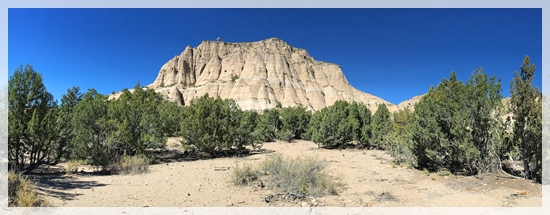
UtahThis is my command—be strong and courageous! Do not be afraid or discouraged. For the Lord your God is with you wherever you go.” [Joshua 1:6a,9 (NLT)]
Joshua 1:9 was my Bible verse for the day but I decided to make it my verse for the week. To make sure I kept it in mind, I wrote it on a post-a-note and stuck it where I’d be sure to see it: on my phone!

Wanting to put this inspirational verse in context, I reread the first chapter of Joshua. The book of Joshua is about the fulfillment of God’s promises to Abraham made four hundred years earlier. Its first chapter is one of my favorite chapters of the Old Testament narratives. To set the stage: Israel is camped on the east side of the Jordan River with the Promised Land in sight. Forty years have passed since the parting of the Red Sea. Moses is dead and only Caleb and Joshua remain of the adults who’d once been slaves in Egypt. The Israelites are standing on the edge of the unknown and the Jordan River is at flood stage. With no bridges or ferry boats, they must have wondered how they’d manage to get safely to the other side. Joshua is the new leader of the Israelites and God tells him to be strong and courageous.

Granted, God’s words were spoken to Joshua around 1400 BC in an entirely different setting but, because I’m standing on the edge of the unknown as well, God’s words to Joshua are both comforting and encouraging. Then again, we’re all standing on the edge of the unknown. None of us know what tomorrow (or even the rest of today) will bring: be it good news or bad, tornadoes or sunny skies, an accident or a near miss, the making of a new friend or the loss of an old one.

When Joshua is told to be strong, God wasn’t talking about working out at the gym. This strength had nothing to do with muscles unless, of course, we’re talking about spiritual muscles. It had to do with having the strength to prevail, withstand, and sustain. Being of good courage, is more than not being a fearful coward; it’s being alert both physically and mentally, steadfast, and determined. It wasn’t powerful foes or a lack of weapons, battle strategy, or seasoned warriors that threatened Israel; it was fear, discouragement, and weakness of faith.

Being strong and courageous is easier said than done. Nevertheless, God tells Joshua exactly how to do that: meditate on and obey the instructions in the Torah (the first five books of the Bible and the only scripture at the time). Authored by God through Moses, those books contained the people’s history and God’s law, promises and plan. If the Israelites had only done that, the Old Testament would be an entirely different (and far less violent) story! 3,400 years later, we’re no longer limited to a mere five books; we have both Old and New Testaments to make us strong and courageous. Just the same, knowing and obeying those words can be as much of a problem for us as it was for the Israelites.

At least for me, the best part of Joshua 1:9 is God’s promise that He is with us wherever we go. Whether we’re crossing a deep river or just going across the street, confronting an enemy army or a CT scan, or facing a walled city or the loss of a spouse, we know that, no matter what befalls us, God is with us. When we’re standing at an abyss, facing the great unknown, there is no need to be afraid or discouraged. We can be strong and courageous because we have his promise in writing; He is always with us, “even to the end of the age.”

If the Lord be with us, we have no cause of fear. His eye is upon us, His arm over us, His ear open to our prayer – His grace sufficient, His promise unchangeable. [John Newton]

Teach these new disciples to obey all the commands I have given you. And be sure of this: I am with you always, even to the end of the age. [Matthew 28:20 (NLT)]

Copyright ©2019 jsjdevotions. All rights reserved.

THE LAMB OF GOD – ASH WEDNESDAY

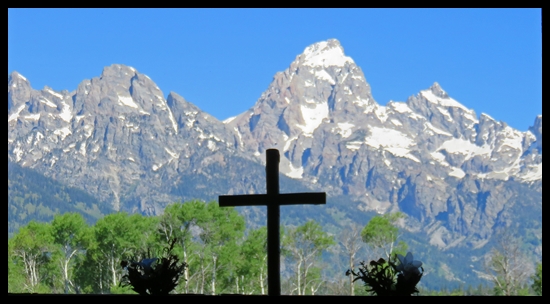
New mexicoThe next day John saw Jesus coming toward him and said, “Look! The Lamb of God who takes away the sin of the world! [John 1:29 (NLT)]

Today is the first day of Lent, a season in which we remember the time Jesus went into the wilderness and fasted for forty days and nights. Because Lent occurs in the weeks leading up to Good Friday and Easter, we tend to associate this period of Jesus’s life with the end of his ministry. It actually occurred early in His ministry, shortly after his baptism by John and his empowerment by the Holy Spirit.

During Jesus’s time in the wilderness, Satan visited and tempted Him. Jesus first was tempted to serve Himself—to alleviate his hunger by turning stones into bread. In the second temptation, Satan urged Jesus to jump off the Temple and reveal Himself in a spectacular display. This action would also test God’s love by coercing Him into saving Jesus. In the third test, Satan tempted Jesus to skip the cross altogether; all the kingdoms of the world would be His if only He’d worship the evil one.

Just because Jesus was divine doesn’t mean He couldn’t have fallen; He also was human and, like us all, susceptible to Satan’s wiles. He could have sinned as easily as Adam and Eve, but He didn’t! Resisting temptation was as essential to His mission as was suffering on the cross. Just as sin came into the world through one man, God would redeem the world through one man, but Jesus had to remain sinless for that to happen. If He hadn’t, there would have been no point to the cross; only a perfect sinless sacrifice could atone for mankind’s sins.

Because Jesus countered all of Satan’s temptations with Scripture, we tend to think of the temptation of Christ as sort of a “how to” manual on overpowering temptation. While it is that, it is so much more. Jesus didn’t go into the wilderness to teach us a lesson—He went into the wilderness to save us. He wasn’t just battling for His soul—He was fighting Satan for ours! He was defeating Satan by deliberating choosing to suffer for us as a man when He was God! He endured hunger when he could have spoken food into existence. He humbly chose to remain an obscure rabbi from Nazareth rather than use His power to win a following. Refusing to compromise with Satan, He chose obedience to God: to live, suffer and die as a man. Jesus, the spotless Lamb of God, chose to endure the cross for sinful selfish mankind: the very people who would put Him there!

For God made Christ, who never sinned, to be the offering for our sin, so that we could be made right with God through Christ. [2 Corinthians 5:21 (NLT)]

This High Priest of ours understands our weaknesses, for he faced all of the same testings we do, yet he did not sin. So let us come boldly to the throne of our gracious God. There we will receive his mercy, and we will find grace to help us when we need it most. [Hebrews 4:15-16 (NLT)]

Copyright ©2019 jsjdevotions. All rights reserved.

A MOUNTAINTOP EXPERIENCE – THE TRANFIGURATION

Chapel of the Transfiguration - Grand Teton National Park

Don’t misunderstand why I have come. I did not come to abolish the law of Moses or the writings of the prophets. No, I came to accomplish their purpose. [Matthew 5:17 (NLT)]

In the middle of Grand Teton Nation Park is a small log church, the Chapel of the Transfiguration. Built in 1925, it offers a beautiful view of the majestic Teton Mountain Range through a window behind the altar. When people gaze out that window, I wonder how many think of the amazing event—the transfiguration—that took place on another mountaintop more than 2,000 years ago.

About a week after Peter called Jesus “the Messiah sent from God!” and Jesus explained that He’d suffer, die, and be raised, Peter, John and James accompanied Him up a mountain to pray. While tradition says it was Mt. Tabor, both its height (only 1,800 feet) and location make that unlikely. While not as high as the 13,000 ft. Grand Teton, Mt. Hermon’s height (9,000 feet) and location make it the more likely location of this glorious event.

While praying, Jesus made a dramatic change: his face transformed and his clothes turned white and gleaming. Having only seen Jesus in his human form, His now glorious presence gave the disciples a greater understanding of his deity. Two men then appeared and spoke with Jesus about his exodus (or departure) from this world. They were Moses and Elijah—representing, at least symbolically, the Law and the Prophets. Jesus, as we know, was their fulfillment.

Amazed at what was the ultimate mountaintop experience, Peter foolishly suggested building three shelters for Jesus and his visitors. That, of course, was a mistake; neither the lawgiver not the prophet were Jesus’s equal. Furthermore, that Peter wanted this glorious event to continue would have kept Jesus from the mission He’d already explained to His disciples. A cloud then enveloped them all and a voice, unmistakably that of God, said, “This is my dearly loved Son, who brings me great joy. Listen to him.” [Matthew 17:5] The “Listen to him,” made it clear that the One who was new would be replacing the old way. After this powerfully dramatic event, the four men found themselves alone on the mountaintop.

Jesus commanded the disciples to keep silent as to what had taken place until after his resurrection. Looking for a Messiah who’d be a political deliverer rather than one who was a suffering servant, the world wouldn’t understand what had transpired. Even the disciples, the men who’d walked with Him for three years, didn’t fully understand the meaning of their mountaintop experience. It was not until Jesus joined them in that locked room on Easter that they finally understood that He’d come to conquer death rather than Romans.

The transfiguration was a foretaste of things yet to come and, someday, we all will see the fullness of Christ’s glory as did Peter, James, and John. Although Jesus told His disciples to keep his identity a secret, let us not forget that was only a temporary request. He later told them to “make disciples of all the nations.”

Jesus came and told his disciples, “I have been given all authority in heaven and on earth. Therefore, go and make disciples of all the nations, baptizing them in the name of the Father and the Son and the Holy Spirit. Teach these new disciples to obey all the commands I have given you. And be sure of this: I am with you always, even to the end of the age.” [Matthew 28:18-20 (NLT)]

Copyright ©2019 jsjdevotions. All rights reserved.

SAY IT NOW

Hong Kong Orchid - Hepatica - HibiscusThis is the message you have heard from the beginning: We should love one another.  [1 John 3:11 (NLT)]

Last week, I delivered the eulogy for my 102-year-old mother-in-law at the celebration of her life. The word “mother-in-law” does not adequately describe our relationship. Although my mother died when I was fifteen, at the age of twenty God blessed me with another mother when I got married. Along with a husband, I gained his wonderful parents. My mother-in-law opened both her arms and heart to me and loved me well. It was from her that I learned how to be a woman, wife, mother, grandmother, mother-in-law, and friend. I never had a problem calling her Mom; indeed, I loved her as if she had been my very own birth mother.

Four years ago, I wrote a Mother’s Day devotion about Ruth and Naomi titled “Mothers-in-law.” While considering what an amazing woman Naomi must have been to inspire such love, I kept thinking of my mother-in-law and how I was a Ruth to her Naomi. Since my mother-in-law was approaching her 99th birthday that year, I suspected that I would probably use that comparison in a eulogy at her Celebration of Life in the not too distant future. When I delivered my father-in-law’s eulogy nearly fifteen years ago, I had glowing words to say about him; sadly, as happens with eulogies, he never heard them.

Although anyone who would be in attendance at my mother-in-law’s eventual funeral would certainly know from my words how much I loved this beautiful woman, I wondered if she knew it. People say actions speak louder than words and my actions were always kind, loving, respectful and considerate. Yet, in spite of my behavior, I wondered whether my mother-in-law knew that, even in difficult circumstances such as those encountered by Ruth and Naomi, I gladly would say, “Don’t ask me to leave you and turn back. Wherever you go, I will go; wherever you live, I will live. Your people will be my people, and your God will be my God. Wherever you die, I will die, and there I will be buried.” [Ruth 1:16-17 (NLT)] Sometimes, words need to be spoken and it occurred to me that I should share my thoughts with my mother-in-law while she was alive rather than wait to say them to those who mourned her when she’d passed. And so, along with Mother’s Day candy, flowers, and card, I gave her a letter comparing us to Ruth and Naomi and expressing my devotion, admiration and love for her.

When the Apostle Paul told us that eloquent words and generous actions without love were worthless, he wasn’t telling us not to express ourselves but rather to use our words and actions authentically. We often assume that the people we love know it, but do they? The time to express our love is now, when our words and actions can be appreciated, rather than later, when they can’t!

I would rather have a single rose
From the garden of a friend,
Than to have the choicest flowers
When my stay on earth must end.
I would rather have the kindest words
Which may now be said to me
Than flattered when my heart is still
And this life has ceased to be.
I would rather have a loving smile
From the friends I know are true,
Than tears shed ’round my casket
When this world I’ve bade adieu.
Bring me all your flowers,
Whether pink, or white, or red,
I’d rather have one blossom now
Than a truckload when I’m dead. R.D. Richards

Dear children, let’s not merely say that we love each other; let us show the truth by our actions. [1 John 3:18 (NLT)]

Copyright ©2019 jsjdevotions. All rights reserved.

DIGGING FOR THE TRUTH

Open your ears to my teachings, my people. Turn your ears to the words from my mouth. I will open my mouth to illustrate points. I will explain what has been hidden long ago, things that we have heard and known about, things that our parents have told us. We will not hide them from our children. We will tell the next generation about the Lord’s power and great deeds and the miraculous things he has done. [Psalm 78:1-4 (GW)]

limpkinYesterday, I wrote about archeological support for the story of Balaam; his is but one of many Old Testament stories with evidence provided by archeology. When reading about King Belshazzar giving a feast for 1,000 in his Babylonian palace, it’s easy to think there must have been exaggeration as to the size of his party. Archaeologists, however, have excavated a large hall in Babylon that was 55 feet wide and 165 feet long, a room sufficient to host a gathering of that size. The Bible mentions writing that appeared on the room’s plaster walls and archeologists found that this ancient room had plaster walls!

In 2 Chronicles 12, we read of Judah’s invasion by Egypt’s Pharaoh Shishak during Rehoboam’s fifth year as king. Archeologists have found evidence of their devastating invasion at settlements in both Israel and Judah. Hieroglyphics on the wall of the temple at Karnak describe Egypt’s 926 BC campaign and list 183 conquered cities, 43 of which are known Bible cities. Notably missing from the list of destroyed towns is Jerusalem, the city that Shemaiah prophesized God would not allow to be destroyed. Instead, Rehoboam surrendered and the Egyptians robbed Solomon’s temple of its treasures. When we wonder where all of that plunder went, a pillar in a temple at Bubastis tells of Osorkon I (Shishak’s son) giving away 383 tons of gold and silver to all the gods of Egypt just five year later.

When King Uzziah (who was struck with leprosy) died in 740 BC, 2 Chronicles 26 tells us he was buried in a field that belonged to the kings. His stone burial plaque was discovered on the Mt. of Olives with these words: “Here, the bones of Uzziah, King of Judah, were brought. Do not open.”

The Old Testament tells us of the Babylonians’ defeat of Judah but so do a collection of clay tablets known as the Babylonian Chronicles. These annals record Babylon’s history from 750 to 280 BC and tell of such things as the battle of Carchemish (recorded in Jeremiah 46), Nebuchadnezzar’s siege of Jerusalem (found in 2 Kings 24), and removing King Jehoiachin and replacing him with Zedekiah (recorded in 2 Kings 24). They even include receipts for goods that were issued to the deposed Jehoiachin when he was in Babylonian captivity (mentioned in 2 Chronicles 36).

The cornerstone of our faith is the Bible and archeology should never be the litmus test for its truth. Archeology can’t prove Scripture’s divine inspiration or the exactness of its every word. Because it’s based on what’s been left behind, discovered and deciphered, many pieces are missing in the puzzle. Moreover, since the Bible tells just a portion of the story, some ancient pieces will be found that don’t fit. Although we will never have undisputed historic proof of its truth, archeology can confirm the historicity of many Biblical events, people, civilizations, and places. For me, it is comforting to find that external evidence points to the trustworthiness of the Bible. Of course, since it is God-breathed, we shouldn’t be surprised that secular history dovetails so well with Biblical truth.

Every Scripture passage is inspired by God. All of them are useful for teaching, pointing out errors, correcting people, and training them for a life that has God’s approval.  They equip God’s servants so that they are completely prepared to do good things. [2 Timothy 3:16-17 (GW)]

Copyright ©2019 jsjdevotions. All rights reserved.