BRIBERY

Don’t take bribes. Bribes blind perfectly good eyes and twist the speech of good people. [Exodus 23:8 (MSG)]

Don’t twist the law. Don’t play favorites. Don’t take a bribe—a bribe blinds even a wise person; it undermines the intentions of the best of people. [Deuteronomy 16:19 (MSG)]

wrong wayA college admissions conspiracy is in the news and we’re learning about parents bribing test takers, proctors to correct answers, and coaches to recommend college acceptances. There have been allegations of false references, fake ethnicity, made-up athletic credentials, Photoshopped pictures, sham charities, and bribes disguised as charitable donations!

I’m reminded of King Ahab and his infamous wife, Jezebel. Wanting a vegetable garden next to the palace, Ahab offered to buy the vineyard of his neighbor Naboth. Because God had commanded that ancestral land was not to be sold permanently, Naboth refused the king’s offer. Unaccustomed to not getting what he wanted, Ahab pouted and even refused to eat. Jezebel, like her husband, was used to having her own way. Plotting to get Ahab what he coveted, she hatched a devious scheme and bribed false witnesses; as a result, the righteous landowner was stoned to death and the king got his property.

Like Ahab and Jezebel, the indicted parents are powerful, wealthy, and accustomed to acquiring whatever they desire. Believing that everything and everyone has a price, they wanted their children accepted by the most prestigious schools. Like Ahab and Jezebel, they resorted to bribery and deception to attain that goal. As I looked at the names of those indicted—including CEOs, entrepreneurs, investors, lawyers, realtors, physicians, and entertainers—I couldn’t help but wonder what other illegal or unethical shortcuts they may have taken through the years.

On the other hand, we have the coaches, proctors, administrators, and others who accepted those bribes and carried out the scam. They’re not much different than the two men Jezebel bribed to falsely accuse Naboth of blasphemy or even Elisha’s money-hungry servant Gehazi. In gratitude for Elisha’s curing him of leprosy, Namaan offered gifts to the prophet. Since it was God’s hand that healed the man, Elisha refused the payment. Like Jezebel’s false witnesses and some of those indicted, Gehazi coveted a piece of that wealth and the servant hatched a plan to defraud Namaan. Gehazi got the gifts for himself and lied about them to Elisha.

Like those who coveted college admission for their children and bribed people to attain it, Ahab, Jezebel, and Gehazi stole what wasn’t theirs to take. Unlike those who accepted bribes and payoffs, however, both Naboth and Elisha refused to disobey God by selling what wasn’t theirs to sell. In the end, God avenged Naboth with the deaths of Ahab, Jezebel and their family; the deceitful Gehazi lost honor, position, and even his health. Right now, things don’t look too promising for those fifty people named in the indictment, either.

Few of us can afford to bribe our children’s way into top universities and few, if any, of us are in a position to facilitate such improprieties. Nevertheless, the enemy is an equal opportunity tempter. He continually offers opportunities to covet, steal, deceive, abuse our position, or sell our honor; it’s just that he does it on a much smaller scale with most of us. Encouraging us to think we’re more deserving than someone else, he tempts us to push our way ahead of others or grab a little of what isn’t ours to take. When God gave the law to Moses, he made it clear that bearing false witness, coveting, and bribery were prohibited and I’m pretty sure He hasn’t changed His mind in the 3,400 years since then. Call it what you want: taking a short cut, using influence, fixing, taking advantage, doing a special favor, greasing the wheels, a sweetheart deal, a gift, or a bribe; whether we offer or accept one, it’s always wrong.

God, who gets invited to dinner at your place? How do we get on your guest list? “Walk straight, act right, tell the truth. Don’t hurt your friend, don’t blame your neighbor; despise the despicable. Keep your word even when it costs you, make an honest living, never take a bribe. You’ll never get blacklisted if you live like this.” [Psalm 15 (MSG)]

The answer’s simple: Live right, speak the truth, despise exploitation, refuse bribes, reject violence, avoid evil amusements. This is how you raise your standard of living! A safe and stable way to live. A nourishing, satisfying way to live. [Isaiah 33:15-16 (MSG)]

Copyright ©2019 jsjdevotions. All rights reserved.

SERMON ILLUSTRATIONS

I don’t want you to forget, dear brothers and sisters, about our ancestors in the wilderness long ago. …  These things happened as a warning to us, so that we would not crave evil things as they did, or worship idols as some of them did. [1 Corinthians 10:1a,6-7a (NLT)]

One of my pastors says that everyone has two kinds of experiences. They’re either good or learning and, if we actually learn from the learning experiences, they can move into the good category! Being a pastor, he admits to categorizing his experiences a slightly different way; they’re either good ones or sermon illustrations (and he readily admits to having many sermon illustrations from which to choose!)

When we learn from the learning experiences of others, we can avoid having to learn those painful things first-hand. When advising the Corinthians, the Apostle Paul offered some “sermon illustrations” as words of warning. Making reference to several of Israel’s failings, he reminded the Corinthians that, as blessed as the Israelites were, because they displeased God, most of their bodies were scattered through the wilderness.

Although the church at Corinth had some Jews, the majority of its members were Gentile converts. I wonder how familiar they were with the stories in Exodus and Numbers to which Paul refers. Did they know that, after the Israelites worshipped the golden calf, 3,000 of them died at the hands of the Levites? Were they familiar with the story of the 24,000 men who were executed for worshipping Baal and defiling themselves with Moabite prostitutes? Did they know that poisonous snakes bit the Israelites after they blasphemed God and rejected Moses? Were they aware that the Israelites’ complaint and rebellion against God, Moses and Aaron led to 14,700 dying in a plague? Did they even know that, of all the adults who came out of Egypt, only two (Joshua and Caleb) ever entered the Promised Land?

Actually, Paul’s congregation in Corinth probably knew those stories better than many Christians today. They had access the Septuagint (the Greek translation of the Hebrew Scriptures) and, while new to the church, I imagine they faithfully studied it and knew the history of Jesus’s people. While many in today’s church occasionally refer to their Bibles, it seems that few of us actually read them. Some of us may read Scripture haphazardly but, by just reading a passage here or there, we never see how it all fits together into a unified whole. If we attend a liturgical church, we may hear snippets of the Old and New Testaments each week, but that’s just bits and pieces. Many Christians who didn’t grow up in the church don’t even know Sunday school stories like Joseph and his coat of many colors, Jacob and Esau, or Moses and the burning bush. How, I wonder, can we learn from Israel’s mistakes when we don’t even know what they were?

Paul hoped the outcome for the Corinthians would be different from that of the Israelites but knew that wouldn’t happen if they didn’t learn from their ancestors’ errors. The Bible is one beautiful sermon illustration and there is much we can learn from others’ faults and failings. As for me, I would rather have my experiences be good ones rather than lessons or sermon illustrations. One way to do that is to learn from other people’s painful learning experiences so to avoid their pitfalls. To learn from them, however, we have to know what they were.

The only ignorance worse than not knowing the book that made us who we are as a civilization is believing we can go on being civilized without that book. The marks of the Bible upon the West and its people are deep. … But they are not indelible. We were barbarians before the God of the Bible found us. And we can become barbarians again. [G. Shane Morris]

Who allowed Israel to be robbed and hurt? It was the Lord, against whom we sinned, for the people would not walk in his path, nor would they obey his law. Therefore, he poured out his fury on them and destroyed them in battle. They were enveloped in flames, but they still refused to understand. They were consumed by fire, but they did not learn their lesson. [Isaiah 42:24-25 (NLT)]

Copyright ©2019 jsjdevotions. All rights reserved.

TRAPPED

Then he said, “Beware! Guard against every kind of greed. Life is not measured by how much you own.” [Luke 12:15 (NLT)]

You say, “I am rich. I have everything I want. I don’t need a thing!” And you don’t realize that you are wretched and miserable and poor and blind and naked. [Revelation 3:17 (NLT)]

grey squirrel in bird feederI looked at the greedy squirrel caught in the bird feeder. He’d managed to get himself in but couldn’t get out and wasn’t even able to enjoy the seeds that enticed him there in the first place. Other squirrels, however, were gathered beneath the feeder feasting on the seeds he knocked out of the feeder with his frantic movements. That silly squirrel lives in a bird sanctuary where there is more than enough food in the way of fungi, nuts, seeds, fruit, caterpillars and insects (along with the bird seed that frequently spills from the bird feeders) to keep him plump and happy all year long. Nevertheless, unsatisfied with enough, he hungered for more. We’re not much different.
I thought about King Solomon; while best known for his wisdom, like the squirrel, he was greedy. Although God had warned against a king amassing great amounts of gold, Solomon collected 25 tons of it every year and, unlike those bird seeds, his wealth didn’t even scatter down to his people. After Solomon’s death, they begged King Rehoboam for relief from their labors and heavy taxes. Perhaps hungry for an even more extravagant lifestyle than his father’s, Rehoboam refused and lost it all to the king of Egypt within five years.

Some say wealth brings happiness but, if anyone should know about wealth and happiness, it would be wise King Solomon. His words in Ecclesiastes, however, are not those of a happy man: “Those who love money will never have enough. How meaningless to think that wealth brings true happiness!” [5:10] Amassing money and possessions is like running on a treadmill: a never ending journey. We think that bigger, better or more will bring contentment but what once seemed a luxury soon becomes commonplace and a mere necessity. So, wanting something even more extravagant, we get back on the treadmill of acquisition. So rich that he considered silver worthless, Solomon got rid of his silver goblets and utensils and replaced them with gold. Had platinum been discovered in his time, I imagine he would have replaced the gold with it.

Wealth is not evil; in fact, it can do wonderful things. Wealth, however, is dangerous because loving it and all that comes with it can lead us into temptation and trap us in spots far worse than a bird feeder.

Don’t feel sorry for the squirrel; a naturalist freed him that afternoon. But, chances are, many of us are still on a treadmill of acquisition, foolishly striving for that elusive place over the rainbow where dreams come true, “troubles melt like lemon drops,” and that pot of gold is hidden. The squirrel’s desire for more held him hostage; we mustn’t let our craving for more do the same to us!

You say, “If I had a little more, I should be very satisfied.” You make a mistake. If you are not content with what you have, you would not be satisfied if it were doubled. [Charles Spurgeon]

After all, we brought nothing with us when we came into the world, and we can’t take anything with us when we leave it. So if we have enough food and clothing, let us be content.  But people who long to be rich fall into temptation and are trapped by many foolish and harmful desires that plunge them into ruin and destruction. For the love of money is the root of all kinds of evil. And some people, craving money, have wandered from the true faith and pierced themselves with many sorrows. [1 Timothy 6:7-10 (NLT)]

Copyright ©2019 jsjdevotions. All rights reserved.

BE STRONG AND COURAGEOUS

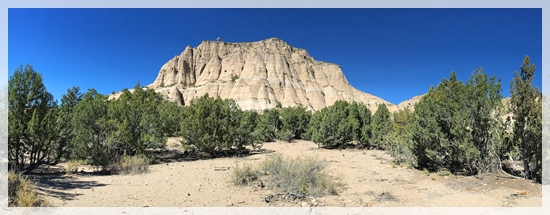
UtahThis is my command—be strong and courageous! Do not be afraid or discouraged. For the Lord your God is with you wherever you go.” [Joshua 1:6a,9 (NLT)]
Joshua 1:9 was my Bible verse for the day but I decided to make it my verse for the week. To make sure I kept it in mind, I wrote it on a post-a-note and stuck it where I’d be sure to see it: on my phone!

Wanting to put this inspirational verse in context, I reread the first chapter of Joshua. The book of Joshua is about the fulfillment of God’s promises to Abraham made four hundred years earlier. Its first chapter is one of my favorite chapters of the Old Testament narratives. To set the stage: Israel is camped on the east side of the Jordan River with the Promised Land in sight. Forty years have passed since the parting of the Red Sea. Moses is dead and only Caleb and Joshua remain of the adults who’d once been slaves in Egypt. The Israelites are standing on the edge of the unknown and the Jordan River is at flood stage. With no bridges or ferry boats, they must have wondered how they’d manage to get safely to the other side. Joshua is the new leader of the Israelites and God tells him to be strong and courageous.

Granted, God’s words were spoken to Joshua around 1400 BC in an entirely different setting but, because I’m standing on the edge of the unknown as well, God’s words to Joshua are both comforting and encouraging. Then again, we’re all standing on the edge of the unknown. None of us know what tomorrow (or even the rest of today) will bring: be it good news or bad, tornadoes or sunny skies, an accident or a near miss, the making of a new friend or the loss of an old one.

When Joshua is told to be strong, God wasn’t talking about working out at the gym. This strength had nothing to do with muscles unless, of course, we’re talking about spiritual muscles. It had to do with having the strength to prevail, withstand, and sustain. Being of good courage, is more than not being a fearful coward; it’s being alert both physically and mentally, steadfast, and determined. It wasn’t powerful foes or a lack of weapons, battle strategy, or seasoned warriors that threatened Israel; it was fear, discouragement, and weakness of faith.

Being strong and courageous is easier said than done. Nevertheless, God tells Joshua exactly how to do that: meditate on and obey the instructions in the Torah (the first five books of the Bible and the only scripture at the time). Authored by God through Moses, those books contained the people’s history and God’s law, promises and plan. If the Israelites had only done that, the Old Testament would be an entirely different (and far less violent) story! 3,400 years later, we’re no longer limited to a mere five books; we have both Old and New Testaments to make us strong and courageous. Just the same, knowing and obeying those words can be as much of a problem for us as it was for the Israelites.

At least for me, the best part of Joshua 1:9 is God’s promise that He is with us wherever we go. Whether we’re crossing a deep river or just going across the street, confronting an enemy army or a CT scan, or facing a walled city or the loss of a spouse, we know that, no matter what befalls us, God is with us. When we’re standing at an abyss, facing the great unknown, there is no need to be afraid or discouraged. We can be strong and courageous because we have his promise in writing; He is always with us, “even to the end of the age.”

If the Lord be with us, we have no cause of fear. His eye is upon us, His arm over us, His ear open to our prayer – His grace sufficient, His promise unchangeable. [John Newton]

Teach these new disciples to obey all the commands I have given you. And be sure of this: I am with you always, even to the end of the age. [Matthew 28:20 (NLT)]

Copyright ©2019 jsjdevotions. All rights reserved.

THE LAMB OF GOD – ASH WEDNESDAY

New mexicoThe next day John saw Jesus coming toward him and said, “Look! The Lamb of God who takes away the sin of the world! [John 1:29 (NLT)]
Today is the first day of Lent, a season in which we remember the time Jesus went into the wilderness and fasted for forty days and nights. Because Lent occurs in the weeks leading up to Good Friday and Easter, we tend to associate this period of Jesus’s life with the end of his ministry. It actually occurred early in His ministry, shortly after his baptism by John and his empowerment by the Holy Spirit.

During Jesus’s time in the wilderness, Satan visited and tempted Him. Jesus first was tempted to serve Himself—to alleviate his hunger by turning stones into bread. In the second temptation, Satan urged Jesus to jump off the Temple and reveal Himself in a spectacular display. This action would also test God’s love by coercing Him into saving Jesus. In the third test, Satan tempted Jesus to skip the cross altogether; all the kingdoms of the world would be His if only He’d worship the evil one.

Just because Jesus was divine doesn’t mean He couldn’t have fallen; He also was human and, like us all, susceptible to Satan’s wiles. He could have sinned as easily as Adam and Eve, but He didn’t! Resisting temptation was as essential to His mission as was suffering on the cross. Just as sin came into the world through one man, God would redeem the world through one man, but Jesus had to remain sinless for that to happen. If He hadn’t, there would have been no point to the cross; only a perfect sinless sacrifice could atone for mankind’s sins.

Because Jesus countered all of Satan’s temptations with Scripture, we tend to think of the temptation of Christ as sort of a “how to” manual on overpowering temptation. While it is that, it is so much more. Jesus didn’t go into the wilderness to teach us a lesson—He went into the wilderness to save us. He wasn’t just battling for His soul—He was fighting Satan for ours! He was defeating Satan by deliberating choosing to suffer for us as a man when He was God! He endured hunger when he could have spoken food into existence. He humbly chose to remain an obscure rabbi from Nazareth rather than use His power to win a following. Refusing to compromise with Satan, He chose obedience to God: to live, suffer and die as a man. Jesus, the spotless Lamb of God, chose to endure the cross for sinful selfish mankind: the very people who would put Him there!

For God made Christ, who never sinned, to be the offering for our sin, so that we could be made right with God through Christ. [2 Corinthians 5:21 (NLT)]

This High Priest of ours understands our weaknesses, for he faced all of the same testings we do, yet he did not sin. So let us come boldly to the throne of our gracious God. There we will receive his mercy, and we will find grace to help us when we need it most. [Hebrews 4:15-16 (NLT)]

Copyright ©2019 jsjdevotions. All rights reserved.

A MOUNTAINTOP EXPERIENCE – THE TRANFIGURATION

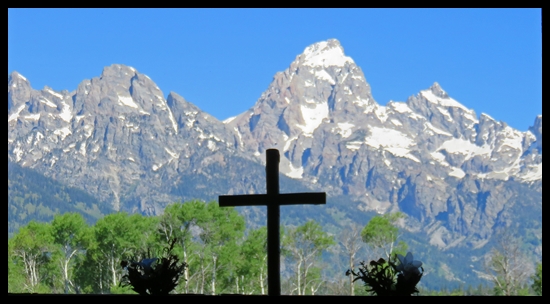
Chapel of the Transfiguration - Grand Teton National Park

Don’t misunderstand why I have come. I did not come to abolish the law of Moses or the writings of the prophets. No, I came to accomplish their purpose. [Matthew 5:17 (NLT)]

In the middle of Grand Teton Nation Park is a small log church, the Chapel of the Transfiguration. Built in 1925, it offers a beautiful view of the majestic Teton Mountain Range through a window behind the altar. When people gaze out that window, I wonder how many think of the amazing event—the transfiguration—that took place on another mountaintop more than 2,000 years ago.

About a week after Peter called Jesus “the Messiah sent from God!” and Jesus explained that He’d suffer, die, and be raised, Peter, John and James accompanied Him up a mountain to pray. While tradition says it was Mt. Tabor, both its height (only 1,800 feet) and location make that unlikely. While not as high as the 13,000 ft. Grand Teton, Mt. Hermon’s height (9,000 feet) and location make it the more likely location of this glorious event.

While praying, Jesus made a dramatic change: his face transformed and his clothes turned white and gleaming. Having only seen Jesus in his human form, His now glorious presence gave the disciples a greater understanding of his deity. Two men then appeared and spoke with Jesus about his exodus (or departure) from this world. They were Moses and Elijah—representing, at least symbolically, the Law and the Prophets. Jesus, as we know, was their fulfillment.

Amazed at what was the ultimate mountaintop experience, Peter foolishly suggested building three shelters for Jesus and his visitors. That, of course, was a mistake; neither the lawgiver not the prophet were Jesus’s equal. Furthermore, that Peter wanted this glorious event to continue would have kept Jesus from the mission He’d already explained to His disciples. A cloud then enveloped them all and a voice, unmistakably that of God, said, “This is my dearly loved Son, who brings me great joy. Listen to him.” [Matthew 17:5] The “Listen to him,” made it clear that the One who was new would be replacing the old way. After this powerfully dramatic event, the four men found themselves alone on the mountaintop.

Jesus commanded the disciples to keep silent as to what had taken place until after his resurrection. Looking for a Messiah who’d be a political deliverer rather than one who was a suffering servant, the world wouldn’t understand what had transpired. Even the disciples, the men who’d walked with Him for three years, didn’t fully understand the meaning of their mountaintop experience. It was not until Jesus joined them in that locked room on Easter that they finally understood that He’d come to conquer death rather than Romans.

The transfiguration was a foretaste of things yet to come and, someday, we all will see the fullness of Christ’s glory as did Peter, James, and John. Although Jesus told His disciples to keep his identity a secret, let us not forget that was only a temporary request. He later told them to “make disciples of all the nations.”

Jesus came and told his disciples, “I have been given all authority in heaven and on earth. Therefore, go and make disciples of all the nations, baptizing them in the name of the Father and the Son and the Holy Spirit. Teach these new disciples to obey all the commands I have given you. And be sure of this: I am with you always, even to the end of the age.” [Matthew 28:18-20 (NLT)]

Copyright ©2019 jsjdevotions. All rights reserved.