THE GOOD OLD DAYS

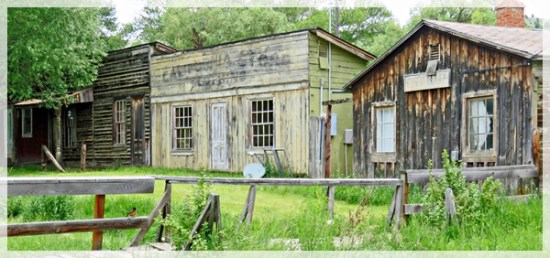
Virginia CityDon’t long for “the good old days.” This is not wise. [Ecclesiastes 7:10 (NLT)]

When talking with my centenarian mother-in-law, we often spoke of the “good old days.” She sometimes indulged in what I came to call “wishful remembering” and her past became more like a Hallmark movie than reality. I suppose, to some extent, we all do the same. The sledding hill grows steeper, the house bigger, the friends nicer, the grades better, the paycheck larger, and the success greater while any failure, disappointment, blame, pain, or drudgery diminishes. Not every memory we have, however, is a correct one; rather than an accurate record, our memories are actually what we tell ourselves about the past. Given the choice, it’s far nicer to have wishful good memories than ones of bitterness, regret and sorrow and I never corrected my mother-in-law’s. Nevertheless, we must be cautious of becoming too attached to our memories, especially if our less than accurate version of yesterday keeps us from moving into tomorrow.

Less than a month after God’s parting of the Red Sea and their song of victory and triumph at the defeat of Pharaoh, the Israelites had a serious case of wishful remembering and started to grumble. Instead of recalling the slaughter of baby boys and the back-breaking labor of Egyptian slavery, they remembered sitting around in comfort eating all the bread and stew they desired. Months later, they again complained about their hardships while recalling free fish, fruit and vegetables instead of the price they paid in sweat for that food. Rather than oppression, they remembered the “good old days” of Egyptian provision.

Sodom was the place where a gang of men wanted to attack Lot, sexually abuse his guests, and, for reasons beyond our understanding, Lot offered his virgin daughters to a mob of depraved men. When Lot’s family was told that Sodom was to be destroyed, they were urged to flee immediately and specifically warned to neither stop nor look back. Nevertheless, stopping and turning back is exactly what Lot’s wife did. According to the Moody Bible Commentary, the Hebrew word used for her looking back (vathabbet) has a very specific meaning of looking at something with desire or approval. Lot’s family left their home, possessions, friends, and even their sons-in-law behind. Choosing not to recall the evil, Lot’s wife turned, remembered the “good old days,” and longed for what had been and was no more.

When we follow God, we’re not promised an easy journey; in fact, Jesus pretty much promises we’ll encounter hardships. Stepping out in faith often means moving from comfort, convenience, and familiarity into the disruption, trials and vulnerability of the unknown. In light of new challenges and burdens, it’s easy to repaint the past with wishful memories of “the good old days.” As bad as the past may have been for either the Israelites or Lot’s wife, for them it seemed preferable to their unknown tomorrows. Those wishful memories, however, cost the Israelites an extra 38 years and Lot’s wife her life!

While wishful memories can make the past more palatable, they also can prevent us from experiencing the blessings of the future. We must never remember the good old days at the expense of failing to trust God with the new ones.

This means that anyone who belongs to Christ has become a new person. The old life is gone; a new life has begun! [2 Corinthians 5:17 (NLT)]

But I focus on this one thing: Forgetting the past and looking forward to what lies ahead, I press on to reach the end of the race and receive the heavenly prize for which God, through Christ Jesus, is calling us. [Philippians 3:13-14 (NLT)]

Copyright ©2019 jsjdevotions. All rights reserved.

REMEMBER LOT’S WIFE – The Pilgrim’s Progress

For there are many unruly and vain talkers and deceivers…Whose mouths must be stopped, who subvert whole houses, teaching things which they ought not, for filthy lucre’s sake. [Titus 1:10-11 (KJV)]

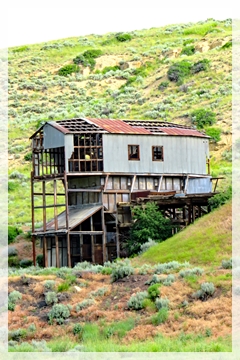
Smith Mine

Demas was a fellow worker of Paul’s during his ministry but, during Paul’s second imprisonment in Rome, Demas left abruptly. Paul wrote Timothy that Demas had deserted him because he loved the good things of the world. How sad it had to have been for Paul to write that he’d been forsaken by one of the men he’d trained, a man with whom he ministered, a man he loved. We don’t know if Demas forsook the Lord along with Paul or whether the worldly things he loved in life were fortune, fame, or flesh. Nowhere in Scripture do read any more of Demas or if he ever returned to the faith.

In John Bunyan’s The Pilgrim’s Progress, Christian and his companion Hopeful come to a hill called Lucre where they encounter Demas. Not a word we use nowadays, “lucre” is a Middle English word for money and both the King James Version of the Bible and Bunyan’s allegory were written in Middle English.

On Lucre hill, and just a little off the Way, is a silver mine. The ground around the mine is quite unstable (Bunyan calls it “deceitful”) and often collapses, causing severe injury or death to anyone who’s ventured too close. Calling to the Pilgrims and inviting them to step off the path is Demas. He promises that, with a little effort, they’ll become rich. Whether it’s merely curiosity or the lure of earthly treasures, Hopeful is tempted to step out of the Way but Christian cautions him. The Pilgrim asks Demas about the danger and whether the stop might hinder people on their pilgrimages. Although Demas assures them it’s not very dangerous if one is careful, his blush gives away the deceit in his answer.

Although Christian calls him an enemy of the Lord of the Way, Demas claims to be one of their comrades. Christian knows better and says Demas is the great-grandson of Gehazi [2 Kings 5:20-24] and the son of Judas [Matthew 26:14-15]: both men who betrayed the Lord for money. As Christian and Hopeful go on their way, other Pilgrims heed Demas’ call and disappear into the pit.

Christian and Hopeful then see a strange monument beside the Highway that looks much like a woman. Its sign reads: “Remember Lot’s wife!” They realize it is the pillar of salt that once was the woman who looked back at Sodom with a “covetous heart.” That she escaped one judgment (Sodom) only to be destroyed by another was a lesson not lost on the men. Serving as both a caution about sin and an example of God’s judgment, the monument stands in sight of Demas and the Pilgrims who prefer earthly treasures to the Way. Those tempted by Lucre’s promise could see the monument’s reminder if only they’d lift their eyes!

As others did before him and more have done after, Demas lost his way because of the allure of lucre. Bunyan’s lesson is clear: the lure of riches can lead us to a slippery and deceitful slope. Don’t venture too close or you may plunge into the depths! Run from sin and don’t turn back. Heed God’s warnings and “always remember Lot’s wife!”

Remember Lot’s wife. Whosoever shall seek to save his life shall lose it; and whosoever shall lose his life shall preserve it. [Luke 17:32-33 (KJV)]

Love not the world, neither the things that are in the world. If any man love the world, the love of the Father is not in him. [1 John 2:15 (KJV)]

Copyright ©2019 jsjdevotions. All rights reserved.

SHARING

For “everyone who calls on the name of the Lord will be saved.” How then will they call on him in whom they have not believed? And how are they to believe in him of whom they have never heard? And how are they to hear without someone preaching? [Romans 10:13-14 (ESV)]

tulips - keukenhof gardens -netherlandsThe king of Aram was at war with Israel, Samaria was under siege, and there was a great famine in the city. Even food that wouldn’t normally be eaten was prized. For example, the head of a donkey, considered an unclean animal, sold for about two pounds of silver. The situation was so dire that some people had even resorted to cannibalism. Without the intervention of God, there was no hope in sight.

Unwelcome in the city, four lepers, the outcasts of society, sat outside the city gate. The men were desperate; either they would die of starvation where they sat or violently at the hands of the enemy. Having nothing to lose, and on the off chance they might even be spared, they decided to surrender to the Arameans.

That evening, the lepers entered the enemy camp only to discover that it had been abandoned. As the prophet Elisha predicted, God had intervened; the Aramean soldiers, thinking they heard the sounds of a great army approaching, had fled the camp in panic. Although the camp was deserted, food, tents, clothing, livestock, silver and gold remained. The men went from tent to tent, enjoying the spoils as they ate and drank their fill and gathered up riches. The four then realized they had to let the townspeople know that the enemy had fled. These pariahs may well have been the last to receive any food had it become available. Nevertheless, fearful that something bad might happen to them if they didn’t share the good news and bounty of the deserted camp, they returned to the people who had shunned them as the “unclean.” The men told the city’s gatekeepers the good news that the siege was over and abundance lay just outside their gate.

We’re unlikely to be under siege and facing starvation in a walled city or to be considered “unclean” lepers and forced to sit outside the city gates, yet I wonder if this story might apply to 21st Christians. The lepers knew they were obligated to share the good news and that it was wrong not to share God’s blessings with the people of Samaria. If they hadn’t, the city could have starved while blessings lay just outside their gates. Their story teaches us about forgiveness and not bearing a grudge and is a reminder to share our blessings. Could this also be a lesson about evangelism? Do we have good news that should be shared? Do we know anything about the living water and bread of life that can feed a starving people and give them eternal life? Could those four lepers also be showing us the importance of sharing the good news of the gospel?

For if I preach the gospel, that gives me no ground for boasting. For necessity is laid upon me. Woe to me if I do not preach the gospel! [1 Corinthians 9:16 (ESV)]

Copyright ©2019 jsjdevotions. All rights reserved.

IN PREPARATION FOR THE JOURNEY

We broke camp at the Ahava Canal on April 19 and started off to Jerusalem. And the gracious hand of our God protected us and saved us from enemies and bandits along the way. So we arrived safely in Jerusalem. [Ezra 8:31-32a (NLT)]

Bryce - Losee CanyonAfter years of exile, the Jews were finally returning home from their captivity in Babylon. Ezra assembled a group of 1,500 men and their families and led the second emigration back to Jerusalem. It would take about four months for the over 5,000 people to make the 900 mile journey across the desert. Since they were transporting about 30 tons of silver, gold, and bronze along with wheat, wine, olive oil, and salt, there was serious danger from marauding bandits.

When Persia’s King Artaxerxes offered Ezra an armed escort, he refused. Having assured the king that God’s hand of protection was all they needed, it would have been embarrassing and hypocritical to then accept military help. The Judeans couldn’t just “talk the talk” about the Hebrew God, they had to “walk the walk” and live as if they truly believed Ezra’s words and God’s promises.

Instead of trusting in soldiers, Ezra chose to trust in God. Although he was confident in God, Ezra did not take His protection for granted. He gave orders for the people to fast and earnestly pray that God would take care of them. Knowing the trip could be disastrous without God’s protection, they committed themselves to trusting in God alone. This choice was a strong test of everyone’s faith. It’s remarkable that two chapters in the book of Ezra are written about their preparation for the trip, but just a few sentences tell about the journey itself and their safe arrival. Perhaps, if we spent more time in prayer and faith preparing for our life’s journeys, they would be as free of difficulty as Ezra’s.

Prayer is the key to Heaven,
But faith unlocks the door;
Words are so easily spoken,
Prayer without faith is like a boat without an oar.
Have faith when you speak to the Master,
That’s all he asks you for.
Prayer is the key to Heaven,
But faith unlocks the door.
[Samuel T. Scott & Robert L. Sande]

But when you ask him, be sure that your faith is in God alone. Do not waver, for a person with divided loyalty is as unsettled as a wave of the sea that is blown and tossed by the wind. Such people should not expect to receive anything from the Lord. [James 1:6-7 (NLT)]

Copyright ©2019 jsjdevotions. All rights reserved.

LIVING WITH AMBIGUITY

For we live by faith, not by sight. [2 Corinthians 5:7 (NIV)]

Lowdermilk Park rainbowAn early morning rainstorm left a rainbow over the Gulf. “Oh, thank you, Lord,” I said, “That’s just what I needed.” You see, I was suffering from a serious case of the glums and gloomies. Having recently undergone foot surgery, I knew some of my blues had to do with pain, poor sleep, the nuisance of immobility, undone tasks, and “cabin fever.” Nevertheless, that didn’t seem to fully explain my melancholy. Struggling to discern its underlying cause, I’d prayed that God would lead me to the root of the problem. In my darkness, I’d also asked Him to give me a little sign that He heard my pleas. God is big on rainbows—just ask Noah—and it felt like He hung that rainbow out just for me and hope was on the horizon.

Later that day, I came across an article listing the qualities of the prodigal son’s father. It included “willing to live with ambiguity” which struck a chord with me. Perhaps my prayers had been answered with that simple phrase. Preferring certainty to ambiguity, I knew that several unresolved issues, unanswered questions, and unclear courses were troubling me. Perhaps, my sadness was because, wary of living with the unknown, I wanted to walk by sight rather than faith!

Out of curiosity, I took an on-line test as to whether or not I’m a risk taker (someone willing to live with ambiguity). By this point in life, I knew the answer and the test results concurred with my assessment. “While you may take risks on rare occasions, you usually choose the well-traveled path,” it said while adding that I prefer a “stable environment in which changes are made gradually and with ample warning.” Telling me that I rarely seek out situations with uncertain outcomes was just another way of saying I don’t like to live with ambiguity. I’m not comfortable unless I know what’s around the next corner!

If I’d been Elisha, before joining Elijah as a prophet, I would have asked a neighbor to care for my plow and oxen rather than cooking the oxen over a plow-fueled fire. If I’d been Peter, I might not have stepped out of the boat. If I’d been Mary, I would have asked Gabriel a whole host of questions before saying I’d be the Lord’s servant. If I’d been Ruth, rather than go to Judah, I probably would have stayed in Moab. And, if I’d been Moses, I would have asked God for a detailed itinerary and map to the Promised Land. All of these people lived with ambiguity and answered God’s call without being given a step-by-step plan or knowing the outcome. They could live with ambiguity because they wholly trusted in the Lord.

Life is filled with unanswered questions and unknown outcomes. While I tend to think of risk and uncertainty as leading to things like loss, sorrow, weakness, insufficiency, insecurity, sickness, trouble, and failure, they also can lead to gain, joy, strength, plenty, confidence, health, opportunity, and success. Elisha, Peter, Mary, Ruth, and Moses all took risks and were blessed for it! Wanting a divine road map, I’d forgotten that I already have one in my Bible where I’m told to trust in God’s plan and reassured that He’s always with me.

Rather than seek to know what the future holds for us, we can seek God’s will and let Him show us where to go. We may not know what tomorrow brings but we know the One who holds our tomorrows in His hands. We can’t control every situation but, by the grace of God, we can control our attitude in every situation and learn to embrace the ambiguity of life.

It is not the cares of today, but the cares of tomorrow, that weigh a man down. For the needs of today we have corresponding strength given. For the morrow we are told to trust. It is not ours yet. It is when tomorrow’s burden is added to the burden of today that the weight is more than a man can bear. [George Macdonald]

May the God of hope fill you with all joy and peace as you trust in him, so that you may overflow with hope by the power of the Holy Spirit. [Romans 15:13 (NIV)]

Copyright ©2019 jsjdevotions. All rights reserved.

GETTING THE RIGHT MEANING

All scripture is given by inspiration of God, and is profitable for doctrine, for reproof, for correction, for instruction in righteousness: That the man of God may be perfect, thoroughly furnished unto all good works. [2 Timothy 3:16-17 (KJV)]

Author John Greco wrote of answering a call for a 24-hour phone prayer ministry to find a man in crisis. Sobbing, the caller confessed that he was a dog breeder and that he hadn’t known that every dollar he gave to the church was a sin that made God angry. A new believer, the man had been following a Scripture reading plan with his King James Bible. That morning, he’d read Deuteronomy 23:18: “Thou shalt not bring the hire of a whore, or the price of a dog, into the house of the Lord … for even both these are abomination unto the Lord thy God.” Thinking God found his tithe from selling dogs disgusting and sinful is what had him so distraught. What the man didn’t understand, but Greco patiently explained, was that, in the Old Testament, “dog” was a euphemism for “male prostitute.” Reassuring his caller, Greco read the same verse from the NIV translation: “You must not bring the earnings of a female prostitute or of a male prostitute into the house of the Lord….” The King James, being a word-for-word translation, had given the literal translation rather than the original meaning. The NIV, being about half way between word-for-word and thought-for-thought translations, used “male prostitute” with a footnote that explained it had been “dog” in the original Hebrew.

Curious, I looked up this same verse in a variety of translations. My NLT, which moves a little further down the thought-for-thought-chain, translates the words in question as, ”the earnings of a prostitute, whether a man or a woman” and also provides a footnote with the original word. Like the King James, the RSV is a word-for word translation but it adds a footnote indicating “dog” meant “sodomite.” The VOICE, a paraphrase translation, refers to the earnings from “cult prostitution.” Although each version is different, they all are right in their own way.

The Bible was originally written in Hebrew, Aramaic, and Greek and many of its original words don’t translate easily into English. For example, there were at least four different Greek words (phileō, storgē, eros, and agapē) for our one word “love.” Moreover, like “dog” for “male prostitute,” idioms often are difficult to translate. In 1 Samuel 24, the word-for-word KJV says that Saul went into a cave “to cover his feet” which doesn’t make sense to us. Covering his feet, however, was a Hebrew idiom for relieving himself (which the thought-for-thought translations make clear) and does make sense.

Because it is the first Bible I ever read, I will always treasure the King James translation; its version of the 23rd Psalm remains my favorite. Nevertheless, when I read that same psalm in the TLB, NLT, or Message versions, I see other nuances. Until reading the TLB’s “Because the Lord is my Shepherd, I have everything I need!” I hadn’t thought of it in terms of cause and effect. Rather than the “valley of the shadow of death,” the NLT broadens it to “the darkest valley,” and the Message refers to “Death Valley.” Thinking of actually traversing Death Valley—an unforgiving land of extremes where one could die from lack of drinking water or drown in a flash flood—and crossing more than 3 million acres of desolate wilderness—gives new depth to some very familiar words!

When we’re struggling to understand a difficult passage of Scripture or when we’ve heard or said the same verse so often that it’s lost its impact, using another translation is often helpful. Whatever Bible translation or translations we have on our bookshelves, however, the important thing is to open and read them!

Every part of Scripture is God-breathed and useful one way or another—showing us truth, exposing our rebellion, correcting our mistakes, training us to live God’s way. Through the Word we are put together and shaped up for the tasks God has for us. [2 Timothy 3:16-17 (MSG)]

Copyright ©2019 jsjdevotions. All rights reserved.