DIGGIN’ UP BONES – NEW YEAR’S EVE 2021

No, dear brothers and sisters, I have not achieved it, but I focus on this one thing: Forgetting the past and looking forward to what lies ahead, I press on to reach the end of the race and receive the heavenly prize for which God, through Christ Jesus, is calling us. [Philippians 3:13-14 (NLT)]

I’m diggin’ up bones, I’m diggin’ up bones
Exhuming things that’s better left alone
I’m resurrecting memories of a love that’s dead and gone
Yeah tonight I’m sittin’ alone diggin’ up bones. [Randy Travis]

lotusI was listening to Randy Travis sing, “I’m diggin’ up bones, exhuming things that’s better left alone.” It seemed an appropriate song for this time of year when we tend to dwell on the past—not just past loves, but past losses, mistakes, oversights, misunderstandings, injuries and pain. As one year ends and another begins, we often dig up all the grievances, regrets, and ”if onlys” of our yesterdays.

The word Randy Travis uses is “exhuming” and that’s a powerful word. When we exhume something, we’re not just digging in the dirt for weeds or post holes—we’re digging a corpse out of its grave and that’s a gruesome ghoulish thought. Once a body is buried, it’s meant to be left undisturbed; that also goes for all those old memories of things dead and gone.

When we dig up the past, we’re trying to rewrite history. Even if we could have a do-over, we would do no better the second time; we’d just make different mistakes and still have regrets! From any time-travel novel or movie, we know that time-traveling is complicated; small changes in the past can have major, and often bad, ramifications. In Back to the Future, Marty McFly nearly erases himself when he accidentally becomes his mother’s high school romantic interest. In Stephen King’s novel 11/22/63, after the protagonist prevents JFK’s assassination, he sadly discovers that the world is worse off because of his actions. Moreover, it’s our history—all of those sad, terrible, painful, embarrassing, frightening, and distressing experiences, along with all the good ones—that make us who and what we are today. We’re us, not in spite of the past, but because of our past.

If we don’t like who or where we are in life, that’s not the past’s fault and it’s certainly not God’s. Tomorrow is the start of a brand new year and we can make a fresh start. The good thing about God’s mercy, love and forgiveness is that we don’t need to wait another 365 days before we can start fresh again. God specializes in fresh starts and we can begin anew any moment of any day. Each minute we waste digging up the bones of the past is a minute we’ve lost to the wonders of the here and now. The only moment we have is this one; let us use it wisely and leave the old bones (and memories) where they belong—dead and buried.

The only way to get rid of your past is to make a future out of it. [Phillips Brooks]

And now, dear brothers and sisters, one final thing. Fix your thoughts on what is true, and honorable, and right, and pure, and lovely, and admirable. Think about things that are excellent and worthy of praise. Keep putting into practice all you learned and received from me—everything you heard from me and saw me doing. Then the God of peace will be with you. [Philippians 4:8-9 (NLT)]

Copyright ©2021 jsjdevotions. All rights reserved.
 

NEIGHBORS

For the whole law can be summed up in this one command: “Love your neighbor as yourself.” [Galatians 5:14 (NLT)]

The only way to have a friend is to be one. [Ralph Waldo Emerson]

When the religious scholar asked, “And who is my neighbor?” Jesus answered with the parable of the Good Samaritan in which he made it clear that one’s neighbors can be strangers—even enemies. Sometimes, however, our neighbor really is the guy next door or the couple sitting in the pew behind us at church.
Many of the houses in our Florida community have beautiful front porches and nearly every one of those porches has a lovely set of wicker chairs sitting on it. Yet, in all of our years here, I never have seen anyone sitting in those chairs. There was a time many years ago when people sat on their front porches and chatted with their neighbors after dinner. Now, I guess we’re all inside in front of our computers or televisions. Have we all become so busy with our own interests and activities that we have no interest in anyone else? Have we become so afraid of getting involved that we don’t even want to know our neighbors? How can we love them if we don’t even bother to meet them?

I thought of neighbors last night while driving through a nearby community famed for their over-the-top Christmas lights. With all the Santas, elves, snowmen, gaudy lights, and music, it was incredibly colorful, tacky, and fun, but it had little or nothing to do with Christ or Christmas. It did, however, have a lot to do with neighbors and friendship.

As we drove down the brightly lit streets, residents were outside chatting with one another, driving friends around in golf carts, or gathering around fire pits in front yards. Older children in Santa hats collected money for the Cancer Society and the little ones were toted around in wagons and strollers. With each street having a theme, neighbors had to talk to and work with one another to erect arches across their roads, place giant angels on the mailboxes, put candy canes in every yard on the block, or help one another assemble their elaborate displays. They probably discussed who on the block would play the holiday music and I’m sure several extension cords were shared. The residents had to communicate, cooperate, and assist one another. In fact, they seem to enjoy decorating so much that they also bedeck the neighborhood for Halloween. Their little community isn’t just a group of homes with the same zip code and garbage pick-up day; it is a group of neighbors who share and care—both for the community and for one another.

Taking the Good Samaritan parable seriously, my husband and I care for our neighbors—or at least the ones we don’t know: the nameless faceless ones who benefit from our donations to good causes. While that’s loving our neighbor, it’s the impersonal and easy way to do it. Rather than simply writing checks for the neighbor we’ll never know, we should think a little closer to home and find ways to know the neighbors down the street. Maybe it’s time to meet the woman next door, make an effort to go beyond a quick hello to the couple with the schnauzer, invite the recently widowed man down the street to dinner, or introduce ourselves to that stranger at church. Perhaps, that neighborhood with the extraordinary holiday decorations had more to do with love, Christ, and Christmas than I realized.

I have always wanted to have a neighbor just like you,
I’ve always wanted to live in a neighborhood with you.
So let’s make the most of this beautiful day,
Since we’re together we might as well say,
Would you be mine? Could you be mine?
Won’t you be my neighbor? [Fred Rogers]

This is my commandment: Love each other in the same way I have loved you. [John 15:12 (NLT)]

Do to others as you would like them to do to you. [Luke 6:31 (NLT)]

Copyright ©2021 jsjdevotions. All rights reserved.

CUSTARD PIES

Consider it pure joy, my brothers and sisters, whenever you face trials of many kinds, because you know that the testing of your faith produces perseverance. Let perseverance finish its work so that you may be mature and complete, not lacking anything. [James 1:2-4 (NIV)

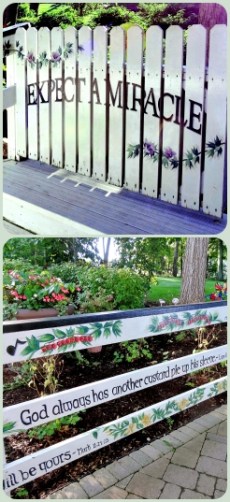
When we lived in the north, we often walked a public path that meandered along the shoreline of a nearby lake. Running through both public and private properties, it crossed the front lawns of historic lakefront estates and stunning homes with beautifully landscaped yards and gardens. One such home placed a lakeside bench for tired walkers that said, “Sit-Pray-Mediate-Enjoy” under a sign that read, “You can trust me. Love, God.” A delightful white fence delineated their private property from the public path. Decorated with whimsey, “Expect a Miracle” was the message on the gate and assorted Bible verses and words of wisdom were painted on the fence’s horizontal slats.
I laughed at actress Lynn Redgrave’s observation that, “God always has another custard pie up his sleeve.” Having grown up watching the Three Stooges, Laurel and Hardy, and Soupy Sales, I knew exactly what she meant! Custard pies are the unplanned quirky episodes of life—the glitches, bugs, hitches, curve balls, obstructions, setbacks, and snags that seem to arise when we least expect them. While they’re not necessarily earth-shattering or tragic, they upset the apple cart of our lives and can throw us off our game!

Sometimes those custard pies come at us the way candy on a conveyor belt did in an old I Love Lucy episode called “Job Switching.”  Working in a candy factory, Lucy and Ethel’s job seemed simple enough: wrap candies as they came down the line. All went well until the line sped up and the candies came faster and faster. Knowing they’d be fired if any unwrapped candy reached the packing room, the women frantically grabbed the candies off the belt and ended up stuffing them in their mouths, hats, and blouses. “I think we’re fighting a losing game,” admitted Lucy.

Most of us can handle one or two custard pies at a time but, when they come flying at us as fast as the candy came to Lucy and Ethel, we feel like we’re playing a losing game and our faith is challenged! As Ms. Redgrave said, it does seem like God has an endless supply of custard pies up his sleeve. For many of us, the last twenty months have been a speeding conveyor belt of those pies and, with months of disappointments, complications, delays, and uncertainty, little went according to our expectations or plans. Before God tosses another pie my way, I wish He’d give me a warning so I could duck!

Nevertheless, as Christians, we know that those pies are part of God’s greater plan for us. Life is unpredictable at best and we need to accept its capriciousness with proper perspective, a positive outlook, a sense of humor, and faith in the One who is in charge. In the meantime, I’ll follow the advice painted by that home owner. Knowing that God loves me, I’ll trust in Him and expect a miracle (or two). I’ll sit, pray, meditate, and enjoy what God has put before me—even if it’s another custard pie!

Challenges are what make life interesting; overcoming them is what makes life meaningful. [Joshua J. Marine]

Though the fig tree does not bud and there are no grapes on the vines, though the olive crop fails and the fields produce no food, though there are no sheep in the pen and no cattle in the stalls, yet I will rejoice in the Lord, I will be joyful in God my Savior. [Habakkuk 3:17-18 (NIV)]

Copyright ©2021 jsjdevotions. All rights reserved.

ONLY THE BEST

When it was time for the harvest, Cain presented some of his crops as a gift to the Lord. Abel also brought a gift—the best portions of the firstborn lambs from his flock. The Lord accepted Abel and his gift, but he did not accept Cain and his gift. [Genesis 4:3-5a (NLT)]

My guests never get the first piece of pie or lasagna because it always turns into a broken, sticky mess with half of it remaining in the pan. They also don’t get the over-baked cookies, the frayed towels, chipped china, or last night’s left-overs. Since I would never serve a guest anything but the best I have to offer, why is it so tempting to give God less than our best?

While Abel offered his first and best, Cain didn’t and we’ve continued much the same way today. We often complain when we’re asked to serve and begrudge the time spent serving. We give God our money after we’ve purchased everything we want and our prayers only when we can find the time or want something. We read His word when there’s nothing better to do, worship Sunday morning if we wake up in time or the golf game is cancelled, and volunteer only at our convenience. It’s our outdated cans that we bring to the food pantry and our stained and torn clothing that we donate to the resale shop.

When Cain and Abel brought their gifts to the Lord, Cain, a farmer, gave from his crops and Abel, a shepherd, gave from his flock. Literally translated, Cain “bringeth from the fruit of the ground a present to Jehovah” and Abel brought “from the female firstlings of his flock, even from their fat ones.” While God was pleased with Abel’s offering, He wasn’t with Cain’s. Some commentators explain God’s displeasure by saying He wanted an animal (blood) sacrifice rather than the bloodless sacrifice from the soil. Scripture, however, doesn’t say that it had to be a blood sacrifice. The Hebrew word used was minchah which clearly meant gift, tribute, or offering and the later law of Moses tells us that both animal and plant offerings were acceptable. The brothers’ offerings were appropriate for their occupations.

God’s problem wasn’t that one gift was fauna and the other flora; he was displeased with one giver’s heart! Showing his love for God, Abel didn’t give just any animal from his flock; he gave the “firstlings.” The Hebrew word used was bakar, meaning the first and best animals. While there is a similar Hebrew word, bakkurah, (translated as “firstfruits”) for the first and best of a grain or fruit offering, that word was not used for Cain’s gift. While the subtle difference is easily missed by 21st century readers, it would have been abundantly clear to the Israelites. While Abel gave the best, Cain just gave some. We don’t know if his offering was blemished, bruised, or just the leftovers from his harvest, but we do know it wasn’t the first and best!

God didn’t confront Cain because he failed to offer meat; he confronted him because Cain’s heart wasn’t in the right place. Rather than an act of worship, his gift was offered begrudgingly rather than willingly, out of a sense of duty than one of love.

We know from the story of the widow’s two coins that it’s not the kind or size of the offering that matters—it’s the heart attitude of the giver that’s important. Man sees only the gift but God sees the heart of the giver. Hallmark’s “When You Care Enough to Send the Very Best” is one of the most recognized slogans of all time. God gave us His best in Jesus; can we give Him anything less in return? Do we care enough to give Him our very best?

We offer with joy and thanksgiving what you have first given us—our selves, our time, and our possessions, signs of your gracious love. Receive them for the sake of him who offered himself for us, Jesus Christ our Lord. Amen. [Lutheran Book of Worship]

Honor the Lord with your wealth and with the best part of everything you produce. [Proverbs 3:9 (NLT)]

As you harvest your crops, bring the very best of the first harvest to the house of the Lord your God. [Exodus 34:26 (NLT)]

Copyright ©2021 jsjdevotions. All rights reserved.

ANSWERED PRAYERS

And we are confident that he hears us whenever we ask for anything that pleases him. And since we know he hears us when we make our requests, we also know that he will give us what we ask for. [1 John 5:14-15 (NLT)]

May he grant your heart’s desires and make all your plans succeed. [Psalm 20:4 (NLT)]

santaWhat do you hope to find tucked into your Christmas stocking or deposited under the tree Christmas morning? From the above words, it’s easy to think God is promising something like Christmas morning every day. Although He promises to hear and answer our prayers, let’s remember that He’s not so specific as to how He’ll answer them.

Remember the story of King Midas? As a reward for the King’s kindness, Dionysus offered Midas anything he wanted. Coveting wealth, Midas wanted everything he touched to be changed into gold. Although he was warned to think seriously about such a wish, the king insisted. How thrilled he was when the twigs and stones he handled became precious metal. Midas’ joy at his gift began to fade, however, when he discovered that gold roses have no aroma and food became metal before it could be eaten. After a simple touch turned his daughter into a golden statue, the king detested the gift he’d so desired. Taking pity on him, Dionysus told the king to wash in the river Pactolus to lose his golden touch and make things right again.

While the Midas story has pagan beginnings, there is much a Christian can learn from this ancient myth, the first of which is not to love material possessions. When we pray, we shouldn’t act like children looking through Amazon’s “Ready, Set, Play” holiday toy catalog or grown-ups browsing through the Neiman Marcus 200-page Christmas Book and marking the pages with our holiday fantasies. Prayer is not like writing a wish list to Santa for all the gifts we desire and God’s promises are never an excuse for greed or selfishness.

Unlike a mythical Greek deity, God will not give us anything that could harm us. While we’re not likely to ask for a snake or scorpion, we have been known to ask for other things that could bring us harm—the extra money, new job, sexy guy at work, vacation in Vegas, or that big house with an even bigger mortgage. Just like King Midas, our limited (and selfish) perspective cannot possibly see all of the ramifications of our prayer requests. We ask for things without understanding how they may affect our life or the lives of others. We may know what we want but God, in his infinite wisdom, knows what will happen if we get it. If God had given me everything for which I prayed, it would have taken way more than a bath in the river Pactolus to clean up the resulting mess and set things right again. It’s been said that God’s answers are far wiser than our prayers and, indeed, they are. With love and wisdom, in His own time and way, God will always answer our prayers. Let’s give thanks that “Yes” is not always His answer to our requests.

The devil doesn’t come in a red cape and pointy horns. He comes as everything you’ve ever wished for. [Anonymous]

You fathers—if your children ask for a fish, do you give them a snake instead? Or if they ask for an egg, do you give them a scorpion? Of course not! So if you sinful people know how to give good gifts to your children, how much more will your heavenly Father give the Holy Spirit to those who ask him. [Luke 11:11-13 (NLT)]

Copyright ©2021 jsjdevotions. All rights reserved.

BUBBLING OVER

Words bubble up from waters deep within a person; a stream gushes from the fountain of wisdom. [Proverbs 18:4 (VOICE)]

Reichenback Falls - Switzerland“A children’s story which is enjoyed only by children is a bad children’s story,” said C.S. Lewis. I agree and admit to enjoying the seven books comprising Lewis’ The Chronicles of Narnia both as a child and an adult. Even though the Narnia books take place in a make-believe world filled with talking animals, mythical creatures, and magic, there are Christian overtones to the entire series. For example, the first book calls up images from Genesis when Aslan, the Great Lion, sings Narnia into existence and evil is introduced to the land. In the second, Aslan willingly dies so that the sins of one boy are forgiven but comes alive again. In another book, Eustace, who had “greedy, dragonish thoughts” becomes a dragon. When Aslan strips away the boy’s scales and throws him into the water, the repentant boy is transformed and images of rebirth and baptism come to mind. Resembling the last book of the Bible, the final story in the series tells of a beast, a false prophet, Narnia’s fall, and a Narnian paradise (where sadness and weariness do not exist).

In spite of the Christian symbolism throughout the series, Lewis never set out to use his fairy tale as a way of writing a “Christian” book for children. “Everything began with images, a faun carrying an umbrella, a queen on a sledge, a magnificent lion. At first there wasn’t even anything Christian about them,” said Lewis. In fact, that image of the faun had been in his mind since he was 16, long before he became a believer. When Lewis began writing The Voyage of the Dawn Treader, he thought it would be the last in the series. He didn’t anticipate writing four more Narnia books and evoking the end times with the last one. How then did his books become “Christian”? The author explained: “That element pushed itself in of its own accord. It was part of the bubbling.”

Without deliberately meaning to do so, Lewis’ deep faith in Christ couldn’t help but bubble over into his work. As the tale solidified, Lewis found himself answering the imaginary question of “What might Christ become like if there really were a world like Narnia, and He chose to be incarnate and die and rise again in that world as He actually has done in ours?” The question, however, came after he’d begun writing the answer.

Lewis’ phrase, “part of the bubbling,” got me thinking. Gifted with a brilliant mind, C.S. Lewis has been called “one of the intellectual giants of the 20th century.” Nevertheless, I don’t think those stories sprang just from his genius; they came from the presence of the Holy Spirit! His genius may have put the words on paper but the spring from which they bubbled over was filled with Biblical truth, Christian doctrine, and love of God. Once Lewis became a believer, he couldn’t help but put Christian ideals and a Biblical worldview into everything he said or wrote.

None of us are likely to be called intellectual giants but, as followers of Jesus, I wonder if what bubbles out of us in our day-to-day existence reflects our faith the way it should. Instead of imagining what Christ would be like in Narnia, perhaps we should consider what He would be like in our world today and then make Him visible in our words and actions. What bubbles from our fountain?

There is but one good; that is God. Everything else is good when it looks to Him and bad when it turns from Him. [C.S. Lewis]

Do not slack in your faithfulness and hard work. Let your spirit be on fire, bubbling up and boiling over, as you serve the Lord. [Romans 12:11 (VOICE)]

Copyright ©2021 jsjdevotions. All rights reserved.