
And while they were there, the time came for her to give birth. And she gave birth to her firstborn son and wrapped him in swaddling cloths and laid him in a manger, because there was no place for them in the inn [Luke 2:6-7 (ESV)]
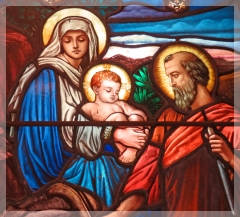 Tomorrow (December 16) is the first day of Las Posadas. Originally a solemn Christmas novena, it was brought to Mexico in 1587 by Spanish priests. Perhaps, because it occurred during the Aztec celebration of the birthday of their pagan god Huitzilopochtli, what began as formal nine-day prayer vigil eventually moved out of the church and into the community where it became a nine-day religious pageant.
Posadas is Spanish for “lodgings” or “accommodations” and the ritual commemorated Mary and Joseph’s trip from Nazareth to Bethlehem. At dusk December 16, people dressed up as Mary and Joseph, angels, and shepherds reenacted the couple’s journey and their unsuccessful search for lodging. Going to several houses each night, the pilgrims (called Peregrinos) were sent away until the ninth night (Christmas Eve) when they finally were given shelter. People along the route decorated their homes’ entrances with luminaria to light the way. This tradition spread into our nation’s southwest when Catholic settlers migrating from Spain and Mexico came northward.
When reenacting Mary and Joseph’s quest for housing, the participants sang a carol called “Pidiendo Posada” and the verses alternated between those outside seeking lodging and those responding from behind their doors. “In the name of the heavens I request lodging from you…,” sang the pilgrims while, from inside, they’re told it’s not an inn and the door won’t be opened because they could be scoundrels. The song went back and forth as the pilgrims begged for mercy and promised God’s reward but were answered with denials, excuses, and threatened with a beating. Although the Peregrinos identified Mary as “the Queen of Heaven,” the response was doubt that a queen would travel without an entourage. Not until the last house and entrance was gained was the final verse sung: “Enter holy pilgrims. Receive this haven. That although it’s a poor dwelling I offer it to you from the heart.”
When a homeowner received the Peregrinos, they were welcomed with food and a piñata shaped like a seven-pointed star. Like everything else about Las Posadas, the star had religious significance. Representing the star of Bethlehem, each of its points represented one of the seven deadly sins, and its bright colors denoted the lure of sin. Participants were blindfolded and made to turn around 33 times before trying to hit and break the piñata with a stick. The 33 turns represented the years in Jesus’ life and the resulting dizziness denoted the disorientation caused by temptation. The blindfold signified Christians’ blind faith that good will triumph over evil, the stick represented the virtue needed to overcome sin, the breaking of the piñata symbolized the triumph of good over evil, and the candy and fruit that spilled out once the piñata broke open signified the riches of the kingdom of Heaven. The rituals of Las Posadas served as a perfect way to teach a largely illiterate population the Christmas story and the gospel message.
Through the centuries, piñatas have lost most of their religious connotation and can be found in all sorts of shapes and sizes at all times of the year. While Las Posadas celebrations continue wherever a large Hispanic population is found, its observance has changed, as well. Rather than the original nine days of processions, it often is observed only one night. Like the piñata and many of our Christmas traditions, it even has become secularized in some places with Santa’s appearance.
Beyond its pageantry and symbolism, what does Las Posadas mean to those of us who are neither Roman Catholic nor of Hispanic origin? Since it’s about welcoming strangers in need, we might recall that this beautiful tradition was brought to our country hundreds of years’ ago by immigrants who, like the Holy Family, were seeking a place of refuge. There are parallels between Joseph and Mary’s pilgrimage to Bethlehem (and their escape from Herod into Egypt) and the challenges today’s migrant families face when they flee their countries. While Las Posadas is about the importance of finding room for Jesus in our hearts so that His Spirit can live in us, it also is about finding room in our hearts for others who, like Joseph and Mary, seek safe shelter. A local Hispanic pastor explained that Las Posadas is about “doing right by Christ.” Let us remember that Jesus made it clear what doing right by Him meant.
There was no room that night so long ago, will we make room for Him today?
 In Jesus’ day, Roman law allowed a soldier to compel any able-bodied man in a conquered province to carry the soldier’s gear one mile. A Roman mile was 1,000 paces of five feet each (a little less than our mile) and a soldier’s pack could weigh as much as 100 pounds. In a similar way, Roman soldiers forced Simon of Cyrene to carry the cross of Jesus out of Jerusalem. Such impressment by an occupying army was viewed with outrage by the Jews and yet Jesus told them to willingly carry the load beyond what demanded by the soldier.
 When she lived in Florida, my mother-in-law hired a woman to do the cleaning. In spite of representing herself as a “cleaning service,” this woman had a long list of “won’ts”—won’t do windows, mirrors, get on step ladders, move furniture, or bend over to wipe the baseboards, etc. Nevertheless, she always had a long list of complaints and financial needs that she was more than willing to share.
 Although it sounds like something Satan might say to his demons, it was Alex Dumas, CEO of Hermès, who said “Our business is about creating desire.” It’s not just Hermès (with their $8,500 Della Cavalleria “magical bag”) that is in the business of creating desire; that seems to be the goal of many businesses. The LA Times has a “Coveted” column in their Image magazine featuring a curated list of luxury items (like $950 Gucci sneakers) they claim to be “mandatory” or “must-haves.” The October Vogue featured “coveted street style trends,” (like $1,364 velvet trousers and $600 Levi jeans) while urging its readers to purchase them “before it’s too late.” There’s even an on-line game called “Covet Fashion” in which you build your virtual dream wardrobe and then follow links to purchase the desired items.
 While researching 1st century dining habits, I learned how guests traditionally were seated. Although da Vinci’s famous mural places Jesus in the middle of the group at a long rectangular table, the position of Jesus (as the host) would have been second from the left on the left side of a U-shaped table. Customarily, a trusted friend was seated to the host’s immediate right and the guest of honor to the host’s immediate left. The rest of the diners were seated to the left starting with the highest-ranking person and proceeding on down to the least important. If a servant were present during the meal, the last seat was his since it was closest to the door. With no servant, it was given to the youngest or lowest ranking guest.
 When picturing the Last Supper, we probably visualize it much like Leonardo da Vinci’s famous mural with the men seated on chairs at one long table. While visually appealing, the picture is inaccurate. Instead of sitting on chairs with their feet concealed under the dinner table, Jews and Romans in Jesus’ day lounged on low sofas or cushions surrounding a low three-sided table called a triclinium. The cushions or couches were placed on the outside of the three sides which left the inside open for serving and entertainment. Diners would recline on their left sides, lean into the bosom of the person on their left, support their heads with their left arms, eat and drink with their right hands, and stretch their legs out to the right.
