
For the Kingdom of God is not just a lot of talk; it is living by God’s power. [1 Corinthians 4:20 (NLT)]
 When John Bunyan wrote The Pilgrim’s Progress, he was concerned both with the godless unbeliever and the casual and superficial believer: the nominal or counterfeit Christian. We all know them: people who may look and talk a lot like Christians but don’t live like one. Without even realizing it, we may even be one!
When Christian and Faithful encounter Mr. Talkative, Faithful initially considers the man a fine companion; he’s enthusiastic, speaks well and knows his Scripture. Christian, who knew Talkative in his hometown, warns Faithful that, “Religion has no place in his heart, or house, or lifestyle. The man’s religion is found only in his tongue rather than in him.” Known as a saint abroad and a devil at home, Christian says Talkative is the sort of man who’s better looking from a distance. Although he can talk about faith, repentance, being reborn, and prayer, like the Pharisees, he doesn’t practice what he preaches. Christian then points out that Talkative isn’t even aware of the difference between speaking and being; he’s deceived himself into thinking that hearing and talking are all he needs to be a good Christian. “Knowing is a thing that pleases talkers and boasters, but doing is the thing that pleases God,” agrees Faithful.
Testing his new companion and cautioning him not to give an answer to which God would not give an “Amen!” Faithful asks Talkative, ”Does your religion exist in word or tongue and not in deed and truth?” Balking at giving a reply, Talkative leaves the men. After Christian points out, “Just as a body without the soul is dead, so talking by itself is but a dead carcass,” Faithful promises that he’ll pay closer attention to the distinction between talking and doing in the future.
Faithful observes that just as a prostitute is a shame to all women, a man like Talkative is a shame to all true believers. Christian adds that the number of people whose religion is in their words rather than their life is the reason religion stinks in the nostrils of so many men. We don’t have to be well-known evangelists caught in financial or sexual improprieties to give Christianity a bad name. We just have to be like Talkative: people whose religion is found only in their words rather than their hearts and actions.
I wondered at my answer to Faithful’s question; does my religion exist in word or tongue (or, in my case, web page) and not in deed and truth? What would be your answer to Faithful’s question? More important, would God shout a loud ”Amen!” in agreement to our answers? Let us always remember that faith without works is dead and it takes far more than words to be Christ’s witnesses.
The greatest single cause of atheism in the world today is Christians: who acknowledge Jesus with their lips, walk out the door, and deny Him by their lifestyle. That is what an unbelieving world simply finds unbelievable. [Kevin Max]
 By 1658 in England, it had become illegal to conduct a religious service differing from the Church of England’s official liturgy or for “one not in Episcopal orders” to address a congregation. A Puritan, John Bunyan, was arrested for preaching the gospel without a license. After three months in the Bedford jail, he was offered his freedom if he’d agree not to preach publicly. He refused saying, “If I was out of prison today, I would preach the gospel again tomorrow by the help of God.” Bunyan spent twelve years imprisoned. During that time, he wrote The Pilgrim’s Progress. No country cub prison, the Bedford jail was overcrowded, unsanitary, unheated, and the plague of 1665 claimed forty prisoners as victims. Years later, Bunyan wrote: “Satan can make a jail to look like hell itself.” Although all looked hopeless for the man, he found strength in prayer and in his writing.
 When we’re told to “Be still” in Psalm 46, we tend to think in terms of stopping movement—our busyness, frantic activity, or agitated actions. We associate it with a director yelling, “Cut!” the ref blowing his whistle, or a frustrated parent’s “Cut it out!” Being still can entail all of that, but it is much more. The root of the original Hebrew word used for “still” is the verb rapa which means to be faint, forsake, or sink down. When used as the imperative ra’pha’h, as it is in Psalm 46, it means to drop or release our concerns, to become weak, or surrender. While most Bible versions translate this as “Be still,” some translate as desist, stop fighting, cease striving, be quiet, or be at peace. In short, we’re being told to stop anxiously fighting a situation and leave the matter to God—to relax our grip on things, stop worrying and let it be.
 As a friend’s father used to say, “I couldn’t have made the day any better myself!” The temperature was perfect, the humidity had dropped, the pink of the sunrise tinged the early morning sky, and the aroma of jasmine made every breath a pleasure. When I looked one way, I still could still see the full moon and, when I looked the other, I saw the golden fire of the rising sun. Like a mirror, the lake reflected the clouds and colorful sky. Mocking birds were singing their joyful songs, rabbits were munching the grass, squirrels were chasing one another, ducks effortlessly glided through the water, and a few woodpeckers were tapping on the palms. It seemed like God had given me the beautiful morning as a special birthday gift. Of course, I know He didn’t do it just for me but it felt that way. I was especially appreciative of these little everyday things because I knew it would be my last walk for many weeks; the following day I was having foot surgery and faced a long recovery. As I tried to gather in the morning’s memory to keep me content for the next several weeks of inactivity, I wondered why I didn’t appreciate every morning as much as that day’s.
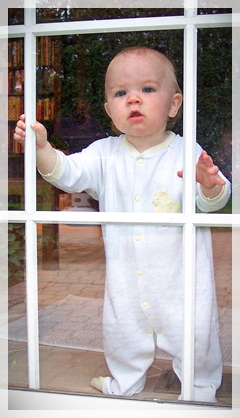 Although my husband attended law school, there is one law he never knew until he became a father: the Toddler Property Law. Starting out with the basic premise of “What’s mine is mine!” it then defines exactly what is meant by “mine.” The toddler defines “mine” as the following: it’s mine if I like it; if I think it’s mine, it is; if it’s yours, it’s mine; if I can take it from you, it’s mine; if I had it but put it down, it’s still mine; if you had it but put it down, then it’s mine; and, if it is broken, it’s yours.
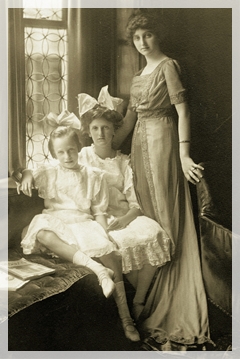 My Great-aunt Camilla began to lose her hearing as a girl and was completely deaf by the time she reached adulthood. Although she didn’t sign, she did lip-read quite well. In spite of her deafness, as long as we were face-to-face, we were able to converse without much difficulty. However, if Camilla didn’t want to continue the discussion or disagreed with us, she’d simply turn away and refuse to look at us. Tug as we might at her sleeve, she’d not turn back to rejoin the conversation until we’d convinced her that the subject had changed to one she preferred or that we agreed wholeheartedly with her opinion.
