NOT EVERYTHING IS A PROMISE

Their purpose is to teach people wisdom and discipline, to help them understand the insights of the wise. Their purpose is to teach people to live disciplined and successful lives, to help them do what is right, just, and fair. These proverbs will give insight to the simple, knowledge and discernment to the young. [Proverbs 1:2-4 (NLT)]

gulf fritillaryWhen claiming God’s promises, we must be cautious of thinking the words of Proverbs come with the same guarantee as do God’s promises. Rather than promises or fool-proof formulas, Proverbs are general life principles telling us how to live honorably, constructively, and successfully in the world. While they prove true far more often than not, they do not ensure success. For example, in spite of directing our children on a godly path and teaching them to seek God’s wisdom [Proverbs 22:6], they still may walk away from the faith and righteous living. Nevertheless, there’s a far better chance for that child to walk the right path, or return to it after straying, if his parents taught him God’s ways.

Proverbs 1:1 credits the wise King Solomon with its words but we know he wasn’t the only author. Although chapters 1 through 24 probably were written around 950 BC. during his reign, Proverbs 22:17 introduces a nameless sage whose thirty wisdom sayings continue though Proverbs 24:22 where we find “further sayings of the wise” similar in style to the previous section. The thirty proverbs in those chapters are markedly similar to sayings found in The Instructions of Amenemope, a book of Egyptian wisdom believed to have been written prior to Solomon’s time. Since Solomon made a successful alliance with Egypt and married one of Pharaoh’s daughters, it is likely that he was familiar with Egyptian wisdom. The king who wrote, “Intelligent people are always ready to learn. Their ears are open for knowledge,” [18:15] may well have read Amenemope’s words and modified the Egyptian advice by adding references to the God of the Israelites. On the other hand, the Egyptian texts could be misdated or two wise men penned remarkably similar texts independently; we don’t know.

Proverbs 25 credits King Hezekiah (716-687 BC) with compiling the next collection of Solomon’s proverbs. This was a time of spiritual renewal and, with over 3,000 of Solomon’s pithy sayings from which to choose, Hezekiah’s scribes may have gathered, edited, and added these to the previous collection. The dates of the last two chapters of Proverbs are unknown and they are attributed to men not mentioned elsewhere. Chapter 30 is credited to Agur, son of Jakeh and Chapter 31 to King Lemuel. While Agur clearly knew that God’s wisdom was greater than his own, Lemuel ascribes his wise instruction to his mother’s sage advice. Although Jewish tradition often attributes this last chapter to Solomon, several Aramaic spellings indicate non-Israelite schooling. Regardless of who laid pen to parchment, the voice of God is heard in all of Proverbs’ words. God’s wisdom has no boundaries and He may have inspired different people with His words.

The wisdom that starts with fear of the Lord is found in Proverbs. Noting that Jesus’ prayer said, “On earth as it is in heaven,” Eugene Peterson calls wisdom “the biblical term for this on-earth-as-it-is-in-heaven everyday living.” Like a handbook for righteous living, Proverbs’ wisdom gives us a guide for our daily lives. When taken to heart, its words can shape our thinking, attitude, and moral character so that we are better able to live according to God’s ideal. They may not be promises, but they are wise advice!

Fear of the Lord is the foundation of wisdom. Knowledge of the Holy One results in good judgment. [Proverbs 9:10 (NLT)]

Let the wise listen to these proverbs and become even wiser. Let those with understanding receive guidance by exploring the meaning in these proverbs and parables, the words of the wise and their riddles. Fear of the Lord is the foundation of true knowledge, but fools despise wisdom and discipline. [Proverbs 1:-7 (NLT)]

Copyright ©2020 jsjdevotions. All rights reserved.

 

CATALOG OF JOY

Make a joyful noise to the Lord, all the earth! Serve the Lord with gladness! Come into his presence with singing! Know that the Lord, he is God! It is he who made us, and we are his; we are his people, and the sheep of his pasture. [Psalm 100:1-2 (ESV)]

The surest mark of a Christian is not faith, or even love, but joy.[ Samuel M. Shoemaker]

great blue heronWhen we retired, we joked that our pill boxes were the only way we knew the day of the week. Now that we’re sheltering in place, that is more true than funny. For young and old alike, the days are blending one into the other with the only difference between yesterday and today being the news (which just seems to gets worse).

While COVID-19 is an enemy lurking at our door, chances are another enemy has already entered our lives: common garden variety depression—what I call the glums and gloomies. As the days wear on, it’s harder to see the bright side of life. Built for community, we now live in a world where kisses are weapons and we show our love by staying away from one another! Instead of hoarding toilet paper and bleach wipes, we wish we’d stockpiled hugs. We’d happily trade a bottle of hand sanitizer just to cuddle with a grand for a minute or shake a friend’s hand.

This prolonged isolation reminds me of a winter spent at our mountain home back in 1997. Having broken my knee the first day on the slopes, my mobility was severely limited. In spite of having hung up my skis for the season, I maintained good spirits until my husband and son departed for two weeks on business. Although they left me well stocked with food and a stack of library books, it was just me, my crutches, and the four walls for the duration and the glums and gloomies descended in full force. In one of those beautiful God-incidences, I happened upon an Oprah show about keeping a gratitude journal. Since my days were all the same, writing down five things for which I was grateful every day was a challenge at first. But, once I started, it got easier as I found joy in little everyday things: seeing a cardinal on the back deck, getting a phone call, reading a good book, or sipping cocoa by the fire on a snowy night! That gratitude journal was my life-line to sanity (and continues to be one today) because it moved my focus from me and my misery to God and His goodness.

When the glums and gloomies visited one of my friends fourteen years ago, she made a list of the things that gave her joy and ended up with about fifty things—none of which cost money. As with my gratitude journal, her entries weren’t deep spiritual thoughts: just simple things like hearing her little grand’s giggle, balancing her checkbook on the first try, or seeing her golf ball miss the water hazard. Although she’s made a few revisions and additions to the list through the years, she still pulls out her catalog of joy whenever she feels depression knocking at her door! I imagine she’s been looking at it a lot nowadays.

It’s easy to be grateful when life is good but, when life takes a downhill slide into discouragement or despair, gratitude doesn’t come naturally—certainly not easily. Nevertheless, it’s worth the effort. Even though the world has gone topsy turvy, we can be thankful because our sovereign God, a God who loves and cherishes us, is firmly in control. We can be thankful that, even though we are apart from one another, we are not alone; we are united in Christ with other believers. We can be thankful because we have the hope given to us by Jesus. We may not feel grateful for all that has occurred but we can be grateful by choosing to look beyond our circumstances. We don’t have to be thankful for this pandemic but we can practice being thankful in the midst of it.

Between the horror of this pandemic and the sameness of our days, we must be intentional about gratitude and joy and open our eyes to God’s many blessings. An attitude of gratitude, even in our trials, is what distinguishes us as Christians. What would you write in a gratitude journal today? What would be in your catalog of joy?

The Christian who walks with the Lord and keeps constant communion with Him will see many reason for rejoicing and thanksgiving all day long.[Warren Wiersbe]

Enter his gates with thanksgiving, and his courts with praise! Give thanks to him; bless his name! For the Lord is good; his steadfast love endures forever, and his faithfulness to all generations.  [Psalm 100:4-5 (NLT)]

 Copyright ©2020 jsjdevotions. All rights reserved.

REFLECTING HIS LIGHT

You are the light of the world—like a city on a hilltop that cannot be hidden. No one lights a lamp and then puts it under a basket. Instead, a lamp is placed on a stand, where it gives light to everyone in the house. In the same way, let your good deeds shine out for all to see, so that everyone will praise your heavenly Father. [Matthew 5:14-16 (NLT)] 

super moonDid you happen to see the full moon last week? It was considered a super moon because it came within 90% of the moon’s closest approach to earth. Its nearness (221,772 miles) made it appear about 7% larger and much brighter than a typical full moon. When I saw its brilliance through the window, I stepped out on the lanai to view the glowing orb in the sky. Don’t be disappointed if you missed it, there will be another one, nearly as bright, on May 7!

Saying I saw the moon’s bright light is misleading—the moon itself has no light and doesn’t glow. It simply borrows its light from the sun and reflects it down to us as would a mirror. With the moon’s dark grey surface and bumpy landscape, it’s a poor mirror and only reflects between three and twelve percent of the sun’s light. Even that little bit, however, was enough to brightly light our lanai that night.

Even if the moon were perfectly white, it still wouldn’t appear as bright as the sun because the light would reflect off in all directions instead of straight back to us. Astronomer Roger Sinnott of Sky & Telescope theorizes that, in order to appear as bright as the sun, the moon would need a 2,160 mile-wide flat mirror to directly reflect the sun’s light back toward us on earth.

In Matthew 5, Jesus tells us to let our lights shine so that people see our good deeds. Even if we shine as brightly as the full moon, like the moon, that light isn’t ours; it is God’s Holy Spirit within us and we’re not the ones who should get the credit. Let us never forget that our good deeds are done not to enhance our reputations but rather to glorify our Father in Heaven. It’s His light that is seen and not ours. When people experience our love, compassion, forgiveness, gentleness, joy, peace, patience, thoughtfulness, integrity, faithfulness, and self-control, they see God’s beautiful light.

As Christ’s followers, we are to let God’s glory reflect through us. We may not be able to light up a lanai like the moon but we can bring His light to the world around us. Moreover, even without an enormous flat mirror, I think we could do better than the moon’s paltry three to twelve percent when it comes to reflecting God’s glory in our lives!

Poor world! What a faint light it receives from most Christians! The lighthouse, if its light is not burning is a peril instead of a safeguard. [Matthew Henry]

Make sure that the light you think you have is not actually darkness. If you are filled with light, with no dark corners, then your whole life will be radiant, as though a floodlight were filling you with light.” [Luke 11:35-36 (NLT)]

Copyright ©2020 jsjdevotions. All rights reserved.

CRUCIFIED WITH HIM

I have been crucified with the Anointed One—I am no longer alive—but the Anointed is living in me; and whatever life I have left in this failing body I live by the faithfulness of God’s Son, the One who loves me and gave His body on the cross for me. [Galatians 5:20 (VOICE)]

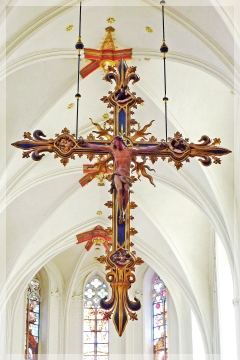
Our Lady Cathedral - Antwerp

The Apostle Paul wrote that he joined Christ in both death and resurrection. His old sinful life had been crucified with Christ and he now shared in Christ’s resurrected life. When Jesus came to live in him, Paul didn’t become a mindless automaton and their spiritual union didn’t cause the tent-maker to lose his uniqueness or personality. He was still Paul. By dying to sin and adding the characteristics of Christ to his heart and mind, however, the Apostle was a new and far better version of himself. He was still the same brilliant and well-educated man, skilled in making an argument or proving a point, who had set out for Damascus. But, by joining Christ in His resurrection, this single-minded Pharisee became entirely devoted to Jesus. Undeterred by persecution, he was faithful, patient, humble, courageous, filled with the Fruit of the Spirit, and passionate about passing along the gospel message. Indeed, Christ lived in him.

When Jesus met Paul on the road to Damascus, He changed Paul from a persecutor of Christians into a lover of Christ and His followers. While we probably didn’t experience a conversion as dramatic as Paul’s, when we accepted Christ, we also died to our old selves. Have we experienced that same spiritual death and resurrection described by the Apostle? Does Christ live in us or is He just an occasional guest, invited only on special occasions or when we feel like having company? Does He live in us or is He simply the cleaning service we call when there’s a mess we can’t clean by ourselves? Does He live in us or is He like a salesman who needs an appointment before calling? Does He live in us or is He just a kind-hearted acquaintance, welcome only when He has something we need or want?  Does He live in us or is He a renter whose lease will be terminated the moment we feel inconvenienced? If we say Christ lives in us, can anyone see Him there or do we hide Him behind a wall of self-righteousness? Are our words the words Christ would say? Are our actions His actions? Are our thoughts His thoughts? Can we honestly echo the Apostle Paul’s words?

Last Sunday, we celebrated the resurrection of Christ. Have we been resurrected with Him? Does He truly live in us? If not, then we haven’t yet been crucified with Him.

Therefore, if anyone is united with the Anointed One, that person is a new creation. The old life is gone—and see—a new life has begun! [2 Corinthians 5:17 (VOICE)]

Those of us who belong to the Anointed One have crucified our old lives and put to death the flesh and all the lusts and desires that plague us. Now since we have chosen to walk with the Spirit, let’s keep each step in perfect sync with God’s Spirit. This will happen when we set aside our self-interests and work together to create true community instead of a culture consumed by provocation, pride, and envy. [Galatians 5:24-26 (VOICE)]

Copyright ©2020 jsjdevotions. All rights reserved.

THE MAUNDATUM – Maundy Thursday

oxeye daisyIf any of you wants to be great, he must be your servant. If any of you wants to be first, he must be the slave of all. That’s how it is with the son of man: he didn’t come to have servants obey him, but to be a servant – and to give his life as “a ransom for many.” [Matthew 20:26b-28 (NTE)]

When my coed grand arrived in Florida last December, she wanted to celebrate going from boots to sandals with a pedicure. Although I enjoyed the comfy chair with its rolling massage, the warm whirlpool bathing my feet, the technician massaging the knots in my feet and calves, the exfoliating and buffing, and having someone else clip and paint my nails, I was incredibly uncomfortable with the whole thing (which is why I usually do my own pedicures). Even though I’d scrubbed my feet before arriving, was paying for the service, and liked being pampered, having someone wash my feet and tend to my toes seemed too intimate for me. I felt awkward being served in such a personal way.

My discomfort brought to mind that of the disciples on that Thursday evening so long ago when Jesus washed their feet in the upper room. Unlike mine, the men’s feet were filthy from walking sockless in sandals along unpaved dirt roads littered with animal waste, garbage, and the contents of people’s chamber pots. While the washing of feet was usually the job of the lowest servant, if no servant was present, people usually washed their own feet. Luke tells us the disciples argued that night about who would have the most prestige in the Kingdom. Perhaps it was then that Jesus, their rabbi, the guest of honor, and truly the greatest among them, removed his robe and, dressed like a slave, took on the menial task of washing their filthy feet—a task none of them were doing for themselves, one another, or Him.

If I’m uncomfortable with a pedicure, I can only imagine the discomfort of the disciples as their teacher humbly knelt before them, bathed their filthy calloused feet in the basin, and dried them with the towel at his waist. Not wanting to see his teacher perform such a menial task, Peter even objected and then, in typical Peter manner, told Jesus to wash his hands and head as well!

Today is Maundy Thursday, a day Christians throughout the world remember Jesus washing the disciples’ feet, the breaking of bread and drinking of wine during their Passover supper, Judas’ betrayal, Jesus’ prayers in Gethsemane, His arrest in the garden, and Peter’s betrayal. While many Christians observe this day with the sacrament of Holy Communion, most have no idea how this day got its name. “Maundy” comes from the Latin maundatum for commandment; after being translated into the French mande it was anglicized into “maundy.” This day is named for the mandate or command Jesus gave to his disciples after performing His extraordinary act of humility by washing the men’s feet. This new commandment (maundatum novarum ) was to love one another as Jesus loved them.

Maundy Thursday is a day for more than remembering the Last Supper. It is a day to remember Jesus’ lesson that we must serve others in the same way He did: as a lowly servant who willingly served with humility and love. As He loved us, so we must love one another, not just today but every day.

Love consecrates the humblest act
and haloes mercy’s deeds;
it sheds a benediction sweet
and hallows human needs.
Love serves and willing stoops to serve;
what Christ in love so true
has freely done for one and all,
let us now gladly do!
[“Love Consecrates the Humblest Act” (Silas B. McManus)]

Well, then: if I, as your master and teacher, washed your feet just now, you should wash each other’s feet. I’ve given you a pattern, so that you can do things in the same way that I did to you. … I’m giving you a new commandment, and it’s this: love one another! Just as I have loved you, so you must love one another. This is how everybody will know that you are my disciples, if you have love for each other. [John 13:14-15,34-35 (NTE)]

Copyright ©2020 jsjdevotions. All rights reserved.

A PROTECTIVE HEDGE

“Does Job fear God for nothing?” Satan replied. “Have you not put a hedge around him and his household and everything he has? You have blessed the work of his hands, so that his flocks and herds are spread throughout the land. But now stretch out your hand and strike everything he has, and he will surely curse you to your face.” [Job 1:9-11 (NIV)]

armor - castle chillon - lake genevaYou’ve probably heard people pray for a hedge of protection around friends or family members. Is it an impenetrable bubble that keeps tragedy and trouble at bay or a substance that acts like kryptonite against Satan and protects us from his temptations and deceit?

In Biblical days, hedges of loosely packed stones or thorny bushes were built around livestock and crops to protect them from wild animals and thieves. A hedge in Scripture often represented God’s protective care and we find mention of such a hedge in the book of Job. A wealthy and godly man, Job’s righteousness was challenged by Satan. Questioning the motivation for Job’s blameless behavior, Satan complained that God put a hedge of protection around the man and all his possessions. Wanting to prove that Job only worshiped God because of the blessings he’d received, Satan suggested that once God removed the hedge and Job’s blessings disappeared, rather than worshiping God, the man would curse God to His face! When Job loses his ten children and their families, his workers, his livestock and wealth, and then his health, it becomes clear that no hedge protected him from tragedy.

Satan, however, was wrong about Job cursing God! His righteousness and integrity weren’t because of God’s gifts. Job worshiped God out of love and not as payment for the blessings of health, wealth, and family. Although the afflicted man questioned God’s reasons while trying to sort out his dilemma, he never cursed Him. A hedge didn’t make Job invincible to Satan’s ploy; it was his faith!

Today, COVID-19 is putting us all to the test and, like Job, we find life incomprehensible. Job didn’t know the why of his troubles and we’ll never the why of this pandemic but, like Job, we know who is in charge! Satan thought people believe in God only when they’re prospering under a hedge of protection, not when they suffer loss, pain, or defeat. Are we fair weather believers and only willing to follow God if the road is filled with blessings? Or, like Job, will we stay faithful while experiencing the devastation this disease will leave in its wake? Much will be lost before the crisis passes and it probably won’t be returned two-fold as it was for Job—at least not in this world! Let us rest assured: full restoration will occur in the life to come.

Rather than building a hedge of protection out of rocks or thorny shrubs, let us erect one out of our unshakable faith in a loving God and our confidence that His ultimate purpose will come to pass. While social distancing, sheltering in place, and washing our hands may serve to protect us from this virus, only the armor of God will protect us from Satan!

Anyone can rejoice when things are going reasonably well. But when we’re facing adversity or sickness or hardship or death and then we rejoice, we are obeying God. God is on his throne. He loves you and is watching out for you. So rejoice in the Lord. [Greg Laurie]

Finally, be strong in the Lord and in his mighty power. Put on the full armor of God, so that you can take your stand against the devil’s schemes. … so that when the day of evil comes, you may be able to stand your ground, and after you have done everything, to stand. Stand firm then, with the belt of truth buckled around your waist, with the breastplate of righteousness in place, and with your feet fitted with the readiness that comes from the gospel of peace. In addition to all this, take up the shield of faith, with which you can extinguish all the flaming arrows of the evil one. Take the helmet of salvation and the sword of the Spirit, which is the word of God. [Ephesians 6:10-11,13-17 (NIV)]

Copyright ©2020 jsjdevotions. All rights reserved.