POWER

But Jesus called them together and said, “You know that the rulers in this world lord it over their people, and officials flaunt their authority over those under them. But among you it will be different. Whoever wants to be a leader among you must be your servant, and whoever wants to be first among you must become your slave.  [Matthew 20:25-27 (NLT)]

red-shoudered hawkRecently, the news has been filled with stories about powerful men who have misused their influence to prey on others. Unfortunately, abuse of power is nothing new. Consider our Biblical hero King David. While strolling on his roof late one afternoon, he looked down on the city below and spotted a beautiful woman taking her ritual bath. Even though he knew she was married, David sent for her. With at least six wives already, he wasn’t lacking for female companionship. Nevertheless, he wanted the beautiful Bathsheba. The Bible tells us the two had sex, she got pregnant, and David killed her husband to conceal their adultery. The Bible, however, tells us nothing of Bathsheba. We know she didn’t ask David to invade her privacy and, obedient to her king, she went to his palace. How could she refuse and to whom could she complain? Whether David managed to seduce her with his charm or forced himself on her doesn’t matter. He was her king and she had no choice. He wrongly took advantage of his power when he sent his men to get her, had sex with her, and manipulated events so that her husband was killed in battle.

This is not a male-bashing devotion; it is a reminder to us all that power and authority of any kind is a privilege. We are told to be good stewards of our wealth and use it wisely. When we are blessed with positions of authority or power, we should use that wisely, as well. If we’re not millionaires, CEOs, politicians, producers, or celebrities, we might think we have little or no power, but we do. We have the power to make someone else’s day good or bad and we have the power to affect their future. We can badger or intimidate co-workers, baby sitters, interns, clerks, sales people, bus drivers, assistants, neighbors, care givers, maintenance people, spouses and even children. It’s not just sexual abuse; there are many other ways to abuse, demean, mistreat, manipulate, or exploit people. Bullies aren’t found just on the playground; I’ve seen them berate wait staff, receptionists, and students. Threats aren’t made just by bosses; I’ve seen them made by irate customers. Politicians aren’t the only ones with clout; many of us have the ability to put in a good (or bad) word that can change someone’s future. We can make or break someone’s reputation with a few keystrokes. Having the upper hand never gives us the right to hit with it and having the power to do something doesn’t necessarily mean we should.

Abuse of power has consequences; conceived in adultery, David and Bathsheba’s child died and we’ve recently seen numerous successful careers crash. We may not make the tabloids when we shortchange the sitter, take out our anger on the secretary, or threaten someone out of spite. Nevertheless, there will be consequences for us as well—if not in this world, then in the next. In the parable of the talents, Jesus tells us that we’ll be held accountable for the way we use our gifts. We tend to think of those gifts as money, time and skills. They also include knowledge, relationships, privilege, power and authority and we should use all of them with love and compassion. Moreover, when we use our influence or authority to mistreat those less powerful, let us remember that we are mistreating the most powerful one of all!
And the King will say, “I tell you the truth, when you did it to one of the least of these my brothers and sisters, you were doing it to me!” [Matthew 25:40 (NLT)]

Copyright ©2017 jsjdevotions. All rights reserved.

FOOD INSECURITY

The crowds asked, “What should we do?” John replied, “If you have two shirts, give one to the poor. If you have food, share it with those who are hungry.” [Luke 3:10-11 (NLT)]

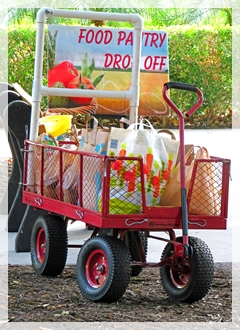
food pantry - feed the hungryYesterday, our nation celebrated Thanksgiving, a holiday that revolves around food and unites our nation across lines of culture, race, religion, and politics in a way little else can. Regardless of what football team they support, where they live or from where they came, whether liberal, conservative or somewhere in between, my Muslim, Hindu, Jewish, Christian, and unbelieving friends all celebrated around tables heavy laden with food. The menu and traditions varied—some had naan and others enjoyed cornbread or Parker House rolls. Some plates had ham alongside the turkey while others tofurkey and lentils or some of Grandma’s lasagna. Some cooks put pork sausage in their dressing and others kept kosher. There may have been glazed sweet potatoes and green beans at one house and mashed whites with gravy and corn casserole at another but, whatever was served, no one went away hungry and there were plenty of leftovers. Unfortunately, not everyone’s plate was piled with food and not everyone complained of feeling stuffed.

When I grew up, I was told there were starving children in Armenia so I should clean my plate. I once gave the smart-aleck retort that what I didn’t eat couldn’t be sent to those kids so what difference did it make! That was, of course, the wrong response and, most definitely, the wrong attitude. It wasn’t so much about cleaning my plate; my parents were trying to teach me appreciation and gratitude for the bounty at our table. They wanted me to understand that not everyone was so blessed. Unlike me, many children knew the real meaning of hunger.

The UN defines “food security” as always having physical, social and economic access to enough safe and nutritious food to meet one’s dietary needs for a productive and healthy life. Although there is more than enough food in the world to feed everyone, they estimate that some 815 million people in our world are “food insecure.” In our nation alone, some 41 million people (13 million of whom are children) are considered food insecure. It’s not just the Armenians or whoever else our parents mentioned that are hungry; it’s our neighbors!No one anywhere should go hungry but it’s disgraceful that anyone in our wealthy nation should be without reliable access to a sufficient quantity of affordable and nutritious food.

As Christians, we must respond to food insecurity with compassion and action—prayer, advocacy, volunteering, and donating. When we pray, “Give us this day our daily bread,” let’s remember the bread with which we are blessed is meant to be shared. When Jesus shared a few loaves and fish, He managed to feed thousands; consider how many we could feed if we shared our resources! As you write up your Christmas gift list, perhaps you will include a Christian relief organization and help combat poverty and hunger. If you’re wondering what to get your pastor or child’s teacher, rather than a tie or mug, what about a flock of chicks, geese or ducks (only $20) from someplace like Heifer International? Your donation will provide both food and a source of income for a hungry family. These next few weeks, you’ll be making several trips to the grocery store. Every time you shop, consider taking advantage of the BOGO specials and giving that free item (better yet both of them) to the local food pantry. There are more than enough resources in our world so that everyone can eat well but we each must do our part.

Yesterday, we looked at our bountiful Thanksgiving feast and asked ourselves, “What will I eat?” Please remember that someone not that far from you may have said, “Is there anything for me to eat?”

For I was hungry, and you fed me. I was thirsty, and you gave me a drink. I was a stranger, and you invited me into your home. I was naked, and you gave me clothing. I was sick, and you cared for me. I was in prison, and you visited me. … I tell you the truth, when you did it to one of the least of these my brothers and sisters, you were doing it to me! [Matthew 25:35-36,40 (NLT)]

Copyright ©2017 jsjdevotions. All rights reserved.

MARA

Monarch butterfly - queen anne's laceBut she said, “Don’t call me Naomi; call me Bitter. The Strong One has dealt me a bitter blow. I left here full of life, and God has brought me back with nothing but the clothes on my back. Why would you call me Naomi? God certainly doesn’t. The Strong One ruined me.” [Ruth 1:20-21 (MSG)]

The final lesson of learning to be independent – widowhood…is the hardest lesson of all. [Anne Morrow Lindberg]

When we first meet her in the book of Ruth, the widowed Naomi does not seem the sort of unpleasant meddlesome mother-in-law about whom jokes are made; she is much loved and respected by her daughters-in-law. After great tragedy strikes their family, Naomi’s widowed daughter-in-law Ruth chooses to leave home, return with her to Israel, and adopt the God of the Israelites. Naomi must have been a very special woman to have a daughter-in-law so determined to stay at her side. By the time the widows arrive in Bethlehem, however, we see another side to the older woman. “Don’t call me Naomi,” she says, telling people to call her Mara, meaning bitter. For Naomi and Ruth, circumstances improve when Ruth meets and marries Boaz and presents her mother-in-law with a grandchild. Unfortunately, not every widow has a Boaz to act as her redeemer and provide a happy ending to the story.

I have a group of widowed friends who, if comparing tragic sob stories with Naomi, could put hers to shame. They lost as much or more and have endured as many hardships and challenges as did Naomi. Nevertheless, in spite of having their lives turned upside down by their losses, none of them would call themselves bitter. While they have their moments of complaint, sorrow and loneliness, their faith strengthens them and allows them to face their new reality with an eagerness and joy that does not depend on outer circumstances. Their grief hasn’t left them bitter; if anything, it has made them better. They radiate a sense of peace, purpose and zest for life because their redeemer isn’t a relative who has chosen to take care of them; their Redeemer is Jesus Christ!

I can’t pretend to know what it’s like to lose a spouse but I imagine it’s like being ripped in half. Someday, either my husband or I will face the grief and uncertainty that comes with widowhood. When the “we” of our lives becomes just “me,” loneliness, anger and resentment can easily follow. We can become bitter or allow our faith to fill us with hope. Death may take away a spouse, but Jesus will take that spouse away from death! I pray that, in our grief, we will be strengthened by our faith in God’s purpose and receive the consolation offered by our Comforter, the Holy Spirit.

Most loving God, you know the pain and sorrow of death; mercifully hear our prayer for those who mourn the death of their beloved. The nights are lonely and the days are too long. Comfort them and bring an end to the days of tears. Bless them and bring an end to their days of sorrow. Renew them with the joy of life and bring to an end their days of mourning. Let the bond of love which you have for your people be the foundation of their hope that love never ends and that precious moments with our beloved are forever held dear in our hearts. Amen. [Vienna Cobb Anderson]

The Friend, the Holy Spirit whom the Father will send at my request, will make everything plain to you. He will remind you of all the things I have told you. I’m leaving you well and whole. That’s my parting gift to you. Peace. I don’t leave you the way you’re used to being left—feeling abandoned, bereft. So don’t be upset. Don’t be distraught. [John 14:26-17 (MSG)]

You’re blessed when you feel you’ve lost what is most dear to you. Only then can you be embraced by the One most dear to you. [Matthew 5:4 (MSG)]

Copyright ©2017 jsjdevotions. All rights reserved.

HALLOWED BE THY NAME

So you shall keep my commandments and do them: I am the Lord. And you shall not profane my holy name, but I will be hallowed among the people of Israel; I am the Lord who sanctify you, who brought you out of the land of Egypt to be your God: I am the Lord. [Leviticus 22:31-33 (RSV)]

water lilyFor several years, a well-known and highly regarded actor/comedian’s name was synonymous with fatherhood and family values. After becoming the subject of sexual abuse allegations, spanning more than fifty years, by more than fifty women, his name went from respected to scorned. Several universities rescinded the honorary degrees awarded him, removed him from their boards and fund-raising campaigns, and eradicated his name from buildings and scholarships. His statue was removed from a Disney theme park, reruns of his shows were cancelled, there was a petition to revoke his Presidential Medal of Freedom, and he was dumped by his agent. No one wanted their good names tarnished by any association with such disgraceful behavior.

Names and reputations are important and none of us want our names to be besmirched by someone else’s words or actions. Apparently, God felt the same way when He gave us that often ignored commandment about not taking His name in vain. Some Bibles translate “in vain” as misusing, using thoughtlessly or irreverently, or making empty promises in God’s name. Whatever Bible we use, the meaning is clear; we must honor God’s name and never use it in a disrespectful, false or blasphemous way.

When Jesus taught us to pray, after addressing our Father in heaven, He said the words, “Hallowed be thy name.” Although some Bibles translate that sentence as, “May your name be kept holy,” the King James’ words are the ones most of us use in the Lord’s Prayer. I used to think those words were a call to worship and pretty much dismissed them as part of the preface to the actual prayer. I hadn’t realized that they are the first petition (or request) the prayer makes. In those four prayerful words, “Hallowed be thy name,” we are appealing to God to help us keep His commandment about not dishonoring His name! That sentence, however, means far more than just not cursing or committing perjury after promising to tell the truth.

If we call ourselves Christians—followers of Jesus Christ—whenever we act or speak shamefully we are not keeping God’s name holy. If we distort God’s word with our witness or actions, His name is not hallowed. It’s not just blasphemy, irreverence or profanity; hypocrisy, deception, treachery, insincerity, falseness, and immorality of any kind profane His name! We don’t have to be celebrities and have our transgressions blasted across the tabloids; we disgrace His name whenever we speak or act in any way that dishonors Him.

If we never get beyond those four little words, “Hallowed be thy name,” we’ve said enough. In that one sentence, we ask God to make our words and actions reflect His holiness. We express our desire to live godly lives and ask Him to enable us to live in a way that makes His name holy. Heavenly Father, hallowed be thy name!

We always pray for you, that our God may make you worthy of his call, and may fulfil every good resolve and work of faith by his power, so that the name of our Lord Jesus may be glorified in you, and you in him, according to the grace of our God and the Lord Jesus Christ. [2 Thessalonians 1:11-12 (RSV)]

Bless the Lord, O my soul; and all that is within me, bless his holy name! [Psalm 103:1 (RSV)]

Copyright ©2017 jsjdevotions. All rights reserved.

OUR FATHER

Mute swan - cygnetsPray like this: Our Father in heaven…” [Matthew 6:9a (NLT)]

Throughout Scripture, God is called by several ancient names that reflect His character: El Shaddai (God Almighty), El Olam (The Everlasting God), El Elyon (The Most High God), and El Roi, (The God Who Sees). He is Yahweh-Jireh (The Lord Will Provide), Yahweh-Rapha (The Lord Who Heals), and Yahweh-Roh (Our Shepherd). We also find references to God as both a Rock and a King. Yet, with all these ways to address God, when Jesus taught us how to pray, He chose to address God with the words “Our Father.”

As I pondered calling on our Father in prayer, I recalled an episode that occurred more than twenty-five years ago when two of our children attended college together. They went camping with a group of friends and enjoyed beers around the campfire. In the wee hours of the morning, the group was awakened by a police officer who breathalyzed them all. Unfortunately, the results indicated they’d been drinking and, since all were all under 21, each received a ticket for “illegal possession of alcohol by consumption” (a Class C misdemeanor). My children’s friends were amazed when they immediately called their dad, admitted their mistake, and asked his advice. My daughter’s response to her friends’ shock at their quick call was simple: “If I can’t call my father, who can I call?”

Our children called their father not because he paid their tuition and provided for them or even because he has a law degree. Even knowing he would expect them to face the consequences of their foolishness, they called on their father because he loves them! He’s their daddy and they are his children and they knew that, in spite of his disappointment in them, he would lovingly forgive and wisely counsel them.

“Our Father,” said Jesus. We can address God as Creator, Most High, Shepherd, Rock, Healer or any of a dozen other impersonal ways but it’s like calling on someone great and powerful; we know of Him but we don’t know Him. Prayer isn’t like scheduling an appointment to present a petition before a foreign king; it is an intimate conversation with someone we love who also loves us. It’s like my children coming to their daddy, confessing their error, and asking for his guidance. We appeal to God in love, not in fear of His anger or even awe of His power. God adopted us when we accepted Christ—we are His children, His heirs, and we can come boldly before Him with our prayers. That our unchanging, sovereign, all-knowing, all-powerful, ever-present, infinite God desires a relationship with us and wants us to address Him as “Our Father” is a privilege and an honor—let us never take it lightly.

For all who are led by the Spirit of God are children of God. So you have not received a spirit that makes you fearful slaves. Instead, you received God’s Spirit when he adopted you as his own children. Now we call him, “Abba, Father.” For his Spirit joins with our spirit to affirm that we are God’s children. [Romans 8:14-16 (NLT)]

May God our Father and the Lord Jesus Christ give you grace and peace. [Romans 1:7b (NLT)]

Copyright ©2017 jsjdevotions. All rights reserved.

THE MEANS TO AN END

The human mind is the most deceitful of all things. It is incurable. No one can understand how deceitful it is. I, the Lord, search minds and test hearts. I will reward each person for what he has done. I will reward him for the results of his actions. [Jeremiah 17:9-10 (GW)]

Dame's rocketIn Leviticus, we find Aaron’s sons, Nadab and Abihu, offering incense to worship God. Although their goal was good, priests were required to fulfill their duties without variation and the brothers disregarded the method specified by God. Worshiping God was the right intent but using prohibited fire was the wrong way to do it and they were consumed by God’s fire. Bringing the Ark of the Covenant back to Jerusalem was a good goal but using a cart to transport it was the wrong method and Uzzah was struck dead when he reached out to steady it.

We may be tempted to sin in order to achieve an important aim and then rationalize our behavior by saying that the noble result justified the questionable method. As unfair as it seems, those men’s deaths at God’s hand tell us that the end, no matter how worthy the goal, never justifies the means if the means require a compromise of our faith or ethics. It is never acceptable to do something against God’s law. Right and wrong are not determined by a situation; they are determined by God! No matter how honorable or well-intentioned the goal, doing anything in sin to achieve an objective is not honoring God. Moreover, as worthy as we may consider our motives, they’re probably nowhere near as noble as we think they are. More often than not, those motives have more to do with ourselves—our desires, relief or convenience—than we’d care to admit.

Father, sometimes we’re tempted to let a situation justify sinful or questionable behavior. Thank you for showing us that even the most worthy purpose never justifies disobedience to your Word. If it’s not what Jesus would do and done the way He would do it, then it doesn’t honor you. Remembering that the end never justifies the means if the means offend you, show us how to achieve your goals in the way you have commanded. May we let your Holy Spirit guide us in all we say and do.

Not everyone who says to me, “Lord, Lord!” will enter the kingdom of heaven, but only the person who does what my Father in heaven wants. Many will say to me on that day, “Lord, Lord, didn’t we prophesy in your name? Didn’t we force out demons and do many miracles by the power and authority of your name?” Then I will tell them publicly, “I’ve never known you. Get away from me, you evil people.” [Matthew 7:21-23 (GW)]

Copyright ©2017 jsjdevotions. All rights reserved.