HIS SANCTUARY

Don’t you realize that your body is the temple of the Holy Spirit, who lives in you and was given to you by God? You do not belong to yourself, for God bought you with a high price. So you must honor God with your body. [1 Corinthians 6:19-20 (NLT)]
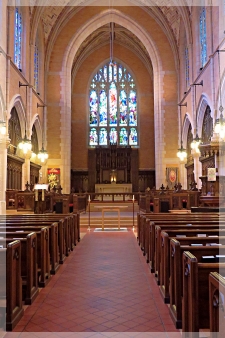
St. Paul's Cathedral - MNSince we both attended liturgical churches as girls, my friend and I were trying to recall the terms for the various parts of a traditional church building. We knew the foyer is called the narthex and the congregation sits the church’s nave. We also knew the altar rail usually separated the nave from the chancel in the front. It’s from the chancel that the service is conducted and where the altar, pulpit, and lectern are located. We even recalled that the sacristy was the room holding Communion supplies and linens. Since we were worshipping in a park that morning, my friend asked the location of our sanctuary. In historic usage, sanctuary and chancel were synonymous but, in modern usage, a sanctuary consists of the entire worship space of a church. With no building, we had no narthex, nave, or chancel but we did have a worship space; our sanctuary was a gazebo in a county park.

As God would have it, my next morning’s reading took me to today’s verse from 1 Corinthians. The Greek word usually translated as “temple” was naós, meaning a sanctuary, a divine dwelling-place, a temple, or place of divine manifestation. In Paul’s day, naós referred to the Temple proper, from the inner courts to the Holy Place with the seven-branched candlestick, golden incense altar, and showbread table all the way to the innermost area called the Holy of Holies—a place so sacred that it could be entered only by the High Priest once a year, on the Day of Atonement.

Having recently written about the lack of respect and reverence now common in a church sanctuary, Paul’s words gave me pause. The Temple and all its utensils—from the Ark, altars, and lamps to the snuffers, basins, oil, incense, and priest’s garments—were considered holy. Dedicated solely to serving God, they were not to be used for common or profane uses. If we are God’s sanctuary, a place of worship and the divine dwelling place of the Holy Spirit, do we treat ourselves with the reverence and respect due God’s temple? Are we solely dedicated to serving God? Are we ever used for vulgar, disrespectful, or profane purposes?

Do we ever desecrate our sanctuary by not treating our bodies properly? Do we treat them with the same care and regard we would Communion wafers, altar linens, or a Baptismal font? God’s sanctuary, however, is more than our physical bodies; it’s our entire being, our hearts and minds. Do we speak, read, look at, find humor in, think about, or do things we wouldn’t if we were in church? Do we always serve as a worship space of our amazing Triune God or just during prayers or worship service? Do we reflect the dignity, sanctity, and holiness that comes with being the house of God?

A great deal of responsibility comes with being God’s dwelling place. Just as the Temple was defiled in 168 BC when Antiochus Epiphanes sacrificed a pig on the altar of incense, our sins defile us. They are like obscene graffiti on a church walls, vandalism of the altar, defacement of the Bible, or leaving excrement on the pews. Preacher Harry Ironside reminds us, “How careful you and I ought to be that we grieve not that blessed One who dwells within, that we do not bring dishonor upon the name of the Savior who has sent His Spirit to live in our body.”

The Jews were so zealous about maintaining the purity of God’s sanctuary that a low fence  separated the court of the Gentiles from the rest of the Temple mount complex. Gentiles and ritually unclean Israelites were forbidden, on pain of death, from passing through its gates to the interior areas—the sanctuary of the Temple. Are we that zealous about keeping His dwelling place within us—His sanctuary—pure and undefiled?

For that matter, our brothers and sisters in Christ also serve as a dwelling place of God. Do we treat them with the same reverence and respect due God’s sanctuary? We should!

Don’t you realize that all of you together are the temple of God and that the Spirit of God lives in you?… All of you together are Christ’s body, and each of you is a part of it. [1 Corinthians 3:16,12:27 (NLT)]

Copyright ©2023 jsjdevotions. All rights reserved.

DESIGNED WITH A PURPOSE

You made all the delicate, inner parts of my body and knit me together in my mother’s womb. Thank you for making me so wonderfully complex! Your workmanship is marvelous—how well I know it.  [Psalm 139:13-14 (NLT)]

Effortlessly skimming over the water, the bird occasionally dipped its bill into the water before gracefully rising, circling the pond, and returning to skim along the water again. Even though I’d never seen one inland, the bird’s large bill, distinctive black and white coloring, and unique flight identified it as a black skimmer. Although skimmers usually spend their lives around sandy beaches and coastal islands, sometimes they feed in inland lakes during nesting season and I was thrilled to watch several skimming over our lake just before sunrise.

The skimmer’s beak is unique because its lower part is longer than its upper. As it skims over the water, the bird drags the bottom half of its beak through the water to collect small fish. When it contacts its prey, the skimmer bends its head forward and snaps the upper bill closed to catch its meal! Hunting solely by touch rather than by sight, skimmers feed from late evening until dawn when the waters are calm and the fish are closer to the surface.

Continuing my morning walk, I came upon a limpkin—another one of God’s creatures gifted with a unique and perfectly-designed beak. These wading birds eat snails and their bills are bent and twisted at the tip. With a gap just before the tip, the bill acts like tweezers. Curved slightly to the right, it easily slips into the right-handed curve of a snail’s shell.

I then spotted one of our resident brown pelicans nose-dive into the water for its breakfast and witnessed another one of God’s specialized bills. Unlike the skimmer who fishes by feel, a pelican can spot a fish from 60-feet up. When it plunges into the water, a large fibrous skin pouch dangling from its lower beak immediately opens and two to three gallons of water (along with any fish) are sucked in. The bird closes its beak, hangs its head down to let the water drain out the sides, and then flips up its beak and swallows the fish! God even provided the bird with a little hook on the tip of its upper beak to help it grip onto slippery fish!

Noticing a woodpecker drilling on a tree to get at insects under the bark, I saw how God tapered its beak to form a chisel perfectly designed for its task. With beaks clearly on my mind, I considered the aptly named roseate spoonbill with its spoon-like beak that serves as a strainer while it forages in the ponds; the hawk with its sharp hooked beak that enables it to catch, kill and tear up its prey; and the tiny hummingbird who can eat three times its body weight in a day. Its long needle-like bill fits deep into tubular flowers while its tongue darts in and out of the nectar about 13 times a second! God designed each of their bills with a specific purpose in mind.

While we people look more alike than do a skimmer and a spoonbill or hummingbird, God has endowed each one of us with unique capabilities perfectly designed for our specific purpose in life. Rather than a specialized beak, we have unique traits, talents, strengths, and abilities that set us apart from one another. Just as the bills of the skimmer and hummingbird were designed for the roles they play in the ecosystem, we have been specifically designed for the role that God has assigned us in the world—a role unlike that of anyone else.

Whether teacher, pastor, chef, clerk, janitor, farmer, dishwasher, programmer, carpenter, maintenance worker, musician, mail carrier, or barista, no one is insignificant. The very hairs on our head are numbered and Jesus told us we’re more valuable than a flock of sparrows (whose short cone-shaped beaks are perfectly designed to crack open seeds). The God who designed the spear-like bill of the anhinga to impale fish and the whimbrel’s curved bill to fit into a fiddler crab’s burrow knew exactly what He was doing when He designed each and every one of us. Designed for a purpose, we are one-of-a-kind creations made by the hands of God. May we serve Him well!

You are who you are for a reason.
You’re part of an intricate plan.
You’re a precious and perfect unique design,
Called “God’s special woman or man.”
You look like you look for a reason.
Our God made no mistake.
He knit you together within the womb,
You’re just what He wanted to make!
[Russell Kelfer]

For we are God’s masterpiece. He has created us anew in Christ Jesus, so we can do the good things he planned for us long ago. [Ephesians 2:10 (NLT)]

Copyright ©2023 jsjdevotions. All rights reserved.

PUT AWAY YOUR CALCULATORS AND CALENDARS! (Revelation – Part 3)

blood moon - lunar eclipse

Photo Courtesy Dennis Johnson


However, no one knows the day or hour when these things will happen, not even the angels in heaven or the Son himself. Only the Father knows. [Matthew 24:36 (NLT)]

I couldn’t finish writing about Revelation without a caution to beware of end times predictions. If someone claims to have secret knowledge or frightens you with their teaching—abandon them ASAP! If Jesus didn’t know when the end would occur, I can guarantee that no mortal will!

Nevertheless, in 1994, radio evangelist Harold Camping predicted the world would end on September 6. When it didn’t, explaining his mistake was a mathematical error, Camping got out his calculator again and predicted the apocalypse would begin precisely at 5:59 PM, May 21, 2011. At that time, those chosen by God would ascend to heaven in the Rapture and cataclysmic earthquakes would rock the earth. After finding himself still here May 22, Camping admitted his understanding of God’s plan was slightly off but continued predicting the world’s end on October 21. When October 22 dawned, the evangelist confessed such predictions were “incorrect and sinful” and finally conceded that God might not tell people the date of Christ’s return. Camping’s apology, however, was little comfort to his followers who’d given up jobs and families to warn people of God’s coming judgment!

Because Joel 2:31 and Revelation 6:12 describe the sun growing dark and the moon turning red as blood before the great day the Lord arrives, we frequently read of “blood moon” predictions! A “blood moon” is a total lunar eclipse during which we see the moon slowly darken and change color from bright white to an orange-red coppery color. Not a rare event, one occurred last November and another will in 2025. On September 28, 2015, however, the fourth such lunar eclipse occurred within two years (a “tetrad event”) and coincided with the Jewish celebration of Sukkot. The concurrence isn’t surprising since Sukkot always occurs on the first full moon following the autumn equinox. Nevertheless, this caused some Christian evangelists to warn of imminent world-shaking events or that the Four Horsemen of the Apocalypse would reveal their missions. They didn’t! Nevertheless, we’ll probably hear more tribulation prophecies in 2033 when the last full moon in the tetrad occurs on October 8—the first day of Sukkot!

Because Revelation calls “666” the number of the Beast, people try to use 666 to predict the end. Although Revelation’s message shouldn’t frighten believers, many Christians in 17th-century Europe feared the world’s end in 1666. When the Great London Fire that year destroyed much of the city, they thought it the end of the world but, since it lasted only four days and left only ten dead, that wasn’t much of an end!

To determine the Beast’s name, some people use gematria (a system of assigning numeric values to letters or words in the Hebrew language). Although originally limited to Hebrew, they also use Greek, Latin, English, or whatever suits them. Depending on the language, whether first and/or last name is used, and the number of mathematical applications employed, just about any name can be made to total 666 (including Nero Caesar, Julius Caesar, Domitian, Vespasian, Caligula, Mohammed, Pope Benedict IX, Luther, Ronald Reagan, and Mikhail Gorbachev). Don’t fret about 666 or its meaning. We aren’t going to know the Beast’s identity until it appears but we’ll recognize the Beast by the mark!

Last week I wrote about the Episcopal priest Jeopardy contestant and his easy dismissal of Revelation. His dismissal is understandable. False prophecies, outlandish predictions, and farfetched interpretations of Revelation bring shame and ridicule to John’s vision and, by extension, to Jesus. False rapture and end-of-the-world predictions do more than embarrass and discredit the false prophet, they dishonor the Lord and the Christian doctrine of Christ’s return!

It is only by studying Revelation that we can maintain both our hope in the return of Jesus and dispel the doomsday delusions of today’s false prophets. Let us remember that God doesn’t want us to speculate about the timing of His return; He wants us to remain faithful, righteous, watchful, and ready. In the meantime, rather than being sign watchers, we should be disciple makers!

So when the apostles were with Jesus, they kept asking him, “Lord, has the time come for you to free Israel and restore our kingdom?” He replied, “The Father alone has the authority to set those dates and times, and they are not for you to know. But you will receive power when the Holy Spirit comes upon you. And you will be my witnesses, telling people about me everywhere—in Jerusalem, throughout Judea, in Samaria, and to the ends of the earth.” [Acts 1:6-8 (NLT)]

Copyright ©2023 jsjdevotions. All rights reserved.

LITERAL OR FIGURATIVE (Revelation – Part 2)

Above all, you must realize that no prophecy in Scripture ever came from the prophet’s own understanding, or from human initiative. No, those prophets were moved by the Holy Spirit, and they spoke from God. [2 Peter 1:20-21 (NLT)]

columbineThe Apostle Peter tells us that true prophecy isn’t a product of the prophet—prophets only speak God’s revelation. Directed by the Spirit, their words communicate the message the Lord wants sent. Sometimes, however, prophecy is difficult to understand and interpretations of Revelation go from one extreme to the other. Some, like that priest in Monday’s devotion, dismiss it as completely symbolic. To them, Revelation is an allegory about the conflict between good and evil with good winning in the end. On the other extreme, we find obscure theories, convoluted correlations, and implausible explanations of every symbol and metaphor along with sensationalism and unchecked speculation connecting Revelation to current events.

A simple rule of thumb in hermeneutics (the interpretation of Scripture) is, when it obviously is literal, we should accept it as such. The key to understanding Revelation is to interpret it as literally (and simply) as possible. Extra meaning shouldn’t be given to words or phrases if they can be understood as written. For instance, we shouldn’t assume 1,000 years means anything else. Moreover, when a description is of something we’ve never seen, such as cherubim or heaven, we shouldn’t immediately dismiss it as totally figurative. Nevertheless, we can’t read Revelation as we might a newspaper. When a passage clearly uses figurative language or obviously is symbolic, we should interpret it as such.

At the same time, we should be careful about finding extra meaning in John’s figurative descriptions. For example, Revelation 4:3 describes the One sitting on the throne “like a jasper stone and a sardius in appearance; and there was a rainbow around the throne, like an emerald in appearance.” Although the word “like” clearly indicates a simile, many commentators ascribe extra meaning to the descriptions, e.g. the stones allude to the high priest’s breast plate, the red sardius signifies God’s righteous anger or Jesus’ blood, the green denotes God’s mercy and grace, or the rainbow means God’s won’t depart from His covenant with Israel. To understand John’s words, we don’t need to get bogged down in possible symbolic meanings when what we’re being told clearly is that there was a spectacular radiance to the One (God) sitting on the throne.

Revelation, like other apocalyptic prophecy, often has bizarre imagery. John describes such things as locusts wearing armor with wings that roared like an army of chariots and horses with heads like lions with fire, smoke, and burning sulfur coming from their mouths. While these horrifying things may have been living demonic creatures, they also could be weaponry like helicopters, drones, missiles, or tanks. Prophecy describes the future and, not knowing what he saw, John may have used metaphors to describe their size, power, and noise. Whatever he saw was unfamiliar, frightening, and capable of mass destruction and his imagery conveys that perfectly.

While meant for all believers, John specifically wrote to the seven churches in Asia and many of his allusions make sense in historical context. When he describes a woman sitting on seven hills, his 1st century readers easily would have known he was referring to Rome (a city built on seven hills). Moreover, because concepts and symbols from the entire Bible echo throughout Revelation, John’s allusions must be put in scriptural context. Without ever making a direct quote, 278 of Revelation’s 404 verses make at least one allusion to the Old Testament. For example, after one of the elders points out “the lion from the tribe of Judah, the Root of David,” John sees a “Lamb, standing as if slaughtered.” John’s original readers easily would have recognized Messianic descriptions found in Isaiah and Genesis.

With events taking place simultaneously in heaven and on earth, Revelation doesn’t follow a strict chronology and can be challenging to follow. With its wars, famine, and disasters, it can be distressing and, with its allusions and figurative language, it can be confusing. But, as God’s word, Revelation can’t be ignored or treated as fictional fantasy.

Because Revelation was written for the servants of Christ (that’s us), it seems unlikely that God expected us to have theology degrees to understand its message. Nevertheless, understanding Revelation is easier with a good study Bible, a commentary or two, and a study guide or group, along with prayers for the Spirit’s guidance.

Revelation shows us God’s amazing patience as He gives mankind opportunity after opportunity to repent and plenty of reasons to do so! For those who choose not to believe, Revelation is a book of dire warning but, for those who believe, it is a beautiful book of hope. Spoiler alert—Jesus wins!

The big picture of Revelation is clear: Jesus returns, people must be ready, evil is defeated…. With the rest of the details, there is room for disagreement. [Scott McConnell]

Then the angel said to me, “Everything you have heard and seen is trustworthy and true. The Lord God, who inspires his prophets, has sent his angel to tell his servants what will happen soon.” [Revelation 22:6 (NLT)]

Copyright ©2023 jsjdevotions. All rights reserved.

NOT TO BE IGNORED (Revelation – Part 1)

Behold, I am telling you a mystery; we will not all sleep, but we will all be changed, in a moment, in the twinkling of an eye, at the last trumpet; for the trumpet will sound, and the dead will be raised imperishable, and we will be changed. [1 Corinthians 15:51-52 (NASB)]

little blue heronWhen researching another devotion, I learned that a Jeopardy contestant missed this $1,000 clue: “It’s the ascension heavenward by true Christians both living & dead at Christ’s second coming.” Although the answer was the Rapture, the contestant, an Episcopal priest, remained silent. He later explained that he didn’t believe in the Rapture or hold to a literal reading of Revelation, adding that the literal reading of Revelation is a “a product of the modern era.” His words gave me pause.

In the decades I attended denominational churches, I never heard any reference to the Rapture and can’t recall ever hearing a sermon about the tribulation or Christ’s return. While I’d read bits and pieces of Revelation, it seemed so bizarre after the first three chapters that I thought the Apostle John might have imbibed in the 1st century version of LSD. It was not until I began attending more evangelical and Bible-based churches that I became familiar with both the Rapture and Revelation.

Although not found in Scripture, the word “rapture” comes from the Latin rapiõ meaning “to seize, snatch away,” which is equivalent to the Greek word harpazõ or “caught up” that is found in 1 Thessalonians 4:13-18 and 1 Corinthians 15:50-52. In the Rapture, dead and living believers will be caught up together to meet Jesus in the clouds to make way for God’s judgment and wrath that will be poured out on the earth during the Tribulation. Because Scripture is unclear about how and when this will occur, Paul called it a mystērion—something that only can be known through God’s revelation. Being a mystery, however, doesn’t mean something like it won’t happen.

While there is general agreement throughout the Church about the resurrection of the dead and Christ’s return, there is a diversity of thoughts about the particulars. Unlike essential doctrine in which Christians have unity (e.g. the forgiveness of sins and Christ’s deity, death, and resurrection), there’s plenty of liberty about the specifics of the end times and Christ’s return. That Episcopal priest is just one of many Christians who don’t believe in the Rapture.

My issue is with the priest’s easy dismissal of Revelation. Perhaps he’s like a mainstream pastor friend who questions whether Revelation belongs in the Bible. Even though the New Testament canon was not firmly established until 397, the book of Revelation was considered part of the Church’s holy Scriptures in the early stages of Christianity. It was listed as part of the canon around 180 AD in both Irenaeus’ Against Heresies and on the Muratorian Fragment. Church fathers like Irenaeus (bishop of Lyons), Papias (bishop of Hierapolis), Theophilus (bishop of Antioch), Justin Martyr, Tertullian, and Clement of Alexandria all accepted the Apocalypse as revealed in John’s vision.

While a renewed interest in Revelation may be “a product of the modern era,” the earliest church fathers like Irenaeus and Justin Martyr took a literal view of the thousand-year reign with Christ. It was only after Constantine awarded full legal recognition and favor to the Christian church in 313 and Christianity became the official religion of the Roman Empire in 380 that the focus of the church changed. No longer being persecuted for their faith, Christians went from looking for their ultimate comfort in the world beyond the grave to seeking comfort in this world. As believers became more content in the here and now, they became less eager for the Apocalypse, God’s future judgment, and Jesus’ return.

While we don’t know whether the end is near or in another 2,000 years, we should look to Christ’s promised return. As the final chapter of our salvation, Revelation never should be ignored, scorned, or forgotten. It can be confusing, intimidating, and mind-boggling at times, and we’ll probably never fully understand it. Nevertheless, Revelation is worth reading; after all, it’s the only book in the Bible promising a blessing to those who read its words and do what it says!

Blessed is the one who reads, and those who hear the words of the prophecy and keep the things which are written in it; for the time is near. [Revelation 1:3 (NASB)]

Copyright ©2023 jsjdevotions. All rights reserved.

THE ONLY CONSTANT

I am the Lord, and I do not change. [Malachi 3:6a (NLT)]

rainbowOur fast-paced world is ever-changing and once ordinary items like slide rules, cassette tapes, boom boxes, floppy discs, dial phones, film, and VCRs are relics. My kids don’t use maps, write checks, or have a land line and my grands have never used a library card catalogue, set of encyclopedias, dictionary, carbon paper, or typewriter. We no longer need to get up to change channels, turn the lights on or off, or see who’s at the door. Our camera, maps, calculator, credit cards, compass, note pad, address book, plane tickets, and Bible all fit into our cell phones and everything on our phones (along with a fitness tracker and heart monitor) fits into a watch!

The world is in a constant state of flux! 38 different models of the iPhone have been released since its introduction in 2007 (with a new generation expected in the fall)! Since its introduction in 1985, there have been 49 versions of the Windows operating system. What with chatbots, artificial intelligence, the metaverse and internet of things, chatbots, NFTs, cryptocurrency, 3-D printers, and reality that can be extended, augmented, or virtual, by the time I’ve caught up to the latest technology, I’m already behind the times!

In theory, all those changes are supposed to be for the better but new doesn’t necessarily mean better (as the Coca-Cola company learned when they tried to change their drink formula in 1985). Unfortunately, the updated and improved version can be worse than its predecessor (which is what most tech people would say about Windows ME, Vista, and Windows 8)!

The Greek philosopher Heraclitus said, “The only thing constant is change,” and, despite my previous rant, I disagree. The one unchanging constant in our lives is God and His unchangeability is called immutability. Unlike things that can be modified like iPhones, Windows, and Coke, something immutable cannot change. Regardless of technology, innovative trends, style, or the passage of time, God’s truth, purpose, promises, and character remain the same. God needs no updates because He is the very essence of perfection—He can’t become more or less, greater or smaller, or any better than He already is!

God’s immutability doesn’t mean that He is a static, impersonal, remote, disinterested being. Although He is unchanging, we are not deists who think of God as an indifferent uninvolved clockmaker who made a clock, wound it up, and then ignored it. He is actively involved in all of His creation and regularly interacts with everything and everyone in it.

Rather than impassive and distant, God is enmeshed in our lives. He walked and talked with Adam and cared enough to give him a companion in Eve! He made covenants with Noah and Abraham and revealed Himself to people like Moses, David, Elijah, Paul, Peter, and John. The God who walked in Eden with Adam, hung a rainbow in the sky for Noah, wrestled with Jacob, etched His law onto stone tablets for Moses, sent manna from heaven, and blinded Paul on the road to Damascus is the very same God who walks with us today!

Although God’s interaction with us may change (as it did when He evicted Adam and Eve from Eden, permitted Satan to plague Job, or allowed Judah to be taken into captivity), God’s nature never changes! Timeless and eternal, God was and always will be holy, unlimited, all-powerful, ever-present, all-knowing, all-loving, and divine. Fortunately, the original 1.01 version of God (introduced at the beginning of time) is all we need or want! Thank you, O Lord, for being the one constant in our lives.

It is well for us that, amidst all the variableness of life, there is One whom change cannot affect; One whose heart can never alter, and on whose brow mutability can make no furrows. [Charles Spurgeon]

Jesus Christ is the same yesterday, today, and forever. [Hebrews 13:8 (NLT)]

Whatever is good and perfect is a gift coming down to us from God our Father, who created all the lights in the heavens. He never changes or casts a shifting shadow. [James 1:17 (NLT)]

Copyright ©2023 jsjdevotions. All rights reserved.