
Once Jesus was in a certain place praying. As he finished, one of his disciples came to him and said, “Lord, teach us to pray, just as John taught his disciples.” Jesus said, “This is how you should pray: Father, may your name be kept holy. May your Kingdom come soon. Give us each day the food we need, and forgive us our sins, as we forgive those who sin against us. And don’t let us yield to temptation.” [Luke 11:1-4 (NLT)]

While the ability to calm storms would have been handy, rather than asking Jesus how he managed to do that or turn water into wine, heal the sick, provide a miraculous catch of fish, make the paralyzed walk, one of Jesus’ disciples asked the Lord how to pray. Scripture makes frequent mention of Jesus praying so the disciple knew that prayer was an integral part of His life. Perhaps he suspected that Jesus’ power sprang from His prayers.
Although rabbis often taught their disciples prayers, by Jesus’ day, every Jew knew at least one prayer, the Amidah (or Eighteen Benedictions), that was to be prayed daily. No doubt, Jesus and His followers prayed that prayer regularly. With the Amidah’s promise to sanctify God’s name; its acknowledgment of God’s power and glory; and its petitions for forgiveness, deliverance from affliction, provision, the righteous reign of God, and the Messianic kingdom to come, the prayer Jesus taught was a somewhat abbreviated version of this much longer and more formal Jewish prayer.
Although Jesus’ prayer has come to be known as the “The Lord’s Prayer,” its title is somewhat misleading. This is unlike the prayers Jesus said for His disciples or when He asked that His “cup of suffering” be taken the night before His death. It’s not like Jesus’ prayers on the cross when He asked why He’d been forsaken, that God forgive the people, and when He entrusted His spirit into God’s hands. Those prayers truly were the Lord’s prayers; the prayer Jesus taught us is ours!
Rather than offering this prayer to God, Jesus was giving this prayer to His disciples. Because the possessive determiners and pronouns are plural, we are not asking as an individual but as a group. United in faith, we pray to our Father, not mine. We’re asking for ourselves along with one another. It’s not give, forgive, and let me; it’s give, forgive, and let us. It’s not the food I need or the people I forgive who sinned against me; it’s the food we need and the people we must forgive who hurt us. This is a prayer meant to be said with one another. A prayer of community, it is a corporate prayer of submission and dependence. Perhaps a more appropriate title for this well-known prayer would be “The Disciples’ Prayer.”
Some version of this prayer is found in the liturgies of the Christian church as early as 65 AD and it continued to be used regularly through the Middle Ages. After the Reformation, the Lord’s Prayer was used in Protestant liturgies as well as Roman Catholic and Orthodox. Church leaders like Martin Bucer, John Calvin, Thomas Cranmer, and John Knox included it as a regular part of public worship.
In spite of this being the only prayer Jesus taught, many of today’s non-denominational churches don’t say it. Perhaps they see it as a relic from the past, believe that Jesus meant it only as a model, fear that people might treat it as a “magic formula,” or are concerned that such a familiar prayer will be repeated thoughtlessly. While special power should never be ascribed to words and no prayer ever should be said carelessly, anything Jesus said is worth repeating over and over again! Although we attend a non-denominational non-liturgical church on Sundays, we attend a liturgical church Saturday evenings. There we join with other believers reading a psalm, reciting the creed, and praying the Lord’s Prayer as one; there is nothing unthinking or perfunctory about any of it. Singing, declaring, and praying with one voice reinforces our oneness in the Spirit and the Lord.
When Cyprian wrote about the Lord’s Prayer early in the 2nd century, he emphasized the importance of praying it with other believers as a way of uniting them with their church family: “Our prayer is public and common; and when we pray, we pray not for one but for the whole people, because we the whole people are one.” Indeed, the Lord’s Prayer is a prayer to be said with other believers as a way of uniting us in the Body of Christ!
May we never hesitate to offer this beautiful prayer to our Father!
 In his letter to the Galatians, Paul refutes the message of those who preached that adherence to Jewish laws was required of all believers. His are harsh judgmental words from a man who never even walked with Jesus on earth. Why was Paul’s Gospel the definitive one rather than the one the Galatians heard preached by the Judaizers? For the first two chapters of his letter, Paul explains the source of his apostolic authority.
 Of the twenty-seven books of the New Testament, thirteen are attributed to the Apostle Paul. We know he wrote another letter to the Corinthians and the prolific letter writer probably wrote letters to believers in places like Damascus, Caesarea, and Jerusalem, but these thirteen are all that remain. Considering Nero’s persecution of Christians, the violence during the Jewish revolt, and Domitian’s persecution of Jews and Christians, all of which happened before the end of the 1st century, it’s a wonder that any of Paul’s letters survived! God, however, saw to it that these thirteen ”God-breathed” epistles were preserved and became part of the Christian canon.
 Most trees begin life as a seed in the soil of the forest floor and most trees also observe proper forest etiquette by not killing one another. The strangler fig (Ficus aurea), however, is not your typical tree. Rather than starting in the soil where the fig’s seeds would struggle to germinate in the darkness of the dense forest’s floor, strangler figs usually begin life high up in the forest’s canopy. Blown there by the wind or deposited by animals in their droppings, the sticky fig seed usually begins its life in the bark crevices of a mature tree.
 In a classic Peanuts comic (drawn by Charles Schulz), the meek Linus asked his bossy big sister Lucy, “Why are you always so anxious to criticize me?” She answered, “I just think I have a knack for seeing other peoples’ faults.” When Linus queried, “What about your own faults?” Lucy replied, “I have a knack for overlooking them.” Along with her over-sized ego, Lucy has what psychologists call “fundamental attribution error.”
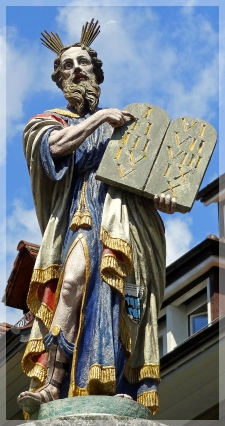 Our Colorado church had a large worship center with excellent acoustics so, when the local Jewish congregation wanted to present a concert of Jewish music by a well-known Jewish performer, we were happy to offer our venue to them. The Christians in attendance never expected the evening to end with Jews and Christians joining hands and dancing the hora around the church while singing “Hava Nagilah” (Let Us Rejoice). What the Jews hadn’t expected were the Bibles on the back of every chair. Before the concert began, many intently looked through them and, after the concert, they expressed their surprise at finding their Hebrew Scriptures in our Christian Bibles!
 Devotions of the Heart