
And then a little later, God-of-the-Angel-Armies spoke out again: “Take a good, hard look at your life. Think it over. You have spent a lot of money, but you haven’t much to show for it. You keep filling your plates, but you never get filled up. You keep drinking and drinking and drinking, but you’re always thirsty. You put on layer after layer of clothes, but you can’t get warm. And the people who work for you, what are they getting out of it? Not much—a leaky, rusted-out bucket, that’s what. That’s why God-of-the-Angel-Armies said: “Take a good, hard look at your life. Think it over.” [Haggai 1:5-7 (MSG)]
 “I Can’t Get No Satisfaction” sang the Rolling Stones in 1965. Back in 520 BC, the Jews of Jerusalem were probably singing their own version of that song. Sixteen years earlier, upon their return to Jerusalem from exile in Babylon, they had started to rebuild the temple just as God had instructed them to do. Within two years, however, construction had stopped. Granted, they had hostile neighbors who, fearing a prosperous Jewish state, harassed them. In actuality, though, they were more to blame for their delay than were their political opponents. Questioning God’s timing, they’d grown discouraged, lost focus and become more concerned about building their own homes than finishing God’s house. God sent a message to the people through the prophet Haggai pointing out that the harder the people worked for themselves, the less they had to show for it. By ignoring God and fulfilling their needs first, the Jews were destined to remain unsatisfied. Moreover, God was angry that He had been ignored. So angry, in fact, that He sent a drought to destroy their crops and livestock.
Although we’re not building a temple with hammers and nails, we also need to heed Haggai’s message. We should be busy building up God’s kingdom and the church of Christ. Yes, our homes and families, our jobs, even our leisure activities are important, but not as important as God and the task He’s given us. When our relationship with God comes first, the rest of our lives will function better. He will give us the strength and guidance to find peace in our lives. We won’t have to search for happiness; it will be ours. We will, indeed, be satisfied.
 When my children were younger, there were several occasions that I wanted to pretend I had no idea to whom they belonged! There was that time one noticed (and used) the red emergency stop button on an escalator, or another discovered the meaning of the “domino effect” after pulling over one stanchion at the airport and seeing another ten follow suit, or one managed to be so nasty to the babysitter that she went home in tears, or when hotel security came knocking because of spitballs dropping from the window of our children’s adjoining hotel room. I really didn’t want to admit I knew them, let alone had given birth to them. We expected better from our children and their conduct certainly didn’t bring honor to our name. Unfortunately, their behavior, while unacceptable, was a somewhat unavoidable and unpleasant part of their growing up. Fortunately, those times of boundary testing are long over and I am now proud that they bear my name.
 “Be mindful to be a blessing…” After reading Paul’s words as translated in the Classic Amplified Bible, I thought of a comic I recently saw in the newspaper. (Oddly, I get lots of inspiration from the comics and I’m not sure what that says about my intellect.) Nevertheless, in “Nancy,” written by Guy Gilchrist, it’s Nancy who is reading the comics page. The speech balloon says, “Today’s Motivation: Let your presence be a gift to all you meet!” The next panel shows her walking down the street. Instead of her typical hair ribbon, she is wearing an enormous bow and a gift tag that says, “To you!”
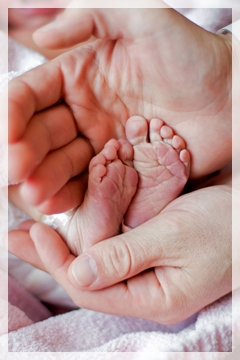 Writing about my granddaughter yesterday made me think about birth defects. In actuality, all of us have what could be called birth defects—it’s just that some are more obvious than others. While all of God’s children have defects, none are defective. I consider a young man at our Florida church. Cerebral palsy keeps him strapped into a wheel chair and his physical limitations are immense. There is, however, nothing defective about this bright young man. I ponder the enthusiastic grocery worker with Down’s syndrome. She may have an extra chromosome, but there is nothing defective about her. I think of a fellow at church who has no ears. He may be deaf but there is nothing defective about him, nor is there anything defective about a friend’s grand born with only a partial arm and hand or my grand, with her heart defects and learning issues. They are all marvelously made—different from others, but no less wonderful.
 I have a small wooden box on my desk—my “God box.” It’s where I literally give my concerns to God; right now there are three items in it. The first is a photograph of a little girl. It is my grand, a sweet child with three congenital heart defects—none of which is going to disappear and all of which promise more trouble in the future. She also has learning issues—none of which will dissipate and all of which will cause more difficulty as she progresses into higher grades. The second item is a medallion from a sobriety program. It represents several people I love who have battled alcoholism or addiction—a battle they will continue to fight daily for the rest of their lives. The third item is a laminated card on which is written Reinhold Niebuhr’s Serenity Prayer. That one is for me.
 Back in 1765, Dr. John Fawcett became the pastor of a small church in Wainsgate, England. Although his congregation of farmers and shepherds paid him a modest salary and donated wool and potatoes to them, the growing Fawcett family struggled to make ends meet. When a prestigious London church extended a call to him, Fawcett accepted and preached his farewell sermon. The family’s belongings were loaded on their wagon when parishioners gathered around him and begged him to stay. When his wife cried, “Oh John, John, I cannot bear this,” the pastor agreed. He ordered the wagon unloaded and remained at that parish for 54 years. Tradition has it that Fawcett wrote the words to “Blest be the Tie” in commemoration of that day.
 Devotions of the Heart