COUNTING THE COST

If you want to be my disciple, you must, by comparison, hate everyone else—your father and mother, wife and children, brothers and sisters—yes, even your own life. Otherwise, you cannot be my disciple. And if you do not carry your own cross and follow me, you cannot be my disciple. But don’t begin until you count the cost. [Luke 14:26-28a (NLT)]
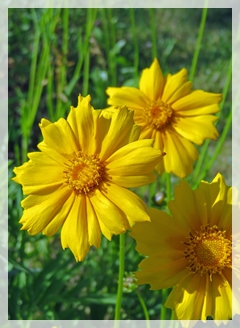
coreopsisHis cautionary words to the disciples are difficult to understand. How can Jesus, who told us to love our enemies and do good to them, tell us to hate our families? Do we have to despise our relatives if we want to be his disciples? Fortunately, after getting the disciples’ attention with that unusual statement, Jesus followed with a parable about a man who undertook a project without counting the cost and then couldn’t finish what he began. Hating our family is just a hyperbole; it’s a way of saying that anyone who follows Christ must love Him more than anything else. Christ is to be first and foremost in our hearts and minds. In comparison to our love for Jesus, we are to love them less (or “hate” them). To be His disciple, Jesus demands total commitment; we must be willing to give up everything for Him, even if that means the things and people we love. Sadly, when we choose Christ over loved ones, they might perceive our love of Jesus as a betrayal and may even hate us for that choice.

I was raised in a family of believers and married a believer so I never had to choose between Jesus and family. For a moment, however, consider the disciples and their families. When they left their jobs to follow Jesus, did they leave behind loved ones? Did their families disown them or distance themselves from what seemed fanaticism or membership in a strange cult? What about the Apostle Paul? Originally known as Saul of Tarsus, he came from a family of Pharisees and spent many years studying Scripture under the celebrated rabbi Gamaliel. If not already a member of the Sanhedrin, he was well on his way to becoming a member of the high council and was an active leader in persecuting the followers of Christ. Saul was probably everything a devout Jewish family would want in a good Jewish son until he became a Christian evangelist named Paul! Think of what it cost him to follow Jesus.

While some of us gave up a few bad habits or unsavory friends when we accepted Christ, Christian apologist Nabeel Qureshi gave up far more. When this Pakistani-American gave up his Muslim faith, he gave up his loving family as well. His becoming Christian caused a devastating destruction of their relationship and it took nearly ten years for the healing to begin. I cannot begin to comprehend the difficulty of his choice to follow Christ and the pain experienced by both parents and son. When I read Qureshi’s story, I finally understood what Jesus meant when He said to count the cost before we give up our lives and pick up that cross.

How could I betray my family after all they had done for me? By becoming a Christian, not only would I lose all connection with the Muslim community around me, my family would lose their honor as well. My decision would not only destroy me, it would also destroy my family, the ones who loved me most and sacrificed so much for me. I began mourning the impact of the decision I knew I had to make.… “But Jesus,” I said, “accepting you would be like dying. I will have to give up everything.”… For Muslims, following the gospel is more than a call to prayer. It is a call to die. [Nabeel Qureshi]
Then he said to the crowd, “If any of you wants to be my follower, you must give up your own way, take up your cross daily, and follow me. If you try to hang on to your life, you will lose it. But if you give up your life for my sake, you will save it. [Luke 9:23-24 (NLT)]

Then Peter began to speak up. “We’ve given up everything to follow you,” he said. “Yes,” Jesus replied, “and I assure you that everyone who has given up house or brothers or sisters or mother or father or children or property, for my sake and for the Good News, will receive now in return a hundred times as many houses, brothers, sisters, mothers, children, and property—along with persecution. And in the world to come that person will have eternal life. [Mark 10:28-30 (NLT)]

Copyright ©2017 jsjdevotions. All rights reserved.

OUR FOUNDATION

In that day he will be your sure foundation, providing a rich store of salvation, wisdom, and knowledge. The fear of the Lord will be your treasure. [Isaiah 33:6 (NLT)]

Dear God, what misery I beheld! The ordinary person, especially in the villages, knows nothing about the Christian faith, and unfortunately many pastors are completely unskilled and incompetent teachers. [Martin Luther]

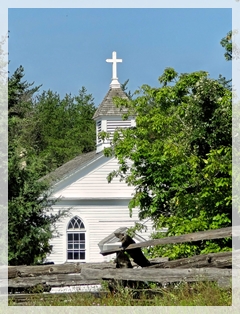
Old World Wisconsin churchYesterday I mentioned getting an email with the subject, “How firm is your foundation?” Although it was an advertisement for a new study Bible connecting Biblical teachings to Christian beliefs, that very question has been the topic of discussion in our northern church for the last few weeks. The parish is doing a church-wide study of Martin Luther’s Small Catechism. Back in the 1500s, Martin Luther was appalled at the lack of knowledge of both pastors and their congregations. Not especially tactful, he accused some pastors of being “lazy bellies and presumptuous saints!” His words for their congregations, “simple cattle and mindless pigs!” were no more diplomatic. People who called themselves Christians had no idea what that meant. They didn’t know the Ten Commandments, the Apostle’s Creed or even the Lord’s Prayer, let alone anything else in the Bible. Last week, our Pastor asked us what Luther might say if he visited today’s churches. We agreed that his words for our pastors would be more complimentary but that his words for their congregations might be the same or worse!
To remedy the deplorable lack of knowledge he found, Luther wrote his Small Catechism in 1529. This little book of Christian instruction was written not for theologians and priests but for ordinary people. It covers the Ten Commandments, the Apostle’s Creed, the Lord’s Prayer, Holy Baptism, confession, Holy Communion, daily prayers and even offers a Household Chart of Bible passages describing the duties of people in various walks of life. Much of the catechism is done in question and answer form with the answer succinctly provided. For example, after listing the first commandment, it asks, “What does this mean?” and then explains: “We are to fear, love, and trust God above all things.” In short, Luther’s Small Catechism is a 16th Century version of Christianity for Dummies. Surprisingly, given its age, it is amazingly straightforward. Without theological minutia or argument, it is easily understood and certainly not limited to the Lutheran church.

This brings me back to the question that appeared in my email yesterday, “How firm is your foundation?” Do you know and understand what it is you profess to believe? Do you know why you believe it? How firm is your foundation?

How firm a foundation, ye saints of the Lord,
Is laid for your faith in His excellent Word!
What more can He say than to you He hath said,
You, who unto Jesus for refuge have fled? [John Rippon]

Anyone who listens to my teaching and follows it is wise, like a person who builds a house on solid rock. Though the rain comes in torrents and the floodwaters rise and the winds beat against that house, it won’t collapse because it is built on bedrock. But anyone who hears my teaching and doesn’t obey it is foolish, like a person who builds a house on sand. When the rains and floods come and the winds beat against that house, it will collapse with a mighty crash. [Matthew 7:24-27 (NLT)]

Copyright ©2017 jsjdevotions. All rights reserved.

IF SOMEONE ASKS

And if someone asks about your hope as a believer, always be ready to explain it. [1 Peter 3:15b (NLT)]

Yesterday, I echoed Paul’s words that, when witnessing, we need to speak our words with love. Of course, before that can happen we need to speak and, therein lies our problem. To speak, we need words and most of us are sure we don’t have them. Granted, the way we conduct ourselves is a continuous sermon but, if we never speak, no one will know what makes us the way we are. Actions may speak louder than words but that doesn’t mean words aren’t necessary.

We don’t have to go knocking on doors, stand on street corners with a sign, accost strangers, or go on a mission trip; we just have to be open to the opportunities that arise nearly every day to share our love of God. Peter instructed us to be ready to explain the reason for our hope; I think we’re asked that question more than we realize. There’s a good chance people have commented on your joy, peace, or calmness. In all likelihood someone may have said something like, “How do you do it?” or, “You don’t seem to worry,” or even, “I wish I had your life!” In reality, that person is asking about the source of your hope. Rarely have my answers to such comments revealed the true source of that hope, strength, peace and joy. I’ve chosen the innocuous reply rather than the true one simply because I didn’t think I had the right words to explain! When Jesus told us to go out into the world and be His witnesses, He promised we wouldn’t have to do it alone. Since the Holy Spirit will empower us to be His messengers, let’s allow Him to do His work! We can’t speak with love until we speak!

God forbid that I should travel with anybody a quarter of an hour without speaking of Christ to them. [George Whitefield]

But this will be your opportunity to tell them about me. So don’t worry in advance about how to answer the charges against you, for I will give you the right words and such wisdom that none of your opponents will be able to reply or refute you! [Luke 21:13-15 (NLT)]

Copyright ©2017 jsjdevotions. All rights reserved.

SOUNDING BRASS

Though I speak with the tongues of men and of angels, and have not charity, I am become as sounding brass, or a tinkling cymbal. [1 Corinthians 13:1 (KJV)]

maccaw

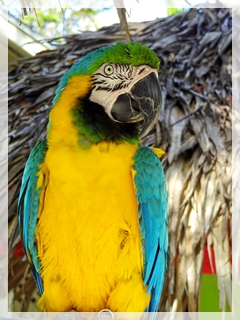
1 Corinthians is actually Paul’s second letter to the young church at Corinth;  the first letter does not remain. What we consider the first letter is actually Paul’s reply to the Corinthians’ response to his first one. While much of his letter is spent confronting the Corinthians about their sins and correcting their behavior, this rebuke to a troubled church has one of the most beautiful chapters in the Bible: 1 Corinthians 13. Paul, however, is actually writing about the Corinthians’ abuse of their spiritual gifts. By only associating this chapter with weddings and anniversaries, we may miss some of its original meaning.

The “tongues of men” probably refers to the Sanhedrin, the supreme judicial and administrative council of the Jews. Having jurisdiction over religious matters, the high priest acted as its president and its members consisted of the chief priests, scribes and elders. They were to be men of distinction and wisdom conversant in all seventy languages of mankind so interpreters weren’t needed in court. It’s likely that the tongues of men to which Paul referred were the supposedly wise and multilingual tongues of the Sanhedrin. Being ministering spirits, angels have no need for tongues. Nevertheless, there were times they took on flesh and appeared to man and, when acting as God’s messengers, they were inspiring and eloquent in their speech.

Personally, I like brass quartets and the sound of those tinkling cymbals worn on the fingers of Middle Eastern dancers, but those are not what Paul meant. Paul actually was referring to sounding (or echoing) brass which were large cast urns placed around the back of a theater. This primitive sound system served to amplify the actors’ voices and Corinth had a famed set of them. The “sounding brass” could no more create their own sound than could a Bose speaker; having no voice of their own, they only could reproduce sound. As for tinkling cymbals, the two kinds of cymbals used during Jewish worship were percussion instruments. Only played during interludes in the vocal music, they didn’t produce a light tinkle. One was more of a shaker with small cymbals attached to a handle that was shaken. The other cymbals were smaller and heavier than today’s orchestral ones. Rather than the pleasant ringing of wind chimes, they were said to penetrate “as far as Jericho.”

In their cultural context, Paul’s words make far more sense. Even if he could speak with great wisdom, in every language known to man and as magnificently and eloquently as an angel, if his words didn’t come from his heart, they would have no meaning. If he just thoughtlessly  echoed words, his voice simply would be an irritating  loud sound.

We worry so much about what to say and how to say it when an opportunity to share our faith arises that we usually fail to share God’s message at all. Paul’s words should reassure us that it’s not the words or eloquence that matter; it’s the love behind those words. If we love God and love people, then the words we speak will be filled with love. Without love, however, no matter how articulate, self-assured and knowledgeable we are, our message will be meaningless noise.

The purpose of my instruction is that all believers would be filled with love that comes from a pure heart, a clear conscience, and genuine faith. [1 Timothy 1:5 (NLT)]

Copyright ©2017 jsjdevotions. All rights reserved.

STORMS

God is our refuge and strength, always ready to help in times of trouble. So we will not fear when earthquakes come and the mountains crumble into the sea. Let the oceans roar and foam. Let the mountains tremble as the waters surge! [Psalm 46:1-3 (NLT)]

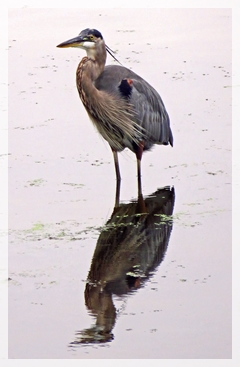
great blue heronThe damage done by Hurricane Harvey seemed unbelievable until Irma hammered the entire state of Florida. Fortunately, our Florida home was prepared and we were safely situated in the Midwest during Irma’s tirade. Would that all the storms of life announced themselves a week in advance to give us time to put up storm shutters and evacuate to safety.

Unfortunately, most of life’s storms are more like tornadoes and hit with little or no warning. Yesterday, sixteen years after 9/11, we were again reminded how unpredictable and precarious life can be. Plywood, sand bags, flashlights, batteries, generators, and stores of fuel, water, and canned goods are of no use when a plane crashes into a building, a spouse has a disabling stroke, a car careens into a crowd, or a stray bullet hits. Addiction, Alzheimer’s, job loss, divorce, cancer, mental illness or a drunken driver don’t warn us before wreaking havoc with our lives. We cannot escape from life’s tempests and trials and they can be far more destructive than any hurricane with its accompanying storm surge.

Someone asked if I had a digital record of our property and another if I was worried about losing anything. Possessions were the least of my concerns; “It’s just stuff!” was my response. We did our best to protect our Florida home and belongings but they are things. I can’t take them with me at the end so, if I lose them now, what difference does it really make? Perhaps I’m being cavalier; it’s our second home so, even if everything is destroyed, I still have a place to rest my head. Nevertheless, although most of those affected have only one home, the same holds true for us all; it really is just stuff. Eventually, power will be restored and homes and businesses will be rebuilt; life goes on.

The question about what I didn’t want to lose got me wondering about my answer—if not house and possessions, to what am I attached? The answer is my faith and relationships, neither of which can be insured or replaced. In the last few days I’ve heard from friends far and near, checking on us and offering their help. These are people who already have more than enough on their plates and yet they offered us both moral support and helping hands. I would mourn losing relationships like those far more than anything in my houses. As for my faith, I’d like to think it will take more than a hurricane or even a terrorist attack to topple it.

Our Florida home was built to withstand a hurricane and should have survived the storm’s onslaught; I don’t yet know. The more important question is whether my faith and relationships can survive the sort of pounding that Irma inflicted on Florida. Are they strong enough to survive gale force winds? Rather than taking pictures of stuff, shuttering the windows or putting furniture up on blocks, what am I doing to reinforce and protect both my faith and relationships to make sure they survive whatever storms come my way?

Heavenly Father, thank you for keeping us strong during life’s storms. Let your written word and the Spirit’s voice bolster us when we start to waver in the wind. Thank you for the gift of friends and family—the people who love and strengthen us so we can survive the squalls, challenges, and losses of our troubled world. Help us be the kind of friends who can be counted on to encourage, reinforce and sustain those around us.

Two people are better off than one, for they can help each other succeed. If one person falls, the other can reach out and help. But someone who falls alone is in real trouble. Likewise, two people lying close together can keep each other warm. But how can one be warm alone? A person standing alone can be attacked and defeated, but two can stand back-to-back and conquer. Three are even better, for a triple-braided cord is not easily broken. [Ecclesiastes 4:9-12 (NLT)]

Copyright ©2017 jsjdevotions. All rights reserved.

ON THE TRAIL

You go before me and follow me. You place your hand of blessing on my head. [Psalm 139:5 (NLT)]

Lake louiseOur recent trip to the Canadian Rockies reminded me of a hiking trip I took there with my daughter more than twenty years ago. With two guides for our group, one acted as lead and tied orange ribbons along the trail to mark the way. Knowing that we are to leave nothing in the forest but footprints, a second guide (the sweep) followed the last hiker and removed the trail markers. That morning’s hike was a trek up to a mountainside teahouse and my daughter and I (both fast walkers) wanted to have time at the top to explore. Confident we couldn’t get lost, we shot ahead of the guide, promising to meet at the teahouse. Apparently, there was a fork in the trail we missed in our haste; we veered left when we should have stayed right. After a while, it occurred to us that we seemed to be going down when the trail should be going up. Nevertheless, expecting an uphill just around the next turn and unwilling to admit we may have erred, we continued down. When we arrived at the same lake from which we’d started, we saw the error of our ways, turned around, and made the hike back uphill. By the time we reached the main trail, the trail markers placed by the lead guide had already been removed by the sweep. Knowing we needed to go further uphill, we continued our trek and eventually rejoined our group at the teahouse. In our case, the first really were the last and we barely had enough time to eat lunch before starting back down the mountain.

“You go before me and follow me,” David said about God in Psalm 139. Had my daughter and I allowed the lead to set the pace, the same could have been said about our hiking guides. Sure that we knew the way, however, we charged ahead, lost our way, and went down instead of up. Sarah charged ahead of God by giving Hagar to Abraham, Saul charged ahead by making a sacrifice without waiting for Samuel, and the prodigal son charged ahead when he demanded his inheritance before his father’s death. As so often happens when people take matters into their own hands rather than waiting for God, they discovered that things can go downhill quickly and often with tragic consequences.

Fortunately, God is in front of us—leading us, marking the way, lighting the path ahead, and smoothing the trail. He also is behind us—lifting us when we stumble, strengthening us when we weaken, encouraging, correcting and protecting us. Like our hiking guides, however, He will allow us to barge ahead and make mistakes along the trail. Fortunately, along with allowing us the freedom to turn the wrong direction, God allows us to make U-turns! Unlike our hiking guides, however, we can never leave Him in the dust nor will He ever leave us behind Him. Moreover, He won’t remove the signs that show us the right path. He is right there, both in front and behind us, leading and sweeping, like the extraordinary guide that He is.

Then I will lead the blind along a way they never knew; I will guide them along paths they have not known. I will make the darkness become light for them, and the rough ground smooth. These are the things I will do; I will not leave my people. [Isaiah 42:16 (NCV)]

If you go the wrong way—to the right or to the left—you will hear a voice behind you saying, “This is the right way. You should go this way.” [Isaiah 30:21 (NCV)]

Copyright ©2017 jsjdevotions. All rights reserved.