SEE THEM

Don’t let selfishness and prideful agendas take over. Embrace true humility, and lift your heads to extend love to others. Get beyond yourselves and protecting your own interests; be sincere, and secure your neighbors’ interests first. [Philippians 2:3-4 (VOICE)]

peonyOne week after Hurricane Irma, our Florida church met where they usually do in the city park. As the service began, an irate city official arrived. Afraid of unsafe conditions and liability issues, he insisted that the service be stopped immediately. While the senior pastor continued the service, our associate pastor tried to calm him down. He started by asking the bureaucrat how he was doing. The overwrought man’s response was a recitation of all of the challenges he’d dealt with in a city without power, working sewers or safe water. “No,” our pastor said, “I know the city is a mess, how are you doing?” He went on to ask about the man’s family, his house, and whether he was in need of anything. Instead of seeing him as a problem to be solved, our Pastor saw him as a person under a great deal of stress. As the two men talked and shared their personal hurricane stories, the official calmed. He finally took a good look at the park and decided the service could continue. This didn’t happen because our pastor won an argument; it happened because he saw the city employee as a person with problems of his own and showed that he (and our church) cared.

I heard the story of another minister, one who kept asking his new neighbor to church but was always rebuffed. When the minister stopped seeing his neighbor as a potential convert and actually spoke with him, he learned that the fellow liked barbecue. When he extended an invitation for a rib dinner rather than church, the invitation wasn’t declined. As the men got to know one another, a friendship resulted and that church invitation was eventually accepted. This didn’t happen because the new neighbor liked barbecue ribs; it happened because the minister took the time to look at his neighbor as a person and not a prospect.

I think of Jesus and his first encounters with the two tax collectors, Matthew and Zacchaeus. He didn’t confront the men about being cheats or traitors to their people.  Instead, Jesus went home to dinner with them. They didn’t become believers just because Jesus was a good dinner guest. They believed because Jesus saw them (and their friends) as people and not just the sinners they were.

We must never see people merely as foes, problems to be solved, prospective church members, causes, sinners, or troubled souls that need saving. Before we can change people’s minds or lives, we need to show that we care about who they are, what they believe, what made them the way they are, and the challenges they are facing today. We are told to love our neighbors but, before we can love our neighbors, we must truly see them—not just their faces but the person and circumstances behind that face.

Christianity is not a religion or a philosophy, but a relationship and a lifestyle. The core of that lifestyle is thinking of others, as Jesus did, instead of ourselves. [Rick Warren]

Love others well, and don’t hide behind a mask; love authentically. Despise evil; pursue what is good as if your life depends on it.  Live in true devotion to one another, loving each other as sisters and brothers. Be first to honor others by putting them first. [Romans 12:9-10 (VOICE)]

Copyright ©2017 jsjdevotions. All rights reserved.

RESTORATION SPECIALISTS

RainbowThese people are false apostles. They are deceitful workers who disguise themselves as apostles of Christ. But I am not surprised! Even Satan disguises himself as an angel of light. So it is no wonder that his servants also disguise themselves as servants of righteousness. In the end they will get the punishment their wicked deeds deserve. [2 Corinthians 11:13-15 (NLT)]

More than four weeks have passed since Hurricane Irma wreaked havoc on southwest Florida. Debris is piled into mini-mountains along the roads and, with over $320 million in damages in our county alone, the storm chasers have descended. Calling themselves restoration specialists, their trucks prowl the neighborhoods. They claim expertise in water extraction, mold removal, window and screen replacement, roofing, landscaping, carpet cleaning, drywall, plaster, demolition and reconstruction. At best they are anything but expert and do shoddy work; at worst, they are scam artists who take their money and run! Desperate to get back to some semblance of normalcy after this devastating storm, people will hire just about anyone who promises speedy restoration. These swinders are having a heyday while leaving behind a mess for the homeowners.

As Christians, we have the genuine restoration specialist: Jesus Christ. Rather than restoring flooded houses, He restores sight to the blind and life to the dead. His death and resurrection restored our relationship with God the Father. Nevertheless, during the hurricanes that occur in our lives—those storms that leave us emotionally battered and bruised—we can fall prey to another team of counterfeit restoration specialists. Called false prophets or false apostles in Scripture, I think of them as the pseudo philosophers and ersatz preachers of today. Some just may be misguided but others are charlatans and hypocrites. Either way, their teachings are incorrect and, like faulty wiring, dangerous!

When desperate, we tend to grab onto the first thing we see and the enemy is no fool; he quickly has his restoration specialists at our doors with their false promises of repair and renewal. Knowing that outright lies are far easier to recognize than half-truths, their deception is usually mixed with a little truth. Rather than denying the entire Gospel, they distort and misrepresent its message. Like storm chasers, they’re  great salesmen—friendly, empathetic and smooth talkers who tell us what we want to hear. Instead of a new roof in two days, they promise hope and a means to a better life but, like any scammer, their work is costly and defective!

Knowledge is power. The more we know about our homes, the more knowledgeable we are about their repair. We can recognize a solution that is too easy, too expensive or too cheap to be true. Knowledge is power when it comes to our faith, as well. The more we know about the Bible, the better able we are to recognize incorrect or fabricated doctrine. The entire message—not just a few cherry picked verses—must come from the Bible. Jesus is essential; the only salvation is through Christ and the cross. Rather than asking for a business license, we should make sure our spiritual storm chaser exhibits the Fruit of the Spirit and that his message will yield that same fruit in us. Moreover, we must be wary of any message that promises a quick easy fix. If it promises forgiveness without repentance or heaven without hell, it really is too easy (and too cheap) to be true! Repair and renovation after a hurricane takes time and effort and so does spiritual renewal after we’ve been hit by any storm in life. Just be sure to depend on the number one restoration expert—Jesus Christ!

Satan is the counterfeiter. …He has a false gospel, preached by false ministers, producing false Christians. …Satan plants his counterfeits wherever God plants true believers. [Warren Wiersbe]

Dear friends, do not believe everyone who claims to speak by the Spirit. You must test them to see if the spirit they have comes from God. For there are many false prophets in the world. This is how we know if they have the Spirit of God: If a person claiming to be a prophet acknowledges that Jesus Christ came in a real body, that person has the Spirit of God. But if someone claims to be a prophet and does not acknowledge the truth about Jesus, that person is not from God. Such a person has the spirit of the Antichrist, which you heard is coming into the world and indeed is already here. [1 John 4:1-3 (NLT)]

Copyright ©2017 jsjdevotions. All rights reserved.

I’M FINE

And we are confident that he hears us whenever we ask for anything that pleases him. And since we know he hears us when we make our requests, we also know that he will give us what we ask for. [1 John 5:14-15 (NLT)]

snowy egretsWhen asked about her boys, a friend used to answer, “They’re doing their own thing.” Years later, I learned “their own thing” meant they were breaking her mama’s heart with their addictions and run-ins with the law. Because she kept her pain concealed, she carried the weight of that burden alone for many years. We often hear similar answers when we ask someone how they’re doing— brusque responses like, “I’m fine,” “It’s taken care of,” or “We don’t need a thing.” Maybe everything really is hunky dory but those answers are often used when life has gone seriously awry and things are anything but fine. Those vague but terse responses are conversation stoppers. Even best friends, who suspect something is amiss, won’t pry and the subject is politely changed.

We wrap ourselves up in a nice package on the outside when inside we’re a mess. We allow people into the vestibule of our lives but won’t let them in to see the messy kitchen or dirty floor. We refuse to expose our vulnerabilities and then we wonder where our friends are when we need them. No one knows we need them if we refuse to allow them into our lives. The same goes for God. “Where are you God?” we complain without being willing to admit life’s a mess and we need Him.

Think of the paralyzed man whose friends took him to see Jesus in Capernaum. What if he’d told his friends he was just fine and didn’t need a thing? While his friends went off to see Jesus, he would have remained paralyzed at home and there would be one less miraculous healing. What if the blind man in Bethsaida or the centurion’s servant had said they were fine? Scratch two more healings!

As for Job’s friends—he could have rebuffed them at the door, telling them, “I’m fine; this is just a little setback.” Instead, he allowed them inside to see his scabs, sores and misery. Even with his friends’ erroneous theology, Job must have found comfort when they remained at his side. Perhaps their discussions even strengthened his faith in God.

We tell people we’re okay when we’re not and we often tell God the same thing. We’re so used to replying, “I’m fine,” when a stranger says, “How are you?” that we forget our friends and God actually care about the answer. Most of the time, when people inquire about our lives or ask how they can help, they sincerely want to know. If they’re not really interested, their response to our answer likely will be, “Sorry, I’m busy!” Even though God knows everything about us and all that we need, He tells us to ask Him. He knows we’re not fine, but do we? Fortunately, with God, we can be confident that He’ll never tell us He’s too busy!

Refusing to ask for help when you need it is refusing someone the chance to be helpful. [Ric Ocasek]

You haven’t done this before. Ask, using my name, and you will receive, and you will have abundant joy. [John 16:24 (NLT)]

Keep on asking, and you will receive what you ask for. Keep on seeking, and you will find. Keep on knocking, and the door will be opened to you. For everyone who asks, receives. Everyone who seeks, finds. And to everyone who knocks, the door will be opened. [Matthew 7:7-8 (NLT)]

Copyright ©2017 jsjdevotions. All rights reserved


COMPASSION FATIGUE

Then he went on alone into the wilderness, traveling all day. He sat down under a solitary broom tree and prayed that he might die. “I have had enough, Lord,” he said. “Take my life, for I am no better than my ancestors who have already died.” [1 Kings 19:4 (NLT)]

hibiscusMost of us think of sloth as laziness: a dislike of work or any physical exertion. Having watched the local zoo’s sloth in action (or, rather, inaction), I think the sluggish animal is appropriately named. Spiritual sloth, however, is far different than being a couch potato. Originally, the sin of sloth was two sins: sadness and acedia. Compiled by Evagrius of Ponticus, a 4th century monk, these two “capitals sins” were part of a list of eight he believed to the greatest threats to devout monasticism.
We know what sadness is and it’s important to remember that the sadness which Evagrius found problematic for his monks was not clinical depression; it was that despondency or gloom that easily came upon a monk living an ascetic life of prayer, fasting and labor in the middle of the Egyptian desert in the 4th century. It was unhappiness with one’s present situation and the melancholy that comes from longing for something different. It was distress at one’s circumstances and the inability to give thanks in all things. In this troubled world, we certainly don’t have to be monks to suffer that kind of sadness.

Acedia comes from the Greek and means without care or concern. Rather than laziness, it is apathy or a fatigue of mind and soul. A spiritual boredom or weariness, acedia results in listless prayers, study or service. In the midday heat, the monks were tempted to let their minds wander during study and prayers and then fall asleep causing Evagrius to call acedia the “noonday demon.” Seeing the correlation between sadness and acedia, in the late 6th century, Pope Gregory combined the two sins into sloth .

A few mornings ago, I fell victim to compassion fatigue and began to understand spiritual sloth. The previous night’s discussion in Bible study had been disheartening. We’d talked of the recent hurricanes (with yet another one on the horizon), Mexico’s earthquakes, Puerto Rico’s devastation, Korea’s threat, the horrendous carnage in Las Vegas, a polarized nation, and the unrest in the Middle East. As I added that night’s heartbreaking prayer requests to my already burgeoning and depressing list, I grew numb with grief. “What’s the point? I wondered as I listed a two-year old just diagnosed with metastasized stomach cancer, a woman who may lose her feet because of nursing home neglect, and a friend’s suicidal son. “What difference can I make? Why bother?” I cried. At that point, my heart was so weary with grief that I no longer wanted to care or pray. I probably felt as Elijah did when, while fleeing Jezebel, he sat down under that broom tree and said he wanted to die. That’s spiritual sloth and it’s not just monks and Old Testament prophets that can be afflicted with it. The enemy wants us all to become so downhearted and world-weary that we fall into spiritual inactivity or sloth.

Elijah was cured of his spiritual sloth by food, rest, and a talk with the Lord. Although I didn’t eat, I was nourished by Scripture. I didn’t sleep but I rested in the words I read and then, like Elijah, I had a prayerful chat with God. God whispered to Elijah and gave him new strength. He whispered to me and refreshed me with his words of love, comfort, reassurance and hope.

I cried out, “I am slipping!” but your unfailing love, O Lord, supported me. When doubts filled my mind, your comfort gave me renewed hope and cheer. [Psalm 94:18-19 (NLT)]

And now, dear brothers and sisters, one final thing. Fix your thoughts on what is true, and honorable, and right, and pure, and lovely, and admirable. Think about things that are excellent and worthy of praise. [Philippians 4:8 (NLT)]

Copyright ©2017 jsjdevotions. All rights reserved.

MYOB

If you are insulted for the name of Christ, you are blessed, because the Spirit of glory and of God rests upon you. But let none of you suffer as a murderer or a thief or an evildoer or as a meddler. [1 Peter 4:14-15 (ESV)]

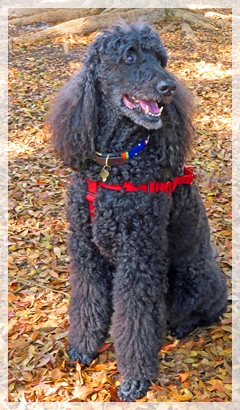
standard poodleThe store was called “Ms. Bossy Boots” and the sign in the window said, “I’m not bossy, I’m just helpful.” Having just had an encounter with a precocious youngster who’d been wearing some very bossy boots, I laughed. After advising me that I needed to put televisions in all my bedrooms, she informed me we couldn’t sell our house because she didn’t want new neighbors! She announced her disapproval of the appetizers, questioned the dinner menu, told me jam should be served with the bread, and criticized the vegetables. Following dinner, I was advised that any remaining cookies should be packed up for her. In a younger child, her behavior might have been slightly excusable. At her age, however, it was demanding and ill-mannered. Over-indulged by her mother and grandparents, she has not learned that it is the meek who will inherit the earth.

Most of us don’t behave like impertinent children but that doesn’t mean we aren’t meddlesome or bossy; we’re just more subtle than that cheeky little girl. When we put on our bossy boots, we excuse ourselves by saying we’re being helpful, interested, or supportive. If anyone had the right to interfere, it was Jesus but He refused to intervene when asked to settle a dispute about an inheritance. Because rabbis often resolved disagreements, it wasn’t such an odd request. Nevertheless, our Lord, knowing what constituted His business and what didn’t, refused to get involved. He did, however, take that opportunity to teach about greed.

We were told, “Mind your own business,” when we tattled in school and, “Keep your eyes on your own paper!” when taking tests. Keeping our mouths shut and our eyes on our own business remains good advice today. Far too often, our “helpfulness” is really just an excuse to be bossy or stick our noses into somebody else’s affairs. Soon we’re just a word away from engaging in gossip and self-righteousness while telling others how much we are doing, solving or repairing and how well we are doing it. The Apostle Peter lumps meddlers in with thieves, murderers and other criminals and Proverbs likens meddling to grabbing a dog by the ears. Whether we call it helping, tweaking, or enlightening, it’s wise to remember that just a few inches away from a dog’s ears are some pretty sharp teeth. Eventually, meddling will turn around and bite us!

Whoever meddles in a quarrel not his own is like one who takes a passing dog by the ears. [Proverbs 26:17 (ESV)]

And to aspire to live quietly, and to mind your own affairs, and to work with your hands, as we instructed you, [1 Thessalonians 4:11 (ESV)]

Copyright ©2017 jsjdevotions. All rights reserved.

GOD’S BANKERS

wild geraniumThere are always going to be poor and needy people among you. So I command you: Always be generous, open purse and hands, give to your neighbors in trouble, your poor and hurting neighbors. [Deuteronomy 15:11 (MSG)]

The Hebrew word for what we call “charity” is tzedakah; its nature, however, is far different than acts of benevolence or generosity. Rather than being a magnanimous act by someone more fortunate, tzedakah is considered an act of justice and righteousness. It is remedying a wrong, doing what is right and just, and fulfilling a duty; in short, it is giving the poor what they deserve.

In writing about charity, Rabbi Yanki Tauber tells of a wealthy man who often supported his rabbi’s charitable activities. One day a letter requesting a large sum for a good cause arrived. At the time, money was a little tight and making a donation was inconvenient so the rich man ignored the request. Shortly after that, his businesses began to fail and the wealthy entrepreneur lost his entire fortune.

The distraught fellow went to the synagogue and berated the holy man for not warning him that he’d suffer if he ignored the rabbi’s plea. “I would have given you the money had I known what punishment I would suffer!” he said. The rabbi calmly responded that the loss of money wasn’t a punishment. “Nothing that was yours has been taken from you,” he explained, adding that God had allotted a certain amount of resources to the rabbi in his work. Since the time he spent in prayer, studying, teaching, counseling and helping others left him no time to manage finances or property, the rabbi’s resources had been placed in the trust of several people who acted as “bankers” for that wealth. In turn, those bankers recognized the value of the rabbi’s work and supported it. When the once rich man failed to carry out his banking duty, the money was simply transferred to another, more responsible, “banker.”

God loves all of His children but that does not mean that He allots equal portions of blessings or sorrows to each of them. Some are healthier, wealthier, smarter, more talented or more attractive than others. Some people seem to escape misfortune while others seem to encounter storms at every turn. Because of an accident of birth, we may live comfortable lives in a wealthy nation or suffer in poverty in a corrupt or war-torn land. Some people have power and are easily heard while others are powerless and often ignored. That we are not given equal portions, however, does not mean that we are not equally deserving. If we have been blessed with wealth, education, influence or opportunities, we should think of ourselves as God’s bankers. We’re just holding on to other people’s resources and it is our job to distribute those resources to their rightful owners. Like our Jewish brothers and sisters, Christians should be dispensers of tzedakah. Unlike them, however, we don’t do it to buy our way into heaven (which it won’t). We do it because God tells us it is the right thing to do!

God does not need your good works, but our neighbor does. [Martin Luther]

This is how we’ve come to understand and experience love: Christ sacrificed his life for us. This is why we ought to live sacrificially for our fellow believers, and not just be out for ourselves. If you see some brother or sister in need and have the means to do something about it but turn a cold shoulder and do nothing, what happens to God’s love? It disappears. And you made it disappear. [1 John 3:16-17 (MSG)]

Then the King will say, “I’m telling the solemn truth: Whenever you did one of these things to someone overlooked or ignored, that was me—you did it to me.” [Matthew 25:40 (MSG)]

Copyright ©2017 jsjdevotions. All rights reserved.