
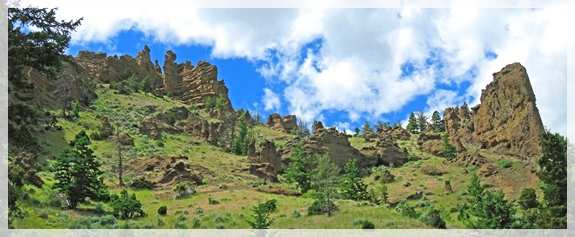
 For ever since the world was created, people have seen the earth and sky. Through everything God made, they can clearly see his invisible qualities—his eternal power and divine nature. So they have no excuse for not knowing God. [Romans 1:20 (NLT)]
All things bright and beautiful, All creatures great and small,
All things wise and wonderful: The Lord God made them all.
[“All Things Bright and Beautiful” by Cecil F. Alexander]
“When in doubt, trust your horse!” was the sign I’d seen earlier in the corral and so, as we slowly wended our way through the pinyon-juniper forest and up the mountain trail, I trusted my mount. After all, he didn’t want to fall down the ravine any more than did I. When we reached the ridge, I gasped—somewhat out of relief but more so out of wonder. The scenery was breathtaking! As I looked across the Wapiti Valley, I saw the incredible volcanic rock formations of the Absaroka Mountain Range and, when I looked down into the valley, I saw some of what Teddy Roosevelt called “The fifty most beautiful miles in America”. Surrounding us in the sage meadow on the ridge was an incredible array of wildflowers. An abundance of color, there were red Wyoming paintbrush, bright yellow mule’s ears and sunflowers, purple lupine, white snowbells, low pink bitterroot, tall green gentians, delicate bluebells, and a few pale yellow prickly pear cactus. Fritillaries and a white admiral 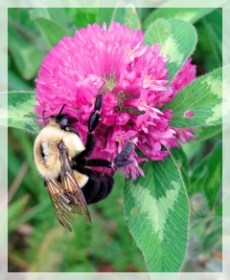 butterfly flitted among the blossoms and a marmot peeked out from behind a rock. So as to not spook the horses or spoil the day for my fellow riders, I silently sang the chorus to All Things Bright and Beautiful.
Only able to remember the hymn’s chorus, I looked up the lyrics when I got home. The author is Cecil F. Alexander. An Irish woman known as Fanny to her friends and family, she lived in the mid-19th century and was married to a clergyman. It is said that she based her hymn on the words of the Apostles’ Creed: “I believe in God the Father, Maker of heaven and earth.” She easily could have been inspired by Psalms 19 or 104. I doubt she ever visited a ranch in Wyoming so she wasn’t thinking of the Absarokas and a colorful mountain meadow. Nevertheless, I imagine the Irish countryside can be just as extraordinary; perhaps Fanny’s inspiration came from visiting some place like Ireland’s Cliffs of Moher where she stood in awe of God’s handiwork.
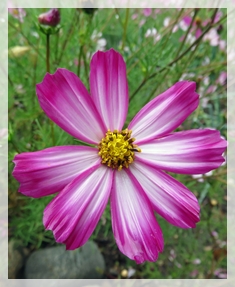
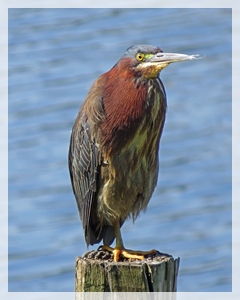
I couldn’t help but think of the Apostle Paul’s words in the first chapter of Romans; we see evidence of God everywhere in His amazing creation and there is no excuse for denying His existence or not knowing Him. It doesn’t have to be majestic mountains and spectacular scenery; God’s workmanship is just as evident in our backyards in the exquisiteness of things like red clover and the wings of a bumblebee. Indeed, “How great is God Almighty, who has made all things well!”
Each little flow’r that opens, Each little bird that sings,
He made their glowing colors, He made their tiny wings.
The purple-headed mountains, The river running by,
The sunset and the morning That brightens up the sky. …
He gave us eyes to see them, And lips that we might tell
How great is God Almighty, Who has made all things well.
[“All Things Bright and Beautiful” by Cecil F. Alexander]
 “I don’t do desserts!” my neighbor said. My initial thought was, “Anyone can bake brownies!” As it turns out, my neighbor was absolutely right; a horrible cook, she is proof that not everyone can bake a tray of brownies! Unlike me, however, she has a gift with animals and volunteers at the Conservancy caring for injured wildlife.
 “That’s more like it!” I thought as I read Psalm 47; I certainly preferred it to the curses of the previous set of Psalms I’d read. I’m reading the Bible in chronological rather than in canonical order which means that the various books and chapters have been divided and rearranged. As a result, the psalms of lament and complaint were grouped together during David’s trials and the praise psalms were placed after the chapters outlining the duties in the Temple. These psalms of worship, adoration and thanksgiving seem more appropriate for Israel’s book of hymns than the earlier ones about wickedness, treachery, calamity and vengeance.
 Psalm 139 is one of my favorites among the psalms. As I read it this morning, however, I got annoyed with David. Near the end of this beautiful song praising God for His omniscience, omnipresence, and intensely personal involvement in his life, David throws in a curse on his enemies. Granted, they’re God’s enemies, too, but sometimes David seems incredibly angry and vengeful. After comparing his enemies to deadly snakes, hungry lions, and vicious dogs, among others things, he wants them to dissolve into slime like snails, be cast into the fire, become palsied and blind, and for their wives to become widows and their children fatherless beggars. One Bible commentary said David had a “particularly vigorous attitude toward the enemy,” but wanting to wash his feet in the blood of the wicked sounds merciless and vindictive to me.
 Devotions of the Heart