
Then the rich man said, “O Father Abraham, then please send him to my father’s home—for I have five brothers—to warn them about this place of torment lest they come here when they die.” But Abraham said, “The Scriptures have warned them again and again. Your brothers can read them any time they want to.” The rich man replied, “No, Father Abraham, they won’t bother to read them. But if someone is sent to them from the dead, then they will turn from their sins.” But Abraham said, “If they won’t listen to Moses and the prophets, they won’t listen even though someone rises from the dead.” [Luke 16:27-31 (TLB)]
A land of contradictions, a spectacular pageant, a world incomprehensible…a wonderful gift to men from a benign God—all this and more. [Olin Wheeler, 1914]
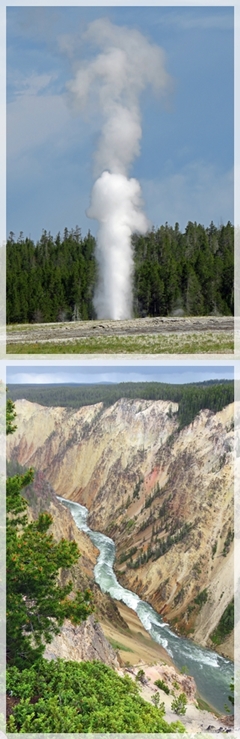
Although Native Americans have existed in the Yellowstone area for as long as 11,000 years, it took three major expeditions before the American public finally believed that the wonders in what is now Yellowstone National Park actually existed. The earlier descriptions of “fire and brimstone,” huge waterfalls, exploding geysers, boiling mud pots and other strange features of the region were met with unbelief until William Jackson’s photographs and Thomas Moran’s paintings from their 1871 Yellowstone expedition were presented to Congress. Once people had visual proof of the area’s bizarre geothermal wonders, they finally believed and Yellowstone became our nation’s first national park.
Indeed, having recently toured this park that sits on atop of the largest super-volcano in North America, I can understand how unbelievable those first mountain men’s stories must have seemed. In my wildest dreams, I couldn’t have imagined either the beauty or the strangeness of Yellowstone—colored travertine terraces, mud volcanos, steaming caves, a 24-mile long canyon, over 200 waterfalls, and more than 10,000 geysers and hot springs. Other worldly, it is something that truly must be seen to be believed.
Jesus told the Pharisees a parable about two men: the unrighteous rich man who died and went to a place of torment and the beggar Lazarus who died and went to a heavenly banquet. The rich man wanted to send Lazarus back to warn his brothers to change their ways. His request was denied since, like him, his brothers had ignored the warnings found in the Law and the Prophets so they wouldn’t be convinced by someone returning from the dead. Indeed, even though Jesus did return from the dead, there are many who do not believe.
We often wonder what heaven and/or hell will be like. Jesus didn’t mince any words when he spoke of the final judgment and it doesn’t sound pleasant. When the Apostle John was given a glimpse of heaven, his words in Revelation seem almost as incomprehensible to us as the words the mountain men used to describe Yellowstone’s bubbling mud pots and hissing fumaroles were to nineteenth century Americans. Father Abraham didn’t send back Lazarus and no one is going to return from death with photographs or paintings to prove what happens when we take our last breath.
Words can’t adequately describe Yellowstone and the few Biblical descriptions of both heaven and hell don’t do them justice, either. Nevertheless, like the rich man’s brothers, we have all the information we need in Scripture. As the American public learned in 1871, just because we can’t imagine something doesn’t mean it isn’t there!
 “I don’t do desserts!” my neighbor said. My initial thought was, “Anyone can bake brownies!” As it turns out, my neighbor was absolutely right; a horrible cook, she is proof that not everyone can bake a tray of brownies! Unlike me, however, she has a gift with animals and volunteers at the Conservancy caring for injured wildlife.
 “That’s more like it!” I thought as I read Psalm 47; I certainly preferred it to the curses of the previous set of Psalms I’d read. I’m reading the Bible in chronological rather than in canonical order which means that the various books and chapters have been divided and rearranged. As a result, the psalms of lament and complaint were grouped together during David’s trials and the praise psalms were placed after the chapters outlining the duties in the Temple. These psalms of worship, adoration and thanksgiving seem more appropriate for Israel’s book of hymns than the earlier ones about wickedness, treachery, calamity and vengeance.
 Psalm 139 is one of my favorites among the psalms. As I read it this morning, however, I got annoyed with David. Near the end of this beautiful song praising God for His omniscience, omnipresence, and intensely personal involvement in his life, David throws in a curse on his enemies. Granted, they’re God’s enemies, too, but sometimes David seems incredibly angry and vengeful. After comparing his enemies to deadly snakes, hungry lions, and vicious dogs, among others things, he wants them to dissolve into slime like snails, be cast into the fire, become palsied and blind, and for their wives to become widows and their children fatherless beggars. One Bible commentary said David had a “particularly vigorous attitude toward the enemy,” but wanting to wash his feet in the blood of the wicked sounds merciless and vindictive to me.
 Is virtue its own reward? An article in Psychology Today reporting the conclusions of seven studies found that virtue actually does bring rewards. The benefits of doing the right thing include less depression, better self-esteem, increased happiness, a “helper’s high,” and a good night’s sleep! That good night’s sleep might well be the result of the clean conscience that accompanies virtue. Given the momentum of the #MeToo movement, I suspect many prominent people are losing sleep nowadays. Unfortunately, it’s not just well-known producers, actors, newsmen, ministers and politicians who abandoned virtue for self-interest. Many everyday folk are losing sleep as people continue to step forward and break their silence about wrongs that have been committed.
 In one of our small group sessions earlier this year, we heard the story of a man who spent more than twenty years imprisoned for a crime he didn’t commit. The evidence proving his innocence had been suppressed by the police and he was a bitter angry man. Sixteen years into his incarceration, he became a Christian but he still struggled with forgiveness. Knowing Jesus expected him to forgive the men whose lies had stolen his life, he couldn’t find the power to do so. How can we forgive someone who has deliberately hurt us, someone who isn’t even contrite or repentant? Vengeance, anger, retribution, and revenge come much easier than forgiveness and yet forgiveness is what God calls us to do.
 Devotions of the Heart