
For the life of the body is in its blood. I have given you the blood on the altar to purify you, making you right with the Lord. It is the blood, given in exchange for a life, that makes purification possible. [Leviticus 17:11-12 (NLT)]
 For most of us, the meat we purchase arrives at the grocery store prepackaged. We’re not used to seeing animals slaughtered, skinned or butchered and, unless we’re phlebotomists, rarely see large amounts of blood. As a result, much of Leviticus makes for rather gory reading since the temple, a place of worship, also served as a ritual slaughterhouse. Perhaps it’s my vegetarian sensibilities but, when the Bible refers to the pleasing aroma of sacrifice, I wince when thinking of the stench of dried blood and burnt meat.
Biblical sacrifices go as far back as Cain and Abel but it is in Leviticus that we read of the sacrifices God required of the Israelites. The book gives complicated instructions for each of the sacrificial rituals: everything from the kind of animal offered and the draining of its blood to splashing that blood around the altar and what to do with the meat. Nowadays, these bizarre rites seem sickening and gruesome. Then again, perhaps that is exactly what they were supposed to be even back then. Watching one’s best lamb have its throat slit and seeing its blood pour out was probably as awful 3,400 years ago as it seems today. Seeing the animal’s life offered as a substitute for the sinner’s symbolized the high cost of sin and could not have been taken lightly. Moreover, as offensive as all that blood and butchering seems, think of how offended God is by our sins! Sin is far uglier and more repugnant than any abattoir.
My 21st century self has difficulty understanding why blood had to be shed in the first place and how blood—something that stains—could ever be considered cleansing. Caught up in picturing all of that blood, gore and smell, it’s easy to forget that the reason for those sacrifices was atonement. The Israelites sacrificed what was precious to them to satisfy God as atonement for their sins. A price had to be paid for mankind’s sins and, without blood, there could be no forgiveness. For God, the aroma was not that of blood and seared meat but of repentance. Those bloody offerings, however, were temporary substitutes. Even though the animal died rather than the sinner, the sacrifice had to be repeated again and again. It is those sacrifices, however, that foreshadowed the one true and everlasting sacrifice that took place on Calvary. Our sins against a holy and infinite God required a holy and infinite sacrifice: the flawless lamb, Jesus Christ. Our atonement is now found in our faith in Christ—the one perfect and final sacrifice.
 Last week was “Fall Prevention Week” but it wasn’t about keeping summer’s flowers blooming or preventing Jack Frost from coloring the maple trees. Although accidents can happen, most falls are preventable and last week was dedicated to preventing those falls. Apparently, because my age puts me in the group most at risk of falling, my son sent me an article identifying the best ways to prevent falls. Instead of clearing walkways or installing non-slip tape and a grab bar in the tub, I ended up thinking about ways to prevent another kind of fall—the one into sin. In reality, I’m far more likely to fall that way than to stumble over my entry rug.
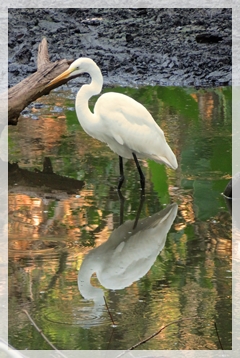 From the viewing platform at the marsh, I watched a Cooper’s hawk soar high in the sky. When I turned to leave, I looked down and saw several white egret feathers on the ground below. Whether it was the hawk, a raccoon, or some other predator, the park had one less egret in the pond. Those beautiful white feathers were a stark reminder of how precarious life is, not just for wild birds, but for us all. I was reminded of Ecclesiastes: “For people and animals share the same fate—both breathe and both must die.” [3:19]
 I recently saw a play in which the only character, Lisa, presents a monologue about her life and family. The audience learns that her father, Walter, a German-born Jew, escaped to the U.S. as part of the kindertransport effort but that the rest of his family perished at Auschwitz. During her monologue, Lisa tells of taking her then 75-year old father to visit the Auschwitz Memorial. While touring the concentration camp, Walter tells his daughter about attending school with members of the Hitler Youth. Being a Jew, he couldn’t wear one of their uniforms but another boy in his school, a Gentile, refused to wear one. Her father then tells her that, in spite of the horror of Auschwitz and the loss of his family, he is glad he was born a Jew—because he didn’t have the option of becoming a Nazi! Unlike the Gentile boy who refused to join (and suffered because of it), Walter realized that, had he not been Jewish, he might have joined the Nazis. He knew that part of him could have been as merciless and evil as the men who rounded up and exterminated his family.
 We’re sure to notice God in the Grand Canyon, the multitude of stars in the night sky, or when watching two million wildebeest, zebra and gazelles migrate through the Serengeti. We sense Him in extraordinary or exotic things like the peacock’s splendid tail, Devil’s Tower, or spectacular sunsets and sunrises. But do we notice Him in the commonplace and unremarkable?
 Having just returned from the East Coast, I had a lengthy “to do” list and thought I could fit in a few errands before picking up my mother-in-law for her doctor’s appointment. As I pushed the cart through the store, I glanced down at my watch to check the time and gasped. To my dismay, I’d lost an hour! I should have been picking her up right then; there was no way we would make it to the doctor’s on time. Leaving the cart in the aisle, I rushed to my car. Rather than think how to save the situation, my first thought was how to spin it! Other than my own carelessness and stupidity, what valid excuse could I have for my tardiness? As I started the car, I glanced at the clock on the dash and realized that hour hadn’t disappeared; I’d left it back East. While my watch was still on EST, my car, mother-in-law, the doctor and I were in CST and there was still plenty of time.;
 Devotions of the Heart