
The Lord is in his holy temple; the Lord sits on his throne in heaven. He sees what people do; he keeps his eye on them. [Psalm 11:4 (NCV)]
 When I was a little girl and got sick, my mother would dress me in a fresh pair of pajamas, tuck me into her bed, get out her hairbrush, and do my hair. “Why bother?” I’d ask, “No one is going to see me.” She’d always reply, “God sees you and you want to look your best.” I found it comforting, as I lay in bed, to know that both God and my mother were watching me.
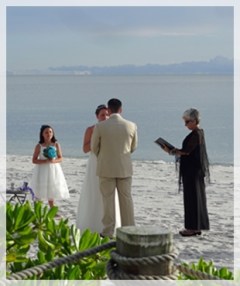
It’s not just God, however, who watches—people do, too. While enjoying dinner on the patio of a local restaurant, we observed a couple exchange wedding vows on the beach. Although here were only five people present for the ceremony, when the groom kissed the bride, the entire patio applauded in joy. The couple beamed with delight and enthusiastically waved at the sixty uninvited guests who had witnessed their nuptials.
Their joy as being observed was a contrast to another al fresco dinner many years earlier. We were seated on a porch overlooking a well-lit boat launch. Two couples were trying unsuccessfully to get their boat back onto its trailer. With one attempt, the trailer wouldn’t be back far enough but, with the next, it would be too far back. The boat would drift, the trailer tires spin, or the boat motor would quit. As the evening wore on and the boat remained in the water, the boaters’ tempers flared. That they may have enjoyed too much liquid refreshment during the day didn’t help and there were angry words, cussing and name calling. We were finishing our key lime pie when their truck successfully pulled the trailered boat out of the water. In relief, the entire dining room broke out in applause. The four looked up at us, somewhat mortified that their poor behavior had been witnessed by so many.
Unlike the wedding couple, we’re not always in our best attire and on our best behavior. Our conduct, like that of the boaters, frequently leaves much to be desired. We’re told to let our lights shine so that people will see Christ in us but we’ve been known to let our lamps get so dim that Christ is nowhere to be seen in us. Whether we’re shining or not, however, a bright light may be shining on us (as it was on the boaters)! It’s not just the eyes of God that are upon us; people observe us, as well. Are we the shining light we’re called to be?
We are indeed the light of the world—but only if our switch is turned on. [John Hagee]
 The billboard’s message read, “When push comes to shove, don’t!” It was sponsored by a nonprofit foundation that uses a variety of media sources to encourage positive values, good role models, and a better life. “Hard to argue with a goal like that,” I thought before discovering that some people took exception to their peaceful message. Re-tweeting it, one rock musician told his fans just to “shove harder.”
 The early church encountered difficulty in trying to reconcile the humanity and divinity of Jesus. In the 5th century, one group, from Alexandria, referred to the Virgin Mary as Theotokos, the one who gave birth to God, while the group from Antioch insisted that she was merely Anthropotokos, the one who gave birth to the human nature. Trying to bring about a compromise but pleasing no one, the bishop Nestorius suggested that the term Christotokos, the one who gave birth to Christ. The controversy, however, wasn’t about Mary; it was about the nature of Jesus. Did Mary give birth to a man who also was God or did Mary give birth to a man who later became God? The debate continued until 451 when the Chalcedonian Creed was adopted which confirmed the two natures of Christ (human and divine) in one person.
 In January, there will be an Empty Bowls event in our town. Attendees will purchase a bowl and then fill it with soup and bread donated by local restaurants. The money raised will help feed the more than 36,000 food insecure people in our county. To make that event possible, 4,500 one-of-a-kind bowls are made by local potters. Then, with the help of local volunteers, the bowls are painted and fired. Recently, several of us from church gathered to decorate some of those bowls. While we painted, I thought about the potters who made our bowls—how they formed and reformed their creations until they were just right. Varying in shape and size, no two bowls were exactly the same and, by the time they are painted, each will have a personality of its own. When their purchasers are done eating soup from them, they will be put to different uses. The ones embellished with paw prints or bones probably will be used by pets, and the others may be used for popcorn, nuts, cereal, loose change, or even soup!
 There is much in Scripture, such as the subjugation of women, that I find troubling and would just as soon skip reading . For example, there’s no mention of their handmaid slaves’ consent when Sarah, Rachel or Leah offer them as surrogates to their husbands! Scripture may call them righteous because of their faith but Lot readily offered up his virgin daughters to a crowd of lustful men and Abraham twice gave Sarah to another man to save his own skin and benefitted financially both times he did it! There’s a word for a man who does that and it isn’t usually righteous. Then there was the Levite who pushed his concubine out the door to be raped by a gang of men. Many would consider David’s tryst with Bathsheba to be rape and even he tolerated the rape of his own daughter!
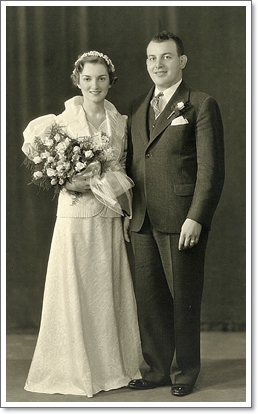 As I sorted through the papers that my mother-in-law had saved through the years, I came to a letter written to her in 1936 by her soon to be mother-in-law, Hattie. Hoping the young couple liked the mixer she’d given them, Hattie sent best wishes for a “long happy wedded life.” Wondering why such a mundane letter had been saved for 83 years, I read on. “May there be lots of love, joy and contentment in your home,” she continued, “forgiving each other as God forgives you.” Praying that my in-laws would have a long and “sweet contented life,” Hattie signed the letter “One who wishes you well in everything, Mother.”
 Devotions of the Heart