NEVER OBSOLETE

I will be your God throughout your lifetime—until your hair is white with age. I made you, and I will care for you. I will carry you along and save you. [Isaiah 46:4 (NLT)]

If I’d known I was going to live so long, I’d have taken better care of myself. [Anonymous]
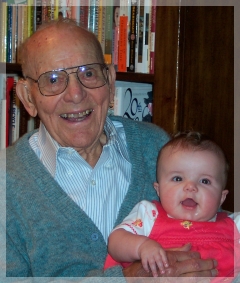
Grandpa J

Several years ago, a friend’s spry 94-year old mother emailed the family about having forgotten her elbow brace on the way to the exercise room in her senior residence. After returning to her apartment and donning the brace, the woman took an inventory of the other pieces of hardware she needed to get through each day. Along with the elbow brace, she wore bi-focal glasses, two hearing aids, a knee brace, two sets of dentures, two orthopedic shoe inserts, and one doe-skin support for three toes. Even without inventorying the number of medications that were part of her daily regimen, she observed that “it’s not a simple management situation” to keep track of it all. Feeling blessed that she didn’t need a cane and walker as did many her age, she closed her message by reminding the younger family members to take care of themselves. She continued her optimistic outlook and daily exercise routine until she went home to the Lord just a few months before her 100th birthday. Her light-hearted email remains a serious reminder that time takes a toll on our bodies.

Within my circle, many have reached the age when God has started to recall some of their parts. A few are nearly  bionic with their titanium plates, pacemakers, implanted cardioverter defibrillators, replacement heart valves, intraocular lenses, artificial hips and knees, or portable oxygen concentrators. As my mother-in-law observed in her 102nd year, “Old age is not for sissies!” Indeed, it presents a fair number of challenges. Nevertheless, as long as we’re still breathing, we should be in good spirits and thankful. Old age is a gift from God and one denied to far too many of our friends and family. It is a privilege not a punishment, an opportunity rather than a misfortune, and a blessing not a curse.

Even though we slow down and start wearing out as the years progress, God (who is older than time itself) remains the same and is constant in His care for us. He doesn’t stop working in our lives because parts of our bodies have ceased to function properly. He doesn’t put us out to pasture because we can no longer carry a load, consign us to the trash heap because we have some broken parts, or scrap us because we’re out of date. In God’s eyes, no matter how old or run-down His children are, no one is considered unusable or obsolete! He is as close to us now as when we took our first breath and He’ll be right beside us when we take our last one. God carried us as children and He will continue to carry us until He recalls our worn out bodies and takes us on our final trip home.

Before we take that last journey, however, there is still work to be done in God’s earthly kingdom. As long as we are breathing (even if we need an oxygen concentrator to do it), there is someone somewhere with whom we can share God’s love and good news. Just don’t forget your elbow brace or cane on the way out the door!

But the godly will flourish like palm trees and grow strong like the cedars of Lebanon. For they are transplanted to the Lord’s own house. They flourish in the courts of our God. Even in old age they will still produce fruit; they will remain vital and green. They will declare, “The Lord is just! He is my rock! There is no evil in him!” [Psalm 92:12-15 (NLT)]

That is why we never give up. Though our bodies are dying, our spirits are being renewed every day. [2 Corinthians 4:16 (NLT)]

Today’s picture is of my father-in-law—a man who never grew obsolete. Even though his physical strength waned, his spiritual strength never did and he continued to bear fruit until he went home at age 96.


Copyright ©2020 jsjdevotions. All rights reserved.

RULES

This is what the Lord has commanded: A man who makes a vow to the Lord or makes a pledge under oath must never break it. He must do exactly what he said he would do. [Numbers 30:1-2 (NLT)]

“What sorrow awaits you teachers of religious law and you Pharisees. …For you say that it means nothing to swear ‘by God’s Temple,’ but that it is binding to swear ‘by the gold in the Temple.’” [Matthew 23, 15-16 (NLT)

water lily

As any parent of a teenager knows, it’s impossible to have enough rules to cover all the ways your child can err. Schemers that they are, they’ll always find a way around restrictions. When I attended boarding school, for example, several of us girls had our ears pierced by a fellow student (an aspiring physician). We knew that neither school nor parents would endorse numbing our ears with icicles and piercing them with a sewing needle and dental floss but, without a specific rule against it, we pierced them anyway. Because it was the school’s second year, the administration hadn’t anticipated all the ways we teens could misbehave and our student handbook was only one page. Now, 57 years later, that handbook is 33 pages long and covers such things as body piercings and tattoos, drones, room searches, recording devices, prohibited clothing, subwoofers, a roommate’s rights, and unauthorized access to the school’s computer system. I imagine next year’s handbook will be even longer and reflect yet another way its students have managed to flout authority.

Of course, it’s not just teenagers who assume that, if something isn’t specifically prohibited, it must be allowed. No matter their age, people will try to find a way around every inconvenient or bothersome rule. For example, God made it clear that a vow made before Him was binding. Keeping promises, however, can prove problematic and, through a convoluted re-interpretation of the law, the Pharisees of Jesus’ time created a loophole. If one swore by the gold on the altar, the promise was binding. But, if one swore only by the altar or temple, it was like crossing your fingers and the promise could be broken with impunity: a promise was only a promise if it was expedient.

We girls knew we shouldn’t have pierced our ears that way, the Pharisees knew that God meant for all promises to be kept, and today’s students shouldn’t need a specific rule stating that roommates must be spoken to in a respectful manner. While there were plenty of laws in the Old Testament, Jesus boiled them all down to two simple ones: love God and love our neighbor. In a perfect world these would be the only laws necessary. The world, however, isn’t perfect which is why we still have regulations and school handbooks.

Just because something is legal doesn’t necessarily make it right and just because something isn’t specifically prohibited doesn’t mean it should be done. Jesus lived by one law: the law of love. Regardless of the rules, like Him, we must let the two-fold commandment of loving God and loving our neighbor guide us in everything we do.

Owe nothing to anyone—except for your obligation to love one another. If you love your neighbor, you will fulfill the requirements of God’s law. For the commandments say, “You must not commit adultery. You must not murder. You must not steal. You must not covet.” These—and other such commandments—are summed up in this one commandment: “Love your neighbor as yourself.” Love does no wrong to others, so love fulfills the requirements of God’s law. [Romans 13:8-10 (NLT)]

Copyright ©2020 jsjdevotions. All rights reserved.

MAYIM CHAIM

On that day life-giving waters will flow out from Jerusalem, half toward the Dead Sea and half toward the Mediterranean, flowing continuously in both summer and winter. And the Lord will be king over all the earth. On that day there will be one Lord—his name alone will be worshiped. [Zechariah 14:8-9 (NLT)]

Is anyone thirsty? Come and drink—even if you have no money! Come, take your choice of wine or milk—it’s all free! … Seek the Lord while you can find him. Call on him now while he is near. [Isaiah 55:1,6 (NLT)]

from hanging lake, coloradoLiving in a country where clean water readily flows out of a faucet, we don’t fully understand the concept of “living water” or mayim chaim. Ancient Israel was an arid land where fresh water was precious. Because it only rained a few months of the year, rain was stored in cisterns and grew stagnant. In contrast, living water came directly from God either by rain or a natural spring. Unlike sea water and the hypersaline Dead Sea, which looked refreshing but were poisonous and made the surrounding land barren, mayim chaim brought life. Throughout Scripture, “living water” was associated with God.

During the harvest festival of the Feast of Booths (Hag Sukkot), the Jews were called to remember God’s providential care for them during the forty years of wandering in the wilderness before coming to the Promised Land. God commanded Israel to observe this festival by leaving their homes and living in temporary shelters (sukkot) as they had done during the exodus.

By the time of Jesus, several rituals had been added to enrich the celebration. As a way of remembering the water God supplied when Moses struck the rock with his staff, the Hoshana Rabbah (meaning “please save”) was performed on the last day of the feast. With great ceremony, the priests filled a golden container with water from the pool of Siloam, brought it to the Temple, and circled the altar seven times. Prophecies from Ezekiel 47 and Zechariah 14 were read and, after three trumpet blasts, the priests poured out the water.  The water spilling onto the ground signified God’s salvation through water and the prophets’ promises that, in the time of restoration, rivers of living water would flow from the temple and Jerusalem. As the water poured down, words from Psalm 18:25-26 were chanted: “Please Lord, save us …. Bless the one who comes in the name of the Lord.”

It was on the last day of Sukkot, when the courts of the Temple would have been packed with people, that Jesus stood and shouted to the crowds: “Anyone who is thirsty may come to me! Anyone who believes in me may come and drink! For the Scriptures declare, ‘Rivers of living water will flow from his heart.’”[John 7:37-38] Whether Jesus spoke while the priests poured out the water, during the chanting of “Save Us,” or while people dismantled their shelters, we don’t know but the connection between this ceremony and Jesus’ declaration that He was the living water caused a tremendous disturbance. Referring to the Spirit and eternal life rather than drinking water, Jesus was claiming to be the Messiah.

Some of those who heard Jesus’s words thought Him to be the Messiah. Others, knowing the prophecies but not knowing His birthplace, argued Jesus couldn’t be the Messiah since He wasn’t born in Bethlehem. Some believed Him to be a prophet and others wanted Him arrested for blasphemy. Indeed, if Jesus hadn’t been the Messiah, His words would have been blasphemous.

When Jesus spoke that day, He was repeating God’s invitation to salvation found in Isaiah 55. By saying that rivers of living water flowed from Him, Jesus’ words fulfilled all that the Festival of Booths signified. As the mayim chaim, Jesus would satisfy people’s thirst for God.

Jesus replied, “Anyone who drinks this water will soon become thirsty again. But those who drink the water I give will never be thirsty again. It becomes a fresh, bubbling spring within them, giving them eternal life. [John 4:13 (NLT)]

With joy you will drink deeply from the fountain of salvation! [Isaiah 12:3 (NLT)]

Copyright ©2020 jsjdevotions. All rights reserved.

RICH AND HEALED

For I know the plans I have for you,” declares the Lord, “plans to prosper you and not to harm you, plans to give you hope and a future. [Jeremiah 29:11 (NIV)]

And everyone who has left houses or brothers or sisters or father or mother or wife or children or fields for my sake will receive a hundred times as much and will inherit eternal life. [Matthew 19:29 (NIV)]

white peacock butterflySo, since God wants us to be prosperous, we’ll get 100 acres of land for every acre we give up or a return of $10,000 for every $100? Sounds too good to be true and it is. Logic tells us Matthew 19:29 can’t be taken literally—we can’t have one hundred fathers and none of us want one hundred children or wives! To make sure the disciples understood, Jesus made it clear that God is not our heavenly banker who dispenses gifts (especially monetary ones) to the most deserving with His parable of the Gracious Landowner. “Do I not have the right to do what I want to do with my own money? Does your eye make you want more because I am good?” asked the landowner. Jesus explained: “So those who are last will be first and the first will be last.” [Matthew 20:15-16] His message was clear: God’s grace can’t be earned or controlled. Moreover, the word often translated as “prosper” in Jeremiah 29:11 is shalom, meaning completeness, soundness, welfare, and peace rather than wealth. Biblical prosperity and prosperity theology are not the same!

Nevertheless, the health and wealth/name it and claim it/prosperity gospel movement would have us believe otherwise. Their distorted version of the gospel asserts that our words and actions can influence God with some sort of faith force so that we’ll get the health and wealth supposedly promised in today’s verses and others like it. Things like illness and financial troubles result from a lack of faith. If we just picture what we want, have enough faith, and ask for it in Jesus’ name, it’s ours! Thinking that we can somehow manipulate God to do our bidding, however, denies His sovereignty and God becomes more a heavenly vending machine than the ruler of the universe. Our hope is not in the power of our words or size of our faith; our hope is in the power of God alone!

 While we’d like the think that all we need for health and wealth is faith, Scripture tells us otherwise. Not everyone who deserved healing got it while some who didn’t deserve it did! Out of all the sick, blind, and lame people by the pool at Bethesda, Jesus asked just one man if he wanted to get well. Instead of answering the question, the man complained. Nevertheless, when Jesus told him to get up, pick up his pallet, and walk, the man was healed instantly. Censured by the Jewish leaders for carrying his mat on the Sabbath, he explained that he’d been told to do so by the man who healed him—a man whose identity he didn’t know! This sinner, who didn’t know Jesus, have faith in Him, and never asked for healing, was restored to health while the “thorn” in Paul’s flesh remained in spite of his faith, service, and devout prayers!

The gospels and epistles give us more guarantees of suffering and persecution than promises of health or wealth. Rather than a get rich plan, our sovereign God offers a plan for salvation. Our relationship with God is not a business transaction and giving us stuff or taking away our illness is not what makes Him good. God is good because He alone is God. He’s good whether we’re sick or healthy, in debt or flush with money, out of work or gainfully employed, infertile or pregnant, struggling in school or on the honor roll, have a child in rehab or one in seminary. God is good because, in Jesus, we are both rich and healed!

If you have everything but you don’t have Jesus. You have nothing. If you have nothing but you have Jesus, you have everything. He’s worth it. [Costi Hinn]

For you know the grace of our Lord Jesus Christ, that though he was rich, yet for your sake he became poor, so that you through his poverty might become rich. [2 Corinthians 8:9 (NIV)]

And my God will meet all your needs according to the riches of his glory in Christ Jesus. [Philippians 4:19 (NIV)]

Copyright ©2020 jsjdevotions. All rights reserved.

THE INVISIBLE FENCE

Cling to your faith in Christ, and keep your conscience clear. For some people have deliberately violated their consciences; as a result, their faith has been shipwrecked. [1 Timothy 1:19 (NLT)]

african irisThe barking dog came charging down the driveway toward me before skidding to a halt. “Thank you, God, for invisible fences,” was my relieved thought. Unwilling to cross that invisible barrier, the fiercely barking dog followed me from his yard while keeping his distance. A bed of beautiful African iris was between us and I debated about stepping closer to get a photo of their blossoms. While the threat of his collar deterred the dog as long as I remained where I was, I wasn’t sure what he’d do if I ventured any closer. My stepping on his turf could have proven too much temptation for the fellow and he may have been willing to take the punishment for a chance to show me who was boss. My flower picture could wait until another day.

Life would be so much easier if I had an invisible fence. No, I don’t have a dog; the fence would be for me. It would warn me when I got too close to sin and give me a shock if I dared cross the line into sinfulness. When talk veered toward gossip, I’d hear a little buzzing sound; if I continued the conversation, I’d get a zap! The same thing would happen whenever pride reared its ugly head or when tempted to be selfish, deceitful or envious. I’m a quick learner; I imagine my behavior would improve quickly if I got an unpleasant buzz or a little shock every time I started to step across the line into sin!

Actually, I do have an invisible fence, only it’s called a conscience and it’s my built-in ability to know right from wrong. A gift from God, it is His voice planted within my heart. Unfortunately, just like an angry dog with an invisible fence, when sorely tempted, I’m capable of ignoring my conscience. Moreover, just as the battery in the dog’s collar can weaken or die, my conscience isn’t entirely reliable. It tends to be stronger when others are present, weaker when I’m alone and can even atrophy from lack of use. That’s why I like having the Holy Spirit at my side—He operates at full strength all of the time. Even when my conscience fails me, He is sure to convict me when my behavior doesn’t glorify Jesus—He might even give me a spiritual zap!

The paradoxical and tragic situation of man is that his conscience is weakest when he needs it most. [Erich Fromm]

God knows what each one of us is dealing with. He knows our pressures. He knows our conflicts. And He has made a provision for each and every one of them. That provision is Himself in the person of the Holy Spirit, indwelling us and empowering us to respond rightly. [Kay Arthur]

So I say, let the Holy Spirit guide your lives. Then you won’t be doing what your sinful nature craves. The sinful nature wants to do evil, which is just the opposite of what the Spirit wants. And the Spirit gives us desires that are the opposite of what the sinful nature desires. [Galatians 5:16-17a (NLT)]

Copyright ©2020 jsjdevotions. All rights reserved.

FAIRY TALE ENDINGS

Can anything ever separate us from Christ’s love? Does it mean he no longer loves us if we have trouble or calamity, or are persecuted, or hungry, or destitute, or in danger, or threatened with death?. [Romans 8:35,38-39 (NLT)]

blue flag irisAs a child, I loved the way fairy tales always ended with these words: “and they lived happily ever after.” Real life, however, is anything but a fairy tale. I suspect that after Cinderella and the Prince had two kids, she went right back to cooking and cleaning all day and never went to another ball. Prince Eric’s fondness for ahi tuna sushi and sashimi led to his divorce from Ariel for irreconcilable differences. Snow White ended up under arrest for dwarf exploitation and trafficking in blood diamonds while Barbie, who turned 60 last year, keeps undergoing plastic surgery in an unsuccessful attempt to regain her youth. Because of Ken’s bad investments, their dream house went into foreclosure and their dream cars, boat and motor home were repossessed. In real life, no fairy godmother shows up with a magic wand to turn pumpkins into carriages, mice into horses, and our sweetest dreams into reality.

The “grown-up” life we expected at age ten probably bears little resemblance to our present reality. Naively, we were sure that life would be easy for us. We envisioned a life that went according to plan, never expecting that circumstances beyond our control could leave a loved one dead or take away our business. If we anticipated marriage, we didn’t picture things like infidelity or “irreconcilable differences.” We certainly didn’t consider the possibilities of job loss, unpaid bills, or bankruptcy. Piles of laundry, dirty dishes, or having to work two jobs never entered our thoughts. If we imagined children, they didn’t have cerebral palsy, autism, Down’s or an addiction. If we even visualized ourselves as senior citizens, we’d be athletic, slender, healthy and as attractive as we were at twenty. We never imagined being alone, needing a walker, artificial hips or cardiac rehab. Nor did our mental picture have age spots, wrinkles, a bald spot or dementia.

If there’s anything we’ve learned from this pandemic, it’s that life doesn’t go according to our plan. It isn’t like a private train ride in which we set the destination, map the route, and schedule the stops. It’s more like we’re hitch-hiking across the country with all of the delays, detours, rejections, good and bad encounters, and unscheduled stops that come with thumbing a ride. Life is filled with the unexpected and, like a successful hitch-hiker, we just have to make the most of what comes our way.

Rest assured that we are never alone on this journey. Life doesn’t go according to our perfect plan but it does go according to God’s! As the Apostle Paul told the Romans: “Nothing can ever separate us from God’s love.“ Rest assured, as a believer in Jesus, there really is a “happily ever after!”

That is why we never give up. Though our bodies are dying, our spirits are being renewed every day. For our present troubles are small and won’t last very long. Yet they produce for us a glory that vastly outweighs them and will last forever! So we don’t look at the troubles we can see now; rather, we fix our gaze on things that cannot be seen. For the things we see now will soon be gone, but the things we cannot see will last forever. [2 Corinthians 4:16-18 (NLT)]

Copyright ©2020 jsjdevotions. All rights reserved.