
Hear my prayer, O Lord; listen to my plea! Answer me because you are faithful and righteous. … Show me where to walk, for I give myself to you. … Teach me to do your will, for you are my God. May your gracious Spirit lead me forward on a firm footing. [Psalm 143:1,8b,10 (NLT)]
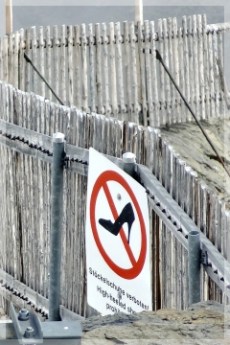 Many years ago, I was facing a difficult decision about a project. In spite of praying, pondering, searching Scripture for direction, and consulting with wise advisors, I was still in a quandary. Nothing brought me closer to a clear answer to my dilemma. Although it seemed like a good idea (at least in theory) and I felt like I should want to be part of it, doubts kept nagging at me. Wanting God to make known His will, I prayed the words of Psalm 143:10: “Teach me to do your will, for you are my God. May your gracious spirit lead me forward on a firm footing.”
The phrase “firm footing” reminded me of a sign I’d seen at the top of the Schilthorn in the Swiss Alps. Warning that high-heeled shoes shouldn’t be worn while hiking the mountain, the caution seemed to demonstrate a firm grasp of what seemed obvious. The steep slope was covered with scree and would prove precarious even for a properly equipped and skilled hiker! I realized the footing on this particular project felt anything but firm. In spite of its good intentions, it was as ill-considered as wearing a pair of strappy high heels while hiking the Schilthorn. While there’d been no cautions about prohibited footwear, I’d seen plenty of other warning signs about the venture; I just hadn’t wanted to heed them. It’s easy to confuse what we want to do with what God intends for us or to think we’re hearing God’s voice when it is only ours speaking louder than His!
Had I been reading any other Bible translation, rather than “firm footing,” the verse would have read level ground, land of uprightness, level pastureland, or good paths. Whether those words would have resonated with me the way “firm footing” did, I don’t know. But, as God would have it, I was using my NLT Bible and I finally understood the project was not right for me.
God has challenged, admonished, cautioned, and tested me but He has never steered me wrong. Even when I haven’t especially liked God’s task for me, He’s always given me a sense of peace along with His mission, even when it meant stepping into unknown territory. Admittedly, obedience often has upset my plans, meant more work, pushed me out of my comfort zone, or challenged my capabilities, but it always has led to peace. The sense of peace I had as soon as I declined this undertaking told me that I’d finally found and followed God’s will.
If we don’t have peace about a choice we’ve made, if we don’t feel confident in our walk, it’s time to stop, reconsider, and pray. We’ll only know we’re on firm footing and following His plan when God gives us peace about our decision.
 Although its customs and rituals have changed over time, Lent has been observed in some way by believers for centuries. In the early years of the church, the days leading up to Easter were a time of fasting and prayer in preparation for Easter baptisms and as penance for those who’d been excluded from communion. Irenaus of Lyons (c.130-200) wrote of such a season that lasted only a few days (or forty hours) and commemorated what was believed to be the duration of Christ’s time in the tomb. By the mid-third century, Bishop Dionysius spoke of a six-day fast practiced by the devout in Alexandria and, according to the Byzantine historian Socrates, the Roman Christians kept a pre-Easter fast of three weeks.
 Intercessory prayer simply is praying on behalf of others and we find it throughout Scripture. After Israel’s shameful behavior with the golden calf, for example, Moses interceded for a sinful people before an angry God who was ready to wipe them out. The man pled for mercy rather than condemnation. Later, he interceded for his sister Miriam when God struck her with leprosy after her opposition to Moses’ leadership. When the Israelites again rebelled, refused to enter Canaan, and talked of choosing another leader to take them back to Egypt, Moses again interceded for the Israelites.
 The anchor, the Christian symbol of hope, is the most prevalent of all the Christian symbols found in the Roman catacombs. In fact, all of the symbols, paintings, mosaics, and reliefs found in the miles of labyrinth-like narrow tunnels and thousands of graves in the catacombs reflect hope in some way. Instead of the dark funereal images you might expect in an underground cemetery, the white walls of the Christian catacombs feature living things like flowers and birds along with Bible stories expressing hope in God’s plan of salvation. Prominent themes from the Old Testament include Daniel emerging untouched from the lions’ den and Shadrach, Meshach, and Abednego exiting unharmed from the fiery furnace. Frequently depicted are the stories of Noah, who escaped from the flood, and Jonah who was delivered from the sea monster. Continuing the theme of deliverance are many images of the good shepherd so frequently mentioned in Psalms. New Testament stories usually showed Jesus raising the dead (with over fifty representations of Lazarus), healing people, and feeding the multitude. The art of the catacombs is all about man’s hope in God’s deliverance, provision, and plan of salvation.
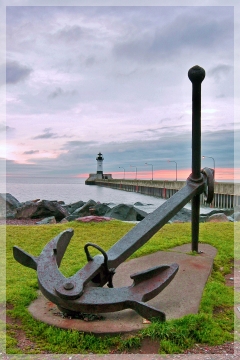 The sign in front of a nearby church read, “Our hope is anchored in the Lord,” which got me thinking about anchors. I’d never given them much thought until we took a Windjammer cruise off the coast of Maine many years ago. Accompanied by four friends and a crew of two, we sailed for a week. At dusk, we’d lower the sails and anchor in a harbor for the night. After breakfast, we’d pull up anchor for another relaxing day of sailing by lighthouses, granite cliffs, fishing villages, and even a few seals. One day, however, gale force winds replaced the gentle breeze and the calm sea turned violent. The sky darkened as rain and hail poured down on us. We immediately pulled into the nearest inlet, lowered the sails, and dropped two anchors to keep from being blown into the rocks! If we’d had two more anchors (as did the sailors in Acts 27), I suspect we would have dropped them, as well. After donning my life jacket and slicker, all I could do was pray and hope those anchors held. You really don’t appreciate the worth of an anchor until you’ve needed one in a storm!
 Devotions of the Heart