
“For my house shall be called a house of prayer for all peoples.” The Lord God, who gathers the outcasts of Israel, declares, “I will gather yet others to him besides those already gathered.” [Isaiah 56:7b-8 (ESV)]

In the Old Testament, the Levites acted as gatekeepers. Among their many duties, they maintained decorum, enforced the laws of ritual cleanliness, directed worshippers to the correct area, and prohibited entry to anyone considered defiled or unclean (such as lepers, eunuchs, or Gentiles). The gatekeepers placed a large stone between the Court of the Gentiles and the Women’s Court to remind the unclean they would die if they passed it; if they entered into the Temple area, they would be dragged out and killed.
Gatekeepers who determine one’s fitness to worship remind me of my response to Jimmy, about whom I’ve previously written. A man with what could be called a colorful past, Jimmy started attending our Florida church last March. I admitted in “It Takes All Kinds” that I was less than enthusiastic when my husband invited him to church after meeting him in the park. A bit of a character, Jimmy is a recovering addict/alcoholic and, while not homeless, he lives on the fringe of society. Although I knew my misgivings were unchristian, as I got to know him, I quickly learned they also were unfounded. After starting to attend our church, he began coming to Bible study, bringing his well-worn Bible with him, and often joined our group for fellowship after class. Early this summer, when Jimmy asked to be baptized, ten others from our church joined him in the Gulf of Mexico for that sacrament.
During the summer, Jimmy went north to be with family but kept in touch with our pastor. He wrote about meeting a man in the park who was new to recovery. When the fellow asked Jimmy how he managed to stay sober, his reply was simple and to the point: Jesus! Our new Christian became a witnessing disciple. Jimmy recently returned to Florida and was warmly welcomed by all when he joined us for Sunday worship; I felt honored to take his hand during prayers.
The story is told of a homeless man, disheveled and dirty, who entered a church Easter morning. The service had just started and the pews were jam packed. As the man walked up the aisle in search of a seat, people avoided eye contact and no one made room for him in the pews. Once at the front of the church, the man sat down on the floor near the altar rail. As an usher, dressed in a black suit with a boutonniere in his lapel, made his way up the aisle, the parishioners were sure that he would quietly ask the man to leave (as any good gatekeeper would do). Instead, to the surprise of the congregation, the usher handed the man both program and hymnal and sat down beside him.
Although more and more churches now use security people to protect personnel and worshippers, we no longer have Levites to keep the unclean out of worship. If we did, our churches would be empty because we’re all soiled by sin! While we don’t have official gatekeepers, let us all be cautious of being unofficial ones. What would have happened to Jimmy if we had gatekeepers in our churches? What of his new friend? The best part of any man is what’s found in his heart and we’ll never know what’s in his heart until we take the time to know the man.
May the church be the place of God’s mercy and love, where everyone can feel themselves welcomed, loved, forgiven and encouraged to live according to the good life of the Gospel. And in order to make others feel welcomed, loved, forgiven and encouraged, the church must have open doors so that all might enter. And we must go out of those doors and proclaim the Gospel. [Pope Francis]
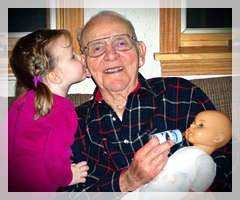 I actually thought the prayer’s words that Sunday asked God to show us what children can teach us about love. Looking through old photos of my children and grands later that day, I thought about the ways children love. Unconcerned with decorum (or potential lawsuits), they’re demonstrative: touching freely and unabashedly. They cuddle and climb on laps, hold hands, and spontaneously give hugs and kisses. They burrow under the covers with us and aren’t bothered by morning breath or bed head. It doesn’t matter if they’re soaking wet from the sprinkler or their faces are covered with jelly or chocolate nor do they care if we’re sweaty and dirty from working in the garden or dressed in our finest for a night on the town. Children know that touch, whether a high-five or hug, is an important part of love.
 While there’s nothing wrong with my hearing, I can’t always understand what’s being said. For example, when my husband tells stories, he prefers pronouns to nouns. Yesterday, I didn’t know whether the “he” to whom he was referring was the newsman, Uber driver, passenger, angry motorist, shooter, or police officer. Without knowing which man did what, the story was confusing so I kept asking for clarification. As it turned out, the Uber driver, who was also a policeman, shot the gun!
 But the Lord said to Samuel, “Don’t judge by his appearance or height, for I have rejected him. The Lord doesn’t see things the way you see them. People judge by outward appearance, but the Lord looks at the heart.” [1 Samuel 16:7 (NLT)]
 “He will deliver us from our troubles or carry us through them. Either way, we will be free of them eventually.” How easily these words can be uttered until, of course, those troubles apply to us. Had Job’s friends been Christian and said those words, I don’t think they would have been any more comforting than what was said. While true, they won’t bring back the amputated limb or cancerous breast, pay the staggering medical bills, tuck the motherless child in bed at night, change the diagnosis of Parkinson’s or schizophrenia, or bring back an abused child’s innocence. While true, those words can’t wipe the tears of a mother holding her stillborn baby, the husband watching his wife vanish into dementia, or the man whose body is in mutiny because of ALS.
 Devotions of the Heart