
 This I declare about the Lord: He alone is my refuge, my place of safety; he is my God, and I trust him. [Psalm 91:2 (NLT)]
The Lord is my light and my salvation—so why should I be afraid? The Lord is my fortress, protecting me from danger, so why should I tremble? [Psalm 27:1 (NLT)]
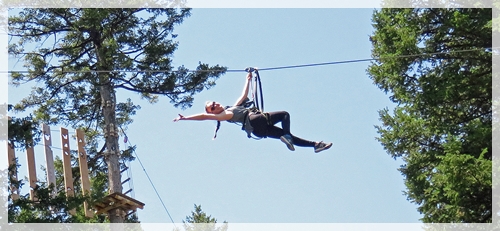
During our western trip with the grands, I wasn’t the only one to step out of my comfort zone. The two youngsters (fifteen and eighteen) took some big steps when they did a four-hour “Treetop Adventure” – think Swiss Family Robinson crossed with the X-Games or Tarzan meets American Ninja Warrior. After ascending the mountain, they had a short safety briefing, suited up in body harnesses with tethers, and set off on their aerial adventure. They maneuvered through the tree tops on elements like swaying bridges, z-shaped balance beams, high wires, hanging ropes, swinging logs, and flying skateboards. They climbed ladders, scrambled up and through cargo nets, rode thirteen zip lines, 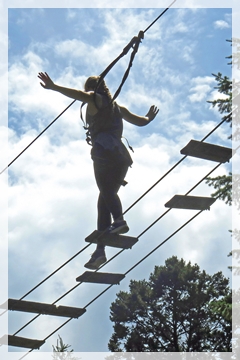 and literally jumped through hoops; all of this took place some twelve to eighty feet above the forest floor.
Their equipment included a safety belay system which, in theory, always kept them clipped to a safety wire. Although participants could fall, the harness and tethers would keep them from falling more than a few feet. While it would be difficult, they could pull themselves back up and continue the course. If unable to get back up, injured, exhausted, or faint of heart, there were a few guides scattered about who could effect a rescue and lower them down to the ground. In spite of all the safety precautions, the detailed waiver we’d signed that morning made it clear there was an element of risk to the activity.
As we watched (and prayed) from the ground while the teens progressed through the course, I thought of my granddaughter’s words earlier that day: “I know it’s dangerous and that I might fall, but I also know that I’m tethered to the cable and can’t fall far.” That’s the sort of confidence we find in the Psalms. David, of course, faced far greater challenges than a ropes’ course and zip lines and, rather than trusting a cable and safety harness, he trusted God. Trusting God doesn’t mean there’s no risk or that we might not fall. Trusting God means that, like the safety harness, we know God’s there to catch us! Trusting God doesn’t mean that our journey will be easy or effortless. Trusting God means that while our journey may be challenging, like the arduous ropes’ course, getting through it is possible. Trusting God doesn’t mean we’ll never find ourselves in a dark valley. Just as the guides were there to help in an emergency, trusting God means we know we’ll never be in that dark place alone; God is always with us.
The kids completed their adventure without mishap (Praise God!). Their confidence in facing that extreme course made me wonder why I so often am hesitant about taking on much lesser challenges: not challenges requiring a liability waiver or a tethered safety harness but challenges that simply require trusting in the Lord.
If the Lord be with us, we have no cause of fear. His eye is upon us, His arm over us, His ear open to our prayer – His grace sufficient, His promise unchangeable. [John Newton]
 But when the right time came, God sent his Son, born of a woman, subject to the law. [Galatians 4:4 (NLT)]
 Richard Williams was watching TV when he saw a tennis player awarded a $40,000 check for winning a tournament. He decided then that his as yet unborn children would become tennis stars. Williams wrote a 78-page plan detailing their future, taught himself how to play tennis and, when his girls were four, started teaching them to play the game. Before they were even born, he’d planned the future for tennis greats Serena and Venus Williams.
 My child, pay attention to what I say. … Guard your heart above all else, for it determines the course of your life. … Look straight ahead, and fix your eyes on what lies before you. Mark out a straight path for your feet; stay on the safe path. Don’t get sidetracked; keep your feet from following evil. [Proverbs 4:20a,23, 25-27 (NLT)]
 Many years ago, we did some major remodeling on our lake house. The original structure was gutted: carpets ripped up, paneling pulled off, decks knocked down, stairs demolished, walls cut open, and our landscaping ruined. Filled with fear and misgivings, I stared at the gaping hole in the hillside and what was left of the original dwelling. The architect/builder kept reassuring me that, having drawn the plans, he knew how everything would eventually fit together. Me? I just saw the ruined house, a deep pit and piles of dirt. I hadn’t expected this devastation; it had seemed so simple on paper. How this mess was ever going to become the house we’d pictured, I didn’t know. I simply had to trust the builder and leave it in his hands. Seven months later, I stood in the same spot, thrilled with the final result; it was better than I’d ever expected!
 Devotions of the Heart