
Jesus, full of the Holy Spirit, left the Jordan and was led by the Spirit into the wilderness, where for forty days he was tempted by the devil. He ate nothing during those days, and at the end of them he was hungry.… When the devil had finished all this tempting, he left him until an opportune time. [Luke 4:1-2,13 (NIV)]
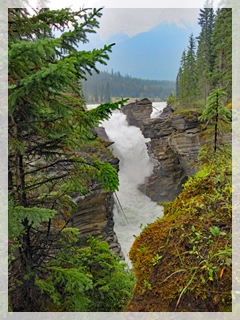 As I viewed the picturesque waterfall, the tremendous amount of water pouring over the rock, and the deep gorge formed by the glacial river, I thought of H. Jackson Brown’s quote: “In the confrontation between the stream and the rock, the stream always wins, not through strength but by perseverance.” Thinking it a good start for a devotion about patience and determination, I looked forward to writing it when I got home. Having been out of town thirty out of the last seventy days, however, I’ve been playing “catch-up” since returning from Canada. Domestic chores, family obligations, paper work, commitments, appointments, assorted health issues, and then my mother-in-law’s hospitalization have eaten away at me and I’m physically and emotionally exhausted. Today, during prayers, it occurred to me that something else is as persistent (and effective) as that rushing water—Satan! While the enemy enjoys throwing major disasters our way, as he did with Job, he also likes to peck at us like a troublesome woodpecker or whittle away at us as water does to rock. Through persistence, water defeats rock; like that persistent water, the enemy is determined to defeat us.
Satan came to Jesus when he was weakest—alone, tired and hungry after forty days of fasting in the wilderness. He does the same with us. It doesn’t take much for him to start his work. Even a small amount of worry, exhaustion, illness, busyness, discouragement, fear, delay, discontent, frustration, adversity, anger, anxiety, or pain makes us vulnerable to the enemy’s attacks. Add enough of them together for a long enough time and what seemed rock solid may break down or collapse.
The Apostle Peter likened Satan to a prowling lion and we should be wary of his attacks. If he can’t devour us in one assault, however, he’ll take a nibble out of our souls whenever an opportunity arises. Enough little nibbles can erode our spirit the same way water erodes rock. This morning, I realized that Satan was making inroads; it was time to shine up my armor of God and go on the offense. Instead of spending less time in Bible study and prayer, I needed to spend more (especially in the praise and thanksgiving departments)! While it may have taken five million years for water to carve the Grand Canyon, it wouldn’t take the enemy that long to leave a large chasm in my heart.
Almighty Father, Creator of all, thank you for the blessings of this and every day. Strengthen us so that we can resist the enemy’s attacks. Give us wisdom to understand your word and grace that we may live in obedience to it. May our faith increase daily so that we can do your work and fulfill your purpose for us; through Jesus Christ our Lord. Amen.
 On our recent visit to the Canadian Rockies, we had a delightful bus driver named Phil. At seventy, he’s logged thousands of miles. We were his eleventh tour of the summer and he knows the area like the back of his hand. Although kind and good-natured, Phil was just formidable enough that we wanted to obey his directions for fear of encountering his wrath. Clearly, he was the boss of the bus!
 As we watched the helicopters fly through the sky, we could see the water buckets hanging under them. Once the copters were in position, hoping to extinguish the forest fire, the crews would open the dump valve and empty water on the flames below them. The helicopters flew back and forth all afternoon as they refilled their buckets from the glacial lakes. If the helicopters are too low or slow in dropping the water, the water will be too concentrated to work effectively and, rather that put out the flames, the rotors’ downwash will intensify it. Even though those buckets can carry as much as 2,600 gallons of water, to those of us on the ground, it seemed a little like a mop bucket was being used to extinguish a house fire. Nevertheless, the firefighters continued their valiant fight against the blaze.
 They [the Levites] are to stand every morning and evening to thank and praise the Lord. [1 Chronicles 23:30 (NLV)]
 After it was returned by the Philistines, the Ark of God had been neglected in Kiriath-jearim for twenty years. Fresh from victories over the Philistines, David decided to bring the Ark back to its rightful home in Jerusalem. It certainly seemed like a good idea at the time. Unfortunately, ignoring the law’s clear instructions that the Ark could only rest on poles and carried on the shoulders of Levites, David had it placed on a cart pulled by oxen. The oxen stumbled, the cart tipped, and Uzzah reached out to steady it. Under Hebrew law, touching the sacred Ark was a capital offense and Uzzah was immediately struck dead. The Ark should never have been on a cart and it was David’s disobedience and carelessness that caused the man’s death. Nevertheless, David’s reaction was to get mad at God.
 When writing yesterday’s devotion (“It’s Curtains”), I couldn’t help but feel a brief pang of regret because I never had those conversations with my parents before they died. The thoughts, “Please forgive me. I forgive you. Thank you. I love you,” may have been assumed but never were spoken. I was fifteen when my mother succumbed to cancer. I saw her that day in hospital but, when I walked out that afternoon, I was sure I’d see her again when I visited the following day. I never thought the next time I saw her she’d be lying in a casket. When people would say, “She looks so good,” I wanted to shout at them and say, “She doesn’t look good; she looks dead!” Five years later, I was in the same funeral home and surrounded by many of the same mourners. That time, it was my father’s body lying so still in the front of the room. Two day earlier he’d been hunting pheasants when his heart failed; he died in the middle of a corn field. I’d seen him just a few weeks before that and never thought our farewell was the final one. Did my parents know how much I loved them? Did they know how sorry I was for my failings? Did they know I forgave them for theirs? Did they know how thankful I was for the life they gave me?
