
Feed the hungry! Help those in trouble! Then your light will shine out from the darkness, and the darkness around you shall be as bright as day. [Isaiah 58:10 (TLB)]
 While tucking toothbrushes, dental floss, Band-Aids, and soap into shoeboxes already filled with pencils, notebooks, markers, tee-shirts, and toys, I thanked God, not just for the privilege of giving, but also that basic items like these are not a luxury in my world. In many parts of the world, however, they are! For example, our pastor just returned from Cuba where a sample-size tube of toothpaste costs the equivalent of $5 and is so sparingly squeezed that it lasts a family of four one month. The gifts he’d packed in his suitcase were simple drugstore items such as toothpaste, feminine hygiene products, and pain relievers, but the people who received those basics were as appreciative as if he’d delivered a treasure chest of gold and diamonds.
Dwight Moody once told of a man at sea who was ill and confined to his cabin. Hearing that a sailor had fallen overboard and not knowing what he could do to help, the man picked up his light and held it against the port-hole. Upon hearing that the sailor had been rescued, the man returned to his bunk. When walking on the deck after his recovery, this gentleman met the fellow who’d fallen overboard that night. Recounting the frightening episode, the sailor said he’d been sure no one would see him in the darkness as he desperately tried to stay afloat in the churning waves. But, just as he started to go down for what he was sure was the last time, a light from out of a port-hole shone on him; finally seeing the drowning sailor, a man caught his hand and pulled him into the life-boat.
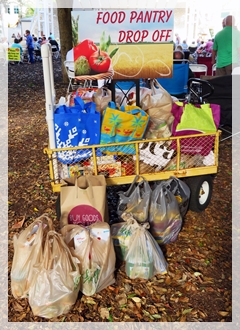
Our pastor’s suitcase of basics and the clothes he and his wife left behind in Cuba can’t stop the blackouts, ease the nation’s food shortages, or shorten the queues waiting for a bus or a few gallons of gas. The Samaritan’s Purse shoeboxes our church filled won’t change governments, provide jobs, or feed the hungry. The meals packed for food banks, clothes donated to resale shops, gifts purchased for strangers whose names hang on a giving tree, food served at a homeless shelter, change dropped into the bell ringers’ buckets, checks written to the Salvation Army, or the animal purchased for Heifer International won’t solve the world’s problems. Nevertheless, while we can’t change the world, we all can do our part to change the world for someone, even if it’s just with a toothbrush or a tube of toothpaste!
“Let us take the torch of salvation and go into these dark homes and hold up Christ to the people as the Savior of the world,” said Moody as he finished his story of the light in the port-hole. “Not all of us can do great things. But we can do small things with great love,” were the words of Mother Teresa. Few, if any, of us will pull a drowning sailor from the sea and we’re not likely to win a Nobel Peace Prize for our humanitarian efforts. Nevertheless, in our own small ways, we each can make a difference by shining a light for those in despair. Let us be the light that brings Christ’s love into the world!
 When we moved to our small Midwestern town over fifty years ago, we paid our utility bills at the local drugstore and I longed for the “good old days” when we sold our northern home recently. Trying to update our information and go completely paperless, I attempted to access our various accounts on line, meaning I had to remember (or create) a wide variety of user names and passwords. If I managed to sign in, I’d get to the security questions and discover that my favorite color or dessert is not what I thought it was! Once past that hurdle, I had to prove I wasn’t a robot by deciphering those squiggly letters and numbers (a near impossibility)!
 The story is told of a circuit-riding preacher who never failed to thank God for the day’s weather. One Sunday, after battling through wind and sleet to his preaching appointment in a distant town, the congregation wondered how he could be thankful in such dreadful weather. When it came time for prayer, however, he said, “This is a wretched day, dear Lord, no doubt about it. But, we thank Thee, Lord, that every day isn’t as bad as this one!”
 We’re selling our northern home and, as I packed up assorted family heirlooms, I came across the little sterling silver salt and pepper shakers we used for so many years. I held one in my hand a bit longer than the others; it had distinct teeth marks on it. For reasons that are unknown, my eldest child tried to bite through it. In spite of its obvious imperfection (or, perhaps because of it), the shaker is still beautiful. I’d wondered which child should get these silver pieces but, after remembering their history, I lovingly wrapped them up and placed them in my son’s box. I only hope his family will find the impressions of his baby teeth as beautiful as do I.
 After the Apostle Paul established the church in Thessalonica, he encountered persecution from both the Jews and city officials so he abruptly fled with Silas. In his first letter to the Thessalonians, Paul sends words of comfort, edification, and encouragement to the new church. Along with some practical advice on Christian living, he reassures the new converts in their persecution and 1 Thessalonians 5:16-18 are some of my favorite verses.
 To impress their students with the importance of commas, English teachers often tell an unsubstantiated story about Maria Fyodorovna, the wife of Tsar Alexander III of Russia. Alexander, a harsh and repressive ruler, had exiled a suspected anarchist to imprisonment and death by writing these words on his warrant: “Pardon impossible, to be sent to Siberia.” Coming across the document, the Tsarina seized the opportunity to save the life of an unknown prisoner and quickly scratched out the comma. She re-inserted it so that the warrant read: “Pardon, impossible to send to Siberia.” With the comma’s transposition, the prisoner’s death warrant became his pardon.

