THE REAL STORY

And she brought forth her firstborn son, and wrapped him in swaddling clothes, and laid him in a manger; because there was no room for them in the inn. [Luke 2:7 (KJV)]

Magi
Between countless Christmas pageants, Christmas card illustrations, nativity sets, and the words of our favorite carols, the Christmas story we know actually may not be the one told by Luke. Although most translations say Mary laid Jesus in a manger because there was “no room for them in the inn,” it probably wasn’t an inn and no mention is made of an innkeeper (or his wife). The word usually translated as “inn” in this verse was kataluma and it appears one more time in Luke 22:11 and Mark 14:14 when Jesus sent Peter and John to Jerusalem to determine the location of the kataluma where they would celebrate their Passover meal. Here kataluma  is translated as guest room or guestchamber and Luke described it as a large upstairs room in a person’s house. Rather than kataluma , the word Luke used for inn when telling the Parable of the Good Samaritan was pandocheion which clearly meant inn or public house.

Rather than staying in the 1st century equivalent of a Motel 6, the couple would have stayed with relatives, as was the custom of the time. But, since everyone else in the family also was in Bethlehem for the census, the house would have been overflowing with people. Even though Mary was pregnant, the older family members had priority on rooms. Rather than no room at the inn, there was no room for them in the normal living quarters.

We wrongly assume Jesus was born in a barn or a stable because of the manger (an animal’s feeding trough) but animals usually weren’t housed in an exterior building. To keep them safe from theft and the elements, they were kept on the ground floor of the house, often under the living quarters. Because of the manger’s mention, it probably was here that Mary gave birth. Had I been Mary and about to give birth, I would have preferred the relative quiet and privacy afforded in the animals’ quarters to the commotion of a house filled with people! While it makes for great drama to think of a cruel innkeeper refusing them a room, it’s rather nice to picture the savior of mankind being welcomed into the wonderful chaos of an extended family oohing and aahing over Him!

Even though animals are included in every pageant and nativity, Scripture doesn’t mention Mary riding a donkey into Bethlehem, the shepherds bringing any sheep, or even camels. Because of the manger, we assume the presence of a cow but that’s mere speculation.

As for the angels—the only mention of angels in Luke’s account is when they announce Messiah’s birth to the shepherds. While it’s logical to think angels watched over the Holy Family that night, Scripture doesn’t say so and there’s no reason to think they were visible. Moreover, as much as I love singing the long “Gloria in excelsis Deo,” in the carol, Scripture only says the angels praised God and spoke their message.

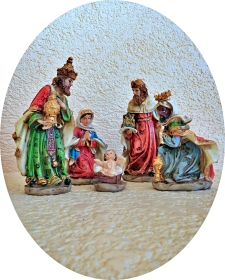
In Matthew’s gospel we read of the wise men (magi) from the east who visited Jesus. While “magi” came to mean astrologers, sorcerers, or magicians, these men probably were Magians, a priestly caste from Media, Persia, Assyria, or Babylonia. Learned in the prophecies of Hebrew Scripture, they were worshipful seekers of the truth. Their number (three) and names come from song rather than Scripture and their kingship and camels may come from their mention in Isaiah 60. Careful reading, however, tells us Isaiah’s prophecy refers to Christ’s return rather than His birth. Nevertheless, an unknown number of Magi brought this young king gifts of gold, frankincense, and myrrh. Whether such costly offerings were theirs or on behalf of a foreign king is unknown.

Even the Magi’s appearance in our pageants and nativities is incorrect. Because the Holy Family fled to Egypt immediately after their departure, the Magi must have arrived after Mary’s purification and Jesus’ presentation in the Temple 40 days after His birth. When the Magi arrive, Matthew refers to Jesus as a child rather than an infant and, based on the age of the boys Herod ordered slaughtered, their visit probably occurred when Jesus was a toddler.

Christmas is a time of great pageantry and kings kneeling in front of an infant in a manger, surrounded by animals, shepherds, and angels, makes for great theater. The facts surrounding Jesus’ birth, however, are more marvelous that any we could imagine! The message that the Son of God came in human form to sacrifice Himself for our sins and provide eternal life to all who believe in Him needs no embellishment.

It is here, in the thing that happened at the first Christmas, that the most profound unfathomable depths of the Christian revelation lie. God became man; Nothing in fiction is so fantastic as this truth of the incarnation.  [J.I. Packer]

And the angel said unto them, Fear not: for, behold, I bring you good tidings of great joy, which shall be to all people. For unto you is born this day in the city of David a Saviour, which is Christ the Lord. And this shall be a sign unto you; Ye shall find the babe wrapped in swaddling clothes, lying in a manger. And suddenly there was with the angel a multitude of the heavenly host praising God, and saying, Glory to God in the highest, and on earth peace, good will toward men. [Luke 2:10-14 (KJV)]

Copyright ©2022 jsjdevotions. All rights reserved.

COMPLETING THE RACE – Part 2

Therefore, since we are surrounded by such a huge crowd of witnesses to the life of faith, let us strip off every weight that slows us down, especially the sin that so easily trips us up. And let us run with endurance the race God has set before us. [Hebrews 12:1 (NLT)]

Monday, when writing about stripping off the weight that keeps us from running the race God sets before us, I likened it to the actions of a triathlete. Whenever I attend one of my son’s triathlons, I’m part of an enormous crowd witnessing the event. Most are like me—trying to spot our loved ones’ swim cap bobbing in the water or their number as they speed past us on the course. Although we cheer, shake cowbells, carry posters, and yell encouraging words to all the racers, we are merely onlookers and few of us have any real idea of the challenges faced by each competitor. When reading of being surrounded by a crowd of witnesses during the race of faith in Hebrews 21:1, it first seems that these witnesses are like the crowd at a triathlon cheering on the athletes.

A look back at Hebrews 11, however, tells us those witnesses are not mere observers; they were participants in the same race! Having already crossed the finish line, they include such stellar names as Noah, Abraham, Isaac, Joseph, Moses, Gideon, David, Samuel, and even Rahab. Without specifically naming them, the author also refers to the trials of people like Daniel, Shadrach, Meshach, Abednego, Stephen, James, Jeremiah, and Elijah. Not limited to ancient Biblical witnesses, we can be inspired by the witness of people like William Tyndale, Eric Liddell, C.S. Lewis, John Wesley, Dietrich Bonhoeffer, Corrie Ten Boom, and Desmond Tutu. All of them encountered things like overwhelming challenges, torture, sickness, combat, beatings, oppression, poverty, hostility, and suffering beyond our wildest imaginings. When they stumbled, they got back up and kept going. Having persevered through doubt, distress, and anguish, their lives affirm God’s absolute faithfulness to them. Their witness of faithful service to God can inspire us to shed anything weighing us down and to faithfully continue running the course God has given us.

There are, however, another set of witnesses to our journey of faith. In his first triathlon, my son was a novice who naively thought that combining three sports in one race couldn’t be that difficult. He made mistakes in his choice of clothing, equipment, nutrition, and training. Although my son finished that first race (with soggy bike shorts and blistered feet), it was just a sprint triathlon. He knew he needed the wisdom and support of other triathletes if he ever hoped to complete an international/Olympic triathlon. Joining a tri club, he attended clinics, meetings, and group workouts where he learned about each discipline within a triathlon. He gained guidance, coaching, training opportunities, encouragement, and friends with whom to train.

If we want to finish well in our faith journey, rather than joining a tri club, we need to join with other Christians. Just as his fellow triathletes witnessed to my son about their experiences, it is our brothers and sisters in Christ who witness to us. Just as his teammates share their experiences, help him up when he falls, and encourage him when he struggles to keep going, our church family is there to encourage, guide, correct, and help us. Even though they haven’t completed their journey, they are well on their way to crossing the finish line. Like my son’s tri teammates, they’re more than mere onlookers; as living testifiers to a life of faith, they bear witness to us that running the race set before us is both doable and worthwhile.

By faith these people overthrew kingdoms, ruled with justice, and received what God had promised them. They shut the mouths of lions, quenched the flames of fire, and escaped death by the edge of the sword. Their weakness was turned to strength. They became strong in battle and put whole armies to flight. [Hebrews 11:34-34 (NLT)]

Copyright ©2022 jsjdevotions. All rights reserved.

SOWING

Here is another story Jesus told: “The Kingdom of heaven is alike a farmer who planted good seed in his field. But that night as the workers slept, his enemy came and planted weeds among the wheat, then slipped away. When the crop began to grow and produce grain, the weeds also grew.” [Matthew 13:14-16 (NLT)]

p0rairie rose - rose hip
Our brief return north last June meant we again enjoyed walking among the Midwest’s summer wildflowers. I only stepped a few feet off the path for a photo and yet my pants were covered with sticky seedpods from the Tick-Trefoil. Sometimes called sticktights or beggar’s lice, their seed pods are covered with fine hooked hair that catches on anything it contacts—whether clothing or a passing squirrel. I spent the rest of the walk picking off the pods and scattering them along the trail. After carefully stepping over a pile of seed-studded raccoon poop, I was reminded that a flower’s purpose isn’t merely to look pretty; it’s to spread its seeds any way it can.

Like the Tick-Trefoil, some flowers have pods that attach to clothes and animals and ride through the forest on pants’ legs and fur until they find a good home. Flowers like the False Solomon’s Seal and Pokeweed, however, produce fruit that is eaten by animals and, like that raccoon, leave the seeds behind in their waste. Other wildflowers, like the Asters and Milkweed, have seeds attached to a feathery sort of “parachute” that is blown away by the wind to (hopefully) land on fertile soil. That the flowers are rooted into the ground doesn’t seem to keep them from spreading their seeds every which way to make more of their kind.

Looking at the colorful blossoms throughout the park, I saw that the native wildflowers have done their seed-spreading job well. Unfortunately, undesirable invasive species like Canadian Thistle and Purple Loosestrife also have been expanding their territory. The seeds of these invasive weeds are trying to defeat the native wildflowers in the same way Satan is trying to defeat us by planting his seeds of evil. So far, the flowers are ahead of the game; are we?

Jesus also told a parable about a farmer who planted seeds and the various kinds of soil on which his seeds fell. Types of soil, however, make no difference if the farmer fails to sow any seeds! Unsown seeds will never germinate! Would that we Christians were as determined to spread God’s word as the flowers are to scatter their seeds. As pretty as it is, the Prairie Rose knows that its job isn’t finished when it blooms into a beautiful flower. Its real purpose is to bear fruit (the rose hip) and spread its seeds far and wide. Unlike the rose, however, many Christians are quite content just looking good and give little thought to bearing fruit, let alone enlarging God’s garden by sowing His word.

It’s what you sow that multiplies, not what you keep in the barn! [Adrian Rogers]

He said to his disciples, “The harvest is great, but the workers are few. So pray to the Lord who is in charge of the harvest; ask him to send more workers into his fields.” [Matthew 9:37-38 (NLT)]

And then he told them, “Go into all the world and preach the Good News to everyone.” [Mark 16:15 (NLT)]

Copyright ©2022 jsjdevotions. All rights reserved.

THE SAD STORY

After that generation died, another generation grew up who did not acknowledge the Lord or remember the mighty things he had done for Israel. … In those days Israel had no king; all the people did whatever seemed right in their own eyes. [Judges 2:10, 21:25 (NLT)]

tulipAs a history of Israel’s disobedience, idolatry, and moral depravity, Judges is one of the saddest books of the Bible; it also is one of the bloodiest and violent. After starting well with war against the pagan tribes of Canaan, it ends with civil war and Israelite killing Israelite. While some tribes obediently drove the pagan people from their land, others found it easier to tolerate sin than fully eradicate it. By the time of Gideon, altars to Baal and Asherah poles had been erected and people wanted to kill Gideon for destroying them. It only went from bad to worse after Samson. Micah sinfully set up a shrine for his idols, wrongly fashioned a priestly ephod, ordained his son into the priesthood, and then purchased the services of a Levite as his personal priest! After the Danites stole his idols, ephod, and Levite, they set up their own idolatrous shrine with the Levite as priest. Did no one remember God’s laws given to them by Moses that specifically covered priests, ephods, Levites, and the worship of idols?

As for violence—along with the carnage of battle, there’s a disembowelment, a tent peg hammered into a head, eyes getting gouged out, and a king’s thumbs and big toes get amputated to humiliate him. Thirty men are killed just to pay a gambling debt and a father’s foolish vow ends in the sacrifice of his daughter. After 300 foxes are set on fire in a vengeful act that destroys a town’s grain fields, vineyards, and olive groves, a father and daughter are burned to death as payback!

Instead of conquering the fertile land they’d been given, the Danites moved north, burned the peaceful city of Laish, and mercilessly killed its inhabitants. When the men of Gibeah raped and killed a Levite’s concubine, the Levite dismembered her body to summon the tribes of Israel. Then, after they nearly eradicate the entire tribe of Benjamin in retaliation for the concubine’s death, the men regret their actions. To right the wrong, they slaughter every man, woman, and child in Jabesh-gilead except for 400 virgins who are given to the surviving soldiers of Benjamin. Needing more virgins, another 200 young women were forcibly abducted from Shiloh. How did this happen? What happened to God’s law? How did Israel fall into such sin, violence, and mayhem?

Scripture tells us that one generation after Joshua’s death, the people forgot and, within one generation of the death of each judge, they forgot again! There was a reason God wanted his word passed on through the generations and a reason he commanded people to keep repeating the law to their children. Whether the command to put His words on hands, foreheads, and doorposts was literal or figurative, God wanted His word to be an inescapable part of His people’s lives and the lives of every generation that followed. Why? Because God’s Word means life!

When I look at the disobedience, idolatry, moral depravity, and violence in Judges, I can’t help but see parallels today. As my mother would say, it seems that the world is going to hell in a handbasket. Indeed, it does! There’s a reason the world doesn’t seem much better in 2022 than during the 300 plus years of turmoil recounted in Judges. As they did nearly 3,400 years ago, people continue to do whatever seems right in their own eyes. We’ve allowed the full story of God’s redemption to be forgotten, disregarded, or never heard. The people of Israel didn’t need a king; they needed God. So do we! What are we going to do about it?

And you must commit yourselves wholeheartedly to these commands that I am giving you today. Repeat them again and again to your children. Talk about them when you are at home and when you are on the road, when you are going to bed and when you are getting up. Tie them to your hands and wear them on your forehead as reminders. Write them on the doorposts of your house and on your gates. [Deuteronomy 6:6-8 (NLT)]

Copyright ©2022 jsjdevotions. All rights reserved

SIMON OF CYRENE

Then he said to the crowd, “If any of you wants to be my follower, you must give up your own way, take up your cross daily, and follow me.” … As they led Jesus away, a man named Simon, who was from Cyrene, happened to be coming in from the countryside. The soldiers seized him and put the cross on him and made him carry it behind Jesus. [Luke 9:23, 23:26 (NLT)]

Simon Carries the Cross
Although Jesus spoke of carrying your own cross, it was Simon of Cyrene who carried His. Cyrene was in Cyrenaica, a land just east of Egypt in what now is Libya. We don’t know if Simon had resettled in Judea or if he was there just for the Passover. We only know that Simon had just come into the city from the fields (or countryside) when the soldiers pressed him into service. Carrying a 75-to-125-pound cross-beam (patibulum) of a Roman cross certainly hadn’t been in Simon’s plans that day but one didn’t refuse a Roman soldier.

If we’re supposed to carry our own cross, why didn’t Jesus carry His? Perhaps because that cross was as much Simon’s as it was Peter’s and John’s and yours and mine. That cross weighed more than 125 pounds because it carried the weight of mankind’s sins. It was at Golgotha that Simon surrendered the weight of his (and everyone else’s) sins to Jesus. Not only did Simon carry his own cross but Luke tells us specifically that Simon followed Jesus as he did it!

When they impressed Simon into service, it seems as if the Roman soldiers finally showed some compassion on the man they’d so mercilessly beaten earlier that day. Kindness, however, may not have been their motivation. Not everyone condemned to the cross survived the soldiers’ scourging but they’d been told to crucify Jesus. If He died before getting to Golgotha, they’d have failed at their task. The soldiers may have enlisted Simon simply to keep Jesus alive long enough so they could inflict more torture on Him!

Whatever the soldier’s motive was for conscripting Simon, theologian John Piper posits that God put Simon there for Jesus. Let us remember that the man who healed the sick, turned water into wine, fed a multitude with a boy’s lunch, gave life back to Jairus’ daughter, and called Lazarus out of the tomb had the power to stop his suffering at any time that day. If we thought Jesus’ anguish was great the previous night while praying to do God’s will, His agony that day was far worse. If we thought Jesus’ temptation to yield to Satan was great in the wilderness, it was even greater as He stumbled toward Golgotha. Angels, however, ministered to our Lord in the wilderness and an angel strengthened Jesus in the Garden of Gethsemane. In the same way, did God have Simon carry the cross as a way of helping and sustaining His Son so that Jesus’ obedience would not falter?

God works in amazing ways and maybe Simon of Cyrene was placed on that roadside at just that time for just such a purpose! Could God have placed us somewhere today so that we can serve as one of His ministering angels?

The Spirit then compelled Jesus to go into the wilderness, where he was tempted by Satan for forty days. He was out among the wild animals, and angels took care of him. [Mark 1:12-13 (NLT)]

“Father, if you are willing, please take this cup of suffering away from me. Yet I want your will to be done, not mine.” Then an angel from heaven appeared and strengthened him. [Luke 22:42-43 (NLT)]

Copyright ©2022 jsjdevotions. All rights reserved.

GOD’S WARDROBE

Since God chose you to be the holy people he loves, you must clothe yourselves with tenderhearted mercy, kindness, humility, gentleness, and patience. Make allowance for each other’s faults, and forgive anyone who offends you. Remember, the Lord forgave you, so you must forgive others. Above all, clothe yourselves with love, which binds us all together in perfect harmony. [Colossians 3:12-14 (NTE)]


When writing to the Colossians, Paul told them to clothe themselves with mercy, kindness, humility, gentleness, patience, and love. A more literal translation would be to sink your heart (or the inner parts of your body) into a garment and wrap yourselves with God’s virtues. The Message translation simply says, “dress in the wardrobe God picked out for you.” When we dress ourselves in His clothing, we’ll begin to look like Christ—not because we’re wearing an inner linen tunic, robe, cincture (belt), sandals, and a cloak—but because we’re acting as Jesus would act!

When my high school presented Jean Giraudoux’s Madwoman of Chaillot, I played one of the madwoman’s elderly and equally mad compatriots. But, at 16, I struggled with getting into the role and feeling like an old woman. It was not until dress rehearsal, when I actually looked like my character, that I truly began to act and feel like her.

The change from teen to old woman began with a make-up base giving me a pallor and continued when shadows were applied around my eyes, under my cheekbones, and along my jawline. Fine lines were drawn on my forehead and around my mouth and a little white grease-paint was sponged onto my eyebrows and hair. The transition continued when I put on my costume—a dark silk dress with petticoats and a bustle along with an elaborate hat and net veil. I wrapped myself with a fringed shawl and picked up the old black umbrella I’d be using as a cane. When I saw myself in the mirror, I gasped at the transformation. It wasn’t just my appearance that changed; once I looked like an old woman, I began to walk, talk, and even feel like one. I felt the aches, pains, and weariness of an octogenarian in a way I hadn’t during previous rehearsals. For a few hours the next several nights, instead of being a junior in high school, I became an eccentric old woman because, once I looked like her, I acted my way into being her!

We are called to live by faith rather than by emotion and it is Scripture, rather than a script, that tells us how to live out our lives. We may not feel like being patient with the co-worker who can’t get the hang of the new system, but we can clothe ourselves with patience and act patient while answering his questions. We don’t have to feel kind, loving, or forgiving to dress in kindness, love, and forgiveness. When we clothe ourselves with the wardrobe of Jesus, we’ll start looking and acting like Him and, the more we act like Him, the more we’ll become like Him! We can act our way into a feeling far easier than feel our way into an action!

Decades ago, I had to look like an old woman before I could act like her and be authentic in my portrayal. Today, in the same way, we must put on Jesus’ wardrobe and act like Him before we can become like Him. When you look in your closet this morning, be sure to put on the garments of God along with your shirt and pants!

Do not waste time bothering whether you ‘love’ your neighbor; act as if you did. As soon as we do this we find one of the great secrets. When you are behaving as if you loved someone, you will presently come to love him. [C.S. Lewis]

For you are all children of God through faith in Christ Jesus. And all who have been united with Christ in baptism have put on Christ, like putting on new clothes. [Galatians 3:26-27 (NLT)]

Imitate God, therefore, in everything you do, because you are his dear children. Live a life filled with love, following the example of Christ. [Ephesians 5:1-2 (NLT)]

Copyright ©2022 jsjdevotions. All rights reserved.