WHEN DID WE SEE YOU? (Part 1)

Yes, just as you can identify a tree by its fruit, so you can identify people by their actions. Not everyone who calls out to me, “Lord! Lord!” will enter the Kingdom of Heaven. Only those who actually do the will of my Father in heaven will enter. [Matthew 7:20-21 NLT]

sheepHaving previously warned people that not everyone who claimed to follow Him would enter the Kingdom, Jesus told the Parable of the Sheep and Goats in which He likened the last judgment to a king separating the sheep from the goats at the end of the day. Placing the sheep to His right and the goats to His left, the King invites the sheep into the Kingdom. The reasoning behind His selection is disarmingly simple: “For I was hungry, and you fed me. I was thirsty, and you gave me a drink. I was a stranger, and you invited me into your home. I was naked, and you gave me clothing. I was sick, and you cared for me. I was in prison, and you visited me.” [Matthew 25:35-36] Having failed to do those things, the goats are sent into eternal punishment.

Both the blessed (sheep) and the condemned (goats) are astonished at the King’s explanation and they ask when they did or didn’t do those things. The goats seemed to expect they’d enter the Kingdom. After all, they’d followed all the rules. They may have recited the creed Sundays at church, tithed (after taxes of course), and avoided even a whiff of scandal but their supposed faith never moved from their heads into their hearts. Nevertheless, they’re confident they would have helped Jesus if they’d ever seen Him.

Like the goats, the sheep don’t remember seeing Jesus. But, unlike the goats, their faith produced fruit. They’d grocery shopped for the ailing neighbor, brought casseroles to the grieving family, offered water to the landscaper, read to the blind woman down the street, written letters to prisoners, worked at the food pantry, brought communion to the house-bound, mentored a refugee family, tutored immigrant children, volunteered in the charity resale shop, been foster parents, or taken cancer patients to chemo. Rather than projects, they saw people in need! Like the goats, they don’t recall seeing Jesus’ face; nevertheless, sacrificial love was a way of life for them.

Both sheep and goats ask Jesus, “Lord, when did we ever see you?” He explains that whatever the sheep did for the “least of these” had been done for Him and that, whenever the goats refused to help the “least of these,” they had refused to help Him! If, like the Pharisees, we split hairs and ask who the “least of these” are, Jesus answered that question with the Good Samaritan parable and his command to love one another as He loved us! [John 13:34]

This isn’t a case of faith versus works. We are, indeed, saved by grace through faith alone. Even so, our faith is judged by our works and it is by our fruit that He will know us. If our faith hasn’t transformed our lives, it is dead. Faith is far more than “lip service;” we can’t claim we love Jesus when we fail to love others as He did!

Being a sheep isn’t about heroic, grand, or impressive deeds. The sheep hadn’t cured cancer,  solved the housing crisis, or reformed the prison system. They didn’t do great things but they continually did little things with great love! Without realizing it, they saw Jesus in every person they met. Both groups claimed to love the Shepherd but only the sheep loved as the Shepherd loved!

Sacrificial love is the real wool that distinguishes the sheep from the goats. Having real wool does not make you a sheep. But being a sheep causes you to have real wool. [Hayden Hefner]

Just as the body is dead without breath, so also faith is dead without good works. [James 2:26 (NLT)]

Dear children, let’s not merely say that we love each other; let us show the truth by our actions. [1 John 3:18 (NLT)]

Copyright ©2024 jsjdevotions. All rights reserved.

APPROVAL RATINGS

Obviously, I’m not trying to win the approval of people, but of God. If pleasing people were my goal, I would not be Christ’s servant. [Galatians 1:10 (NLT)]

green heronThe email from my dentist asked, “Would you recommend us?” When I answered in the affirmative, I was hyperlinked to a site that added my five-star rating to that of other patients. The following day, I received a longer survey regarding my recent visit. Once done, it again asked if I would recommend his services and requested use of my name in an on-line testimonial. It’s clear that my dentist wants more than feedback; he wants the public approval of his patients. Although I like him, I like my privacy more, so I declined!

Like my dentist, we all want to be noticed, liked, approved, applauded, and endorsed but, unlike him, we probably don’t employ a company to do surveys for us. Nevertheless, we tend to measure approval in other ways—the website’s metrics, “friends” on Facebook/Meta, and followers on Twitter/X, Instagram, TikTok, or Snapchat. Approval is determined by the number of compliments received, memberships (and offices held) in various organizations, honors awarded, likes on the posting, hearts on the text, or the quantity of Christmas and birthday cards received and invitations extended or accepted. We judge admiration on the number and expense of gifts we get, the reviews on Yelp or Trip Advisor, the size of the obituary, and the length of the line offering condolences at the funeral home.

Of course, it’s only natural to want the admiration of our family, friends, peers, and employers. Nevertheless, we must never seek their approval at the expense of pleasing God. When Saul initiated a sacrifice rather than wait for Samuel, he was seeking his men’s approval rather than God’s; as a result, he lost his kingdom. When we seek the approval of others, God does not approve! According to the Apostle John, many Jewish leaders would not admit their faith in Jesus for fear of being put out of their synagogues because they “loved human praise more than the praise of God.” Jesus warned us about trying to impress people with our righteousness by putting on a show of our giving, praying, or fasting. While we might be praised by others, the One who sees into our hearts is not impressed.

In Bill Watterson’s comic Calvin & Hobbes, there were several instances (usually after having been disciplined or given a chore) when the precocious Calvin informed his father that his approval ratings were dangerously low, especially among six-year-olds and stuffed tigers. To Calvin’s surprise, his dad seemed unconcerned about his approval ratings’ ups and downs. Like this wise comic strip father, we can’t let approval ratings determine our behavior! As much as we want to be liked and admired, Jesus made it clear that we must not seek the approval of people rather than that of God! Our job is to please Him and His approval rating is the only one that truly counts!

When we try to please both the world and God, the interests of our two masters eventually will collide. When that happens, and it will, whose approval will we seek—man’s or God’s?

Fear of man is the enemy of the fear of the Lord. The fear of man pushes us to perform for man’s approval rather than according to God’s directives. [Paul Chappell]

For we speak as messengers approved by God to be entrusted with the Good News. Our purpose is to please God, not people. He alone examines the motives of our hearts. [1 Thessalonians 2:4 (NLT)]

No one can serve two masters. For you will hate one and love the other; you will be devoted to one and despise the other. [Matthew 6:24a (NLT)]

Copyright ©2024 jsjdevotions. All rights reserved.

OUT OF LOVE, NOT FEAR

But if you refuse to listen to the Lord your God and do not obey all the commands and decrees I am giving you today, all these curses will come and overwhelm you… The Lord himself will send on you curses, confusion, and frustration in everything you do, until at last you are completely destroyed for doing evil and abandoning me. [Deuteronomy 28:15,20 (NLT)]

Moses - Michaelkirsche - MeiringenThere are 613 commandments in the Torah/Pentateuch (the first five books of the Bible). But, as seen in Jesus’ interaction with the lawyer who wanted “neighbor” defined, there was room for interpretation. For example, what exactly does it mean to “honor” one’s parents? When Deuteronomy 11:18-20 says to bind “these words” to one’s hands and forehead and place them on doorposts and gates, exactly what words and how was it to be done? Work on the Sabbath is prohibited in twelve places but is the command limited to the few types of work mentioned? For that matter, what defines work?
Jesus criticized the Pharisees over their pettiness regarding the law but it’s easy to see how the system of laws governing Jewish life became so complex. After listing the blessings for obedience to God in Deuteronomy, Moses laid out the many curses for disobedience. Those curses include everything from wasting diseases, plagues, drought, boils, military defeat, and scorching heat to becoming food for scavenging birds, madness, swarms of insects, starvation, oppression, and exile. Moses painted a graphic and gruesome picture when warning the people to obey all the words of the law.

Since people will use any possible excuse to break a rule, it’s easy to see how fear of punishment led to Jewish legalism—especially in the Second Temple period when the Jews returned to Judah from Babylon. Having seen Jerusalem’s rubble and the Temple’s ruins, religious leaders knew firsthand the steep price Israel paid for their disobedience. Fearful of punishment and striving for absolute obedience, they wanted to cover every eventuality by putting a “fence around the Torah” with the Oral Law.

To clarify honoring and reverencing one’s parents, the oral law obligated children to care for their parents’ needs and prohibited things like sitting or standing in their place, contradicting them, or calling them by their first names. As for the binding and posting of words, the oral law specified tefillin (phylacteries), mezuzahs, and the verses that were to be placed in them. Rather than simplifying obedience, however, they complicated it with several thousand laws governing everything from the text, writer, pen, and ink to letter shape, parchment, and placement.

Based on the work required in building the tabernacle, 39 classes of prohibited work were specified in the Oral Law. Then, lest someone unintentionally work on the Sabbath, more rules were added. Tools used in prohibited work couldn’t be handled on the Sabbath which meant that touching things like scissors or needles was forbidden. Any action resembling prohibited work also was prohibited on the Sabbath so things like braiding hair (weaving) or separating good fruit from spoiled (winnowing/sifting) were banned. When the disciples were criticized for breaking the Sabbath by plucking off and eating some heads of grain, it was because the Pharisees considered their action the work of harvesting.

Jesus’ grievance wasn’t with the Law; it was with the Pharisees who had allowed the minutiae of the law to become more important than a relationship with the One who gave them the Law. Although the law pointed out sin, they didn’t understand that no matter how intricately it was interpreted or followed, the law never could keep people from sin. People are sinful and, try as they may, they always will fall short of perfect obedience.

As Christians, we must never make the mistake of thinking we can reach a level of perfection good enough for God; in spite of all their laws, the people of Judah couldn’t and neither can we. Jesus didn’t abolish the law—He fulfilled it! Our righteousness is attained only through faith in Him. We can’t obey God’s law on our own but, by the grace of God and the power of the Holy Spirit, we can begin to be the people He created us to be. Christians don’t obey God’s law to work our way into His good graces, to earn our way into heaven, or to avoid captivity or pestilence. We obey God out of love! If we genuinely love Him with all our being, obedience isn’t a burden because we want to do only what pleases Him.

The law tells me how crooked I am. Grace comes along and straightens me out. [D.L. Moody]

And he said to him, “You shall love the Lord your God with all your heart and with all your soul and with all your mind. This is the great and first commandment. And a second is like it: You shall love your neighbor as yourself. On these two commandments depend all the Law and the Prophets.” [Matthew 22:37-40 (ESV)]

Copyright ©2024 jsjdevotions. All rights reserved.

EASTERTIDE

Jesus told her, “I am the resurrection and the life. Anyone who believes in me will live, even after dying.” [John 11:25 (NLT)]

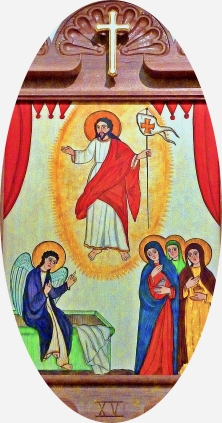
“Happy Easter,” said the Pastor as she welcomed us to worship. She was neither a week late nor four weeks early for Greek Orthodox Easter. While it’s no longer Easter Sunday and all the jelly beans, chocolate bunnies, and hard-boiled eggs have been eaten, it is Eastertide (“tide” just being an old-fashioned word for “season” or “time”). The Christian or liturgical calendar designates Eastertide as the fifty days from Easter/Resurrection Sunday to Pentecost (when we celebrate the outpouring of the Holy Spirit and the birth of the church).

Because it didn’t come by divine revelation, the church calendar isn’t sacred. Scripture doesn’t mandate the celebration of holy days and seasons like Lent, Good Friday, Easter, Advent, and Christmas. Nevertheless, God commanded the Israelites to celebrate specific events in their history and seasons of fasting and feasting tied to Jewish history are found throughout the Old Testament. Although the Christian church calendar isn’t established in Scripture, its basis certainly is.

We don’t even know the exact date of Christ’s birth, death, or resurrection and it wasn’t until 325 AD that Easter’s date was set as the first Sunday after the first full moon on or after March 21. The church (or liturgical) calendar was developed by tradition and church law so that, regardless of their location, all of Christ’s followers could collectively commemorate an act of God in the history of their redemption. People didn’t have ready access to Bibles in the 4th century and the regular celebration of events in the life of Christ and the church helped believers to better understand and remember them.

While liturgical churches such as the Episcopal, Lutheran, Methodist, and Roman Catholic still observe the seasons of the church, many Protestant churches do not. Some non-liturgical churches, however, are beginning to return to the traditional church calendar as a way of combatting the commercialization of our religious holidays. A few years ago, a non-denominational mega-church near our northern home announced, “This year we’re going to observe Lent!” as if it were a new idea rather than one more than 1,500 years old!

Although my neighbors went out and purchased half-price candy the day after Easter, we don’t want to spend the next several weeks dying eggs, making Easter baskets, having egg hunts, or consuming jelly beans and Peeps. Rather than repeating those secular traditions until Pentecost on May 19, Eastertide gives us fifty days to celebrate the meaning of Easter (and seven Sundays to sing the beautiful “alleluias” in Christ the Lord is Risen Today.)

During these next several weeks, let us spend as much time contemplating, appreciating, and celebrating Jesus’ resurrection as we did anticipating, planning, and celebrating His birth last December. After all, Easter is the whole reason for Christmas! Without Jesus’ resurrection, Christmas would simply celebrate the birth of a good man who said some wise things and was killed for his words.

The promise of our salvation didn’t disappear when the last chocolate bunny was eaten; the glorious Easter message is everlasting. Christ’s resurrection brings us love, grace, peace, forgiveness, redemption, and salvation, not just on Easter, but every day of our lives. One day is hardly enough time to celebrate a risen Christ—even fifty days are insufficient to rejoice in our salvation. We should be Easter people all year long.

The resurrection gives my life meaning and direction and the opportunity to start over no matter what my circumstances. [Robert Flatt]

This means that anyone who belongs to Christ has become a new person. The old life is gone; a new life has begun! [2 Corinthians 5:17 (NLT)]

 Copyright ©2024 jsjdevotions. All rights reserved.

THE NEW COVENANT (MAUNDY THURSDAY)

And he took bread, and when he had given thanks, he broke it and gave it to them, saying, “This is my body, which is given for you. Do this in remembrance of me.”  And likewise the cup after they had eaten, saying, “This cup that is poured out for you is the new covenant in my blood.” [Luke 22:19-12 (ESV)]

holy communionToday is Maundy (or Holy) Thursday—the day many Christians throughout the world will observe the institution of the Lord’s Supper/Eucharist/Holy Communion by coming to the Lord’s table. Regardless of what you call this sacrament, Jesus’ mention of a “new covenant” probably will be part of your service. Not a word commonly used today, what is a covenant and how does it differ from a contract?

Both covenants and contracts are binding agreements but, in a contract, the parties negotiate from fairly equal bargaining positions and are free not to sign. Although both parties are expected to abide by its terms, a contract has contingencies. If either party fails to hold up their end of the bargain, the contract is null and void and the relationship ends.

A covenant, however, is not between equals. With no negotiation, it is more like an agreement between the conquering king and the conquered people! While contracts can be amended, covenants are unalterable. In a covenant, the parties agree to hold up their end of the deal even if the other party doesn’t. While a failure on one side or the other will yield consequences, it will not negate the relationship. In Scripture we find covenants between God and Adam, Abraham, Moses, Noah, and David. In them, God promised to provide, protect, and bless his people while they promised to trust and obey him and repent when they didn’t.

God’s standard is perfection but, regardless of how hard we try, we can’t be perfect. As we know from the Old Testament, the people repeatedly failed to keep their promises. In a contractual relationship, that failure would have ended their relationship with God. Fortunately, it was a covenant relationship and, while the Israelites incurred God’s judgment for their disobedience, they never were abandoned. The Hebrew Scriptures promised a new covenant in God’s words to Jeremiah—a covenant uniting God with His people—a covenant of grace in which God fulfilled both sides of the agreement.

When Jesus blessed the bread and wine in that upper room in Jerusalem some 2,000 years ago, a new covenant with God began. Jesus did not negate the law. There was nothing wrong with the law; the problem was with the people who couldn’t abide by it. In the old covenant, people were told what to do (and not to do) to get right with God but, in the new covenant, the getting right with God was done for us by Jesus.

The old covenant required the blood of animals and yearly atonement; the new covenant is for eternity and was satisfied with the sacrifice of God’s only Son. The old covenant was one of the law and works but the new one is one of grace and faith. Instead of the law being written on tablets, it is written on our hearts. The old covenant was signified by circumcision but the new covenant is shown by a change of heart. The old covenant found God in the Temple in Jerusalem but the new finds Him in the temple of the Spirit. The old covenant was one of bondage and the new is one of liberty. The old covenant was established on Mt. Sinai for Israel alone; the new was established on the cross and is for all mankind. It was with Jesus that the old covenant ended and it was with Him that the new covenant began. What was the Last Supper of the old covenant became the First Supper of the new one!

Behold, the days are coming, declares the Lord, when I will make a new covenant with the house of Israel and the house of Judah, not like the covenant that I made with their fathers on the day when I took them by the hand to bring them out of the land of Egypt, my covenant that they broke, though I was their husband, declares the Lord. For this is the covenant that I will make with the house of Israel after those days, declares the Lord: I will put my law within them, and I will write it on their hearts. And I will be their God, and they shall be my people. And no longer shall each one teach his neighbor and each his brother, saying, ‘Know the Lord,’ for they shall all know me, from the least of them to the greatest, declares the Lord. For I will forgive their iniquity, and I will remember their sin no more.” [Jeremiah 31:31-34 (ESV)]

Copyright ©2023 jsjdevotions. All rights reserved.

HE WAS BETRAYED

On the way, Jesus told them, “All of you will desert me. For the Scriptures say, ‘God will strike the Shepherd, and the sheep will be scattered.’ But after I am raised from the dead, I will go ahead of you to Galilee and meet you there.” [Mark 14:27-28 (NLT)]

Church of our Lady - Netherlands

In the days leading up to his crucifixion, the people who claimed to love Jesus the most failed him in many ways. We know about Judas—the disciple trusted enough to carry the money bag who betrayed Jesus for thirty pieces of silver. That last night, the deceitful man had the audacity to have his feet washed by the Lord and to drink from His cup! But what of the other disciples? During that same meal, Peter vowed he’d never deny Jesus, even if it meant his death and the rest of the disciples echoed his pledge. Yet, within a matter of hours, those brave disciples would desert Jesus and Peter would deny Him three times. Even though Jesus asked Peter, James, and John to pray and keep watch with him in the Garden of Gethsemane, they fell asleep, not once but twice!

Where were the disciples when the mob shouted for Barabbas to be freed? For that matter, where were all of those people who had been healed or fed by Jesus? Just a few days earlier, a crowd had shouted, “Hosanna! Blessed is he who comes in the name of the Lord!” Where were they? Why were they silent? Instead of calling for Jesus’ freedom, the mob called, “Crucify him! Crucify him!”

The disciples weren’t even there to carry the cross for Jesus; that task fell to Simon, a stranger from Cyrene. Only John, Mary the mother of Jesus, Mary Magdalene, and some other women followers were at the foot of the cross when Jesus was crucified. Disillusioned and fearful for their lives, the other disciples were absent in His dying hours.

Rather than a disciple, it was a dying criminal who attested Jesus’ innocence, showed his faith, and asked the Lord, “Remember me when you come into your Kingdom.” When Jesus took His last breath and died, it was a Roman soldier and not a disciple who declared, “This man truly was the son of God!” The eleven remaining disciples didn’t even help bury their beloved rabbi. That responsibility was taken by Joseph of Arimathea and Nicodemus, members of the Jewish high council and secret followers of Jesus.

The disciples, confused and frightened, failed Jesus both as disciples and as friends. Nevertheless, despite the way they failed Him, Jesus didn’t fail them. Instead, after His resurrection, Jesus greeted them with words of peace and forgiveness. He then opened their minds to understand the Scriptures and charged these men—the same men who once failed Him—with the task of spreading the good news of His resurrection. Jesus knew it is better to be a believer who sometimes fails than not to believe at all.

Be assured, if you walk with Him and look to Him, and expect help from Him, He will never fail you. [George Mueller]

Jesus came and told his disciples, “I have been given all authority in heaven and on earth. Therefore, go and make disciples of all nations, baptizing them in the name of the Father, and the Son and the Holy Spirit. Teach these new disciples to obey all the commands I have given you. And be sure of this: I am with you always, even to the end of the age.” [Matthew 28-18-20 (NLT)]

Copyright ©2024 jsjdevotions. All rights reserved.