
God saved you by his grace when you believed. And you can’t take credit for this; it is a gift from God. Salvation is not a reward for the good things we have done, so none of us can boast about it. [Ephesians 2:8-9 (NLT)]
 Many years ago, while my son and his pals were playing baseball in the field next to the Miller house, the ball ended up going through the Miller’s window! When my son returned home, he asked me to call Mrs. Miller and ask for the return of his ball. Once I knew how the ball came to be in her possession, I told him he had to pay for the broken window before getting back his ball. So, for the next few weeks, the boy worked extra chores to pay off his debt.
Some people think of good works like the chores my son did to redeem his baseball. They picture a heavenly bookkeeper with a holy ledger who deposits their good deeds in the credit column and their sins in the debit. Whenever they err, a withdrawal is made from the works side to pay for the sin. It seems like a good plan. After all, my son worked off his debt so why can’t we just work off our sin debt?
If God used a balance scale with good works placed on one tray and sins on the other, how would the weight of good works and sins be determined? Would putting a dollar into the red kettle at Christmas be the same as being a hospice volunteer? Would petty theft weigh the same as grand larceny or adultery as much as mass murder? How many sins would be paid off by a mission trip? What would you need to discharge the sins of deceiving a spouse, gossiping about a neighbor, taking unfair advantage of someone, misappropriating funds, or cheating on your taxes?
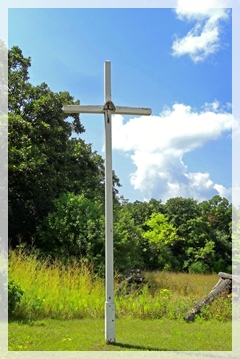
Salvation, however, cannot be earned nor is it for sale. That’s good news for me since I know my sins far outweigh my good works and there’s no way I could do enough to purchase my salvation. Moreover, we can’t stock up good turns, kindness, benevolence, generosity, and service to pay for future sins. Thinking our worth comes from our works undervalues God’s gift of grace because good works aren’t what save us from spiritual bankruptcy! Salvation comes from Jesus alone! He paid our sin debt in full with his blood when He died on the cross.
When my son told me about the mishap at the Millers, he insisted he wasn’t the one who hit the ball that broke their window. Claiming his innocence, he protested paying someone else’s debt. It may not have been fair but it was necessary. Someone had to pay the Millers for their busted window and no one else came forward.
As the sinless Lamb of God, Jesus was far more innocent of any wrongdoing than my son. Nevertheless, He paid both my debt and yours! The only one who was absolutely free of sin deliberately chose to take the full weight of God’s justice for sins He didn’t commit! Jesus paid a debt He didn’t owe because mankind owed a debt that couldn’t be paid! It wasn’t fair, but it was necessary.
The Gospel is good news of mercy to the undeserving. The symbol of the religion of Jesus is the cross, not the scales. [John Stott]
 Hearing the bird’s shrill harsh scream, I looked up expecting to see a blue jay. To my surprise, it was a mockingbird. Of all the beautiful songs it can imitate, I wondered why the mockingbird chose the strident call of the jay. Then, remembering how many blue jays inhabit our neighborhood, I realized their raucous “jaaaaay” is what the mockingbird frequently hears so that has become part of his song.
 Pope Francis recently visited Singapore and, when speaking to young people at an interfaith meeting, he is reported to have said “All religions are paths to God.” After comparing the various religions to “different languages that express the divine,” he added, “There is only one God, and each of us has a language to arrive at God. Some are Sheik, Muslim, Hindu, Christian, and they are different paths [to God].” While the pontiff was encouraging interfaith dialogue, his words are troubling. I will not presume to know the Pope’s meaning or intention with his comments. Nevertheless, I find it important to address how the world understood the pontiff’s message.
 Jeopardy introduced me to the word “performative” but, in an article about how scandals are hurting organized religion, the New York Times introduced me to another new word, “orthopraxy.” While “orthodoxy” means correct belief, doctrine, or teaching, “orthopraxy” has to do with correct practice, behavior, or action. Orthodoxy says, “Hear my words!” but orthopraxy says, “Watch my behavior!” With the flood of scandals throughout the Christian church, it’s easy to point our fingers at the disgraced Christian celebrities, megachurch pastors, and Roman Catholic priests whose orthodoxy didn’t match their orthopraxy—people who espoused devotion to God and adherence to His word while disregarding it in their own lives. Let’s remember, however, that whenever we point a finger at someone, three other fingers point at us! Although the Times article was about the disconnect between orthodoxy and orthopraxy in the church at large, there’s often a disconnect between the two in our personal lives, as well.
 When they had finished breakfast, Jesus said to Simon Peter, “Simon, son of John, do you love me more than these?” [John 21:15 (ESV)]
 If I were doing what accountants call a cost-benefit analysis of our living in Florida, the cost side would include venomous snakes, poisonous cane toads, hurricanes, alligators, sink holes, fire ants, and mosquitos along with humidity, allergies, high insurance, and seasonal traffic. On the other hand, the benefits would include never having to shovel snow, scrape sleet from a windshield, or drive on icy roads, along with the enjoyment of beaches, beautiful birds, colorful flowers, ocean breezes, “early-bird” specials, sunshine, no state income tax, and never-ending summer. While not one hundred times better, the pluses outweigh the negatives and make it worthwhile (at least for us)!
 Devotions of the Heart