
 But the wisdom from above is first of all pure. It is also peace loving, gentle at all times, and willing to yield to others. It is full of mercy and the fruit of good deeds. It shows no favoritism and is always sincere. And those who are peacemakers will plant seeds of peace and reap a harvest of righteousness. [James 3:17-18 (NLT)]
Someone has a small rubber ball tucked into the palm of his hand and you have just one minute to do whatever it takes to get the ball away from him. What would you do? If you were an inner city youth, chances are you’d start by trying to pry his hand open. Your efforts may even escalate into a wrestling match. I’m not sure you’d have to be an at-risk youngster to have that same response; my husband responded the same way. Imagine his reaction when learning that all he needed to do was ask for the ball and it would have been his!
That is just one of the exercises in a program called “Becoming a Man”®, a cognitive behavioral program offered in cities like Boston and Chicago. Knowing that small slights often can lead to pulling a trigger, the program is designed to help young men avoid life’s pitfalls and develop the social and emotional skills necessary for success: integrity, accountability, positive anger expression, self-determination, respect for women, and visionary goal setting. Young women are not exempt from needing life skills and a similar program called “Working on Woman”™ cultivates the core values of self-awareness, emotional intelligence, healthy relationships, visionary goal-setting, and leadership.
Instead of life skills, as Christians, we might call these faculties “Christ skills”, as does a local Christian school in my town. Instead of a formal code of conduct, the school’s teachers make a covenant with the students to live up to ideals listed as Christ skills: trustworthiness, cooperation, truthfulness, courage, organization, curiosity, patience, effort, perseverance, flexibility, pride, common sense, problem solving, caring, resourcefulness, personal best, responsibility, no put-downs, sense of humor, active listening, initiative, friendship, and integrity. With the goal of growing more like Christ, students learn to evaluate their choices and their consequences based on these skills.
All of these programs teach youngsters that there is power in slow thinking—in living deliberately rather than impetuously. Automatic thinking, such as assuming we have to force the ball out of a person’s hand, can mean the difference between life and death in the inner city but it can have bad consequences everywhere. Our typical weapons of anger and irritation may be less lethal than a gang member’s Smith & Wesson but none of us are exempt from needing to learn to think before acting or speaking.
We don’t need to live in the inner city to know it’s an angry, rude, intolerant, and violent world: a world of road rage, air rage, middle finger waving, swearing, bullying, pushing and shoving, domestic violence, tweet rants, peaceful demonstrations that turn violent, school shootings, child abuse, heckling, bickering, heated arguments, fights between students in school, fights between fans at the game, indignant outbursts, name calling, and a “do unto others before they do unto you” kind of mentality. Perhaps we all need a course in cognitive behavioral therapy or a list of desired Christ skills to emulate.
Even so, under our own power, we still will tend to act impulsively and heedlessly. On our own, we’ll never be the people God means for us to be. Maybe, instead of a list, we need a whole lot more of Jesus and the Fruit of the Spirit (love, joy peace, patience, kindness, goodness, faithfulness, gentleness, and self-control) and a whole lot less of self. Along with the power of slow thinking, let’s tap into the power of the Lord!
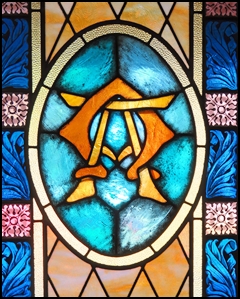 In the book of Revelation, when Jesus says He is the Alpha (the beginning), He also says He is the Omega (the end). He’s not talking of alphabets but rather the absolute beginning, revealed in Genesis, and the absolute end, revealed in Revelation. God had the first word when He spoke the universe into existence and He will have the last word when the world as we know it ends.
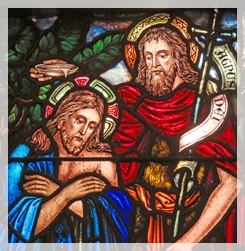 Although I don’t remember my Baptism as an infant, I do have a picture that tells me I wore a long white dress and a bonnet. Another picture tells me that I wore a shorter white dress, a hat instead of a bonnet and my first pair of nylon stockings and heels at my Confirmation thirteen years later. That, however, is about all I remember of making a public reaffirmation of my faith and recommitting to the baptismal promises made for me when I was a baby. Although I knew a lot about Jesus at the time, I’m not sure that I truly knew Him. I know Him now and, in a much simpler ceremony, I recently reaffirmed my Baptism in a way I will never forget.
 If you ever visited the Mayan ruins near Cancun, Mexico, chances are you saw the remains of a stone ball court with sloping walls. Nowhere near as impressive as the Mayan pyramids, I didn’t even take a picture when I saw one. Two stone rings hang about 20 feet up the walls. A ball game called pok-ta-pok was played there. As in volleyball, players passed a solid rubber ball around by hitting it with various parts of their bodies. Unlike volleyball, however, they could not touch the ball with their hands. The goal was to get the ball through one of the rings.
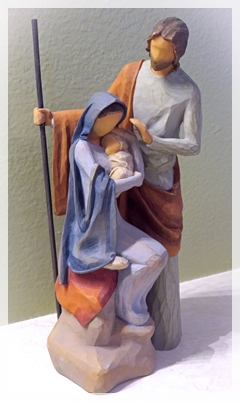 Although Epiphany celebrates the magi’s visit to the Christ child, for many people it simply marks the official end to the holiday season. It’s the day the tree goes down, lights are removed, and nativity scenes get stowed for another year. British tradition holds that if you haven’t removed the holiday décor by January 6, you must leave it in place all year long to avoid misfortune. I don’t know about misfortune but, in our community, you’ll face a fine if holiday lights or decorations remain after this week!
 Although humanity started out as a perfect creation, we quickly lost that perfection in the Garden of Eden; Jesus was the only sinless perfect man. If He’s telling us to be perfectly sinless when He calls us to be perfect, we’re in trouble. I suppose we should be able to resist all sin (as did Jesus) but, in reality, no one else (not even the Apostle Paul) has managed to do that. Perfection is God’s alone and we flawed mortals will never be His equals. If Jesus means things like spotless kitchens, beds made with hospital corners, and clean mirrors when He says to be perfect, even without having guests, I’m still in serious trouble. Yet, Jesus’s answer to the rich young man that, to be perfect, he should sell his possessions and give to the poor tells us that possessions and how neatly they’re arranged have no importance to Him. So, what does it mean to be perfect?
 Devotions of the Heart